Key Monastery (Kye Gompa)
Comprehensive visitor guide to Key Monastery (Kye Gompa) in Spiti Valley. Explore 1,000-year Gelugpa heritage, fortress architecture, murals, timings, and travel tips.
Location
Spiti Valley, Himachal Pradesh
A closer look
Your visit, at a glance.
Spiti Valley, Himachal Pradesh
GET TO KNOW THE PLACE
Key Monastery, known locally and historically as Kye Gompa or Ki Monastery, is one of the most celebrated, visually astonishing, and culturally revered monastic citadels in the…
The story of Key Monastery (Kye Gompa)
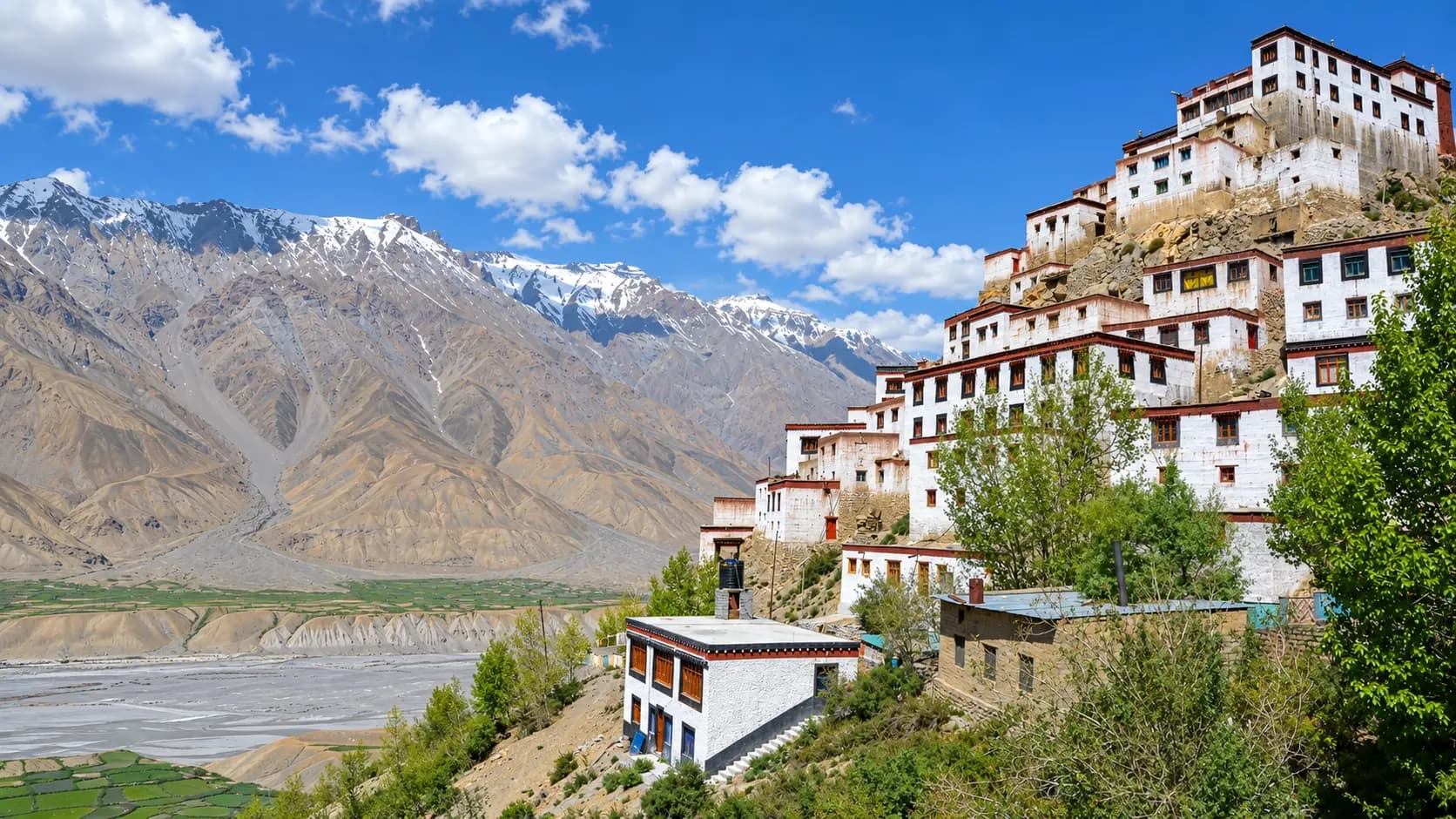
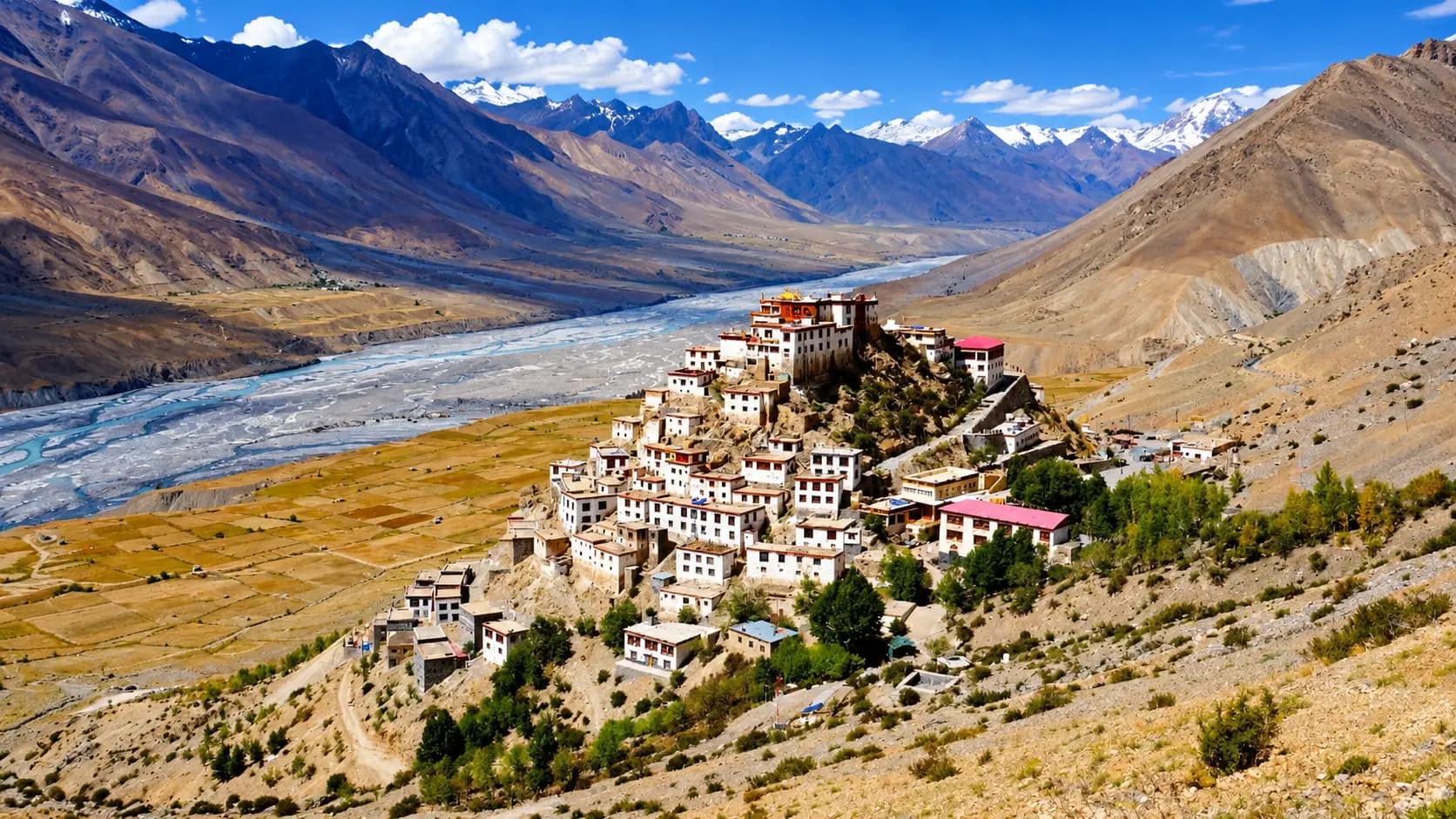
Key Monastery, known locally and historically as Kye Gompa or Ki Monastery, is one of the most celebrated, visually astonishing, and culturally revered monastic citadels in the Tibetan Buddhist world. Rising with dramatic organic majesty atop an isolated conical hill at an altitude of 4,166 meters (13,668 feet) above mean sea level, the monastery commands an expansive amphitheater overlooking the braided gravel floodplains of the Spiti River. Located in the Spiti Tehsil of Himachal Pradesh’s high-altitude Lahaul and Spiti District, approximately fourteen kilometers north of the sub-divisional capital of Kaza, Key Monastery serves as the principal religious training academy and spiritual motherhouse for the Gelugpa (Yellow Hat) order across the Trans-Himalayan valleys of Spiti and Lahaul.
From a distance, Key Gompa resembles a surreal, multi-tiered medieval fortress rather than a single monastic building. Its whitewashed stone-and-mud dwellings, crimson prayer halls, timber balconies, and gilded dhvaja (victory banners) are stacked haphazardly one atop the other across the steep conical rock slopes, creating the distinctive Khangsteg (stacked house) architectural silhouette. This unique architectural form was not designed as an aesthetic choice, but was forged through a millennium of turbulent border warfare, recurring invasions, and destructive earthquakes. Each time the citadel was sacked or collapsed, the monks rebuilt directly upon the rubble of older foundations, creating an intricate vertical labyrinth of subterranean storage vaults, dark prayer rooms, narrow ladders, and sun-drenched rooftop terraces that have withstood ten centuries of Himalayan history.
+----------------------------------------------------------------------------------------------------+
|                                    KEY MONASTERY ARCHITECTURAL PROFILE                             |
|                                                                                                    |
|                                  [Golden Pinnacle / Gyaltsen: 4,180 m]                             |
|                                                  /\                                                |
|                                                 /  \                                               |
|                    [Top Level: Dalai Lama Quarters, Tengyur Library, Upper Shrines]                |
|                                          |===================|                                     |
|                                          | [Zim-chung Rooms] |                                     |
|                                          |===================|                                     |
|                    [Middle Level: Du-khang Assembly Hall, Ancient Frescoes, Stucco Idols]          |
|                                |=======================================|                           |
|                                | [Main Prayer Hall & Thousand Buddhas] |                           |
|                                |=======================================|                           |
|                    [Lower Level: Monks' Residential Quarters, Kitchen / Changsa, Granaries]        |
|                    |===================================================================|           |
|                    | [Traditional Mud-Brick Monastic Cells & Underground Storage Vaults] |          |
|  ==================|===================================================================|=========  |
|                                [Conical Bedrock Spire Base: 4,166 m]                               |
|                                                                                                    |
|  Elevation: 4,166 m | Affiliation: Gelugpa (Yellow Hat) | Millennium Consecration: August 2000     |
+----------------------------------------------------------------------------------------------------+
Start here. Open a tile for the full details.
Why goRead details
Key Monastery is the cultural, spiritual, and artistic crown of Spiti Valley. Whether one travels to the Trans-Himalayas as a pilgrim seeking contemplative solitude, an art historian investigating ancient Buddhist iconography, or a landscape photographer drawn to monumental architecture, Key Gompa delivers an encounter of unparalleled depth.
When to visitRead details
The climate at Key Monastery is dictated by the extreme Trans-Himalayan rain-shadow regime. Because the Greater Himalayan ranges block the Indian summer monsoon from entering Spiti Valley, Key Monastery receives very little rainfall, ensuring predominantly sunny skies throughout the summer months. However, altitude and seasonal freeze dictate access windows.
Entry & permissionsRead details
Fees, visiting hours and entry rules may change. Confirm the latest details with the official operator or local authority before travelling.
Key Monastery is an active, sacred Tibetan Buddhist religious foundation that welcomes spiritual pilgrims and international travelers with open warmth, governed by respectful monastic decorum and regional civil border regulations.
+----------------------------------------------------------------------------------------------------+
|                                    PERMIT & ENTRY FEE MATRIX                                       |
|                                                                                                    |
|  Category             | Indian Nationals                    | Foreign Nationals                    |
|  ---------------------+-------------------------------------+------------------------------------- |
|  Monastery Admission  | Free; No entry ticket or tax        | Free; No entry ticket or tax         |
|  Courtyard & Roofs    | Free public access                  | Free public access                   |
|  Inner Shrine Entry   | Free; Voluntary donation welcome    | Free; Voluntary donation welcome     |
|  Border Permit        | None required for Spiti             | Inner Line Permit (ILP) required     |
|                       |                                     | only if traveling via Kinnaur (NH-5) |
|  Drone Operations     | Strictly prohibited without written | Strictly prohibited without written  |
|                       | permit from SDM Kaza                | permit from SDM Kaza                 |
|  Photography Fee      | Free in courtyards; Prohibited      | Free in courtyards; Prohibited       |
|                       | inside innermost prayer halls       | inside innermost prayer halls        |
+----------------------------------------------------------------------------------------------------+
Entry Fees and Monastic Donations
Admission to Key Monastery is completely free of charge. Neither the District Administration of Lahaul and Spiti nor the monastic trust charges any entry fee, gate pass, or religious tax to enter the citadel, explore the courtyards, or visit the historic prayer halls. To support the maintenance of the ancient thousand-year-old mud-brick structures, provide heating fuel for elderly monks during freezing winters, and fund the education and meals of young novice monks, the monastery maintains transparent wooden donation boxes inside the main assembly hall and the kitchen. Visitors wishing to express gratitude for the monks’ hospitality or support temple conservation are encouraged to offer a modest voluntary donation (typically ₹50 to ₹200).
Visiting Hours and Daily Schedule
Key Monastery is open to visitors daily from 06:00 to 18:00 throughout the year.
- Morning Prayers: The primary monastic morning prayer assembly typically takes place between 06:30 and 08:00. During this time, visitors are permitted to enter the main assembly hall quietly and sit near the rear doorway to observe the chanting and listen to the horns and drums.
- Afternoon Visiting: Between 09:00 and 16:30, resident guide monks are available to escort visitors through the upper Zim-chung chapels, unlock the Tengyur library, explain the significance of the murals, and answer questions regarding monastic life.
- Kitchen Hospitality: The monastic kitchen (Changsa) serves complimentary warm tea to visitors throughout the day, generally between 08:00 and 17:00.
- Evening Closure: The upper chapels and rooftop terraces close at 18:00 as the monks assemble for evening study, debate, and dinner. Visitors not staying in the monastic guesthouse must depart the complex before dusk.
Photography and Monastic Etiquette
To preserve the sacred spiritual sanctity of the monastery and protect its priceless artistic heritage, visitors must adhere to strict guidelines:
- Photography Rules: Photography and video recording are freely permitted on the outer stone approaches, in the central courtyard, and on the rooftop viewing terraces, where panoramic vistas of the valley can be captured. However, photography is strictly prohibited inside the ancient assembly halls and innermost shrine rooms. The intense flash from cameras and mobile phones accelerates the fading and chemical degradation of delicate 500-year-old organic vegetable and mineral pigment murals. Furthermore, taking intrusive close-up photos of monks during deep meditation or prayer is deeply disrespectful.
- Dress Code: Visitors must dress modestly and respectfully. Shoulders, upper arms, and knees must be fully covered; sleeveless shirts, tank tops, and short pants are strictly forbidden. Warm woolen shawls or jackets are recommended, as the stone prayer rooms remain cold even during midsummer.
- Temple Etiquette: Shoes must be removed before crossing the threshold of any carpeted prayer hall or shrine. Always walk around the monastery exterior, shrines, stupas (chortens), and mani walls in a clockwise direction (circumambulation / kora), keeping the sacred monument on your right side. Never touch ancient thangkas, religious statues, or ceremonial instruments unless invited to do so by a monk.
Inner Line Permits (ILP) and Border Formalities
- Indian Nationals: Indian citizens do not require an Inner Line Permit to visit Key Monastery, Kaza, or Kibber. Carrying a valid government-issued photo ID (such as an Aadhaar Card, Driving License, Voter Card, or Passport) is mandatory for routine identity verification at the Sumdo and Losar police checkposts.
- Foreign Passport Holders: Foreign nationals (including OCI cardholders) do not require an Inner Line Permit to visit Key Monastery if traveling strictly within the Spiti Valley or entering and exiting via Manali on NH-505. However, if a foreign traveler enters or exits Spiti via the Kinnaur highway on NH-5, an Inner Line Permit (ILP) is legally mandatory to transit the restricted border corridor between Jangi and Sumdo near the international border with Tibet. Permits can be obtained from the Deputy Commissioner or SDM offices in Shimla, Reckong Peo, or Kaza.
Plan your visitRead details
Reaching Key Monastery requires traversing the dramatic Trans-Himalayan road network of Himachal Pradesh. Because Key Monastery is situated fourteen kilometers north of Kaza, travelers first journey to Kaza before ascending the local mountain road to the monastery gates.
High-Altitude Acclimatization Buffer
Spend at least two full nights resting and hydrating in Kaza at 3,650 meters before visiting Key Monastery at 4,166 meters, avoiding strenuous uphill climbing during your first morning to prevent the onset of Acute Mountain Sickness (AMS).
Explore the full guide - choose a topic below.
Why visit?
Key Monastery is the cultural, spiritual, and artistic crown of Spiti Valley.Explore detailsClose details
Key Monastery is the cultural, spiritual, and artistic crown of Spiti Valley. Whether one travels to the Trans-Himalayas as a pilgrim seeking contemplative solitude, an art historian investigating ancient Buddhist iconography, or a landscape photographer drawn to monumental architecture, Key Gompa delivers an encounter of unparalleled depth.
1. A Millennium of Living Buddhist Heritage
Key Monastery celebrated its 1,000-year anniversary in the year 2000, commemorated by a grand Kalachakra initiation led personally by the 14th Dalai Lama, Tenzin Gyatso. Founded in the eleventh century (circa 1000 - 1050 CE), the monastery’s origins are tied directly to Dromtön (Brom-ston-rgyal-ba'i-'byung-gnas), the foremost Tibetan disciple of the revered Indian saint Atisha (Dipankara Srijnana). Atisha and Dromtön were the pivotal architects of the Second Diffusion of Buddhism (Chodar) in Tibet, restoring monastic discipline, scholarly rigor, and philosophical depth following the dark era of King Langdarma. Key Gompa began as an austere Kadampa foundation, evolved under the influence of the Sakyapa school in the fourteenth century, and was permanently revitalized as a flagship Gelugpa monastery in the seventeenth century under the Fifth Dalai Lama. Today, it remains a bustling, vibrant monastic college housing over three hundred lamas, novices, and scholars studying Buddhist logic, metaphysics, ritual arts, and meditation.
2. A Fortress Forged Through Siege and Catastrophe
The architectural layout of Key Monastery tells a gripping story of physical survival against overwhelming historic odds:
- The Mongol Invasions: During the seventeenth century, Mongol armies allied with rival Tibetan factions raided Spiti Valley, attacking Key Gompa and setting fire to its defensive wooden towers.
- The Dogra War of 1841: In 1841, the fierce Dogra army commanded by General Zorawar Singh invaded Spiti en route to Western Tibet, inflicting severe structural damage on the monastery's outer gates and granaries.
- The Sikh Invasions: Later in the 1840s, Sikh regiments from the Punjab plains swept through the valley, plundering monastic treasures and damaging the upper chapels.
- Seismic Destruction: The monastery was severely damaged by a catastrophic earthquake in 1828 and suffered further structural destruction during the deadly 1975 Kinnaur earthquake. Remarkably, following every assault and disaster, the resident monks re-quarried limestone, gathered clay and mud mortar, harvested alpine juniper timbers, and rebuilt their sacred home directly over the collapsed masonry. This layered reconstruction created the monastery's fortress-like exterior, characterized by defensive buttresses, thick battered mud-brick walls, small defensive embrasures, and an internal network of steep wooden staircases and interconnected corridors.
3. Incomparable Artistic and Scriptural Treasures
The interior prayer chambers of Key Monastery shelter an astonishing collection of sacred Buddhist art that spans nearly eight centuries:
- Ancient Wall Murals (Frescoes): The walls of the oldest assembly rooms are covered with masterfully executed 14th-to-17th century murals painted using mineral pigments and plant dyes. These artworks depict scenes from the life of Gautama Buddha, intricate mandalas of Guhyasamaja and Chakrasamvara, serene portraits of Green Tara, and wrathful protector deities like Mahakala and Palden Lhamo. The stylistic influence reflects an extraordinary synthesis of Western Tibetan (Guge kingdom) line art and Chinese-Tibetan decorative motifs.
- The Tengyur and Kangyur Manuscripts: Key houses an invaluable scriptural library containing hand-scribed, gold-illuminated folios of the sacred Tibetan Buddhist canons - the Kangyur (the direct teachings of the Buddha) and the Tengyur (authoritative commentaries by Indian masters).
- Ancient Stucco Statues and Thangkas: The upper altars enshrine majestic stucco sculptures of Maitreya (the Future Buddha) and Sakyamuni, surrounded by centuries-old silk thangkas embroidered in Lhasa and Kham.
- Ceremonial Instruments: The monastery preserves a collection of historic liturgical instruments, including towering copper-and-brass dungchen (Himalayan long horns measuring up to three meters in length), gyaling (double-reed oboes), damaru skull drums, and sacred bronze cymbals.
4. Warm Monastic Hospitality and the Rooftop Panorama
Despite its formidable fortress-like appearance, Key Monastery is renowned throughout the Himalayas for its exceptional warmth and hospitality toward visitors. Upon climbing the outer stone ramp, travelers are customarily invited into the cavernous, soot-blackened monastic kitchen (Changsa). Here, junior monks operating wood-fired cast-iron stoves generously serve steaming cups of sweet herbal tea or traditional salted yak-butter tea (po cha) to weary travelers, providing comforting warmth against the thin mountain chill. Ascending through the upper chapels to the open rooftop terrace reveals one of the most awe-inspiring vistas on the planet: a 360-degree panoramic sweep across the braided channels of the Spiti River shimmering thousands of feet below, framed by sheer crumbling mud canyons and the snow-crusted 6,000-meter peaks of the Trans-Himalayan mountain barrier.
What to expect
Approaching and entering Key Monastery is a deeply evocative sensory and physical journey.Explore detailsClose details
Approaching and entering Key Monastery is a deeply evocative sensory and physical journey. Perched at an altitude of 4,166 meters, the monastery exists in an environment of extreme dryness, bright ultraviolet sunlight, and crisp, oxygen-thin air. Visitors stepping out of their transport at the base parking terrace immediately feel the physical demands of high-altitude breathing, as their pulse quickens during the short but steep stone staircase climb leading to the main perimeter gate.
+----------------------------------------------------------------------------------------------------+
|                                    KEY MONASTERY VISITOR EXPERIENCE                                |
|                                                                                                    |
|  Aspect               | Details & Practical Realities                                              |
|  ---------------------+--------------------------------------------------------------------------- |
|  Physical Elevation   | 4,166 meters (13,668 feet)  -  approx. 40% less oxygen than sea level         |
|  Internal Layout      | Stacked multistoried layout connected by steep, dark wooden ladder-steps   |
|  Lighting Conditions  | Dimly lit prayer halls illuminated by flicker of brass butter lamps        |
|  Olfactory Atmosphere | Pungent, meditative fragrance of juniper incense and yak-butter oil lamps  |
|  Acoustic Environment | Rhythmic drone of deep chanting, clashing cymbals, long horns at prayer    |
|  Monastic Hospitality | Monks offer herbal tea in the kitchen; English/Hindi spoken by guide monks |
|  Photography Rules    | Permitted in courtyards and roof; strictly prohibited in ancient shrines   |
|  Dress Requirements   | Modest attire covering shoulders and knees; shoes removed at temple doors  |
+----------------------------------------------------------------------------------------------------+
The Interior Journey Through the Stacked Citadel
Inside the monastery, visitors navigate a vertical realm connected by worn wooden staircases, dark tunnels, and heavy wool door curtains. The architectural complex is broadly organized into three structural tiers:
- The Lower Tier: Comprises the monastic administrative offices, the communal kitchen (Changsa), grain storage granaries, and the private residential cells of the lamas and young novice students. The atmosphere here is lively, with young monks memorizing texts, washing copper bowls, and running errands.
- The Middle Tier: Houses the primary Assembly Hall (Du-khang), an expansive pillar-supported sanctum where hundreds of monks gather for communal prayer recitations. The hall is lined with low carpeted seating benches, sacred thankas hanging from structural beams, and a monumental central altar showcasing gilded bronze statues of Sakyamuni Buddha and Je Tsongkhapa (the founder of the Gelugpa order). Adjoining the Du-khang is the ancient Zim-chung (sacred meditation chamber), preserved with 14th-century frescoes and delicate clay stucco figures.
- The Upper Tier: Encloses the most sacred inner sanctums, the Tengyur manuscript library, and the ceremonial private suite maintained exclusively for the Dalai Lama’s visits. Stepping out onto the uppermost rooftop terrace exposes visitors to sweeping mountain winds, fluttering prayer flags, and panoramic valley views.
Daily Rituals and Monastic Soundscape
Visitors who arrive early in the morning (around 06:30 to 07:30) or during mid-afternoon (around 15:00 to 16:00) may witness the profound monastic prayer ceremonies (Puja). The ceremony begins with the resonant, deep-throated wail of the dungchen horns blown from the monastery roof, echoing across the entire Spiti River basin to summon the community. Inside the darkened assembly hall, dozens of monks dressed in heavy maroon wool robes and yellow curved crested hats chant sacred scriptures in deep, harmonic overtone registers, accompanied by the hypnotic tempo of bronze cymbals (rolmo) and double-sided frame drums (nga). The air is thick with the soothing scent of smoldering mountain juniper (shukpa) and the soft golden glow of hundreds of brass butter lamps. Visitors are permitted to sit quietly near the entrance threshold to observe and absorb the spiritual rhythm, provided they maintain complete silence, avoid using flash photography, and keep their mobile devices turned off.
Best time to visit
The climate at Key Monastery is dictated by the extreme Trans-Himalayan rain-shadow regime.Explore detailsClose details
The climate at Key Monastery is dictated by the extreme Trans-Himalayan rain-shadow regime. Because the Greater Himalayan ranges block the Indian summer monsoon from entering Spiti Valley, Key Monastery receives very little rainfall, ensuring predominantly sunny skies throughout the summer months. However, altitude and seasonal freeze dictate access windows.
+----------------------------------------------------------------------------------------------------+
|                                    ANNUAL SEASONAL & CLIMATIC CYCLE                                |
|                                                                                                    |
|  Season               | Months         | Temperature Range | Road Access    | Experience           |
|  ---------------------+----------------+-------------------+----------------+--------------------- |
|  Summer (Prime)       | June - Aug     | 14°C to 22°C (day)| All routes     | Pleasant days, green |
|                       |                | 4°C to 9°C (night)| fully open     | barley, full access  |
|  Autumn (Golden)      | Sep - Oct      | 8°C to 16°C (day) | Manali closes  | Crisp skies, golden  |
|                       |                | -4°C to 3°C (night| late October   | poplars, stargazing  |
|  Winter (Snowbound)   | Nov - April    | -8°C to 2°C (day) | Shimla only    | Extreme sub-zero,    |
|                       |                | -25°C to -15°C (nt| (weather perm) | quiet winter retreat |
|  Spring (Transition)  | May            | 10°C to 18°C (day)| Kunzum opens   | Snowmelt, pre-season |
|                       |                | -2°C to 4°C (night| late May/June  | opening of homestays |
+----------------------------------------------------------------------------------------------------+
Summer (June to August): Peak Cultural Season
Summer is the most popular, comfortable, and accessible time to visit Key Monastery. During these months, both the southern approach from Shimla through Kinnaur (NH-5) and the northern highway from Manali across Kunzum Pass (NH-505) are open to regular vehicular traffic. Daytime temperatures hover comfortably between 14°C and 22°C under clear blue skies, although night temperatures can drop to single digits. The barley terraces around Key village below the monastery turn an intense emerald green, creating an extraordinary visual contrast against the pale limestone hills. All monastic chapels, libraries, and guesthouses operate normally. Visitors should anticipate moderate crowds during July and August, when travelers from across India and international Buddhist pilgrims converge on Spiti.
Early Autumn (September to Mid-October): The Connoisseur’s Window
September is universally recognized by seasoned Himalayan travelers as the single finest month to visit Key Monastery. By September, the monsoon rains that cause landslides in the lower foothills (Shimla and Kullu approaches) have ceased entirely, leaving the approach highways dry and stable. The high-altitude air in Spiti becomes razor-sharp and remarkably clear, offering superior visibility for panoramic photography and nighttime astrophotography. Daytime temperatures range from 10°C to 18°C, while nights begin to freeze lightly (-2°C to 4°C). The poplar and willow groves fringing the Spiti River turn a brilliant amber-gold, and the monks engage in traditional harvest preparations. Visiting in late September or early October allows travelers to enjoy the monastery in serene tranquility without peak-season crowds. However, travelers visiting after October 15 must monitor early snowfall forecasts closely, as Kunzum Pass can close abruptly, requiring an exit via the longer Kinnaur route.
Winter (November to April): The Frozen Spiritual Fortress
Winter reveals Key Monastery in its rawest, most austere beauty. Temperatures regularly plunge between -15°C and -28°C, and heavy winter blizzards coat the multistoried citadel in deep snowdrifts. The highway from Manali across Kunzum Pass is buried and remains closed for six months. Access to Key Monastery is maintained exclusively via the 426-kilometer road from Shimla, which the PWD keeps open except during major storms. Plumbing networks freeze solid, requiring the use of traditional dry composting toilets and bucketed melted snow. Despite the harsh physical hardships, winter offers a rare, deeply authentic encounter with Tibetan Buddhism. Far from tourist crowds, the monks enter extensive study and meditation retreats, performing elaborate masked chaam dances during the winter Guctor festival. Dedicated landscape photographers and wildlife enthusiasts tracking snow leopards in the nearby Kibber Wildlife Sanctuary often base themselves near Key during these quiet winter months.
How to reach
Reaching Key Monastery requires traversing the dramatic Trans-Himalayan road network of Himachal Pradesh.Explore detailsClose details
Reaching Key Monastery requires traversing the dramatic Trans-Himalayan road network of Himachal Pradesh. Because Key Monastery is situated fourteen kilometers north of Kaza, travelers first journey to Kaza before ascending the local mountain road to the monastery gates.
+----------------------------------------------------------------------------------------------------+
|                                    ROAD APPROACH ROUTES TO KEY MONASTERY                           |
|                                                                                                    |
|  [Route 1: Shimla - Kinnaur - Kaza] (Open Year-Round; Gradual Acclimatization)                     |
|  Shimla (2,200 m) ---> Rampur ---> Reckong Peo ---> Nako (3,660 m) ---> Tabo ---> Kaza (3,650 m)   |
|  Distance: ~412 km | Drive Time: 2 to 3 days (Overnight stops recommended in Kalpa and Tabo)      |
|                                                                                                    |
|  [Route 2: Manali - Atal Tunnel - Kaza] (Seasonal: June to October; Abrupt Ascent)                |
|  Manali (2,050 m) ---> Atal Tunnel ---> Gramphu ---> Batal ---> Kunzum Pass (4,551 m) ---> Kaza    |
|  Distance: ~200 km | Drive Time: 8 to 10 hours across rugged Chandra riverbed                      |
|                                                                                                    |
|  [Local Ascent: Kaza to Key Monastery]                                                             |
|  Kaza (3,650 m) ---> Rangrik Bridge ---> Key Village Road ---> Key Monastery Parking (4,166 m)     |
|  Distance: 14 km | Drive Time: 30 minutes on well-paved mountain asphalt                           |
+----------------------------------------------------------------------------------------------------+
The Local Drive from Kaza to Key Monastery (14 km)
From Kaza, vehicles head north along National Highway 505 for approximately three kilometers before crossing the wide, braided Spiti River via the concrete Rangrik bridge. After crossing to the river’s western terrace, the road forks: the left branch continues north toward Losar and Manali, while the right branch climbs northeast into the side canyon toward Key and Kibber. The 14-kilometer road to Key Monastery is fully paved, wide enough for two vehicles to pass with care, and features gentle switchbacks that carve through stark, wind-sculpted clay and shale hillsides. As vehicles round the final curve, Key Monastery appears suddenly above the road - a towering, white-and-red cliffside citadel crowned by golden finials. A dedicated paved parking terrace is situated directly below the outer monastic staircase.
Regional Highway Approaches to Kaza
- The Kinnaur Highway from Shimla (NH-5 & NH-505): Spanning approximately 412 kilometers from Shimla to Kaza, this route tracks the dramatic Sutlej River gorge through Rampur, Reckong Peo, and Pooh before entering Spiti at Sumdo. Medical experts and high-altitude guides strongly endorse this route because its gradual elevation profile (climbing from 2,200 m to 3,650 m over two to three days) allows the human respiratory and vascular systems to acclimatize naturally, minimizing the danger of Acute Mountain Sickness (AMS).
- The High-Mountain Route from Manali (NH-505): Spanning approximately 200 kilometers, this thrilling expedition crosses through the Atal Tunnel into Lahaul, follows the unpaved Chandra River bed past Chhatru and Batal, and climbs over the formidable Kunzum Pass at 4,551 meters (14,931 feet) before descending into the Spiti Valley at Losar. While significantly shorter in distance, this route is only open from late May or early June to mid-October and subjects travelers to an abrupt altitude jump of over 2,500 vertical meters in a single day.
Public Transit and Local Transport Options
- Himachal Road Transport Corporation (HRTC) Buses: A scheduled daily HRTC rural bus departs from the Kaza New Bus Stand in the afternoon (typically between 14:00 and 16:00 during summer), traveling toward Kibber and dropping passengers directly at the Key Monastery gate road. The bus returns from Kibber and Key toward Kaza early the following morning (around 08:30).
- Private Taxis and Shared Jeeps: The Spiti Taxi Union operates from the central market in Kaza Soma, offering fixed-rate return taxi services covering Key Monastery, Kibber village, and the Chicham suspension bridge as a combined half-day or full-day excursion. Shared Bolero camper jeeps can also be hired or boarded from the Kaza taxi stand.
- Hiking from Kaza: Enthusiastic trekkers who are fully acclimatized can hike from Kaza to Key Monastery via Rangrik along scenic footpaths through the riverside scrub and shale bluffs, covering the 14-kilometer route in approximately four to five hours.
Entry, timings and permissions
Fees, visiting hours and entry rules may change.Explore detailsClose details
Fees, visiting hours and entry rules may change. Confirm the latest details with the official operator or local authority before travelling.
Key Monastery is an active, sacred Tibetan Buddhist religious foundation that welcomes spiritual pilgrims and international travelers with open warmth, governed by respectful monastic decorum and regional civil border regulations.
+----------------------------------------------------------------------------------------------------+
|                                    PERMIT & ENTRY FEE MATRIX                                       |
|                                                                                                    |
|  Category             | Indian Nationals                    | Foreign Nationals                    |
|  ---------------------+-------------------------------------+------------------------------------- |
|  Monastery Admission  | Free; No entry ticket or tax        | Free; No entry ticket or tax         |
|  Courtyard & Roofs    | Free public access                  | Free public access                   |
|  Inner Shrine Entry   | Free; Voluntary donation welcome    | Free; Voluntary donation welcome     |
|  Border Permit        | None required for Spiti             | Inner Line Permit (ILP) required     |
|                       |                                     | only if traveling via Kinnaur (NH-5) |
|  Drone Operations     | Strictly prohibited without written | Strictly prohibited without written  |
|                       | permit from SDM Kaza                | permit from SDM Kaza                 |
|  Photography Fee      | Free in courtyards; Prohibited      | Free in courtyards; Prohibited       |
|                       | inside innermost prayer halls       | inside innermost prayer halls        |
+----------------------------------------------------------------------------------------------------+
Entry Fees and Monastic Donations
Admission to Key Monastery is completely free of charge. Neither the District Administration of Lahaul and Spiti nor the monastic trust charges any entry fee, gate pass, or religious tax to enter the citadel, explore the courtyards, or visit the historic prayer halls. To support the maintenance of the ancient thousand-year-old mud-brick structures, provide heating fuel for elderly monks during freezing winters, and fund the education and meals of young novice monks, the monastery maintains transparent wooden donation boxes inside the main assembly hall and the kitchen. Visitors wishing to express gratitude for the monks’ hospitality or support temple conservation are encouraged to offer a modest voluntary donation (typically ₹50 to ₹200).
Visiting Hours and Daily Schedule
Key Monastery is open to visitors daily from 06:00 to 18:00 throughout the year.
- Morning Prayers: The primary monastic morning prayer assembly typically takes place between 06:30 and 08:00. During this time, visitors are permitted to enter the main assembly hall quietly and sit near the rear doorway to observe the chanting and listen to the horns and drums.
- Afternoon Visiting: Between 09:00 and 16:30, resident guide monks are available to escort visitors through the upper Zim-chung chapels, unlock the Tengyur library, explain the significance of the murals, and answer questions regarding monastic life.
- Kitchen Hospitality: The monastic kitchen (Changsa) serves complimentary warm tea to visitors throughout the day, generally between 08:00 and 17:00.
- Evening Closure: The upper chapels and rooftop terraces close at 18:00 as the monks assemble for evening study, debate, and dinner. Visitors not staying in the monastic guesthouse must depart the complex before dusk.
Photography and Monastic Etiquette
To preserve the sacred spiritual sanctity of the monastery and protect its priceless artistic heritage, visitors must adhere to strict guidelines:
- Photography Rules: Photography and video recording are freely permitted on the outer stone approaches, in the central courtyard, and on the rooftop viewing terraces, where panoramic vistas of the valley can be captured. However, photography is strictly prohibited inside the ancient assembly halls and innermost shrine rooms. The intense flash from cameras and mobile phones accelerates the fading and chemical degradation of delicate 500-year-old organic vegetable and mineral pigment murals. Furthermore, taking intrusive close-up photos of monks during deep meditation or prayer is deeply disrespectful.
- Dress Code: Visitors must dress modestly and respectfully. Shoulders, upper arms, and knees must be fully covered; sleeveless shirts, tank tops, and short pants are strictly forbidden. Warm woolen shawls or jackets are recommended, as the stone prayer rooms remain cold even during midsummer.
- Temple Etiquette: Shoes must be removed before crossing the threshold of any carpeted prayer hall or shrine. Always walk around the monastery exterior, shrines, stupas (chortens), and mani walls in a clockwise direction (circumambulation / kora), keeping the sacred monument on your right side. Never touch ancient thangkas, religious statues, or ceremonial instruments unless invited to do so by a monk.
Inner Line Permits (ILP) and Border Formalities
- Indian Nationals: Indian citizens do not require an Inner Line Permit to visit Key Monastery, Kaza, or Kibber. Carrying a valid government-issued photo ID (such as an Aadhaar Card, Driving License, Voter Card, or Passport) is mandatory for routine identity verification at the Sumdo and Losar police checkposts.
- Foreign Passport Holders: Foreign nationals (including OCI cardholders) do not require an Inner Line Permit to visit Key Monastery if traveling strictly within the Spiti Valley or entering and exiting via Manali on NH-505. However, if a foreign traveler enters or exits Spiti via the Kinnaur highway on NH-5, an Inner Line Permit (ILP) is legally mandatory to transit the restricted border corridor between Jangi and Sumdo near the international border with Tibet. Permits can be obtained from the Deputy Commissioner or SDM offices in Shimla, Reckong Peo, or Kaza.
Nearby places to consider
Key Monastery sits at the center of upper Spiti's cultural and ecological circuit.Explore detailsClose details
Key Monastery sits at the center of upper Spiti's cultural and ecological circuit. Combining a visit to Key Gompa with adjacent historic villages and spectacular geological landmarks creates an unforgettable Trans-Himalayan travel experience.
+----------------------------------------------------------------------------------------------------+
|                                    UPPER SPITI HIGHLAND CIRCUIT                                    |
|                                                                                                    |
|  [Chicham Suspension Bridge: 4,300 m]                                                              |
|  (Suspended 150 meters over vertical limestone gorge)                                              |
|            ^                                                                                       |
|            | 5 km paved road                                                                       |
|            v                                                                                       |
|  [Kibber Village: 4,270 m]                                                                         |
|  (Gateway to Kibber Wildlife Sanctuary; Snow Leopard habitat)                                      |
|            ^                                                                                       |
|            | 6 km paved mountain link                                                              |
|            v                                                                                       |
|  [Key Monastery: 4,166 m]  <--- Millennium Citadel & Gelugpa Seat                                  |
|            ^                                                                                       |
|            | 14 km paved road via Rangrik Bridge                                                   |
|            v                                                                                       |
|  [Kaza Sub-Divisional Base: 3,650 m]                                                               |
|            |                                                                                       |
|            | 16 km mountain road climbing southeast                                                |
|            v                                                                                       |
|  [Langza Highland Village: 4,400 m]  (Golden Buddha & Marine Fossil Beds)                           |
+----------------------------------------------------------------------------------------------------+
Kibber Village (4,270 m)
Located just six kilometers north of Key Monastery along the paved mountain road, Kibber is an idyllic high-altitude agricultural village of flat-roofed stone and mud-brick houses perched atop rolling limestone terraces at 4,270 meters. Until recently recognized as one of the highest permanently inhabited settlements connected by motorable road, Kibber is surrounded by lush green barley fields irrigated by glacial meltwater channels. The village functions as the primary base camp for wildlife conservationists and specialized tracking expeditions venturing into the adjacent Kibber Wildlife Sanctuary, a critical protected habitat for the endangered snow leopard, Himalayan ibex, Tibetan wolf, red fox, and blue sheep (bharal). Kibber offers several authentic family-run homestays where travelers can experience genuine Spitian warmth, traditional foods, and warm wood-fired hospitality.
Chicham Suspension Bridge
Extending five kilometers northwest beyond Kibber village, the Chicham Bridge is an engineering marvel and one of the highest suspension bridges in Asia, spanning a staggering elevation of approximately 4,300 meters. Constructed across the Samba Lamba Nallah, the bridge spans an awe-inspiring, 150-meter-deep vertical limestone chasm that historically isolated the remote village of Chicham from the rest of Spiti. Before the bridge’s commissioning in 2017, local villagers and their livestock had to cross the terrifying canyon using a dangerous hand-cranked steel rope basket (jhula). Today, walking across the sturdy suspension bridge provides heart-stopping, vertical downward views into the shadowed gorge floor below, offering incredible photographic opportunities and sweeping vistas toward the glaciated peaks bordering Ladakh.
Rangrik Village and Valley Meadows
Situated on the broad western floodplain of the Spiti River opposite Kaza, Rangrik is the largest village in the Spiti valley. Framed by expansive willow groves, poplar plantations, and fertile agricultural terraces, Rangrik is known for its serene, unhurried pastoral atmosphere. The village is home to the contemporary Serkong School and a scenic riverside viewpoint that offers striking reflections of the barren mountain cliffs in the clear waters of the Spiti River. Rangrik provides several quiet boutique resorts and peaceful eco-camps away from the commercial hustle of Kaza town.
Langza, Komic, and Hikkim Highland Circuit
Located across the valley on the eastern mountain plateau between sixteen and twenty-two kilometers from Kaza, the highland trio of Langza (4,400 m), Hikkim (4,440 m), and Komic (4,587 m) forms the natural counterpart to Key Monastery. While Key represents the valley's highest expression of classical monastic architecture, Langza features prehistoric marine ammonite fossils and a giant outdoor Golden Buddha; Hikkim houses the world’s highest functioning post office; and Komic features the ancient fortified Tangyud Monastery belonging to the Sakyapa Buddhist lineage.
In pictures
The practical bits
Before you go.
Plan ahead
A journey to Key Monastery requires careful physiological preparation and logistical planning to ensure comfort…Explore detailsClose details
A journey to Key Monastery requires careful physiological preparation and logistical planning to ensure comfort, safety, and cultural sensitivity at an altitude exceeding 4,100 meters.
High-Altitude Acclimatization Buffer
Spend at least two full nights resting and hydrating in Kaza at 3,650 meters before visiting Key Monastery at…Explore detailsClose details
Spend at least two full nights resting and hydrating in Kaza at 3,650 meters before visiting Key Monastery at 4,166 meters, avoiding strenuous uphill climbing during your first morning to prevent the onset of Acute Mountain Sickness (AMS).
Dress and Layering Strategy
Wear modest, easily removable slip-on footwear for frequent temple entries, and dress in versatile breathable…Explore detailsClose details
Wear modest, easily removable slip-on footwear for frequent temple entries, and dress in versatile breathable thermal layers accompanied by a windproof outer jacket to handle the rapid temperature swings between sunny outdoor terraces and chilled, stone prayer halls.
Cash and Donations Preparation
Confirm the current charge and what it includes with the operator or service provider.Explore detailsClose details
Confirm the current charge and what it includes with the operator or service provider. Visitor admission, vehicles, parking, activities and accommodation can have separate charges.
Respectful Monastic Conduct
Maintain complete silence inside active prayer sanctuaries, refrain from touching sacred murals or sitting on…Explore detailsClose details
Maintain complete silence inside active prayer sanctuaries, refrain from touching sacred murals or sitting on high monastic thrones reserved for incarnate lamas, circumambulate all shrines in a clockwise direction, and graciously accept herbal tea offered in the monastic kitchen.
Hydration and Sun Protection
Drink at least three to four liters of clean water daily to counteract the severe dehydrating effects of…Explore detailsClose details
Drink at least three to four liters of clean water daily to counteract the severe dehydrating effects of high-altitude desert air, and apply broad-spectrum SPF 50 sunscreen, lip balm with UV protection, and polarized sunglasses to guard against intense solar ultraviolet radiation.
+----------------------------------------------------------------------------------------------------+
|                                  SUGGESTED UPPER SPITI DAY ITINERARY                               |
|                                                                                                    |
|  08:30 AM  -  Depart Kaza Soma                                                                       |
|  - Board private taxi or vehicle from Kaza. Drive 14 km via Rangrik bridge along scenic NH-505.    |
|  - Stop at the designated roadside viewpoint to capture the classic panorama of Key Gompa hill.    |
|                                                                                                    |
|  09:15 AM to 11:30 AM  -  Comprehensive Key Monastery Exploration                                    |
|  - Ascend outer stone steps to the main gateway; accept warm herbal tea in the monastic kitchen.    |
|  - Tour the historic Du-khang assembly hall, Zim-chung meditation room, and Tengyur library.       |
|  - Climb to the upper rooftop terrace for breathtaking 360-degree vistas across Spiti River.       |
|                                                                                                    |
|  11:45 AM to 01:15 PM  -  Kibber Village & Wildlife Sanctuary Gateway                                |
|  - Drive 6 km further north to picturesque Kibber village (4,270 m).                               |
|  - Walk through whitewashed stone-and-mud alleys and enjoy a traditional lunch in a local homestay.|
|                                                                                                    |
|  01:30 PM to 03:00 PM  -  Chicham Gorge Suspension Bridge                                            |
|  - Drive 5 km beyond Kibber to cross the sensational Chicham Bridge suspended over a 150 m chasm.  |
|  - Photograph the vertical gorge and watch for Himalayan ibex grazing on opposite canyon walls.   |
|                                                                                                    |
|  03:30 PM to 04:30 PM  -  Return Descent to Kaza                                                     |
|  - Descend the mountain link road past Key Monastery, returning to Kaza before evening chill.      |
+----------------------------------------------------------------------------------------------------+
A few things you might wonder
Common questions about visiting Key Monastery (Kye Gompa). Fees, visiting hours and ceremonies are researched details that may change; confirm current arrangements with the operator before travelling.
What is the elevation of Key Monastery, and is altitude sickness a major concern?
Who founded Key Monastery, and what Buddhist sect does it belong to?
Is there an entry fee to visit Key Monastery, and are tickets required?
What are the visiting hours for Key Monastery, and can tourists witness prayers?
Is photography allowed inside Key Monastery?
Can tourists stay overnight at Key Monastery?
How do travelers reach Key Monastery from Kaza without a private vehicle?
Is Key Monastery open during the winter months?
Explore more in Spiti Valley
Discover other destinations around this hub
More Hubs in Himachal Pradesh
Continue exploring other travel hubs in this state
Planning a trip to Spiti Valley?