Kangra Fort
Visit Kangra Fort in Himachal Pradesh. Comprehensive guide to the ancient Trigarta citadel, Katoch dynasty, Mughal sieges, entry tickets, and museum.
Location
Dharamshala McLeodganj, Himachal Pradesh
A closer look
Your visit, at a glance.
Dharamshala McLeodganj, Himachal Pradesh
GET TO KNOW THE PLACE
Rising with defiant majesty above the deep river gorges of the Kangra Valley in Himachal Pradesh stands Kangra Fort (Nagarkot or Bhimkot), the oldest surviving fortified citadel…
The story of Kangra Fort
Rising with defiant majesty above the deep river gorges of the Kangra Valley in Himachal Pradesh stands Kangra Fort (Nagarkot or Bhimkot), the oldest surviving fortified citadel in the Indian Himalayas and one of the most formidable strongholds in all of South Asian military history. Perched atop a narrow, triangular sandstone promontory carved out by the rushing waters of two mountain torrents - the Banganga (Baner Khad) and the Manjhi (Patalganga) rivers - the fort commands a strategic geographic choke-point at an elevation of approximately 670 meters above sea level. Enclosed by massive, four-kilometer-long stone ramparts that plunge sheer into yawning river chasms on three sides, Kangra Fort has witnessed more than three thousand years of dynastic glory, sacred devotion, desperate sieges, and epochal imperial confrontations.
Founded according to regional epics by Maharaja Susharma Chandra of the illustrious Katoch Rajput dynasty - a royal lineage that traces its antiquity to the ancient Trigarta Kingdom mentioned in the Mahabharata - Kangra Fort was historically fabled across Asia for the incomprehensible treasures amassed inside its sacred shrines. That legendary wealth drew the covetous gaze of virtually every major conqueror who marched into northern India: from Mahmud of Ghazni in 1009 CE and the sultans of the Delhi Sultanate to Emperor Jahangir of the Mughal Empire, the Gurkha generals of Nepal, Maharaja Ranjit Singh of the Sikh Empire, and finally the British East India Company. Maintained today as a Centrally Protected Monument of National Importance under the Archaeological Survey of India (ASI, Shimla Circle), the citadel invites travelers to climb its sequential defensive gateways, walk beneath its carved stone temple porticos, and gaze out from its ruined royal ramparts across the snow-streaked ridges of the Dhauladhar Range.
Start here. Open a tile for the full details.
Why goRead details
For anyone traveling through Dharamshala, McLeodganj, or the Kangra Valley, Kangra Fort is an unmissable historical pilgrimmage. While the hill stations of upper Dharamshala showcase colonial British heritage and contemporary Tibetan Buddhism, Kangra Fort anchors the region in deep Indian antiquity, indigenous Rajput statecraft, and high-stakes imperial warfare.
When to visitRead details
Kangra Fort is situated at an elevation of 670 meters in the lower foothills of the Himalayas. Its climate differs significantly from the cooler alpine temperatures of upper Dharamshala and McLeodganj (at 2,000 meters), making seasonal timing an important factor.
Entry & permissionsRead details
Fees, visiting hours and entry rules may change. Confirm the latest details with the official operator or local authority before travelling.
Because Kangra Fort is an Archaeological Survey of India (ASI) Centrally Protected Monument, visitor entry, ticketing, and preservation guidelines follow standard national protocols.
Admission Charges
Category | Cashless Online Booking (QR Code / ASI Portal) | Physical Booking Counter (Cash) |
|---|---|---|
Indian Citizens | ₹25 | ₹30 |
SAARC Nationals (Afghanistan, Bangladesh, Bhutan, Maldives, Nepal, Pakistan, Sri Lanka) | ₹25 | ₹30 |
BIMSTEC Nationals (Bangladesh, Bhutan, Myanmar, Nepal, Sri Lanka, Thailand) | ₹25 | ₹30 |
Foreign Tourists (All other nationalities) | ₹300 | ₹325 |
Children (Up to 15 years, Indian and Foreign) | Free (Valid age ID proof recommended) | Free |
Audio Guide & Museum Fee: Multi-lingual audio guides (available in English, Hindi, German, and French) can be rented at the entrance counter for approximately ₹100 - ₹150. Admission to the Maharaja Sansar Chand Museum at the base is covered either under a combined ticket or for a modest nominal entry fee (approx. ₹50).
Operating Hours
Facility / Area | Days of Operation | Timings | Notes |
|---|---|---|---|
Kangra Fort Gates & Ramparts | All 7 Days (Monday to Sunday) | 09:00 to 17:30 | Ticket counter closes 30 minutes before official closing (17:00) |
Ambika Devi Temple | All 7 Days | 09:00 to 17:30 | Remains open for prayer throughout monument visiting hours |
Maharaja Sansar Chand Museum | All 7 Days | 09:30 to 17:30 | Audio guide distribution and return counter located here |
Municipal Parking Lot | All 7 Days | 08:30 to 18:00 | Attendants on duty throughout monument opening hours |
Permissions, Filming, and Drone Guidelines
- Handheld Photography: Non-commercial personal photography and amateur videography using handheld smartphones, mirrorless bodies, and DSLR cameras are fully permitted throughout the fort without any fee.
- Tripods and Commercial Cinematography: As with all ASI monuments, the use of professional tripods, camera stands, lighting rigs, and commercial video production equipment requires prior statutory permission and payment of prescribed commercial filming fees through the official ASI Shimla Circle web portal (
asishimlacircle.bih.nic.in). - Drone Operations: Flying unmanned aerial vehicles (drones) over Kangra Fort, its river gorges, and the surrounding Purana Kangra valley is strictly prohibited under Directorate General of Civil Aviation (DGCA) security regulations and district administration safety orders.
Plan your visitRead details
Kangra Fort is located in Old Kangra (Purana Kangra) within the Kangra Sub-Division of Kangra District. It is situated approximately 20 kilometers south of Dharamshala, 28 kilometers south of McLeodganj, and 3.5 kilometers south of Kangra town. It is easily accessible via road, railway, and air networks.
Explore the full guide - choose a topic below.
Why visit?
For anyone traveling through Dharamshala, McLeodganj, or the Kangra Valley, Kangra Fort is an unmissable…Explore detailsClose details
For anyone traveling through Dharamshala, McLeodganj, or the Kangra Valley, Kangra Fort is an unmissable historical pilgrimmage. While the hill stations of upper Dharamshala showcase colonial British heritage and contemporary Tibetan Buddhism, Kangra Fort anchors the region in deep Indian antiquity, indigenous Rajput statecraft, and high-stakes imperial warfare.
The Oldest and Largest Fort in the Himalayas
With roots that stretch deep into classical Sanskrit antiquity, Kangra Fort represents the pinnacle of indigenous Himalayan military architecture. The Katoch dynasty, which ruled this mountainous territory for millennia, claims direct descent from the ancient kingdom of Trigarta - literally "the land between three rivers" (the Sutlej, Beas, and Ravi). Unlike forts built on open plains that required artificial moats and concentric walls, Kangra Fort was engineered directly into the natural geomorphology of the Aravalli-Himalayan transitional zone. Its engineers took advantage of a razor-sharp sandstone spur where the Banganga and Manjhi rivers have carved vertical cliffs dropping hundreds of feet to the riverbed, rendering the fortress virtually impregnable to direct frontal assault from three cardinal directions.
A Fabled Treasury Plundered by Conquerors
For centuries, a famous Persian proverb echoed across the royal courts of Central Asia and Hindustan: "He who holds Kangra Fort holds the hills." But beyond its strategic mountain dominion, Kangra was famed for the vast accumulated fortunes housed in the subterranean vaults of its principal royal temples: the Ambika Devi Temple and the Lakshmi Narayan Temple.
In 1009 CE, the Afghan conqueror Mahmud of Ghazni marched his imperial army across the Punjab plains, crossed the Shivalik hills, and besieged the fortress. Ghazni’s chronicler, Al-Utbi, recorded in disbelief the staggering spoils looted from the temple vaults: over 700,000 gold dinars, massive decorative vessels of pure silver weighing tens of thousands of maunds, pearls, diamonds, rubies, and an unblemished silver shrine folding out like a palace hall. Despite this catastrophic pillage, the Katoch kings rebuilt the shrines and restored the treasury, drawing subsequent military campaigns by Sultan Muhammad bin Tughlaq in 1337 CE, Sultan Firuz Shah Tughlaq in 1365 CE, and Sher Shah Suri’s general Khawas Khan in 1540 CE.
Emperor Jahangir’s Hard-Fought Triumph and Mughal Rule
The Mughal Empire spent decades attempting to subdue Kangra. Emperor Akbar launched no fewer than ten military expeditions to reduce the fort, yet succeeded only in extracting nominal tribute while the Katoch rulers retained de facto control of the citadel. It was not until 1620 CE that Akbar’s son, Emperor Jahangir, dispatched an enormous imperial army under Raja Bikramjit and Prince Khurram (later Emperor Shah Jahan). After a grueling, fourteen-month siege that completely severed water and food supplies, the garrison surrendered.
Jahangir was so captivated by the strategic prize that he personally visited Kangra Fort in 1622, ordering the construction of a grand stone gateway (the Jahangiri Darwaza), an imperial mosque, and garrison quarters, while posting a permanent Mughal governor (Nawab) inside. For the next 160 years, the Mughal flag flew from the ramparts of Nagarkot.
The Golden Age of Raja Sansar Chand II and Kangra Miniature Art
In the late eighteenth century, the Katoch dynasty witnessed its greatest cultural and military renaissance under Raja Sansar Chand II (reigned 1775 - 1823 CE). In 1789, through tactical cunning and an alliance with Sikh warrior Jai Singh Kanhaiya, Sansar Chand ousted the last Mughal governor, Saif Ali Khan, and triumphantly regained his ancestral citadel.
Sansar Chand established Kangra as the cultural capital of the Western Himalayas. He transformed his court into a glittering sanctuary for master painters fleeing political instability in the Mughal plains, catalyzing the golden age of the Kangra school of Pahari miniature painting. Celebrated for their lyrical poetic grace, delicate brushstrokes, vibrant natural mineral pigments, and emotive portrayals of Radha and Krishna, Kangra miniatures became world-famous. A visit to the fort and its adjacent Maharaja Sansar Chand Museum allows travelers to view authentic original paintings, royal edicts, and ancestral weapons in the very halls where they were created.
What to expect
Covering an expansive area of several acres on an elevated rocky ridge, exploring Kangra Fort involves an…Explore detailsClose details
Covering an expansive area of several acres on an elevated rocky ridge, exploring Kangra Fort involves an ascending, continuous walking tour. You will climb paved stone ramps, traverse vaulted subterranean portals, cross wide grassy courtyards, and ascend stone steps leading to the highest palace terraces.
1. The Sequential Defensive Gateways
The approach to the fort is a masterclass in ancient military engineering, designed to break the momentum of invading cavalry and expose assaulting infantry to deadly crossfire:
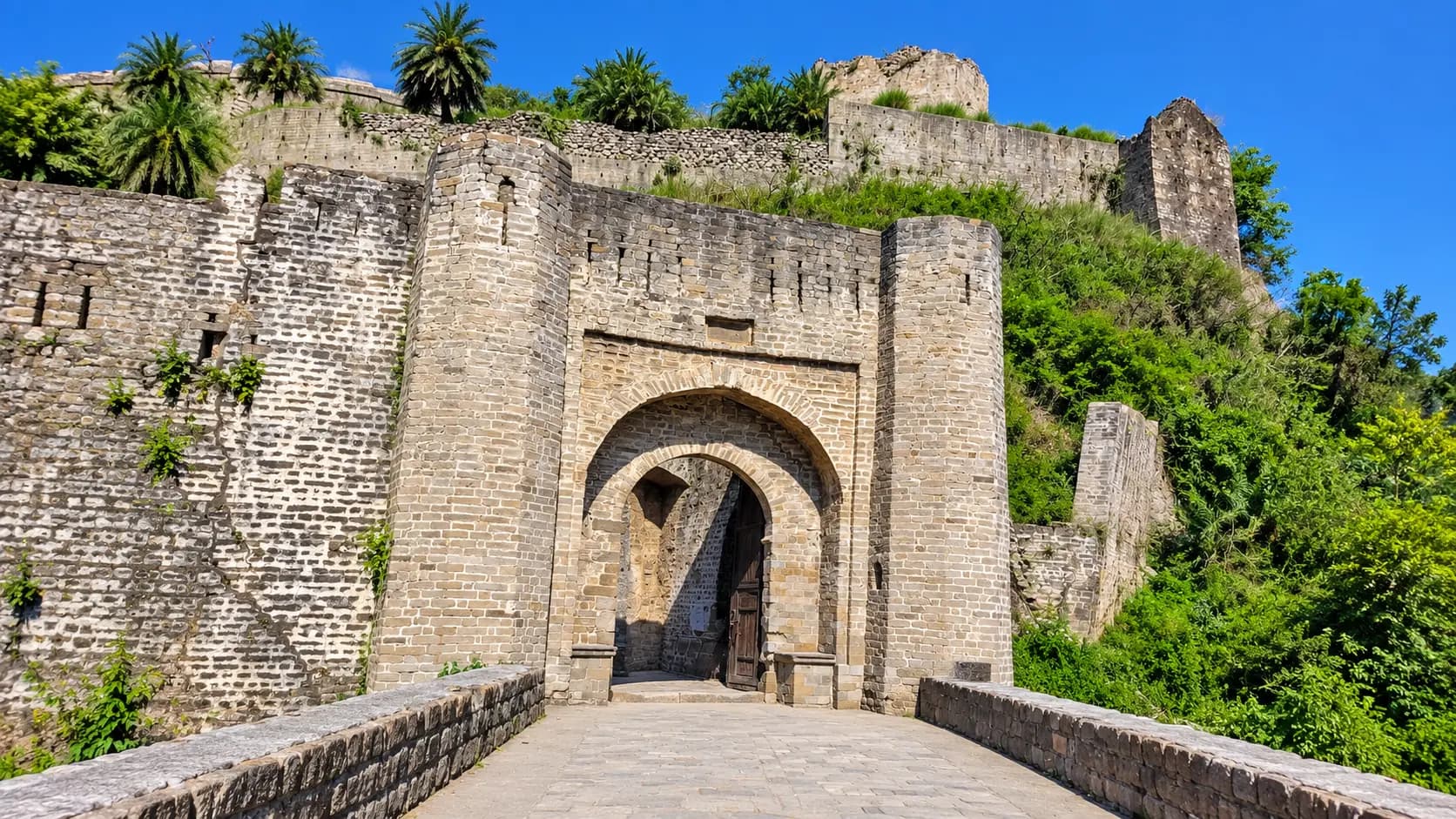
- Ranjit Singh Darwaza: The outermost portal, named in honor of the legendary Sikh emperor Maharaja Ranjit Singh. Constructed with massive wooden door leaves reinforced with thick iron spikes to repel war elephants, it marks the transition from modern Kangra into the fortified precinct.
- Jahangiri Darwaza: A grand pointed archway constructed of dressed grey sandstone, commissioned by Emperor Jahangir following his 1620 conquest. Epigraphic plaques and floral motifs decorate the stone spandrels.
- Ahani Darwaza & Amiri Darwaza: Consecutive portals built by the late eighteenth-century Mughal governor Nawab Saif Ali Khan. The Ahani Darwaza features iron-plated cladding (ahan meaning iron in Persian) that provided secondary defense against battering rams.
- Andheri Darwaza ("The Dark Gate"): Perhaps the most ingenious and terrifying defensive structure in the fort. This long, narrow, covered stone passage ascends steeply in near-total darkness, twisting sharply through two blind right-angle corners. Invading troops forced into this subterranean tunnel were completely blinded to what lay ahead, while defenders positioned above dropped burning oil, rolling boulders, and showers of arrows through defensive murder holes (machicolations) cut into the ceiling.
2. The Sacred Middle Terrace and Temples
Emerging from the Andheri Darwaza brings visitors onto a broad, sunlit terrace known as the temple courtyard, accessed through the magnificent Darshani Darwaza.
- Darshani Darwaza ("Gateway of Sight"): The gateway to the sacred sanctuary of the citadel. The stone jambs of this monumental portal preserve intricate early medieval carvings of the sacred River Goddesses Ganga (standing upon her crocodile vehicle, the makara) and Yamuna (standing upon her tortoise vehicle, the kurma), alongside Guardian Deities dating to the ninth and tenth centuries CE.
- Ambika Devi Temple: The spiritual heart of Kangra Fort. Dedicated to Goddess Ambika, a fierce manifestation of Durga and the revered kuldevi (patron family deity) of the Katoch royal dynasty. The temple features an ancient stone mandapa with carved pillars, an inner sanctum with a sanctified stone icon, and remains an active place of daily worship where priests perform traditional pujas.
- Lakshmi Narayan Temple & Shitala Temple Ruins: Adjacent to the Ambika temple stand the hauntingly beautiful carved stone remains of temple complexes that once rivaled the temple architecture of Khajuraho and Osian. Exquisite carved stone friezes depict dancing celestial maidens (apsaras), composite mythical beasts (yalis), fluted stone columns, and heavy ribbed stone crowning discs (amalakas) that toppled during the 1905 earthquake.
- Jain Temple: A modest stone shrine containing an ancient carved image of the first Jain Tirthankara, Lord Rishabhanatha (Adinatha), testifying to the remarkable multi-faith religious tolerance practiced under Katoch rule.
3. The Upper Citadel and Sheesh Mahal Palace Ruins
Continuing uphill along a stone ramp brings visitors to the highest elevation of the promontory, where the royal residential quarters were situated:
- The Royal Palaces (Sheesh Mahal & Hamam): Historically, these multi-storey palaces featured mirrored glass interiors (Sheesh Mahal), delicate wooden filigree screens, private royal audience chambers (Diwan-i-Khas), and heated steam baths (hamams). While the upper stories were largely brought down by the 1905 earthquake, the massive stone basements, arched doorways, and stone flagstones remain intact.
- Panoramic Lookout Ramparts: The outer battlements of the upper palace terrace offer one of the most breathtaking panoramic viewpoints in Himachal Pradesh. Looking downward, the sheer rock cliffs drop precipitously into the roaring emerald-green waters of the Banganga River directly below. Looking northward, the entire snow-clad wall of the Dhauladhar Range stretches across the horizon, providing a stunning backdrop to the ancient stone battlements.
4. Maharaja Sansar Chand Museum
Located at the base of the fort immediately outside the outer gate, this museum is maintained by the royal family trust of Kangra:
- Exhibits: The museum displays an extraordinary collection of artifacts, including rare original Kangra miniature paintings depicting scenes from the Gita Govinda and Bhagavata Purana, royal silver and copper coins from the Trigarta period, ancestral battle armor, damascened steel swords, matchlock muskets, and original Persian royal decrees (farmans) signed by Mughal emperors Akbar, Jahangir, and Shah Jahan.
- Audio Guide Integration: The museum offers high-quality audio guides (narrated by royal family member Tikka Aishwarya Chandra Katoch) that sync with numbered stations throughout the fort, providing rich historical context for the walk.
Best time to visit
Kangra Fort is situated at an elevation of 670 meters in the lower foothills of the Himalayas.Explore detailsClose details
Kangra Fort is situated at an elevation of 670 meters in the lower foothills of the Himalayas. Its climate differs significantly from the cooler alpine temperatures of upper Dharamshala and McLeodganj (at 2,000 meters), making seasonal timing an important factor.
Autumn and Spring (September to November & March to April) - The Optimal Months
Autumn and spring offer the most comfortable atmospheric conditions for exploring an expansive outdoor stone fortress.
- Weather & Temperatures: Daytime temperatures range between a pleasant 20°C and 28°C under clear, sunlit skies. Autumn provides crystal-clear panoramic visibility of the snow-crested Dhauladhar peaks, while spring brings blooming wild daisies and fresh mountain air.
- Walking Comfort: Exploring the unshaded stone ramps and open palace terraces is easy and invigorating without midday heat fatigue.
Winter (December to February) - Mild and Crisp
Unlike McLeodganj, which experiences freezing winter conditions, Kangra Fort enjoys mild, sunny winter days.
- Atmospheric Conditions: Daytime temperatures average 15°C to 20°C, making midday walking warm and enjoyable. Nights and early mornings are chilly (5°C - 8°C), so carrying a light jacket or woolen sweater is advisable.
- Visitor Footfall: Winter weekdays see moderate visitor numbers, allowing travelers to study the stone carvings and explore the gateways in relative peace.
Summer (May to June) - Warm and Arid
Summer in the Kangra foothill basin can become quite hot, with midday temperatures frequently climbing between 32°C and 37°C.
- Visiting Strategy: The exposed sandstone ramparts and flagstones absorb immense heat. Check the current visiting hours and permitted access with the site operator before departure; ceremonies, closures and visitor sessions can affect access. Spend the warmer midday hours inside the air-conditioned galleries of the Maharaja Sansar Chand Museum.
Monsoon (July to August) - Lush Greenery but Heavy Rain
The Kangra Valley receives heavy precipitation during the southwest monsoon.
- Visual Drama: The surrounding river gorges swell into roaring, muddy torrents, and the steep rock cliffs around the fort become blanketed in vivid green mosses and wild ferns.
- Trail Caution: Stone steps along the Andheri Darwaza and upper palace terraces become slick with water. Visitors must wear shoes with solid grip and carry an umbrella or waterproof jacket.
How to reach
Kangra Fort is located in Old Kangra (Purana Kangra) within the Kangra Sub-Division of Kangra District.Explore detailsClose details
Kangra Fort is located in Old Kangra (Purana Kangra) within the Kangra Sub-Division of Kangra District. It is situated approximately 20 kilometers south of Dharamshala, 28 kilometers south of McLeodganj, and 3.5 kilometers south of Kangra town. It is easily accessible via road, railway, and air networks.
By Road from Dharamshala and McLeodganj
- From Dharamshala (Kotwali Bazaar): Drive south via National Highway 154 through Gaggal or via the scenic State Highway 17 through Mataur. The distance is approximately 20 kilometers and takes 35 to 45 minutes by private taxi or personal car.
- From McLeodganj: Drive downhill via Forsyth Ganj and Dharamshala to Old Kangra (approx. 28 km; travel time 50 to 60 minutes).
- Public Buses (HRTC): Confirm the current charge and what it includes with the operator or service provider. Visitor admission, vehicles, parking, activities and accommodation can have separate charges.
By Air (Kangra Airport, Gaggal - DHM)
- Proximity: Kangra Airport at Gaggal is located just 14 kilometers north of Kangra Fort, making it the most convenient entry point for air travelers.
- Flight Connections: Daily scheduled direct flights operated by IndiGo, SpiceJet, and Alliance Air connect Gaggal with New Delhi (Indira Gandhi International Airport) and Chandigarh.
- Airport Transfers: Confirm the current charge and what it includes with the operator or service provider. Visitor admission, vehicles, parking, activities and accommodation can have separate charges.
By Rail (Broad-Gauge Railhead & Heritage Toy Train)
- Pathankot Junction (PTK) / Pathankot Cantt (PTKC): Located approximately 85 kilometers west in Punjab, Pathankot is the primary broad-gauge railway hub connecting to major Indian cities including Delhi, Mumbai, Jammu, and Amritsar. Direct HRTC buses and private taxis connect Pathankot to Kangra in about 2.5 to 3 hours via NH 154.
- Kangra Valley Heritage Toy Train: For a picturesque travel experience, board the historic narrow-gauge toy train at Pathankot Junction. The train winds through the rolling valleys and tea gardens of the Shivalik foothills, stopping at Kangra Mandir Railway Station, located just 3 kilometers from Kangra Fort. From the station, local auto-rickshaws reach the fort gates in 8 minutes.
By Private Car & Parking Information
- Driving Route: Driving to Kangra Fort is smooth along well-paved two-lane highways. Follow the prominent road signs from Kangra bypass toward "Purana Kangra / Kangra Fort."
- Parking Facilities: A dedicated, spacious paved municipal parking lot is situated directly opposite the fort entrance gate and the Maharaja Sansar Chand Museum. Confirm the current charge and what it includes with the operator or service provider. Visitor admission, vehicles, parking, activities and accommodation can have separate charges.
Entry, timings and permissions
Fees, visiting hours and entry rules may change.Explore detailsClose details
Fees, visiting hours and entry rules may change. Confirm the latest details with the official operator or local authority before travelling.
Because Kangra Fort is an Archaeological Survey of India (ASI) Centrally Protected Monument, visitor entry, ticketing, and preservation guidelines follow standard national protocols.
Admission Charges
Category | Cashless Online Booking (QR Code / ASI Portal) | Physical Booking Counter (Cash) |
|---|---|---|
Indian Citizens | ₹25 | ₹30 |
SAARC Nationals (Afghanistan, Bangladesh, Bhutan, Maldives, Nepal, Pakistan, Sri Lanka) | ₹25 | ₹30 |
BIMSTEC Nationals (Bangladesh, Bhutan, Myanmar, Nepal, Sri Lanka, Thailand) | ₹25 | ₹30 |
Foreign Tourists (All other nationalities) | ₹300 | ₹325 |
Children (Up to 15 years, Indian and Foreign) | Free (Valid age ID proof recommended) | Free |
Audio Guide & Museum Fee: Multi-lingual audio guides (available in English, Hindi, German, and French) can be rented at the entrance counter for approximately ₹100 - ₹150. Admission to the Maharaja Sansar Chand Museum at the base is covered either under a combined ticket or for a modest nominal entry fee (approx. ₹50).
Operating Hours
Facility / Area | Days of Operation | Timings | Notes |
|---|---|---|---|
Kangra Fort Gates & Ramparts | All 7 Days (Monday to Sunday) | 09:00 to 17:30 | Ticket counter closes 30 minutes before official closing (17:00) |
Ambika Devi Temple | All 7 Days | 09:00 to 17:30 | Remains open for prayer throughout monument visiting hours |
Maharaja Sansar Chand Museum | All 7 Days | 09:30 to 17:30 | Audio guide distribution and return counter located here |
Municipal Parking Lot | All 7 Days | 08:30 to 18:00 | Attendants on duty throughout monument opening hours |
Permissions, Filming, and Drone Guidelines
- Handheld Photography: Non-commercial personal photography and amateur videography using handheld smartphones, mirrorless bodies, and DSLR cameras are fully permitted throughout the fort without any fee.
- Tripods and Commercial Cinematography: As with all ASI monuments, the use of professional tripods, camera stands, lighting rigs, and commercial video production equipment requires prior statutory permission and payment of prescribed commercial filming fees through the official ASI Shimla Circle web portal (
asishimlacircle.bih.nic.in). - Drone Operations: Flying unmanned aerial vehicles (drones) over Kangra Fort, its river gorges, and the surrounding Purana Kangra valley is strictly prohibited under Directorate General of Civil Aviation (DGCA) security regulations and district administration safety orders.
Nearby places to consider
Combining Kangra Fort with surrounding cultural, religious, and scenic attractions in the lower Kangra Valley…Explore detailsClose details
Combining Kangra Fort with surrounding cultural, religious, and scenic attractions in the lower Kangra Valley makes for an enriching, full-day regional excursion:
1. Brajeshwari Devi Temple / Kangra Devi (Approx. 3.5 km North)
Located in the heart of Kangra town, the Shree Brajeshwari Devi Temple is one of the 51 venerated Shakti Peethas of Hinduism. According to legend, the left breast of Goddess Sati fell here. Reconstructed in a unique blend of shikhara and dome architecture following the 1905 earthquake, the temple is an intense, vibrant pilgrimage center bustling with thousands of devotees offering worship, bells, and sacred red shawls.
2. Masrur Rock-Cut Temples (Approx. 35 km Southwest)
Often hailed as the "Ellora of the North," Masrur is a breathtaking eighth-century monolithic rock-cut temple complex carved directly out of a natural sandstone ridge. Featuring fifteen monolithic shrines executed in classical Indo-Aryan nagara architectural style with an enormous central reflecting pool, it offers sweeping views across the Dhauladhar Range and stands as one of the architectural wonders of ancient India.
3. Chamunda Devi Temple (Approx. 24 km Northeast)
Perched on the banks of the roaring Baner River at the base of the Dhauladhar mountains, this ancient temple is dedicated to Goddess Chamunda (an incarnation of Durga who vanquished the demons Chanda and Munda). The temple features an active cremation ground, a holy rock sanctum smeared with vermilion, and breathtaking views of mountain rapids rushing over giant white granite boulders.
4. Norbulingka Institute (Approx. 18 km North)
Situated near Sidhpur on the outskirts of Dharamshala, the Norbulingka Institute is dedicated to preserving traditional Tibetan artistic and cultural heritage. Modeled on the Dalai Lama’s summer palace in Lhasa, its serene Japanese-inspired gardens, koi ponds, and traditional craft workshops showcase master woodcarvers, thangka painters, metal statue casters, and silk appliqué artisans at work.
5. Gyuto Monastery (Approx. 16 km North)
Located in Sidhbari, this majestic Tibetan monastery is the temporary headquarters of the 17th Karmapa (Ogyen Trinley Dorje). Famous for its distinctive tradition of tantric ritual meditation, harmonic deep-throat chanting, and magnificent towering golden Buddha statues, the monastery provides a tranquil, contemplative stop on the drive between Kangra and Dharamshala.
In pictures
The practical bits
Before you go.
Plan ahead
To make the most of your excursion to Kangra Fort, review these four fundamental preparation blocks covering…Explore detailsClose details
To make the most of your excursion to Kangra Fort, review these four fundamental preparation blocks covering footwear, timing, hydration, and historical orientation:
Comfortable Traction Footwear
Wear sturdy, supportive walking shoes or athletic sneakers with reliable rubber grip.Explore detailsClose details
Wear sturdy, supportive walking shoes or athletic sneakers with reliable rubber grip. Exploring Kangra Fort involves ascending extensive stone ramps, climbing uneven medieval stone staircases, and walking along the unbarricaded rocky edges of upper palace terraces. Avoid smooth-soled dress shoes, leather-soled loafers, or high heels, which are prone to slipping on polished stone flags.
Audio Guide for Historical Depth
Rent the official multi-lingual audio guide at the ticket counter before entering through the outer gate.Explore detailsClose details
Rent the official multi-lingual audio guide at the ticket counter before entering through the outer gate. While the physical stone structures are awe-inspiring on their own, the audio guide - narrated with personal family insight by descendants of the Katoch royal dynasty - brings the complex alive with dramatic accounts of ancient sieges, architectural details of the gateways, and the legend of the subterranean temple vaults.
Hydration and Sun Protection Supplies
Bring a reusable water bottle, UV-blocking sunglasses, high-SPF sunscreen, and a sun hat.Explore detailsClose details
Bring a reusable water bottle, UV-blocking sunglasses, high-SPF sunscreen, and a sun hat. While purified drinking water dispensers and clean restrooms are located at the entrance gate complex, the expansive upper citadels and palace ruins are fully exposed to the sun without tree canopy shade.
Morning Arrival for Comfortable Exploration
Plan your visit to arrive at the fort gate between 09:00 and 10:30 in the morning.Explore detailsClose details
Plan your visit to arrive at the fort gate between 09:00 and 10:30 in the morning. Arriving early ensures cooler temperatures for the uphill stone climb, optimal front-lighting on the carved facades of the Darshani Darwaza and Ambika Devi Temple, and allows ample time to tour both the fort and the Maharaja Sansar Chand Museum before noon.
Suggested 3.5-Hour Heritage Trail Itinerary
09:00 - 09:30: Arrival, Audio Guide & Museum
Check the current visiting hours and permitted access with the site operator before departure; ceremonies…Explore detailsClose details
Check the current visiting hours and permitted access with the site operator before departure; ceremonies, closures and visitor sessions can affect access. Spend 30 minutes inside the Maharaja Sansar Chand Museum examining the collection of Pahari miniature paintings, royal weapons, and Mughal edicts.
09:30 - 10:15: Ascending the Great Defensive Gates
Enter through the massive spike-studded Ranjit Singh Darwaza.Explore detailsClose details
Enter through the massive spike-studded Ranjit Singh Darwaza. Walk past the Jahangiri Darwaza, the iron-plated Ahani Darwaza, and ascend the dark, twisting stone tunnel of the Andheri Darwaza, listening to audio commentary on medieval siege warfare.
10:15 - 11:15: The Sacred Middle Terraces & Temples
Pass through the Darshani Darwaza to view the carved river goddesses Ganga and Yamuna.Explore detailsClose details
Pass through the Darshani Darwaza to view the carved river goddesses Ganga and Yamuna. Visit the active Ambika Devi Temple to pay respects, then explore the intricate carved stone friezes and toppled amalakas of the ruined Lakshmi Narayan and Shitala temples.
11:15 - 12:00: Upper Citadel, Palaces & River Vistas
Climb the upper stone ramps to the ruins of the Sheesh Mahal.Explore detailsClose details
Climb the upper stone ramps to the ruins of the Sheesh Mahal. Walk the outer sandstone ramparts, marvel at the vertical drops into the Banganga and Manjhi rivers, and take in the panoramic vista of the snow-clad Dhauladhar Range.
12:00 - 12:30: Descent & Traditional Kangra Lunch
Descend through the gateways back to the base.Explore detailsClose details
Descend through the gateways back to the base. Return your audio guide and head into Kangra town to savor an authentic Kangri Dham feast (traditional festive vegetarian meal served on leaf plates featuring madra, mah ki dal, khatta, and meetha bhat).
A few things you might wonder
Common questions about visiting Kangra Fort. Fees, visiting hours and ceremonies are researched details that may change; confirm current arrangements with the operator before travelling.
How old is Kangra Fort, and who built it?
What are the ticket prices and visiting hours for the fort?
How far is Kangra Fort from Dharamshala and McLeodganj?
Why was Kangra Fort attacked so many times in history?
How much walking is involved, and is the fort wheelchair accessible?
What happened to Kangra Fort during the 1905 earthquake?
Explore more in Dharamshala Mcleodganj
Discover other destinations around this hub
More Hubs in Himachal Pradesh
Continue exploring other travel hubs in this state
Planning a trip to Dharamshala McLeodganj?