Tungnath & Chandrashila
Comprehensive guide to Tungnath and Chandrashila in Rudraprayag, Uttarakhand. Explore the world's highest Shiva temple, Panch Kedar history, and Chopta summit trek.
Location
Char Dham Chopta, Uttarakhand
A closer look
Your visit, at a glance.
Char Dham Chopta, Uttarakhand
GET TO KNOW THE PLACE
Towering amidst the majestic high-altitude alpine ridges of Rudraprayag District, Uttarakhand, the celestial shrine of Tungnath and the soaring rocky summit of Chandrashila form…
The story of Tungnath & Chandrashila
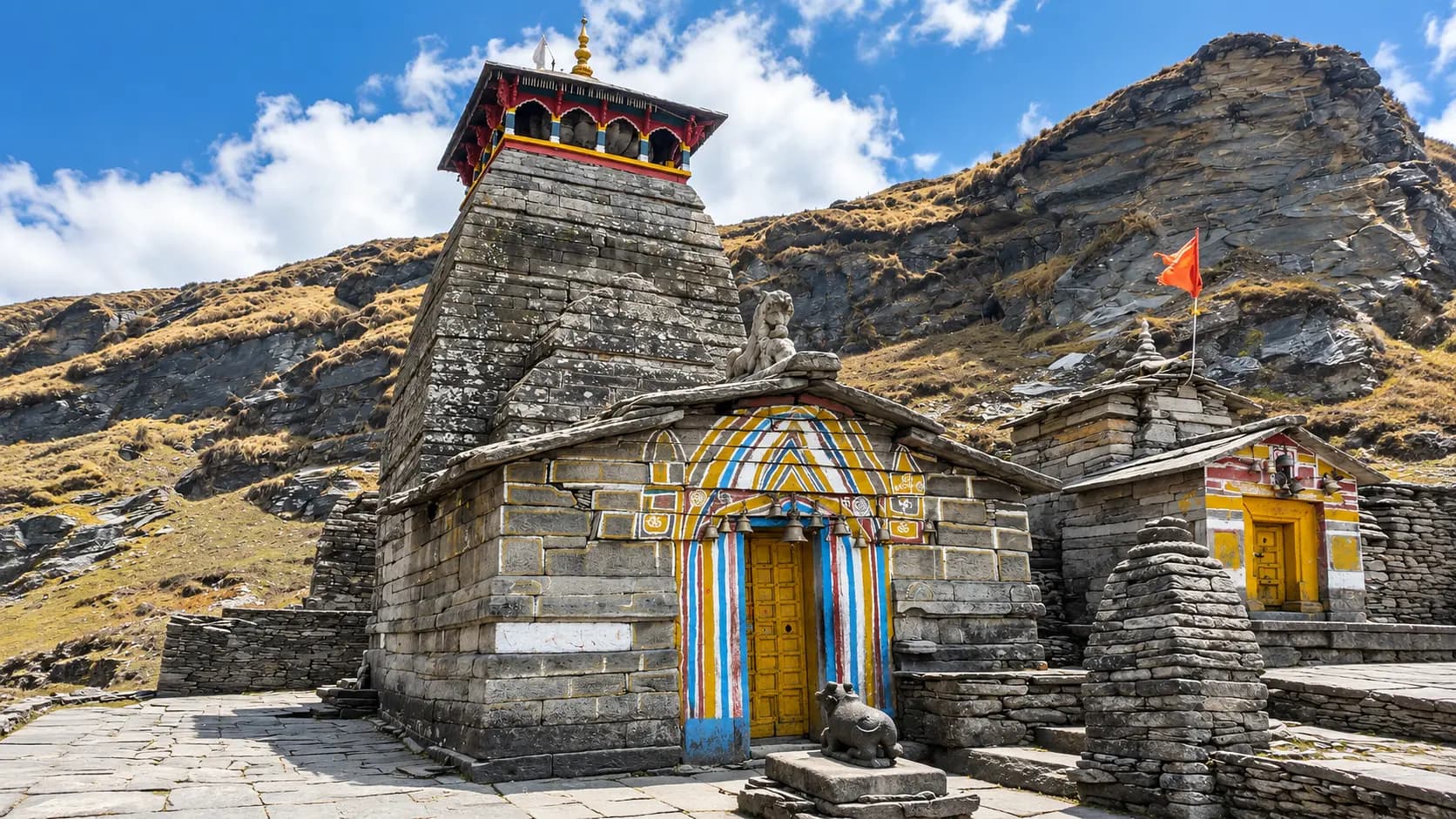
Towering amidst the majestic high-altitude alpine ridges of Rudraprayag District, Uttarakhand, the celestial shrine of Tungnath and the soaring rocky summit of Chandrashila form one of the most spiritually profound and visually spectacular mountain corridors in the entire Himalayan chain. Perched at an astonishing elevation of 3,680 metres (12,073 feet) above sea level, Tungnath holds the undisputed global distinction of being the highest Shiva temple in the world. Revered as the Tritiya Kedar (the third temple) in the legendary Panch Kedar pilgrimage circuit - which also comprises Kedarnath, Rudranath, Madhyamaheshwar, and Kalpeshwar - Tungnath is celebrated in sacred Puranic lore as the exact mountain sanctuary where the divine arms (bahu) of Lord Shiva manifested before the repentant Pandava brothers following the catastrophic Kurukshetra War.
Directly above the ancient stone temple, the mountain ridge culminates in the dramatic, pyramid-shaped crest of Chandrashila (literally the "Moon Rock"), reaching an elevation of 4,000 metres (13,123 feet). Steeped in profound epic folklore, Chandrashila is venerated as the solitary crag where Lord Rama meditated to atone for the sin of slaying Ravana (who was a learned Brahmin and devout devotee of Shiva), and where Chandra, the Moon God, performed severe cosmic penance (tapasya) to break a curse. The summit of Chandrashila serves as a premier natural vantage point in the Garhwal Himalayas, granting travelers a breathless, uninterrupted 360-degree panorama of the Greater Himalayan range - unfolding in a continuous icy rampart featuring Nanda Devi (7,816 m), Trishul (7,120 m), Chaukhamba (7,138 m), Kedarnath Peak (6,940 m), Kedar Dome (6,831 m), Dunagiri (7,066 m), and the twin spires of Bandarpoonch (6,316 m).
The journey to Tungnath and Chandrashila begins at the idyllic high meadow of Chopta (2,680 m), affectionately known as the "Mini Switzerland of Uttarakhand." The trail traverses 5 kilometres of well-graded, stone-paved switchbacks ascending through the pristine temperate rainforests and alpine meadows of the Kedarnath Wildlife Sanctuary. Along the route, dense canopies of scarlet and pink rhododendrons (Rhododendron arboreum and Rhododendron campanulatum), Himalayan oak (banj), and deodar yield to sweeping alpine grasslands (bugyals), where the iridescent plumage of Uttarakhand's state bird, the Himalayan Monal (Lophophorus impejanus), and the elusive Himalayan musk deer thrive. Blending ancient Nagara temple architecture with accessible high-altitude trekking, Tungnath and Chandrashila offer an unforgettable communion with the raw majesty of the Himalayas.
Start here. Open a tile for the full details.
Why goRead details
Tungnath and Chandrashila draw mountain lovers, spiritual seekers, and trekkers for an array of peerless natural and cultural reasons:
When to visitRead details
Tungnath and Chandrashila can be visited in distinct seasons, each offering a completely different mountain ambiance:
Entry & permissionsRead details
Fees, visiting hours and entry rules may change. Confirm the latest details with the official operator or local authority before travelling.
- Entry Fees and Sanction: Entry to Tungnath Temple is completely free for all pilgrims. Because the trail passes through the Kedarnath Wildlife Sanctuary, the Uttarakhand Forest Department levies a nominal eco-development entry fee at the Chopta forest checkpost (approx. ₹150 per person for Indian nationals and ₹600 for foreign citizens; camera charges of ₹100 may apply for professional equipment).
- Opening Timings:
- Tungnath Temple: The temple sanctum is open daily from 06:00 to 19:00 during the pilgrimage season (May to November). An afternoon ritual pause occurs between 13:00 and 14:00.
- Trek Timings: Trekkers are permitted to begin the ascent from Chopta checkpoint between 05:00 and 14:00. Trekkers must begin their descent from Chandrashila summit by 15:30 to safely return to Chopta before dark.
- Camping Prohibitions: In strict compliance with orders from the High Court of Uttarakhand and the State Forest Department, all overnight camping is strictly prohibited on the alpine meadows (bugyals) of Chopta, around Tungnath Temple, and at Chandrashila summit to prevent environmental degradation. Trekkers must return to established camps or guesthouses at Chopta base, Baniyakund, or Dugalbitta.
- Drone Regulations: Operating civilian drones or UAVs is strictly banned throughout the Kedarnath Wildlife Sanctuary to protect nesting raptors and wildlife. Unpermitted drones will be confiscated by forest rangers.
Plan your visitRead details
The gateway to Tungnath and Chandrashila is the scenic alpine hamlet of Chopta, situated on the Kund-Chopta-Gopeshwar road in Rudraprayag District:
Altitude Awareness and Pacing
Ascending from Chopta (2,680 m) to Chandrashila (4,000 m) entails a substantial elevation gain of 1,320 metres in just 5 kilometres. To prevent Acute Mountain Sickness (AMS), spend at least one night acclimatizing in Chopta, Sari, or Ukhimath before trekking. Maintain a slow, rhythmic walking pace, breathe deeply, and drink at least 2 to 3 litres of water. If you experience severe headaches, nausea, or dizziness, descend immediately.
Explore the full guide - choose a topic below.
Why visit?
Tungnath and Chandrashila draw mountain lovers, spiritual seekers, and trekkers for an array of peerless natural…Explore detailsClose details
Tungnath and Chandrashila draw mountain lovers, spiritual seekers, and trekkers for an array of peerless natural and cultural reasons:
- Worship at the Highest Shiva Temple on Earth: Stand before Tungnath Temple, constructed from massive, weathered grey granite slabs in the classical North Indian Nagara style over a millennium ago. Gaze upon the stone bull Nandi guarding the entrance and worship the sacred black stone lingam representing the divine arms of Mahadeva, surrounded by subsidiary shrines dedicated to Goddess Parvati, the Pandavas, and Adi Shankaracharya.
- Stand at the 4,000-Metre Summit of Chandrashila: Conquer the exhilarating 1.5-kilometre summit ridge above Tungnath to reach the wind-whipped apex of Chandrashila at 4,000 metres. The tiny stone temple dedicated to Goddess Ganga at the peak offers one of the most magnificent 360-degree panoramic views in India, with hundreds of snow-crowned peaks reflecting the golden rays of dawn or sunset.
- Witness the Spectacular Himalayan Monal: The high alpine forests and rocky pastures between Chopta and Tungnath are one of the finest habitats in India to observe the radiant, multi-hued Himalayan Monal pheasant foraging along the grassy slopes, alongside the Himalayan griffon vulture soaring on thermal updrafts.
- Experience the Spring Rhododendron Bloom: Visit in April and May when the mountainsides explode into vibrant hues of crimson, scarlet, and pale pink as thousands of wild rhododendron trees burst into full bloom, creating a fairy-tale contrast against the snowy peaks of Chaukhamba.
- Enjoy an Accessible Himalayan Summit Trek: Unlike many 4,000-metre Himalayan summits that require multi-day expeditions and technical climbing gear, Chandrashila can be summited and descended in a single rewarding day hike from Chopta along a clearly marked stone trail, making it an ideal high-altitude trek for fit beginners and families alike.
- Explore Thrilling Winter Snow Trekking: From December to March, the trail transforms into a pristine winter wonderland under 1 to 2 metres of glistening powdery snow. Equipped with microspikes and gaiters, winter trekkers can experience the magic of an alpine snow climb with crystalline blue skies and dramatic frozen vistas.
What to expect
Ascending from Chopta to Tungnath and Chandrashila is a demanding yet profoundly satisfying mountain trek with…Explore detailsClose details
Ascending from Chopta to Tungnath and Chandrashila is a demanding yet profoundly satisfying mountain trek with distinct terrain and climate stages:
- Trail Breakdown and Distance: The trek covers 5 kilometres one-way (10 km round trip) with a vertical elevation gain of 1,320 metres:
- Chopta to Tungnath (3.5 km, ~1,000 m gain): The trail consists of a broad, continuous stone-paved pathway with built-in stone steps and switchbacks winding steadily upward through rhododendron forests before emerging onto open alpine meadows. Ponies and mules operate along this section.
- Tungnath to Chandrashila Peak (1.5 km, ~320 m gain): The paved path ends at the temple. The trail to the summit transitions into a rugged, narrow, and steep earthen-and-rock trail that climbs relentlessly along the exposed mountain ridge. In winter and early spring, this ridge is covered in hard-packed snow and ice. Ponies cannot traverse this upper section.
- Atmospheric Conditions and Cold: The air grows noticeably thin above 3,500 metres. Even in peak summer, high-altitude alpine winds sweep across the ridge, dropping wind-chill temperatures dramatically. Daytime summit temperatures in summer average 5°C to 12°C, while autumn and winter temperatures plunge well below freezing (-5°C to -15°C). Rapid weather changes - including sudden thick fog, hail, or snow flurries - can develop within minutes.
- Sacred Atmosphere and Ritual Heritage: Tungnath possesses a solemn, contemplative spiritual aura. Unlike Kedarnath, which is served by South Indian Rawals, the priestly duties at Tungnath are performed by local Maithani Brahmins from the village of Makkumath. The temple observes strict ritual sanctity, with resounding bells, aromatic incense, and devotional chants echoing across the silent amphitheater of mountains.
- Chopta Base Camp Infrastructure: Chopta is an alpine meadow settlement without permanent concrete hotels, situated along the motorable road. Accommodation consists of eco-lodges, Swiss tents, homestays, and rustic guesthouses operating on solar electricity and mountain spring water.
Best time to visit
Tungnath and Chandrashila can be visited in distinct seasons, each offering a completely different mountain…Explore detailsClose details
Tungnath and Chandrashila can be visited in distinct seasons, each offering a completely different mountain ambiance:
- Spring and Early Summer (April to June): The most popular and accessible trekking season. April showcases the peak blooming of scarlet rhododendrons across Chopta, while May and June offer warm, sunny days (12°C to 20°C at Chopta, 5°C to 12°C at the summit) with lush green meadows. Tungnath Temple opens its doors for pilgrim worship in early May. Clear morning skies provide magnificent summit views before afternoon clouds gather.
- Monsoon (July to August): Characterized by frequent heavy rainfall, dense mist, and slippery stone trails. Landslides occasionally disrupt the road between Rishikesh and Chopta. While the meadows turn intensely green with blooming alpine flora, summit mountain vistas are often completely obscured by cloud cover. Leeches are common in the forested sections below the tree line.
- Autumn (September to November): The absolute finest season for panoramic photography and crisp mountain trekking. Monsoon rains wash the atmosphere clean, yielding crystal-clear, deep blue skies with razor-sharp views of snow peaks stretching hundreds of kilometres. Temperatures turn chilly, especially by November when night temperatures drop below -5°C. Tungnath Temple closes for the winter around Diwali/Bhai Dooj, when the idol is transported down to Makkumath.
- Winter (December to March): An extraordinary period for snow trekking and winter camping. Chopta and the Tungnath trail receive heavy snowfall, often closing the road to vehicles beyond Dugalbitta. The temple remains closed and buried under snow, but the trek to Chandrashila summit remains open for adventurous trekkers equipped with waterproof hiking boots, gaiters, and microspikes. Winter temperatures frequently plummet to -10°C to -15°C at night.
How to reach
The gateway to Tungnath and Chandrashila is the scenic alpine hamlet of Chopta, situated on the…Explore detailsClose details
The gateway to Tungnath and Chandrashila is the scenic alpine hamlet of Chopta, situated on the Kund-Chopta-Gopeshwar road in Rudraprayag District:
- By Road: Chopta is well-connected by paved motorable mountain highways:
- From Ukhimath (40 km): The most common western approach. Taxis and shared jeeps climb through dense forests via Mastura and Sari to reach Chopta in approximately 1.5 to 2 hours.
- From Gopeshwar / Chamoli (30 km): The eastern approach climbs via Mandal and the dense Kedarnath Wildlife Sanctuary reserve to reach Chopta in approximately 1.5 hours.
- From Rishikesh / Haridwar: Rishikesh is located 208 km southwest. The drive follows the all-weather National Highway 7 along the Ganga and Alaknanda rivers past Devprayag and Srinagar to Rudraprayag, then turns north along NH 107 toward Kund, branching onto the scenic Chopta road via Ukhimath (approx. 7 to 8 hours driving time).
- By Rail: The nearest broad-gauge railway stations are Yog Nagari Rishikesh (YNRK, 208 km) and Haridwar Junction (HW, 230 km), connecting to major Indian cities including Delhi, Mumbai, and Kolkata. Private taxis and GMOU/UTC public buses operate daily from Haridwar and Rishikesh to Rudraprayag, Ukhimath, and Guptkashi.
- By Air: The closest airport is Jolly Grant Airport, Dehradun (DED, 225 km), operating multiple daily commercial flights to New Delhi, Mumbai, Bengaluru, and Hyderabad. Taxis can be hired directly from the airport terminal for the scenic drive to Chopta.
Entry, timings and permissions
Fees, visiting hours and entry rules may change.Explore detailsClose details
Fees, visiting hours and entry rules may change. Confirm the latest details with the official operator or local authority before travelling.
- Entry Fees and Sanction: Entry to Tungnath Temple is completely free for all pilgrims. Because the trail passes through the Kedarnath Wildlife Sanctuary, the Uttarakhand Forest Department levies a nominal eco-development entry fee at the Chopta forest checkpost (approx. ₹150 per person for Indian nationals and ₹600 for foreign citizens; camera charges of ₹100 may apply for professional equipment).
- Opening Timings:
- Tungnath Temple: The temple sanctum is open daily from 06:00 to 19:00 during the pilgrimage season (May to November). An afternoon ritual pause occurs between 13:00 and 14:00.
- Trek Timings: Trekkers are permitted to begin the ascent from Chopta checkpoint between 05:00 and 14:00. Trekkers must begin their descent from Chandrashila summit by 15:30 to safely return to Chopta before dark.
- Camping Prohibitions: In strict compliance with orders from the High Court of Uttarakhand and the State Forest Department, all overnight camping is strictly prohibited on the alpine meadows (bugyals) of Chopta, around Tungnath Temple, and at Chandrashila summit to prevent environmental degradation. Trekkers must return to established camps or guesthouses at Chopta base, Baniyakund, or Dugalbitta.
- Drone Regulations: Operating civilian drones or UAVs is strictly banned throughout the Kedarnath Wildlife Sanctuary to protect nesting raptors and wildlife. Unpermitted drones will be confiscated by forest rangers.
Nearby places to consider
The Chopta-Tungnath valley serves as an ideal hub to explore several other spectacular natural and cultural…Explore detailsClose details
The Chopta-Tungnath valley serves as an ideal hub to explore several other spectacular natural and cultural wonders:
- Deoria Tal (20 km southwest): An emerald-green alpine lake situated at 2,438 metres near Sari village. Renowned for its mirror reflection of the Chaukhamba peaks in its tranquil waters, accessible via a delightful 2.5-km forest walk.
- Ukhimath Omkareshwar Temple (40 km southwest): The sacred winter seat of Lord Kedarnath and Lord Madhyamaheshwar, featuring ancient stone courtyards where the deities are worshipped from November to May.
- Makkumath Temple (28 km southwest): The historic winter seat of Lord Tungnath, where the deity's silver idol (Utsav Murti) is worshipped by Maithani priests during the six snowbound winter months.
- Rohini Bugyal (Trek route from Chopta): A pristine, secluded alpine meadow surrounded by ancient oak forests, frequented by birdwatchers and nature enthusiasts on the trail connecting Chopta with Deoria Tal.
- Gopeshwar Gopinath Temple (30 km east): A massive ancient stone Shiva temple dating back to the 9th - 11th centuries, featuring an enormous 5-metre trident (trishul) inscribed with ancient Sanskrit inscriptions.
In pictures
The practical bits
Before you go.
Plan ahead
A successful trek to Tungnath and Chandrashila requires mindful preparation, especially regarding altitude and…Explore detailsClose details
A successful trek to Tungnath and Chandrashila requires mindful preparation, especially regarding altitude and gear:
Altitude Awareness and Pacing
Ascending from Chopta (2,680 m) to Chandrashila (4,000 m) entails a substantial elevation gain of 1,320 metres in…Explore detailsClose details
Ascending from Chopta (2,680 m) to Chandrashila (4,000 m) entails a substantial elevation gain of 1,320 metres in just 5 kilometres. To prevent Acute Mountain Sickness (AMS), spend at least one night acclimatizing in Chopta, Sari, or Ukhimath before trekking. Maintain a slow, rhythmic walking pace, breathe deeply, and drink at least 2 to 3 litres of water. If you experience severe headaches, nausea, or dizziness, descend immediately.
Essential Trekking Gear
Wear broken-in trekking shoes with deep lugged rubber soles for traction on smooth, damp stones.Explore detailsClose details
Wear broken-in trekking shoes with deep lugged rubber soles for traction on smooth, damp stones. Dress in three functional layers: a moisture-wicking thermal base, an insulating fleece or down jacket, and a windproof/waterproof outer shell. Carry a warm woollen beanie, sun hat, UV-protective sunglasses (critical to prevent snow blindness in winter/spring), trekking poles, and rain gear or a poncho.
Pony and Porter Options
Confirm the current charge and what it includes with the operator or service provider.Explore detailsClose details
Confirm the current charge and what it includes with the operator or service provider. Visitor admission, vehicles, parking, activities and accommodation can have separate charges. Palanquins (dandi) carried by four porters are also available. However, ponies cannot ascend the rocky summit trail from Tungnath to Chandrashila; that final 1.5-km section must be completed on foot.
Cash and Connectivity Constraints
Mobile cellular networks (Jio and Airtel) provide intermittent voice signals at Chopta and along the trail, but…Explore detailsClose details
Mobile cellular networks (Jio and Airtel) provide intermittent voice signals at Chopta and along the trail, but data connectivity is weak and unreliable. There are no ATM cash dispensers in Chopta; the nearest functional ATMs are located in Ukhimath (40 km) and Gopeshwar (30 km). Carry sufficient cash in Indian Rupees for food, accommodation, porter services, and forest fees.
A few things you might wonder
Common questions about visiting Tungnath & Chandrashila. Fees, visiting hours and ceremonies are researched details that may change; confirm current arrangements with the operator before travelling.
How difficult is the trek to Tungnath and Chandrashila?
When does Tungnath Temple open and close during the year?
Can I trek to Chandrashila when Tungnath Temple is closed in winter?
Is it possible to see the sunrise from Chandrashila summit?
Can children and senior citizens do the Tungnath trek?
Are there ATMs and mobile internet connectivity available in Chopta?
More Hubs in Uttarakhand
Continue exploring other travel hubs in this state
Planning a trip to Char Dham Chopta?