Konark Sun Temple
Complete visitor guide to the 13th-century UNESCO World Heritage Konark Sun Temple in Puri, Odisha. Explore the stone chariot, 24 sundial wheels, 7 horses, and dance hall.
Location
Golden Triangle, Odisha
A closer look
Your visit, at a glance.
Golden Triangle, Odisha
GET TO KNOW THE PLACE
Rising from the golden coastal soils of Puri District, Odisha, like an enormous celestial war-wagon turned to living stone, the Konark Sun Temple (historically heralded by…
The story of Konark Sun Temple
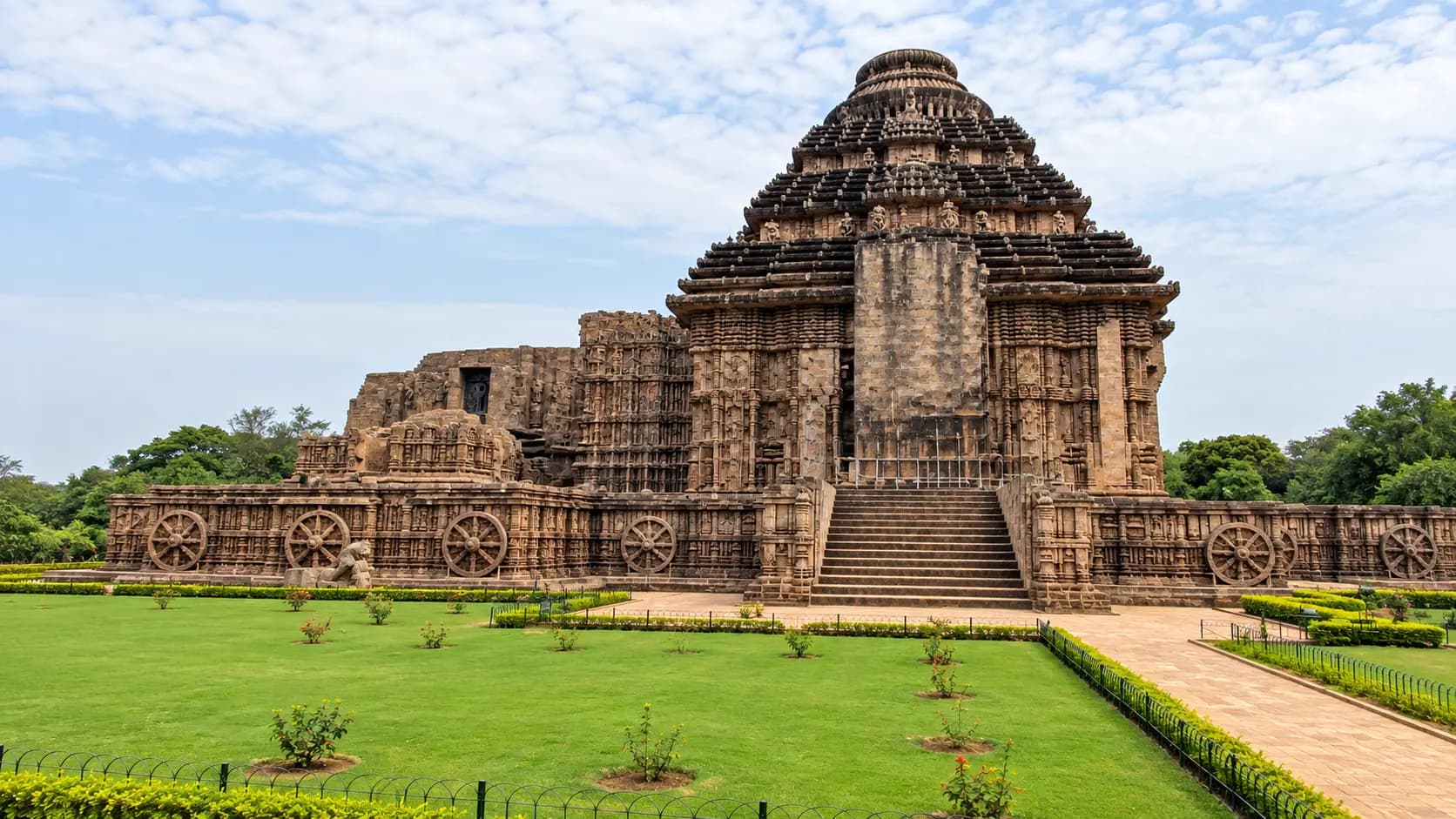
Rising from the golden coastal soils of Puri District, Odisha, like an enormous celestial war-wagon turned to living stone, the Konark Sun Temple (historically heralded by European mariners as the "Black Pagoda") is one of the supreme wonders of world architecture. Inscribed as a UNESCO World Heritage Site in 1984, this 13th-century architectural titan represents the absolute zenith of the ancient Kalinga school of architecture - a monument so sublime in its conception and daring in its scale that Nobel laureate Rabindranath Tagore famously observed: "Here the language of stone defeats the language of man."
Commissioned around 1250 CE by the ambitious Eastern Ganga Emperor Narasimhadeva I to celebrate his military triumphs over the Islamic Sultanates of Bengal and to honor the life-giving Sun God Surya, the temple was conceived not as an ordinary building, but as a colossal, twelve-wheeled royal chariot (Ratha) ferrying the solar deity across the celestial heavens. Carved into its monumental stone plinth are 24 gigantic wheels - each nearly 3 metres (9.9 feet) in diameter and sculpted with astronomical precision to function as sundials - drawn toward the morning ocean by seven spirited, galloping stone horses.
Though its original soaring sanctum tower (Vimana) - which once reached an astonishing height of over 68 to 70 metres (225 - 230 feet), taller than any existing Hindu temple in India - succumbed centuries ago to sandy foundation shifts and maritime storms, the surviving assembly hall (Jagamohana), the roofless Hall of Dance (Nata Mandapa), and thousands of square metres of virtuosic stone reliefs remain a source of universal wonder. From sensual Mithuna sculptures and celestial musicians to royal cavalries, battle elephants, and the famed astronomical sundials, Konark stands as an immortal monument to human creative genius, scientific inquiry, and spiritual ecstasy.
Start here. Open a tile for the full details.
Why goRead details
- UNESCO World Heritage Masterpiece: Explore one of India’s most iconic monuments, inscribed on the UNESCO World Heritage List in 1984 as a masterpiece of human creative genius and the crowning achievement of Kalinga stone architecture.
- The Concept of the Celestial Solar Chariot: Marvel at the grand architectural vision of an entire temple designed as the Sun God Surya’s chariot, featuring 24 carved stone wheels and seven galloping horses carved from living stone.
- The Astronomical 24 Sundial Wheels: Test your time-telling skills against 13th-century sundial wheels whose 8 primary and secondary spokes accurately calculate local solar time down to minutes based on the shadow cast by the central hub.
- The Exquisite Hall of Dance (Nata Mandapa): Walk through an unroofed pillared pavilion whose every pillar, lintel, and base is carved with dynamic stone sculptures of musicians, acrobats, and dancers performing classical Odissi mudras.
- Monumental Guardian Sculptures: Stand in awe before the towering Gajasimha statues (lions crushing war elephants), the muscular, dynamic War Horses trampling enemy warriors, and the ceremonial War Elephants.
- The World-Famous Konark Dance Festival: Attend the prestigious classical dance extravaganza held every year from December 1 to 5 at the open-air auditorium against the illuminated stone silhouette of the temple.
- The Modern Multichannel Light and Sound Show: Experience an enchanting evening spectacle where cutting-edge 3D projection and wireless headphone narration bring the legend of 1,200 craftsmen, King Narasimhadeva I, and boy-architect Dharmapada to life.
When to visitRead details
Entry & permissionsRead details
Fees, visiting hours and entry rules may change. Confirm the latest details with the official operator or local authority before travelling.
Tariffs, Timings and Regulations
- Admission Fee:
- Indian, SAARC, and BIMSTEC Citizens: ₹40 (online booking via
asi.nic.in/ QR code) or ₹50 (cashless on-site counter). - Foreign Tourists: ₹600 per adult.
- Children under 15 years: Free admission.
- ASI Archaeological Site Museum: ₹5 per person (closed Fridays).
- Indian, SAARC, and BIMSTEC Citizens: ₹40 (online booking via
- Visiting Hours:
- Konark Sun Temple: Open daily from sunrise to sunset (06:00 AM to 18:00 PM).
- ASI Archaeological Museum: 09:00 AM to 17:00 PM (closed Fridays).
- Evening Light and Sound Show: Two daily shows (typically 18:30 to 19:15 and 19:30 to 20:15).
- Security & Regulations:
- Flying camera drones over the monument or surrounding ASI heritage boundary is strictly prohibited without prior statutory clearance from the Ministry of Culture and defense agencies.
- Commercial cinematography, tripods, and lighting rigs require prior written ASI permissions. Handheld still cameras and smartphone photography are permitted and free.
- Touching or climbing upon the ancient stone wheels, carvings, and ruined structures is strictly forbidden and punishable under the Ancient Monuments and Archaeological Sites and Remains Act.
Plan your visitRead details
The nearest airport is Biju Patnaik International Airport (BBI) in Bhubaneswar, located approximately 65 kilometres northwest of Konark.
- Major domestic carriers provide frequent non-stop flights connecting Bhubaneswar with New Delhi, Mumbai, Bengaluru, Kolkata, Chennai, and Hyderabad. Confirm the current charge and what it includes with the operator or service provider. Visitor admission, vehicles, parking, activities and accommodation can have separate charges.
Explore the full guide - choose a topic below.
Why visit?
UNESCO World Heritage Masterpiece: Explore one of India’s most iconic monuments, inscribed on the UNESCO World…Explore detailsClose details
- UNESCO World Heritage Masterpiece: Explore one of India’s most iconic monuments, inscribed on the UNESCO World Heritage List in 1984 as a masterpiece of human creative genius and the crowning achievement of Kalinga stone architecture.
- The Concept of the Celestial Solar Chariot: Marvel at the grand architectural vision of an entire temple designed as the Sun God Surya’s chariot, featuring 24 carved stone wheels and seven galloping horses carved from living stone.
- The Astronomical 24 Sundial Wheels: Test your time-telling skills against 13th-century sundial wheels whose 8 primary and secondary spokes accurately calculate local solar time down to minutes based on the shadow cast by the central hub.
- The Exquisite Hall of Dance (Nata Mandapa): Walk through an unroofed pillared pavilion whose every pillar, lintel, and base is carved with dynamic stone sculptures of musicians, acrobats, and dancers performing classical Odissi mudras.
- Monumental Guardian Sculptures: Stand in awe before the towering Gajasimha statues (lions crushing war elephants), the muscular, dynamic War Horses trampling enemy warriors, and the ceremonial War Elephants.
- The World-Famous Konark Dance Festival: Attend the prestigious classical dance extravaganza held every year from December 1 to 5 at the open-air auditorium against the illuminated stone silhouette of the temple.
- The Modern Multichannel Light and Sound Show: Experience an enchanting evening spectacle where cutting-edge 3D projection and wireless headphone narration bring the legend of 1,200 craftsmen, King Narasimhadeva I, and boy-architect Dharmapada to life.
What to expect
The Konark Sun Temple was constructed during the golden age of the Eastern Ganga Dynasty.Explore detailsClose details
The Architectural Blueprint and Celestial Solar Chariot
The Konark Sun Temple was constructed during the golden age of the Eastern Ganga Dynasty. According to ancient palm-leaf temple chronicles (Baya Chakada), the construction engaged 1,200 master sculptors and stone masons over a period of 12 years, consuming twelve years of imperial tax revenue.
The monument was situated originally on the mouth of the sacred Chandrabhaga River, facing eastward directly toward the open waves of the Bay of Bengal, so that the very first rays of the dawn sun pierced through the main doorway to illuminate the bejeweled chlorite image of Surya in the innermost sanctum.
+-----------------------------------------------------------------------------------+
|                           KONARK SUN TEMPLE AXIAL LAYOUT                          |
+-----------------------------------------------------------------------------------+
|                                                                                   |
|                                     [ WEST ]                                      |
|                                                                                   |
|                      ┌──────────────────────────────────────┐                     |
|                      │         RUINED VIMANA SANCTUM        │                     |
|                      │ (Original 70-metre spire collapsed)  │                     |
|                      │   Houses Chlorite Surya Statues      │                     |
|                      └──────────────────┬───────────────────┘                     |
|                                         │                                         |
|                                         ▼                                         |
|                      ┌──────────────────────────────────────┐                     |
|                      │       SURVIVING JAGAMOHANA           │                     |
|   [ NORTH ]          │      (Colossal 39-metre Hall)        │       [ SOUTH ]     |
| 12 Carved Stone      │  - Pyramidal Tiered Pidha Roof       │   12 Carved Stone   |
| Wheels (Sundials)    │  - Chlorite Celestial Musicians      │   Wheels (Sundials) |
| & War Elephants      │  - Interior sand-filled in 1903      │   & War Horses      |
|                      └──────────────────┬───────────────────┘                     |
|                                         │                                         |
|                                         ▼                                         |
|                      ┌──────────────────────────────────────┐                     |
|                      │        NATA MANDAPA (DANCE HALL)     │                     |
|                      │   - Elevated Unroofed Platform       │                     |
|                      │   - Hundreds of Carved Odissi Dancers│                     |
|                      └──────────────────┬───────────────────┘                     |
|                                         │                                         |
|                                         ▼                                         |
|                      ┌──────────────────────────────────────┐                     |
|                      │       MONUMENTAL GAJASIMHA STEPS     │                     |
|                      │  Colossal Lions Crushing Elephants   │                     |
|                      └──────────────────┬───────────────────┘                     |
|                                         │                                         |
|                                         ▼                                         |
|                                     [ EAST ]                                      |
|                       Facing the Rising Sun & Bay of Bengal                       |
|                                                                                   |
+-----------------------------------------------------------------------------------+
The 24 Sundial Wheels
The most famous architectural elements of Konark are the 24 colossal stone wheels, carved in 12 matching pairs along the northern and southern plinths of the temple. Each wheel measures approximately 3 metres (9.9 feet) across, framed by thick rims carved with friezes of dancers, foliage, birds, and hunting scenes.
The wheels are not merely decorative ornaments; they are masterpieces of medieval Indian astronomy and mathematics:
- Solar Months & Fortnights: The 12 pairs of wheels symbolize the 12 lunar months of the Hindu solar year, with each pair representing the waxing (Shukla Paksha) and waning (Krishna Paksha) fortnights.
- The Precision Sundial: Each wheel features eight wide primary spokes and eight narrower secondary spokes. The 8 primary spokes divide the 24-hour day into eight prahars (three-hour segments), with the top spoke representing sunrise (or midday depending on orientation).
- Telling Time Down to the Minute: The circular rim between each spoke is carved with beads, each bead representing an exact division of time (approximately 3 minutes). By placing a slender stick, finger, or pencil at the center of the wheel hub and observing where its shadow falls along the inner spoke markings and rim beads, visitors can determine the exact solar time of day with astonishing accuracy.
The Seven Galloping Horses
Sculpted on the flanks of the eastern grand staircase are seven colossal stone horses, depicted in dynamic, surging motion with flared nostrils, arched necks, and strained muscles, pulling the chariot toward the dawn.
These seven steeds carry profound allegorical meanings in Vedic cosmology:
- They represent the seven days of the week (Sunday through Saturday).
- They symbolize the seven prismatic colors of sunlight (VIBGYOR) that make up white light, remarkably recognized by ancient Indian solar philosophers centuries before Sir Isaac Newton.
- They embody the seven sacred poetic meters of Vedic prosody: Gayatri, Brihati, Ushnik, Jagati, Trishtubha, Anushtubha, and Pankti.
The Surviving Jagamohana and the Sand Conservation
The colossal stone structure that towers over the site today is the Jagamohana (the assembly hall or Mukhasala). Rising to an imposing height of 39 metres (128 feet), its stepped pyramidal roof (pidha) is arranged in three distinct receding tiers, separated by terraces decorated with life-sized chlorite statues of female celestial musicians (Alasa Kanyas). These magnificent sculptures portray celestial women joyously playing musical instruments - including the mridangam drum, cymbals, conch, flute, and veena - celebrating the divine harmony of the cosmos.
By the late 19th century, centuries of abandonment, soft sand subsidence, and devastating coastal cyclones had severely weakened the Jagamohana's internal stone corbeling. In 1901, the Lieutenant Governor of Bengal, Sir John Woodburn, initiated an urgent conservation campaign. Under the direction of British engineer T. H. Ward between 1903 and 1904, workers bored four small openings into the walls and completely filled the interior chamber with thousands of tons of river sand and stone masonry. This radical engineering intervention prevented the imminent catastrophic collapse of the hall, preserving the monument for future generations. In recent years, the ASI has begun delicate scientific surveys using endoscopic cameras and boreholes to study the eventual controlled extraction of the sand.
The Nata Mandapa and the Language of Dance
Positioned directly on the eastern axis in front of the Jagamohana is the elevated, roofless Nata Mandapa (Hall of Dance). Set on a high, intricately sculpted plinth reached by four flights of stone steps, this hall historically served as the sacred performance arena where hereditary temple dancers (Devadasis or Maharis) performed sacred dance rituals for Lord Surya.
Every single square inch of the hall’s multi-faceted stone pillars, balustrades, and lintels is adorned with extraordinary bas-reliefs illustrating:
- Classical Odissi dance postures (Tribhanga, Chowka, and intricate hand mudras).
- Female celestial musicians playing stringed, percussion, and wind instruments.
- Acrobats performing dizzying backbends and contortions.
- Sinuous floral arabesques, dancing peacocks, and mythical Yalis (leogryphs).
The Three Chlorite Images of Surya
Within the recesses of the ruined sanctum plinth stand three monumental, free-standing statues of Lord Surya, sculpted from fine-grained, velvety dark-green chlorite stone that has resisted seven centuries of coastal weathering:
- The Morning Sun (Pratah Surya): Facing south, depicting the youthful Surya crowned with a towering diadem, radiating dawn vitality.
- The Midday Sun (Madhyanna Surya): Facing west, representing Surya in the full, commanding vigor of noon.
- The Setting Sun (Asta Surya): Facing north, portraying the mature, weary deity preparing to descend beneath the horizon. Remarkably, each image depicts Surya wearing knee-high boots and an ornate belt - a distinctive iconographical feature illustrating ancient Central Asian (Scythian/Saka) solar worship traditions synthesized into orthodox Hinduism.
Best time to visit
Explore detailsClose details
Seasonal breakdown
Season | Months | Daytime Temp (°C) | Nighttime Temp (°C) | Monument Atmosphere & Visitor Experience |
|---|---|---|---|---|
Peak Winter | November - February | 24°C - 28°C | 15°C - 19°C | Optimal. Delightful, balmy days and cool evening ocean breezes. Perfect for walking the vast unshaded stone complex, testing sundials, and attending the Konark Dance Festival (Dec 1 - 5). |
Early Spring | March - April | 29°C - 33°C | 21°C - 25°C | Very Good. Pleasant mornings and breezy evenings; stone paving becomes warm by midday. Moderate visitor crowds allow peaceful photography. |
Summer | May - June | 35°C - 39°C | 27°C - 30°C | Hot & Challenging. Check the current visiting hours and permitted access with the site operator before departure; ceremonies, closures and visitor sessions can affect access. Early morning (06:00 to 08:30 AM) visits are essential. |
Monsoon | July - October | 28°C - 32°C | 24°C - 26°C | Lush & Dramatic. Moody monsoon skies provide stunning contrasts against the dark weathered stone. Frequent showers clean the carvings, though heavy rains require umbrellas. |
How to reach
The nearest airport is Biju Patnaik International Airport (BBI) in Bhubaneswar, located approximately 65…Explore detailsClose details
By Air
The nearest airport is Biju Patnaik International Airport (BBI) in Bhubaneswar, located approximately 65 kilometres northwest of Konark.
- Major domestic carriers provide frequent non-stop flights connecting Bhubaneswar with New Delhi, Mumbai, Bengaluru, Kolkata, Chennai, and Hyderabad. Confirm the current charge and what it includes with the operator or service provider. Visitor admission, vehicles, parking, activities and accommodation can have separate charges.
By Train
- Puri Railway Station (PURI): The most convenient major railhead, located 35 kilometres southwest of Konark. Puri is directly linked by express and Vande Bharat trains to all major Indian cities. Taxis and private auto-rickshaws take roughly 45 minutes along the scenic Puri - Konark Marine Drive.
- Bhubaneswar Railway Station (BBS): Located 65 kilometres northwest, offering comprehensive nationwide train connectivity. Regular express tourist buses run directly from the station to Konark.
By Road & Public Transit
- Puri - Konark Marine Drive (NH-316A): One of India's most scenic coastal driving routes, running parallel to the Bay of Bengal coastline through the Casuarina forests of the Balukhand-Konark Wildlife Sanctuary.
- Public & Tourist Buses (OSRTC & Mo Bus): Frequent state-run OSRTC buses and air-conditioned Mo Bus services operate between Bhubaneswar, Puri, and Konark bus terminal throughout the day.
- Self-Drive & Taxis: Ample parking plazas are located 400 metres from the ASI ticket gates, with electric battery rickshaws shuttling visitors from the parking lots to the main entrance turnstiles.
Entry, timings and permissions
Fees, visiting hours and entry rules may change.Explore detailsClose details
Fees, visiting hours and entry rules may change. Confirm the latest details with the official operator or local authority before travelling.
Tariffs, Timings and Regulations
- Admission Fee:
- Indian, SAARC, and BIMSTEC Citizens: ₹40 (online booking via
asi.nic.in/ QR code) or ₹50 (cashless on-site counter). - Foreign Tourists: ₹600 per adult.
- Children under 15 years: Free admission.
- ASI Archaeological Site Museum: ₹5 per person (closed Fridays).
- Indian, SAARC, and BIMSTEC Citizens: ₹40 (online booking via
- Visiting Hours:
- Konark Sun Temple: Open daily from sunrise to sunset (06:00 AM to 18:00 PM).
- ASI Archaeological Museum: 09:00 AM to 17:00 PM (closed Fridays).
- Evening Light and Sound Show: Two daily shows (typically 18:30 to 19:15 and 19:30 to 20:15).
- Security & Regulations:
- Flying camera drones over the monument or surrounding ASI heritage boundary is strictly prohibited without prior statutory clearance from the Ministry of Culture and defense agencies.
- Commercial cinematography, tripods, and lighting rigs require prior written ASI permissions. Handheld still cameras and smartphone photography are permitted and free.
- Touching or climbing upon the ancient stone wheels, carvings, and ruined structures is strictly forbidden and punishable under the Ancient Monuments and Archaeological Sites and Remains Act.
Nearby places to consider
Chandrabhaga Beach (~3 km east): Asia's first Blue Flag certified eco-beach, celebrated for golden sands…Explore detailsClose details
- Chandrabhaga Beach (~3 km east): Asia's first Blue Flag certified eco-beach, celebrated for golden sands, historic 1967 lighthouse, and sacred sunrise dips during Magha Saptami.
- Ramachandi Beach & Temple (~7 km southwest on Marine Drive): A breathtaking river-sea confluence where the Kushabhadra River meets the Bay of Bengal, famous for water sports, motorboating, and the seaside shrine of Goddess Ramachandi.
- Balukhand-Konark Wildlife Sanctuary (~10 km southwest): A protected coastal littoral forest corridor along the Marine Drive, home to over 4,000 spotted deer, reintroduced blackbucks, and Olive Ridley sea turtle nesting beaches.
- Kuruma Buddhist Monastery (~8 km southeast): An excavated 9th to 10th-century Buddhist archaeological site featuring ancient brick monastery cells and a carved stone image of Buddha in the earth-touching mudra.
- Shree Jagannath Temple, Puri (~35 km southwest via Marine Drive): The monumental 12th-century Char Dham pilgrimage epicenter, home to the Holy Trinity and the world-famous Ratha Yatra.
- Puri Golden Beach (~35 km southwest): The bustling Blue Flag ocean promenade of Puri, celebrated for seaside strolls, evening street food markets, and camel rides.
In pictures
The practical bits
Before you go.
Timing for Sundials and Soft Light
Check the current visiting hours and permitted access with the site operator before departure; ceremonies…Explore detailsClose details
Check the current visiting hours and permitted access with the site operator before departure; ceremonies, closures and visitor sessions can affect access. The soft morning light illuminates the eastern Gajasimha stairs and the southern sundial wheels brilliantly, creating striking shadows that make spoke time-reading clear. Furthermore, visiting early allows you to explore the unshaded complex before tour bus crowds arrive and before the sandstone plinth heats up under the sun.
Hiring an Authorized ASI Tour Guide
To truly appreciate the complex astronomical, mythological, and architectural symbolism of Konark, hire an…Explore detailsClose details
To truly appreciate the complex astronomical, mythological, and architectural symbolism of Konark, hire an authorized, government-licensed tour guide carrying an official identity badge at the ASI entrance plaza. Confirm the current charge and what it includes with the operator or service provider. Visitor admission, vehicles, parking, activities and accommodation can have separate charges. An expert guide will demonstrate how to read the exact solar time from the wheels and explain the fascinating iconography of the erotic Mithuna and court life panels.
Footwear Strategy for the Elevated Plinth
While walking around the grassy lawns and outer stone perimeter can be done with normal walking shoes, entering…Explore detailsClose details
While walking around the grassy lawns and outer stone perimeter can be done with normal walking shoes, entering certain elevated sanctum viewing terraces requires removing your shoes. During sunny days between March and October, the dark stone absorbs immense thermal radiation and becomes burning hot to barefoot visitors. Carry a pair of thick cotton socks in your pocket to walk across the hot stone surfaces comfortably.
Combining with Chandrabhaga Beach and Marine Drive
Pair your morning exploration of the Konark Sun Temple with a relaxing afternoon along the coast.Explore detailsClose details
Pair your morning exploration of the Konark Sun Temple with a relaxing afternoon along the coast. Drive 3 kilometres east to Chandrabhaga Beach for a fresh coconut water break, climb the 30-metre Chandrabhaga Lighthouse during its 16:00 to 17:30 PM visitor window, and take a stroll along the Blue Flag certified golden sands before returning to the temple for the evening Light and Sound show.
A few things you might wonder
Common questions about visiting Konark Sun Temple. Fees, visiting hours and ceremonies are researched details that may change; confirm current arrangements with the operator before travelling.
Why is Konark Sun Temple celebrated as a UNESCO World Heritage Site?
Who built the Konark Sun Temple and when was it constructed?
How do the 24 carved stone wheels tell the time?
Why was the temple called the "Black Pagoda"?
What happened to the main spire of the Konark Sun Temple?
Why was the interior of the Jagamohana filled with sand?
What is the Konark Dance Festival?
How much is the entry ticket for the Konark Sun Temple?
Explore more in Puri Konark Bhubaneswar
Discover other destinations around this hub
More Hubs in Odisha
Continue exploring other travel hubs in this state
Planning a trip to Golden Triangle?