Srirangam Temple (Sri Ranganathaswamy)
Comprehensive visitor guide to Sri Ranganathaswamy Temple in Srirangam, Trichy. Discover the world's largest living temple, 73m Rajagopuram, 7 prakaras & timings.
Location
Thanjavur & Trichy, Tamil Nadu
A closer look
Your visit, at a glance.
Thanjavur Trichy, Tamil Nadu
GET TO KNOW THE PLACE
Sprawling majestically across a lush, sacred river island formed by the bifurcation of the Cauvery River and the Kollidam (Coleroon) in Tiruchirappalli District, Tamil Nadu, the…
The story of Srirangam Temple (Sri Ranganathaswamy)
Sprawling majestically across a lush, sacred river island formed by the bifurcation of the Cauvery River and the Kollidam (Coleroon) in Tiruchirappalli District, Tamil Nadu, the Sri Ranganathaswamy Temple at Srirangam is universally recognized as the largest functioning Hindu temple complex in the world. Encompassing an astounding expanse of 156 acres (63.1 hectares / 631,000 square metres) with an outer defensive perimeter extending over 4 kilometres (10,710 feet), Srirangam is not merely a temple - it is an entire sacred city conceived as an earthly replica of the cosmic heavens.
In Sri Vaishnavism, Srirangam holds unparalleled supremacy. It is celebrated as the foremost among the 108 Divya Desams (the sacred geography of Vishnu praised by the twelve Alvar poet-saints) and is reverently known as Bhooloka Vaikuntham (Vaikuntha on Earth) and Periyakovil (The Great Temple). The architectural plan of Srirangam is structured around the esoteric concept of the Saptha-Prakaram - seven concentric rectangular walled enclosures built around the central sanctum sanctorum. These seven enclosures symbolize both the seven chakras of yogic spiritual anatomy and the cosmic sheaths enclosing the soul. The outer three enclosures form a vibrant living township composed of traditional Brahmin agraharams, flower markets, pilgrim rest houses, and bazaar streets, with religious sanctity intensifying progressively as one passes through the 21 monumental gateway towers (gopurams) toward the golden sanctum.
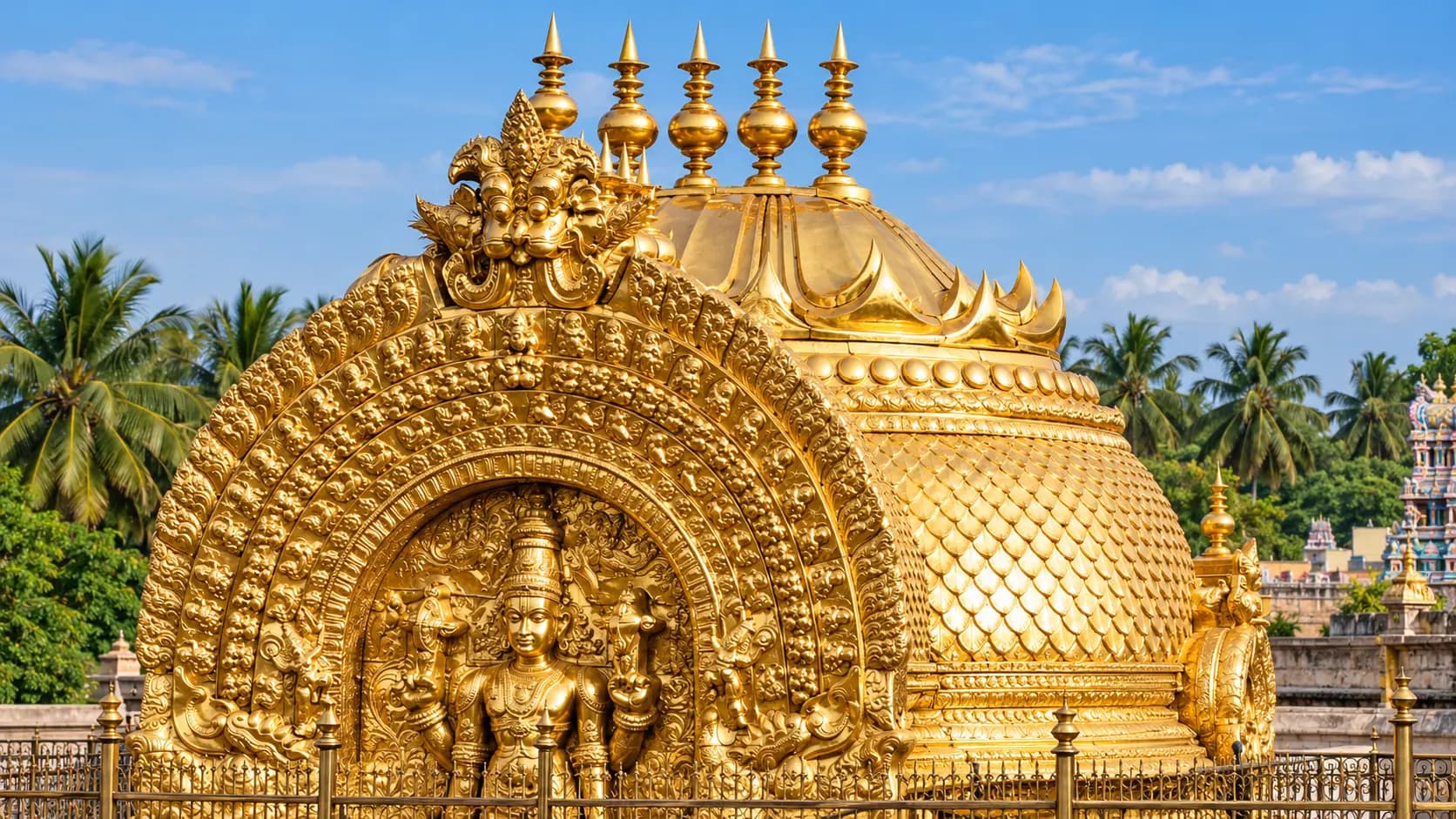
Enshrined within the innermost chamber, beneath the sacred gold-plated oval dome of the Ranga Vimana, lies Lord Vishnu as Sri Ranganatha in his cosmic slumber (Sayanamurti / Anantasayana), reclining serenely upon the five-hooded divine serpent Adisesha. Srirangam was the historical spiritual epicenter where the legendary 11th-century theologian and philosopher-saint Sri Ramanujacharya (1017 - 1137 CE) codified the Vishishtadvaita philosophy and established the ritual traditions that continue to govern the temple today; his preserved physical body (Thirumeni) is venerated in an adjacent temple shrine. In recognition of the monumental community-driven restoration of its ancient tanks, painted ceilings, and stone mandapas, Srirangam was awarded the prestigious UNESCO Asia-Pacific Award of Distinction for Cultural Heritage Conservation in November 2017, affirming its place as a supreme masterpiece of living world heritage.
Start here. Open a tile for the full details.
Why goRead details
- The World's Largest Living Temple Complex: Covering 156 acres, Srirangam's sheer scale is staggering. Exploring its seven concentric enclosures, 21 soaring gopurams, 50 subsidiary shrines, 9 sacred water tanks (pushkarinis), and dozens of vast stone pillared halls is an architectural and cultural journey without equal on earth.
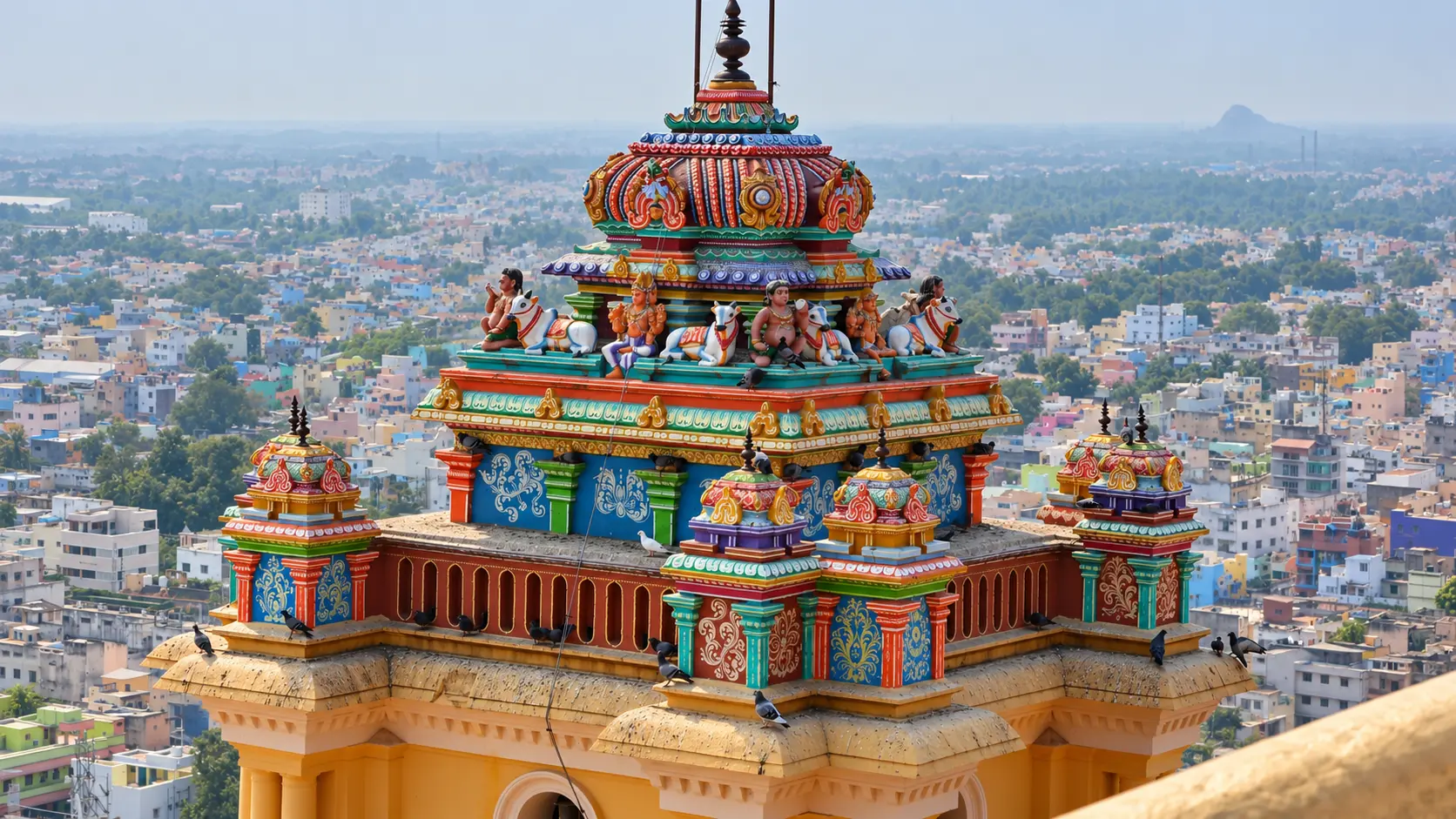
- The Soaring 73-Metre Rajagopuram: Dominating the southern skyline of Tiruchirappalli, the temple's southern gateway - the Rajagopuram - rises to an awe-inspiring height of 73 metres (239.5 feet) across 13 diminishing tiers. Consecrated in 1987 under the guidance of the 44th Jeeyar of Sri Ahobila Matha, it is one of the tallest religious towers in Asia, covered with thousands of brightly painted stucco sculptures depicting scenes from the Puranas.
- Masterpiece of Living Vaishnava Culture: Srirangam is not an archaeological relic; it is a throbbing, vibrant spiritual organism. Experience ancient temple rituals executed with absolute fidelity to centuries-old scriptures: the sound of Vedic recitations, the chanting of the Nalayira Divya Prabandham by temple priests in white silk, hereditary temple elephants offering blessings, and temple pipers playing ancient ragas.
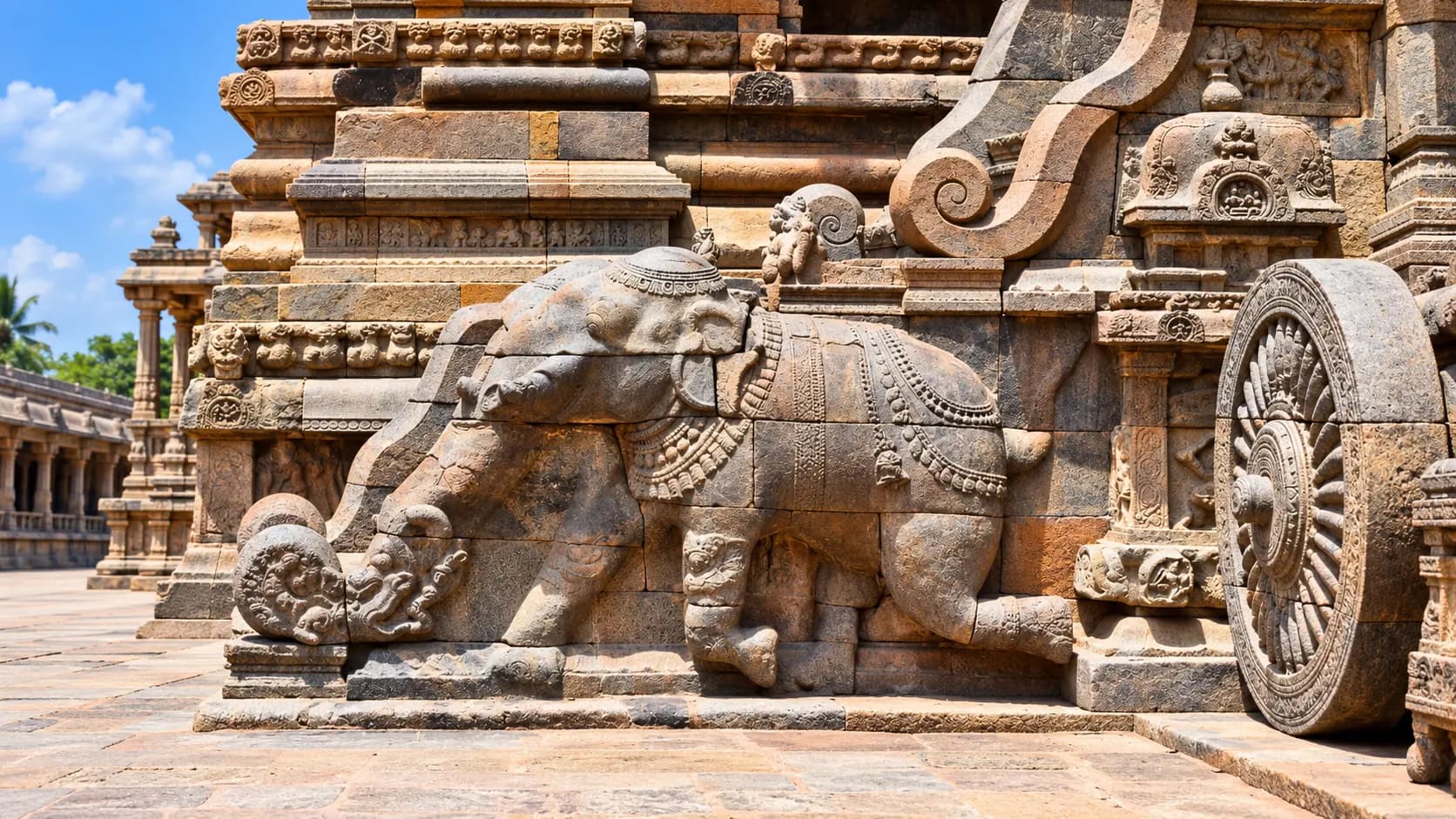
- The Fabled Sesharayar Mandapam & Thousand-Pillared Hall: Art lovers marvel at the Sesharayar Mandapam, whose monolithic pillars feature world-famous Nayaka-period sculptures of rearing battle horses and roaring yalis trampling foreign warriors in astonishing dynamic detail. Nearby, the monumental Thousand-Pillared Hall features 953 carved granite columns, transformed during the annual Vaikunta Ekadasi into a celestial court for the Lord.
- Shrine of Sri Ramanujacharya: Srirangam is home to the extraordinary shrine containing the embalmed physical form (Thirumeni) of the great philosopher Sri Ramanujacharya, who lived here for decades. Preserved in a seated meditative padmasana posture using natural camphor and saffron paste for over 900 years, it is a deeply revered pilgrimage site.
- Rooftop Panoramic Viewpoint: Visitors can purchase a nominal ticket to ascend to the open terrace above the fifth enclosure. From this elevated vantage point, you enjoy an unforgettable panorama looking across the sea of granite gopurams, the gleaming gold Ranga Vimana, the lush coconut canopy of Srirangam island, and the sparkling blue waters of the Cauvery River.
When to visitRead details
Visiting Srirangam requires navigating both regional climate and the intense festival calendar of Tamil Nadu:
Entry & permissionsRead details
Fees, visiting hours and entry rules may change. Confirm the latest details with the official operator or local authority before travelling.
- Temple Opening and Darshan Timings: The temple complex opens at 06:00 AM and closes at 21:00 PM daily, operating across four designated darshan windows:
- Viswaroopa Seva: 06:00 to 07:15 AM
- Morning Free & Special Darshan: 09:00 to 12:00 PM
- Afternoon Free & Special Darshan: 13:15 to 18:00 PM
- Evening Free & Special Darshan: 18:45 to 21:00 PM
- The sanctum is closed for deity food offerings (naivedyam) and daily rituals between 07:15-09:00 AM, 12:00-13:15 PM, and 18:00-18:45 PM.
- Darshan Tariffs:
- General Free Darshan: Free entry for all devotees (queuing time: 1 to 3 hours depending on crowds).
- Special Entry Darshan: ₹50 per person (shorter queue).
- Quick / Priority Darshan: ₹250 per person (fastest access to the inner sanctum).
- Viswaroopa Seva Ticket: ₹100 per person.
- Viewpoint Rooftop Ticket: Nominal fee of ₹20 per person to climb up to the rooftop terrace above the fifth enclosure for panoramic views of the gopurams and golden vimana.
- Dress Code Requirements: Strict traditional Hindu attire is enforced at Srirangam. Men must wear traditional dhotis, pyjamas, or formal trousers with shirts (dhotis are mandatory inside the inner sanctum; shirts may need to be removed as per local priest directives during special pujas). Women must wear sarees, half-sarees, or churidars/salwar kameez with dupattas. Shorts, Bermudas, sleeveless tops, tight jeans, and mini-skirts are strictly forbidden.
- Sanctum Entry Policy: In accordance with long-standing religious customs, only practicing Hindus are permitted to enter the innermost sanctum sanctorum (beyond the fifth enclosure). Non-Hindu visitors and international tourists are warmly welcomed to explore the outer four enclosures, the Thousand-Pillared Hall, Sesharayar Mandapam, the museum, and the rooftop viewpoint.
- Electronic Devices: Mobile phones, digital cameras, and smartwatches are strictly banned inside the inner sanctum enclosures. Free electronic locker counters are available outside the inner gopuram where visitors can safely deposit their phones. Drones are strictly banned throughout the temple precinct.
Plan your visitRead details
Srirangam Temple is situated on Srirangam Island, approximately 9 kilometres north of Tiruchirappalli Junction Railway Station and 15 kilometres from Trichy International Airport.
Explore the full guide - choose a topic below.
Why visit?
The World's Largest Living Temple Complex: Covering 156 acres, Srirangam's sheer scale is staggering.Explore detailsClose details
- The World's Largest Living Temple Complex: Covering 156 acres, Srirangam's sheer scale is staggering. Exploring its seven concentric enclosures, 21 soaring gopurams, 50 subsidiary shrines, 9 sacred water tanks (pushkarinis), and dozens of vast stone pillared halls is an architectural and cultural journey without equal on earth.
- The Soaring 73-Metre Rajagopuram: Dominating the southern skyline of Tiruchirappalli, the temple's southern gateway - the Rajagopuram - rises to an awe-inspiring height of 73 metres (239.5 feet) across 13 diminishing tiers. Consecrated in 1987 under the guidance of the 44th Jeeyar of Sri Ahobila Matha, it is one of the tallest religious towers in Asia, covered with thousands of brightly painted stucco sculptures depicting scenes from the Puranas.
- Masterpiece of Living Vaishnava Culture: Srirangam is not an archaeological relic; it is a throbbing, vibrant spiritual organism. Experience ancient temple rituals executed with absolute fidelity to centuries-old scriptures: the sound of Vedic recitations, the chanting of the Nalayira Divya Prabandham by temple priests in white silk, hereditary temple elephants offering blessings, and temple pipers playing ancient ragas.
- The Fabled Sesharayar Mandapam & Thousand-Pillared Hall: Art lovers marvel at the Sesharayar Mandapam, whose monolithic pillars feature world-famous Nayaka-period sculptures of rearing battle horses and roaring yalis trampling foreign warriors in astonishing dynamic detail. Nearby, the monumental Thousand-Pillared Hall features 953 carved granite columns, transformed during the annual Vaikunta Ekadasi into a celestial court for the Lord.
- Shrine of Sri Ramanujacharya: Srirangam is home to the extraordinary shrine containing the embalmed physical form (Thirumeni) of the great philosopher Sri Ramanujacharya, who lived here for decades. Preserved in a seated meditative padmasana posture using natural camphor and saffron paste for over 900 years, it is a deeply revered pilgrimage site.
- Rooftop Panoramic Viewpoint: Visitors can purchase a nominal ticket to ascend to the open terrace above the fifth enclosure. From this elevated vantage point, you enjoy an unforgettable panorama looking across the sea of granite gopurams, the gleaming gold Ranga Vimana, the lush coconut canopy of Srirangam island, and the sparkling blue waters of the Cauvery River.
What to expect
Visiting Srirangam is an immersive, multi-hour expedition through a living sacred city.Explore detailsClose details
Visiting Srirangam is an immersive, multi-hour expedition through a living sacred city. Entering through the colossal Rajagopuram, visitors initially find themselves on wide municipal streets lined with traditional tiled-roof row houses (agraharams), brassware shops, flower vendors weaving fragrant jasmine and tulsi garlands, and shops selling traditional South Indian delicacies like Srirangam puliyodarai (tamarind rice) and pure ghee sweets.
As you pass through successive inner gopurams, the residential town recedes and the sacred temple environment takes over. Non-Hindus and tourists are welcome to explore up to the fourth and fifth enclosures, where the grand administrative halls, the museum, the temple elephant stables, the Chandra Pushkarini tank, and the famous Sesharayar Mandapam are located. The stonework here is monumental; massive granite beams and ceilings carved with lotus medallions are supported by rows of ornate pillars depicting the avatars of Vishnu.
Beyond the fifth enclosure, visitors enter the strictly consecrated inner sanctum zones (accessible to practicing Hindu pilgrims). Shoes must be deposited at the outer stands. The interior becomes progressively cooler, quieter, and darker, lit by flickering bronze oil lamps. devouts move through wide, echoing circumambulatory corridors, chanting holy names as they queue for the main darshan.
Reaching the threshold of the innermost sanctum sanctorum (Karuvarai), the atmosphere is charged with intense spiritual emotion. Inside the chamber, illuminated by lamps fed with pure cow's ghee, lies the colossal, 21-foot-long black stone idol of Sri Ranganatha, reclining in serene repose upon the coils of the five-headed divine serpent Adisesha. The Lord's right hand rests near his crowned head, while his left hand rests along his body pointing toward his lotus feet. Devotees receive the sacred teertham (holy water), fragrant tulsi leaves, and the Satari (the golden crown representing the Lord's feet) placed on their heads by the temple priests.
Best time to visit
Visiting Srirangam requires navigating both regional climate and the intense festival calendar of Tamil Nadu: -…Explore detailsClose details
Visiting Srirangam requires navigating both regional climate and the intense festival calendar of Tamil Nadu:
- October to March (Winter & Post-Monsoon - Ideal Visiting Season): This is the most pleasant and comfortable time to visit. Temperatures range from 22°C to 30°C, and cool breezes blow across the river island from the Cauvery. Walking through the extensive stone courtyards is comfortable, and skies are predominantly clear.
- The Grand Vaikunta Ekadasi Festival (December - January): Srirangam's most famous celebration lasts for 21 days (divided into Pagal Pathu and Raa Pathu). On the sacred morning of Vaikunta Ekadasi, the Paramapada Vasal (Gateway to Heaven) is opened, and the processional deity (Namperumal) is carried out amidst hundreds of thousands of ecstatic pilgrims. While spiritually exhilarating, crowd volumes exceed 100,000 visitors daily; extensive queuing (taking 6 to 12 hours) and massive congestion require careful advance planning.
- April to June (Summer Season - Extreme Heat): Summer in the Trichy delta is intensely hot and humid, with temperatures reaching 38°C to 42°C. The stone slabs inside the courtyards absorb heat, and queuing in un-airconditioned halls can be physically taxing. Early morning visits (06:00 to 08:30 AM) or evening visits after 17:00 PM are essential.
- Optimal Time of Day for Darshan:
- Early Morning Viswaroopa Seva (06:00 to 07:15 AM): Check the current visiting hours and permitted access with the site operator before departure; ceremonies, closures and visitor sessions can affect access.
- Late Afternoon / Evening (16:00 to 19:30 PM): Check the current visiting hours and permitted access with the site operator before departure; ceremonies, closures and visitor sessions can affect access.
How to reach
Srirangam Temple is situated on Srirangam Island, approximately 9 kilometres north of Tiruchirappalli Junction…Explore detailsClose details
Srirangam Temple is situated on Srirangam Island, approximately 9 kilometres north of Tiruchirappalli Junction Railway Station and 15 kilometres from Trichy International Airport.
- From Tiruchirappalli Junction Railway Station (9 km): Trichy Junction (TPJ) is connected to all major cities in India by daily superfast and express trains. City buses (Route 1 series: 1, 1A, 1B, 1C) run continuously from the junction bus stand directly to Srirangam Temple every 2 to 3 minutes. Prepaid taxis and auto-rickshaws take approximately 20 to 25 minutes via the Cauvery Bridge.
- From Srirangam Railway Station (1 km): Srirangam has its own passenger and express railway station (SRGM) on the Chennai-Trichy chord line. Several daily express trains (including the Pallavan Express, Rockfort Express, and Vaigai Express) stop here. From the station, auto-rickshaws reach the temple in less than 5 minutes.
- From Tiruchirappalli International Airport (15 km): Trichy Airport (TRZ) operates direct international flights to Southeast Asia and the Middle East, plus domestic connections to Chennai and Bengaluru. Taxis take roughly 30 to 40 minutes to reach Srirangam island.
- From Trichy Central Bus Stand (9 km): Direct city buses operate round-the-clock connecting Central Bus Stand to Srirangam.
- Private Vehicles and Parking: Vehicles can approach the temple via the wide Gandhi Road leading up to the southern Rajagopuram. Dedicated multi-acre municipal parking lots are available near the Rajagopuram and the northern Kollidam gate, equipped to handle hundreds of tourist cars, vans, and buses.
Entry, timings and permissions
Fees, visiting hours and entry rules may change.Explore detailsClose details
Fees, visiting hours and entry rules may change. Confirm the latest details with the official operator or local authority before travelling.
- Temple Opening and Darshan Timings: The temple complex opens at 06:00 AM and closes at 21:00 PM daily, operating across four designated darshan windows:
- Viswaroopa Seva: 06:00 to 07:15 AM
- Morning Free & Special Darshan: 09:00 to 12:00 PM
- Afternoon Free & Special Darshan: 13:15 to 18:00 PM
- Evening Free & Special Darshan: 18:45 to 21:00 PM
- The sanctum is closed for deity food offerings (naivedyam) and daily rituals between 07:15-09:00 AM, 12:00-13:15 PM, and 18:00-18:45 PM.
- Darshan Tariffs:
- General Free Darshan: Free entry for all devotees (queuing time: 1 to 3 hours depending on crowds).
- Special Entry Darshan: ₹50 per person (shorter queue).
- Quick / Priority Darshan: ₹250 per person (fastest access to the inner sanctum).
- Viswaroopa Seva Ticket: ₹100 per person.
- Viewpoint Rooftop Ticket: Nominal fee of ₹20 per person to climb up to the rooftop terrace above the fifth enclosure for panoramic views of the gopurams and golden vimana.
- Dress Code Requirements: Strict traditional Hindu attire is enforced at Srirangam. Men must wear traditional dhotis, pyjamas, or formal trousers with shirts (dhotis are mandatory inside the inner sanctum; shirts may need to be removed as per local priest directives during special pujas). Women must wear sarees, half-sarees, or churidars/salwar kameez with dupattas. Shorts, Bermudas, sleeveless tops, tight jeans, and mini-skirts are strictly forbidden.
- Sanctum Entry Policy: In accordance with long-standing religious customs, only practicing Hindus are permitted to enter the innermost sanctum sanctorum (beyond the fifth enclosure). Non-Hindu visitors and international tourists are warmly welcomed to explore the outer four enclosures, the Thousand-Pillared Hall, Sesharayar Mandapam, the museum, and the rooftop viewpoint.
- Electronic Devices: Mobile phones, digital cameras, and smartwatches are strictly banned inside the inner sanctum enclosures. Free electronic locker counters are available outside the inner gopuram where visitors can safely deposit their phones. Drones are strictly banned throughout the temple precinct.
Nearby places to consider
Jambukeswarar Temple, Thiruvanaikaval (2.5 km): Located on the same river island, this celebrated temple…Explore detailsClose details
- Jambukeswarar Temple, Thiruvanaikaval (2.5 km): Located on the same river island, this celebrated temple represents the water element (Appu Lingam) among the Pancha Bhoota Sthalas, featuring a natural underground spring that perpetually bubbles up in the sanctum.
- Rock Fort Temple, Trichy (5 km): The ancient 3.8-billion-year-old rock citadel crowned by the Ucchi Pillayar Temple, reached via 437 stone steps offering panoramic views.
- Samayapuram Mariamman Temple (12 km): One of Tamil Nadu's most powerful and heavily visited Shakti shrines, dedicated to Goddess Mariamman.
- Kallanai Dam / Grand Anicut (18 km): The historic stone weir built across the Cauvery River by Chola King Karikalan in the 2nd century CE, recognized as one of the world's oldest active irrigation structures.
- Mukkombu / Upper Anicut (15 km): A picturesque picnic spot where the Cauvery River officially splits into two channels, featuring lush gardens, boat rides, and fishing spots.
In pictures
The practical bits
Before you go.
Allocate Sufficient Time for the 156-Acre Scale
Do not treat Srirangam as a brief sightseeing stop.Explore detailsClose details
Do not treat Srirangam as a brief sightseeing stop. To comfortably appreciate the monumental architecture, visit the Sesharayar Mandapam and Thousand-Pillared Hall, climb to the rooftop viewpoint, and complete sanctum darshan, you must budget at least 3 to 4 hours.
Utilize the Special Darshan Queues
Confirm the current charge and what it includes with the operator or service provider.Explore detailsClose details
Confirm the current charge and what it includes with the operator or service provider. Visitor admission, vehicles, parking, activities and accommodation can have separate charges.
Climb to the Rooftop View Deck
Confirm the current charge and what it includes with the operator or service provider.Explore detailsClose details
Confirm the current charge and what it includes with the operator or service provider. Visitor admission, vehicles, parking, activities and accommodation can have separate charges. The view looking down upon the golden dome of the Ranga Vimana surrounded by 21 towering painted gopurams rising out of the palm groves is one of the most magnificent sights in South Asia.
Savor Authentic Temple Prasadam
Before leaving, visit the temple prasadam counters located near the Garuda Mandapam.Explore detailsClose details
Before leaving, visit the temple prasadam counters located near the Garuda Mandapam. Do not miss tasting Srirangam's world-famous puliyodarai (tangy tamarind rice seasoned with black pepper, mustard, curry leaves, and roasted peanuts), hot sweet sakkarai pongal, and crispy vadais prepared using ancient Chola recipes in the temple's massive wood-fired kitchens.
A few things you might wonder
Common questions about visiting Srirangam Temple (Sri Ranganathaswamy). Fees, visiting hours and ceremonies are researched details that may change; confirm current arrangements with the operator before travelling.
Why is Srirangam Temple considered the largest temple in the world?
What is the height of the Rajagopuram at Srirangam?
Can non-Hindus visit Srirangam Temple?
What is the dress code for Srirangam Temple?
Who is the deity worshipped at Srirangam Temple?
What is the significance of the Sesharayar Mandapam?
How do I get quick darshan at Srirangam?
Are mobile phones allowed inside Srirangam Temple?
Explore more in Thanjavur Trichy
Discover other destinations around this hub
More Hubs in Tamil Nadu
Continue exploring other travel hubs in this state
Planning a trip to Thanjavur Trichy?