Brihadeeswara Temple
Comprehensive visitor guide to the UNESCO-listed Brihadeeswara Temple (Big Temple) in Thanjavur. Discover Chola history, 66m vimana, monolithic Nandi & timings.
Location
Thanjavur & Trichy, Tamil Nadu
A closer look
Your visit, at a glance.
Thanjavur Trichy, Tamil Nadu
GET TO KNOW THE PLACE
Rising like a granite mountain above the lush rice paddies and historic canals of Thanjavur in Tamil Nadu, the Brihadeeswara Temple - revered across the Tamil realm as Thanjai…
The story of Brihadeeswara Temple
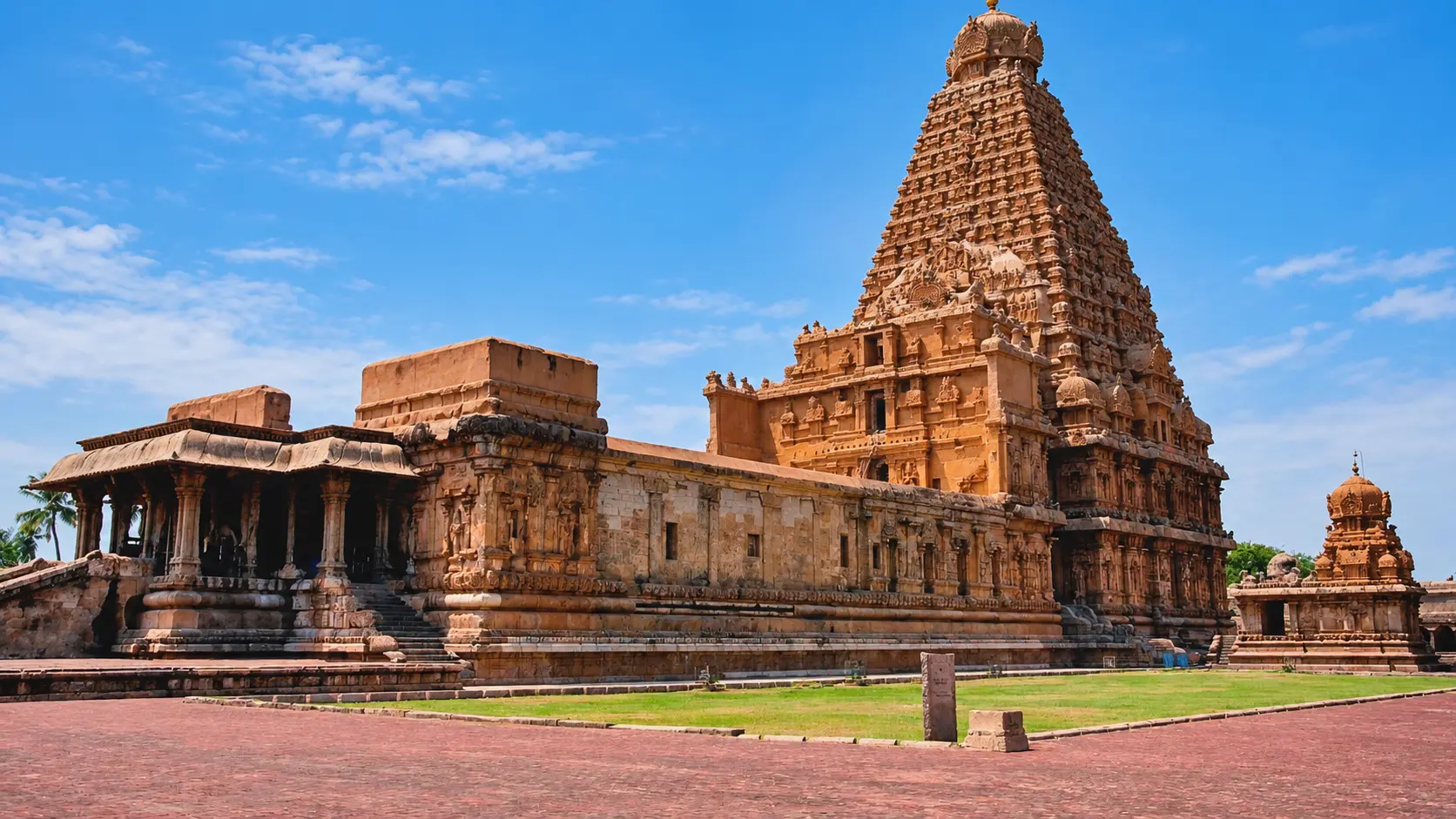
Rising like a granite mountain above the lush rice paddies and historic canals of Thanjavur in Tamil Nadu, the Brihadeeswara Temple - revered across the Tamil realm as Thanjai Periya Kovil (The Big Temple) and known in imperial copper plates as Rajarajeswaram - is indisputably one of the crowning triumphs of world architecture. Consecrated in 1010 CE during the 25th regnal year of Emperor Rajaraja Chola I, this monument celebrated its millennial (1,000-year) anniversary in September 2010. Inscribed on the UNESCO World Heritage List in 1987 as the foundational masterpiece of the "Great Living Chola Temples", Brihadeeswara remains an active spiritual sanctuary and an awe-inspiring testament to the imperial grandeur, engineering audacity, and artistic brilliance of the medieval Chola Empire.
The sheer scale and daring engineering of Brihadeeswara Temple continue to baffle modern architects. Unlike later South Indian temples where the inner shrines are small and overshadowed by towering perimeter gateway towers (gopurams), Rajaraja I flipped the architectural hierarchy: he placed the supreme monumentality directly over the sanctum sanctorum. The pyramidal vimana (tower) rises through 16 stepped storeys to a dizzying height of 66 metres (216 feet), making it one of the tallest stone towers constructed anywhere on earth during the Middle Ages. Resting dramatically at the very apex of this soaring pyramid is the shikhara (kumbam), an octagonal monolithic bulbous dome carved from a single colossal block of crystalline granite weighing an estimated 80 to 81.2 metric tons.
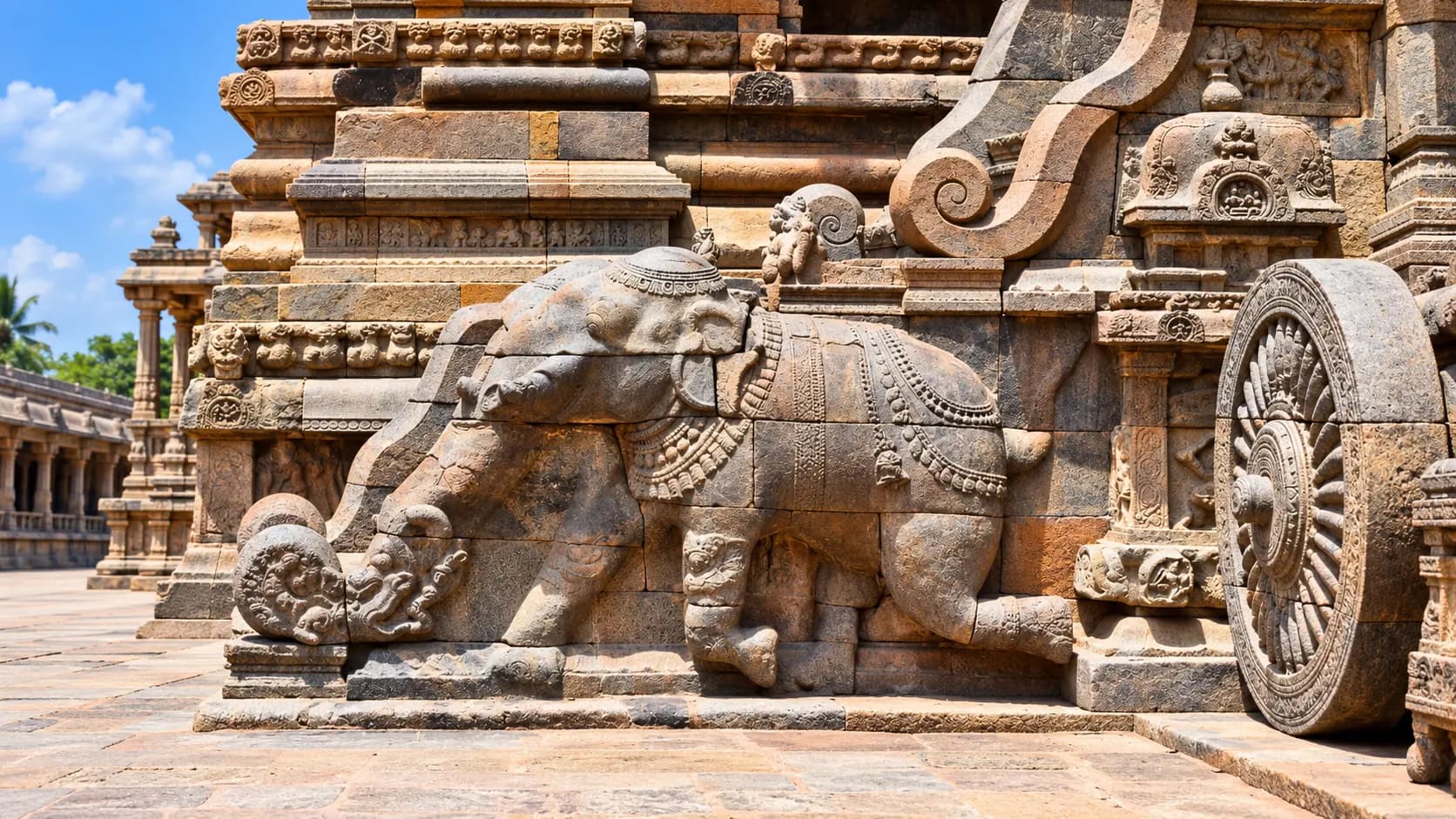
What elevates this accomplishment into the realm of the miraculous is the geological context of the Thanjavur region. Situated in the flat, alluvial delta of the Cauvery River, there are no natural granite outcrops or rocky hills within a 50-kilometre radius of Thanjavur. To construct this monument, over 130,000 metric tons of hard granite had to be quarried from distant rock formations near Tiruchirappalli and Pudukkottai, floated down waterways on heavy timber barges, dragged on wooden rollers by royal war elephants, and carved with chisels without modern steel or explosives. Assembled using dry interlocked stone masonry without mortar, and adorned with thousands of lines of pristine Tamil inscriptions, giant monolithic statues, and 11th-century fresco masterpieces, Brihadeeswara Temple stands as an eternal monument to human ingenuity and cosmic devotion.
Start here. Open a tile for the full details.
Why goRead details
- Supreme UNESCO World Heritage Monument: The Big Temple is recognized globally as the paramount architectural benchmark of the Dravidian style. Its balanced proportions, breathtaking verticality, and monumental granite construction make it one of the most celebrated cultural landmarks in all of Asia.
- The 80-Tonne Monolithic Capstone: Seeing the apex shikhara perched 66 metres in the sky is an unforgettable experience. Standing beneath the tower and contemplating the engineering feat of hauling an 80-ton block of granite up a 4-to-6-kilometre inclined earthen ramp (sarapallam) built through the surrounding villages in 1010 CE is humbling.
- The Great Monolithic Nandi: Housed in a grand, pillared Nayaka-period open mandapa facing the main sanctum is one of India's largest monolithic sculptures of Nandi, the sacred bull of Shiva. Carved from a single massive block of dark stone, it measures 6.0 metres (20 feet) in length, 2.6 metres in width, and 3.7 metres (12 feet) in height, weighing approximately 25 tons.
- The Colossal Sanctum Shiva Lingam: Inside the atmospheric, incense-filled garbhagriha stands the towering granite Lingam, known as Peruvudaiyar. Standing 3.7 metres (12 feet) tall upon an enormous circular pedestal (avudaiyar) with a circumference of over 16 metres (54 feet), it is one of the largest monoliths of Shiva ever consecrated.
- Invaluable Epigraphical & Mural Heritage: The entire granite basement plinth of the temple is etched with thousands of lines of flowing Chola Tamil inscriptions. These public records detail the royal treasury, military campaigns, endowments of gold and jewelry, names of 400 temple dancers (devaradiyar), musicians, astrologers, accountants, and even the names of master bronze artisans who cast the iconic Nataraja bronzes. In the inner passage, hidden 11th-century Chola frescoes reveal royal portraits of Rajaraja I and dynamic depictions of Shiva as Tripurantaka.
When to visitRead details
Visiting Thanjavur requires careful timing due to the intense tropical heat of the southern delta plains:
Entry & permissionsRead details
Fees, visiting hours and entry rules may change. Confirm the latest details with the official operator or local authority before travelling.
- Operating Hours: The temple premises and sanctum are open daily across two main liturgical sessions:
- Morning Session: 06:00 to 12:30
- Evening Session: 16:00 to 21:00
- The sanctum sanctorum closes strictly at 12:30 PM for midday cleaning and deity rest, reopening at 16:00 PM. The outer courtyard and peripheral gardens occasionally remain accessible for walking during midday hours, though visitors cannot enter the sanctum.
- Daily Puja Timings: Six regular pujas (Aru Kala Pooja) are performed daily, with major aarti rituals conducted during Ushakkalam (06:30 AM), Uchikkalam (12:00 PM), Sayarakshai (18:00 PM), and Arthajamam (20:30 PM). Special abhishekam rituals are performed for the giant Nandi on Pradosham days (twice a month) attracting thousands of devotees.
- Admission Charges: Admission to Brihadeeswara Temple is completely free for all domestic and foreign travelers. There are no entry fees.
- Photography Regulations: Casual photography using smartphones and handheld still cameras is permitted free of charge across the outer courtyard, pillared cloister, and around the vimana. However, all photography and video recording are strictly prohibited inside the inner sanctum sanctorum (garbhagriha).
- Drone Regulations: Flying drones or unmanned aerial vehicles (UAVs) is strictly illegal over and around Brihadeeswara Temple, as it is a Centrally Protected Monument under the Ancient Monuments and Archaeological Sites and Remains Act. Violators face immediate equipment confiscation and criminal prosecution by the ASI and local police.
Plan your visitRead details
Brihadeeswara Temple is centrally located in Thanjavur city, positioned immediately west of the Old Bus Stand and approximately 2.5 kilometres from the main railway junction.
Explore the full guide - choose a topic below.
Why visit?
Supreme UNESCO World Heritage Monument: The Big Temple is recognized globally as the paramount architectural…Explore detailsClose details
- Supreme UNESCO World Heritage Monument: The Big Temple is recognized globally as the paramount architectural benchmark of the Dravidian style. Its balanced proportions, breathtaking verticality, and monumental granite construction make it one of the most celebrated cultural landmarks in all of Asia.
- The 80-Tonne Monolithic Capstone: Seeing the apex shikhara perched 66 metres in the sky is an unforgettable experience. Standing beneath the tower and contemplating the engineering feat of hauling an 80-ton block of granite up a 4-to-6-kilometre inclined earthen ramp (sarapallam) built through the surrounding villages in 1010 CE is humbling.
- The Great Monolithic Nandi: Housed in a grand, pillared Nayaka-period open mandapa facing the main sanctum is one of India's largest monolithic sculptures of Nandi, the sacred bull of Shiva. Carved from a single massive block of dark stone, it measures 6.0 metres (20 feet) in length, 2.6 metres in width, and 3.7 metres (12 feet) in height, weighing approximately 25 tons.
- The Colossal Sanctum Shiva Lingam: Inside the atmospheric, incense-filled garbhagriha stands the towering granite Lingam, known as Peruvudaiyar. Standing 3.7 metres (12 feet) tall upon an enormous circular pedestal (avudaiyar) with a circumference of over 16 metres (54 feet), it is one of the largest monoliths of Shiva ever consecrated.
- Invaluable Epigraphical & Mural Heritage: The entire granite basement plinth of the temple is etched with thousands of lines of flowing Chola Tamil inscriptions. These public records detail the royal treasury, military campaigns, endowments of gold and jewelry, names of 400 temple dancers (devaradiyar), musicians, astrologers, accountants, and even the names of master bronze artisans who cast the iconic Nataraja bronzes. In the inner passage, hidden 11th-century Chola frescoes reveal royal portraits of Rajaraja I and dynamic depictions of Shiva as Tripurantaka.
What to expect
Approaching Brihadeeswara Temple, visitors first pass through the outer red-brick battlements and deep moat of…Explore detailsClose details
Approaching Brihadeeswara Temple, visitors first pass through the outer red-brick battlements and deep moat of the Sivaganga Little Fort, constructed centuries later during the Nayaka and Maratha periods. Stepping through the massive outer gate, travelers encounter two successive historic Chola gateway towers: the five-storey Keralantakan Gopuram (commemorating Rajaraja's conquest of the Chera king of Kerala) and the inner Rajarajan Gopuram, flanked by colossal stone dwarapalakas (guardian deities) carved with terrifying fangs and dynamic poses.
Crossing the inner threshold, visitors emerge into an enormous rectangular courtyard measuring an expansive 240 metres by 120 metres (approx. 787 feet by 393 feet). The sheer openness and grandeur of the space take the breath away. The soaring central granite temple stretches longitudinally across the centre, while the perimeter is enclosed by a covered cloistered colonnade (tiruchurrumandapam) lined with 108 stone Shiva Lingams and exquisite Nayaka wall murals.
Before stepping onto the central granite plinth, visitors deposit their footwear at the municipal counter outside the gopuram. Walking along the courtyard, a grand flight of wide stone stairs leads up to the Mukhamandapa and Ardhamandapa, where devotees queue for darshan of the great Lingam. The interior is cool, dark, and fragrant with camphor, oil lamps, and crushed jasmine garlands. Chants of Om Namah Shivaya reverberate through the massive stone halls as hereditary temple priests conduct the sacred shodashopachara pujas.
Outside the main sanctum, visitors can explore exceptional subsidiary shrines that were added by subsequent dynasties without compromising the Chola core. These include the magnificent Subrahmanya Shrine, built by the Nayakas in the 17th century with stone filigree carving of such precision that European traveler James Fergusson described it as "a perfect gem of carved stone architecture"; the Brihannayaki Amman Shrine added by the Pandyas in the 13th century; and the Chandikesvara Shrine, an original 11th-century Chola gem.
Best time to visit
Visiting Thanjavur requires careful timing due to the intense tropical heat of the southern delta plains: -…Explore detailsClose details
Visiting Thanjavur requires careful timing due to the intense tropical heat of the southern delta plains:
- October to March (Post-Monsoon & Winter - Ideal Season): This is universally the finest period to explore the Big Temple. Daytime temperatures are pleasant (22°C to 30°C), skies are clear and blue, and the morning and evening air is comfortable. Crucially, the expansive open granite stone courtyard is comfortable to traverse barefoot throughout most of the day.
- April to June (Summer Season - Extreme Heat): Summer across the Thanjavur plains is fiercely hot, with temperatures frequently climbing between 38°C and 42°C. The bare granite stone courtyard absorbs solar heat intensely; by 11:00 AM, the unshaded flagstones become hot enough to blister bare feet. While temple authorities lay down long runners of burlap coir mats, visitors should bring thick cotton socks and restrict outdoor walking to early mornings or evenings.
- October to December (Northeast Monsoon - Dramatic Skies): The Northeast monsoon brings rejuvenating rains to the Cauvery delta. The deep grey clouds provide a dramatic, moody contrast against the golden-yellow granite vimana, and the temple's ancient Chola storm drainage systems ensure that water drains away rapidly into the Sivaganga tank.
- Optimal Time of Day:
- Early Morning (06:30 to 09:00 AM): Highly recommended for serene spiritual atmosphere, cool stone floors, quiet meditation, and gentle morning sunlight illuminating the eastern facade of the vimana.
- Late Afternoon to Evening (16:30 to 19:30 PM): Exceptional for photography as the setting sun bathes the massive tower in brilliant amber and gold light. At dusk, powerful floodlights illuminate the entire 66-metre vimana against the night sky, creating a truly awe-inspiring spectacle.
How to reach
Brihadeeswara Temple is centrally located in Thanjavur city, positioned immediately west of the Old Bus Stand and…Explore detailsClose details
Brihadeeswara Temple is centrally located in Thanjavur city, positioned immediately west of the Old Bus Stand and approximately 2.5 kilometres from the main railway junction.
- By Train: Thanjavur Junction Railway Station (TJ) is located just 2.5 kilometres from the temple. It is a major railway hub with frequent express and superfast trains connecting directly to Chennai Egmore, Tiruchirappalli, Madurai, Coimbatore, Tirupati, and Bengaluru. Auto-rickshaws and taxis from the station reach the temple gates in under 10 minutes.
- By Air: The nearest airport is Tiruchirappalli International Airport (TRZ), situated approximately 58 kilometres southwest. A smooth drive along the four-lane National Highway 83 connects the airport to Thanjavur in approximately 50 to 60 minutes. Chennai International Airport (MAA) is located roughly 320 kilometres to the north.
- By Road from Trichy (56 km): A modern, four-lane toll expressway (NH 83) links Tiruchirappalli with Thanjavur. State transport express buses operate between Trichy Central Bus Stand and Thanjavur New Bus Stand every 5 to 10 minutes around the clock.
- By Road from Kumbakonam (38 km): State Highway 22 connects Kumbakonam with Thanjavur, passing through Darasuram and Papanasam. Buses run continuously with a transit time of approximately 50 minutes.
- Local City Transit: Inside Thanjavur, frequent town buses connect the New Bus Stand (on the city outskirts) with the Old Bus Stand (adjacent to the temple). Auto-rickshaws are abundant and operate throughout the city.
- Parking Facilities: A spacious municipal parking plaza is situated outside the northern moat area of the Sivaganga Little Fort, accommodating private cars, tempo travelers, and tour buses.
Entry, timings and permissions
Fees, visiting hours and entry rules may change.Explore detailsClose details
Fees, visiting hours and entry rules may change. Confirm the latest details with the official operator or local authority before travelling.
- Operating Hours: The temple premises and sanctum are open daily across two main liturgical sessions:
- Morning Session: 06:00 to 12:30
- Evening Session: 16:00 to 21:00
- The sanctum sanctorum closes strictly at 12:30 PM for midday cleaning and deity rest, reopening at 16:00 PM. The outer courtyard and peripheral gardens occasionally remain accessible for walking during midday hours, though visitors cannot enter the sanctum.
- Daily Puja Timings: Six regular pujas (Aru Kala Pooja) are performed daily, with major aarti rituals conducted during Ushakkalam (06:30 AM), Uchikkalam (12:00 PM), Sayarakshai (18:00 PM), and Arthajamam (20:30 PM). Special abhishekam rituals are performed for the giant Nandi on Pradosham days (twice a month) attracting thousands of devotees.
- Admission Charges: Admission to Brihadeeswara Temple is completely free for all domestic and foreign travelers. There are no entry fees.
- Photography Regulations: Casual photography using smartphones and handheld still cameras is permitted free of charge across the outer courtyard, pillared cloister, and around the vimana. However, all photography and video recording are strictly prohibited inside the inner sanctum sanctorum (garbhagriha).
- Drone Regulations: Flying drones or unmanned aerial vehicles (UAVs) is strictly illegal over and around Brihadeeswara Temple, as it is a Centrally Protected Monument under the Ancient Monuments and Archaeological Sites and Remains Act. Violators face immediate equipment confiscation and criminal prosecution by the ASI and local police.
Nearby places to consider
Thanjavur Maratha Palace Complex (1.5 km): The historic seat of the Nayaka and Maratha rulers, housing the Bell…Explore detailsClose details
- Thanjavur Maratha Palace Complex (1.5 km): The historic seat of the Nayaka and Maratha rulers, housing the Bell Tower, Durbar Hall, and the Royal Art Gallery containing the finest collection of authentic Chola bronze sculptures in the world.
- Saraswathi Mahal Library (1.5 km): One of the oldest and most celebrated libraries in Asia, founded in the 16th century, preserving over 60,000 rare palm-leaf and paper manuscripts in Tamil, Sanskrit, Telugu, and Marathi.
- Sivaganga Tank and Park (Adjacent): Located immediately north of the temple walls, this historic 11th-century water reservoir was built by Rajaraja Chola I to provide fresh water to the temple and township, surrounded by a peaceful recreational park.
- Schwartz Church (1 km): A historic 18th-century Danish Protestant church built by Maratha ruler Serfoji II in honor of his mentor and teacher, the German missionary Rev. Christian Friedrich Schwarz.
- Airavatesvara Temple, Darasuram (36 km): The 12th-century UNESCO World Heritage Chola temple renowned for its delicate stone carvings, chariot-shaped mandapa, and musical steps.
- Gangaikonda Cholapuram (70 km): The majestic second capital temple built by Rajaraja's son and successor, Rajendra Chola I, featuring a gracefully curved 55-metre vimana.
In pictures
The practical bits
Before you go.
Footwear and Socks Strategy
Shoes must be removed before entering through the Rajarajan Gopuram.Explore detailsClose details
Shoes must be removed before entering through the Rajarajan Gopuram. Free and nominal pay-and-use shoe custody counters are situated outside the entrance. If visiting between March and July, the granite stone courtyard absorbs immense heat by mid-morning. Pack a pair of thick, clean cotton socks in your pocket; wearing socks is allowed and will prevent your soles from burning on the unshaded stones.
Allow Ample Time for Details
Do not treat Brihadeeswara as a quick 30-minute photo stop.Explore detailsClose details
Do not treat Brihadeeswara as a quick 30-minute photo stop. The temple requires at least 2 to 2.5 hours to properly appreciate. Walk the full perimeter of the outer cloister to examine the 108 Lingams, study the massive Chola Tamil inscriptions carved along the plinth of the vimana, admire the intricate stone carvings on the Subrahmanya shrine, and observe the scale of the monolithic Nandi.
Attend the Evening Floodlight Illumination
The temple takes on a magical, ethereal quality at nightfall.Explore detailsClose details
The temple takes on a magical, ethereal quality at nightfall. Around 18:30 PM, powerful golden floodlights illuminate the entire 66-metre vimana against the dark sky, highlighting every cornice, niche, and carved figure. Combining a visit in the late afternoon (around 16:30 PM) allows you to see the monument in both natural daylight and dramatic night illumination.
Combine with Thanjavur Royal Palace & Saraswathi Mahal
Located just 1.5 kilometres east of the Big Temple, the Thanjavur Maratha Royal Palace and the world-renowned…Explore detailsClose details
Located just 1.5 kilometres east of the Big Temple, the Thanjavur Maratha Royal Palace and the world-renowned Saraswathi Mahal Library make an ideal midday pairing. Check the current visiting hours and permitted access with the site operator before departure; ceremonies, closures and visitor sessions can affect access.
A few things you might wonder
Common questions about visiting Brihadeeswara Temple. Fees, visiting hours and ceremonies are researched details that may change; confirm current arrangements with the operator before travelling.
Who built the Brihadeeswara Temple and when was it completed?
How was the 80-tonne granite dome lifted to the top of the 66-metre tower?
Is it true that the shadow of the Big Temple vimana never falls on the ground?
Is there an entrance fee to visit Brihadeeswara Temple?
What is the dress code for visitors entering the Big Temple?
What makes the Nandi statue at Thanjavur special?
Where did the granite come from if Thanjavur has no rocks?
Can I take photos inside the temple?
Explore more in Thanjavur Trichy
Discover other destinations around this hub
More Hubs in Tamil Nadu
Continue exploring other travel hubs in this state
Planning a trip to Thanjavur Trichy?