Thirumalai Nayakkar Mahal
Essential visitor guide to Thirumalai Nayakkar Mahal in Madurai, Tamil Nadu. Explore the 1636 CE Indo-Saracenic palace, 20-metre pillars, timings & light show.
Location
Madurai & Rameswaram, Tamil Nadu
A closer look
Your visit, at a glance.
Madurai Rameswaram, Tamil Nadu
GET TO KNOW THE PLACE
Standing as a breathtaking monument to 17th-century regal opulence and cultural syncretism, Thirumalai Nayakkar Mahal is one of the most majestic and visually arresting secular…
The story of Thirumalai Nayakkar Mahal
Standing as a breathtaking monument to 17th-century regal opulence and cultural syncretism, Thirumalai Nayakkar Mahal is one of the most majestic and visually arresting secular heritage buildings in Southern India. Situated along Palace Road in the historic core of Madurai, Tamil Nadu, this magnificent royal palace was constructed in 1636 CE by King Thirumalai Nayak, the most visionary monarch of the Madurai Nayaka dynasty. Commissioned to commemorate the relocation of the royal capital from Tiruchirappalli back to Madurai, the palace was designed as an awe-inspiring royal court that would project the zenith of Nayaka authority, artistic patronage, and wealth.
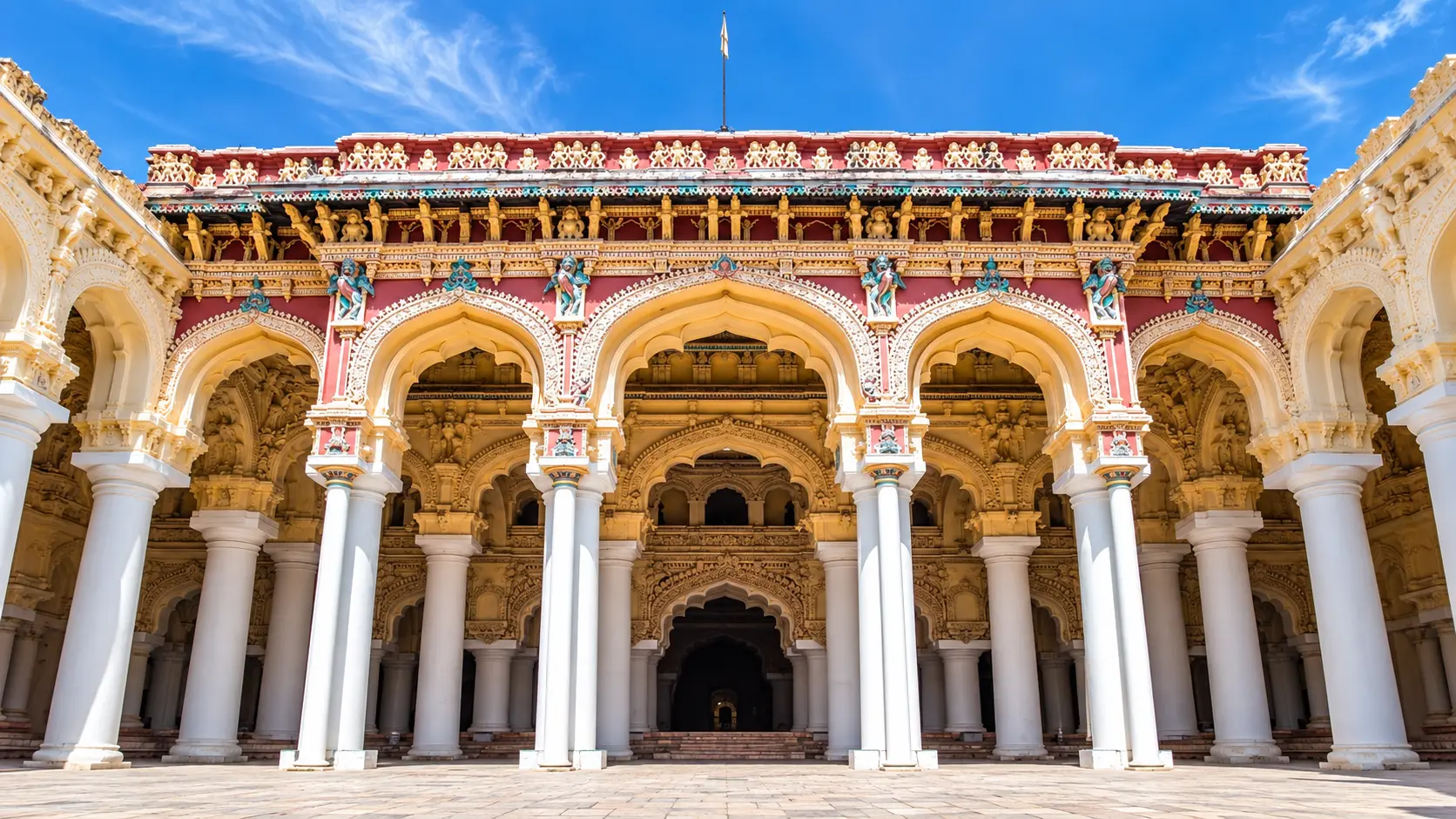
Architecturally, Thirumalai Nayakkar Mahal represents a revolutionary milestone in Indian palace design. Designed with the collaboration of an Italian military engineer and architect, the building is a glorious synthesis of classical Dravidian stone masonry, Islamic Saracenic pointed arches, and European Renaissance barrel vaulting. Its defining feature is a sprawling central courtyard framed by 248 colossal circular pillars soaring 20 metres (up to 82 feet) into the sky, coated in ultra-smooth, gleaming white shell-lime (chunam) plaster that mimics polished Italian marble. Preserved and restored by the Tamil Nadu State Department of Archaeology, the surviving Swarga Vilasam (Celestial Pavilion) enchants daytime architecture enthusiasts and draws evening crowds to its dramatic Sound & Light (Son et Lumière) spectacle, bringing the courtly drama of ancient Tamil history alive under the stars.
Start here. Open a tile for the full details.
Why goRead details
When to visitRead details
- Winter Season (October to March): This is unequivocally the most pleasant season to explore the palace. Daytime temperatures range comfortably between 20°C and 30°C, and evenings are refreshingly cool and breezy. Attending the outdoor evening Sound & Light show in the courtyard is delightful during these winter months, requiring only light clothing.
- Summer Season (April to June): Summer in Madurai is intensely hot, with daytime temperatures regularly climbing past 39°C to 41°C. While the thick masonry and high vaulted ceilings of the palace keep the interior noticeably cooler than the outdoor streets, visiting during the cooler hours - either between 09:00 and 11:30 AM or attending the evening show after sunset - is highly recommended.
- Monsoon Season (October to November): The Northeast Monsoon brings periodic showers to Madurai. The rain-washed white pillars look striking, but evening Sound & Light shows may be delayed or cancelled during sudden outdoor rainstorms.
Entry & permissionsRead details
Fees, visiting hours and entry rules may change. Confirm the latest details with the official operator or local authority before travelling.
Operating Schedule
- Daytime Monument Viewing: Open daily seven days a week from 09:00 to 17:00.
- Mandatory Lunch Closure: The palace is closed daily between 13:00 and 14:00.
- Ticket counter closes at 16:30 for daytime entry.
- Evening Sound & Light Show (Son et Lumière):
- English Show: Daily from 18:45 to 19:35 (Duration: 50 minutes).
- Tamil Show: Daily from 20:00 to 20:50 (Duration: 50 minutes).
- Ticket counter for the evening shows opens at 18:00 at the main gate.
Admission Charges and Tariffs
- Daytime Monument Admission (Department of Archaeology):
- Adult Entry Ticket: ₹10 per person
- Child Entry Ticket (Ages 5 to 12): ₹5 per child
- Children under 5: Free
- Camera Fees (Daytime Only):
- Still Camera / Smartphone: ₹30 per unit
- Video Camera: ₹100 per unit
- Evening Sound & Light Show Tickets:
- Adults: ₹50 per person
- Children: ₹25 per child
- Vehicle Parking Fees:
- Two-Wheelers: ₹10
- Cars / Jeeps: ₹30
- Tourist Vans / Minibuses: ₹50
Photography and Filming Regulations
- Daytime Photography: Non-commercial still photography on smartphones, mirrorless cameras, and DSLRs is permitted during daytime visiting hours (09:00 to 17:00) with a valid ₹30 camera token.
- Sound & Light Show Prohibitions: Photography, flash photography, video recording, and audio recording are strictly prohibited during the evening Sound & Light shows to prevent distracting other audience members and to protect copyrighted audiovisual productions.
- Tripods and Commercial Shoots: Operating tripods, drones, lighting stands, and commercial cinematic cameras is prohibited without prior formal written clearance from the Commissioner, Tamil Nadu State Department of Archaeology, Chennai.
Plan your visitRead details
Explore the full guide - choose a topic below.
Why visit?
While South India is internationally celebrated for its towering granite temple gopurams, secular royal…Explore detailsClose details
A Rare Fusion of Dravidian, Islamic, and Renaissance Architecture
While South India is internationally celebrated for its towering granite temple gopurams, secular royal architecture of the pre-colonial era is exceptionally rare. Thirumalai Nayakkar Mahal is the supreme surviving example of the 17th-century South Indian royal palace tradition. Rejecting rigid stylistic boundaries, King Thirumalai Nayak blended Dravidian decorative motifs (such as roaring Yali gargoyles and lotus medallions) with elegant Islamic multifold foliated arches and grand Italian Renaissance vaulted ceilings. The central throne room (Swarga Vilasam) is crowned by a magnificent ribbed octagonal dome that rises to an astonishing height without any central supporting pillars - a daring structural feat for its era that showcased advanced geometric engineering.
The Colossal Colonnades and Chunam Plasterwork
The visual hallmark of the palace is its scale. Walking into the central courtyard, visitors are immediately humbled by the sheer size of the columns. The palace features 248 massive cylindrical pillars, each rising up to 20 metres (approx. 65 to 82 feet) in height with a girth of 4 metres (13 feet). Rather than carving these giants out of solid granite, Nayaka master masons constructed them from layered burnt-clay bricks and lime mortar, finishing them with a legendary traditional Indian plastering technique called chunam. Made from slaked lime mixed with ground sea shells, egg whites, and plant resin, the surface was polished with agate stones until it achieved a mirror-like, snow-white finish indistinguishable from polished Carrara marble. Even today, the gleaming colonnades evoke the grandeur of ancient Rome set amidst the tropical warmth of Tamil Nadu.
Surviving Splendour of the Swarga Vilasam
Historical chronicles and Jesuit travelogues reveal that the original 17th-century palace complex was four times larger than what stands today, divided into two primary zones: the Swarga Vilasam (Palace of Heaven / Celestial Pavilion) and the Ranga Vilasam (the royal residential and theater quarter). While parts of the palace were tragically dismantled in later decades by Thirumalai Nayak’s grandson King Chokkanatha Nayak to build a competing palace in Tiruchirappalli, the surviving Swarga Vilasam encapsulates the public grandeur of the Nayaka court. It houses the vast Natakasala (Dance Hall / Performance Pavilion), measuring an enormous 4,000 square metres, the elevated throne platform where Thirumalai Nayak granted audience to foreign ambassadors, and the royal music galleries where court musicians played classical Carnatic ragas.
The Evening Sound & Light Show (Son et Lumière)
Every evening as twilight descends over Madurai, the palace courtyard transforms into an open-air theatrical arena for the celebrated Sound & Light Show. Using state-of-the-art multi-colored architectural floodlights, stereophonic sound, and evocative voice narrations, the show brings the palace stones to life. The 50-minute performance narrates the dramatic biography of King Thirumalai Nayak, his diplomatic triumphs, the splendor of his court, and the heart-wrenching ancient Tamil epic Silappadikaram (The Tale of the Anklet), recounting the legendary tragedy of Kovalan and Kannagi in ancient Madurai. Separate shows are staged daily in English (18:45 PM) and Tamil (20:00 PM).
The Archaeological Museum
Situated along the cloistered southern arcades of the palace, the Tamil Nadu State Department of Archaeology maintains an intriguing on-site museum. The gallery displays remarkable stone sculptures recovered from ancient temple ruins across Madurai District, including Chola bronzes, Jain tirthankara carvings, ancient weapon armaments, and copper-plate inscriptions (tamra shasana) detailing land grants issued by the Nayaka kings.
What to expect
Approaching from Palace Road, visitors pass through an impressive high-arched gateway flanked by landscaped…Explore detailsClose details
The Grand Entrance and Courtyard
Approaching from Palace Road, visitors pass through an impressive high-arched gateway flanked by landscaped flower beds and royal palm trees. Stepping inside, you enter the grand central courtyard of the Swarga Vilasam. The courtyard is a vast, open-air rectangular space measuring roughly 75 metres by 50 metres, surrounded on all four sides by wide, raised cloisters supported by the iconic giant white pillars. The high vaulted ceilings above the colonnades are painted with classical geometric patterns in gold, azure, and ochre, while the polished stone floor remains pleasantly cool underfoot.
The Durbar Hall and Throne Platform
At the western end of the courtyard, several broad stone steps ascend to the elevated Durbar Hall. This was the throne room where King Thirumalai Nayak held formal court (Durbars). The throne was originally positioned directly beneath the soaring octagonal dome. Look up into the interior of the dome to admire the intricate floral plaster mouldings, arched clerestory windows that filter soft natural light into the chamber, and the delicate stucco figures of celestial musicians looking down from the cornices.
The Natakasala (Performance Hall)
To the right of the throne hall lies the magnificent Natakasala (Auditorium / Dance Pavilion). Designed with remarkable acoustic clarity, this vast, high-ceilinged rectangular hall was where court dancers performed classical Bharatanatyam recitals for the royal family. The roof is composed of groined brick masonry vaults supported by heavy arcades, completely open on the sides to allow the evening breeze to circulate freely throughout the chamber. Today, tiered spectator seating is installed here for the nightly Sound & Light show.
Colonial Restoration and British History
Observant visitors will notice historical plaques commemorating the meticulous restoration of the palace between 1866 and 1872. When the British East India Company took control of Madurai, the palace was initially used as a military garrison, powder magazine, and district court. Lord Napier, the enlightened Governor of Madras, recognized the immense architectural value of the crumbling structure and commissioned eminent British architect Robert Chisholm - the pioneer of Indo-Saracenic colonial architecture - to faithfully reconstruct damaged domes, reinforce cracked brick columns, and revive the delicate chunam stucco.
Best time to visit
Madurai experiences hot, tropical weather throughout much of the year, making seasonal considerations helpful…Explore detailsClose details
Seasonal Weather Dynamics
Madurai experiences hot, tropical weather throughout much of the year, making seasonal considerations helpful when planning your visit.
- Winter Season (October to March): This is unequivocally the most pleasant season to explore the palace. Daytime temperatures range comfortably between 20°C and 30°C, and evenings are refreshingly cool and breezy. Attending the outdoor evening Sound & Light show in the courtyard is delightful during these winter months, requiring only light clothing.
- Summer Season (April to June): Summer in Madurai is intensely hot, with daytime temperatures regularly climbing past 39°C to 41°C. While the thick masonry and high vaulted ceilings of the palace keep the interior noticeably cooler than the outdoor streets, visiting during the cooler hours - either between 09:00 and 11:30 AM or attending the evening show after sunset - is highly recommended.
- Monsoon Season (October to November): The Northeast Monsoon brings periodic showers to Madurai. The rain-washed white pillars look striking, but evening Sound & Light shows may be delayed or cancelled during sudden outdoor rainstorms.
Ideal Hours of the Day
- Morning (09:00 to 11:30 AM): The best time for architecture photography, quiet exploration, and inspecting the archaeological museum without crowds. The morning sunlight illuminates the eastern arches and casts dramatic colonnade shadows across the courtyard floor.
- Evening (18:30 to 21:00 PM): Essential for experiencing the Sound & Light show. Check the current visiting hours and permitted access with the site operator before departure; ceremonies, closures and visitor sessions can affect access.
- Mandatory Midday Closure: Check the current visiting hours and permitted access with the site operator before departure; ceremonies, closures and visitor sessions can affect access. Plan your visit to arrive either before 12:30 or after 14:00.
How to reach
Thirumalai Nayakkar Mahal is located along Palace Road in Madurai City, Tamil Nadu 625001.Explore detailsClose details
Geographic Orientation
Thirumalai Nayakkar Mahal is located along Palace Road in Madurai City, Tamil Nadu 625001. It is situated just 1.5 km southeast of the Meenakshi Amman Temple, 2.5 km southeast of Madurai Junction Railway Station, and 10 km north of Madurai Airport.
By Auto-Rickshaw or Taxi
Because of its central urban location, the palace is exceptionally easy to reach from anywhere in Madurai:
- From Meenakshi Amman Temple: Confirm the current charge and what it includes with the operator or service provider. Visitor admission, vehicles, parking, activities and accommodation can have separate charges. If you enjoy urban walking, it is an easy 15-to-20-minute stroll through the historic goldsmiths and textile lanes of South Masi Street and Palace Road.
- From Madurai Junction Railway Station: Confirm the current charge and what it includes with the operator or service provider. Visitor admission, vehicles, parking, activities and accommodation can have separate charges.
- From Madurai International Airport (IXM): Approximately 20 to 25 minutes by prepaid taxi or app-based cab (Uber, Ola) via the Ring Road and South Veli Street.
By Public Bus
Madurai’s local Metropolitan Transport Corporation (TNSTC) operates dense city bus services stopping directly outside the palace:
- City buses departing from Periyar Central Bus Stand (Buses 4A, 4E, 11, 23) reach the palace in under 8 minutes; get off at the Mahal Bus Stop located right in front of the palace gates.
- City buses from Mattuthavani Bus Stand (Buses 17, 77, 88) connect directly to the Mahal area in roughly 20 minutes.
Entry, timings and permissions
Fees, visiting hours and entry rules may change.Explore detailsClose details
Fees, visiting hours and entry rules may change. Confirm the latest details with the official operator or local authority before travelling.
Operating Schedule
- Daytime Monument Viewing: Open daily seven days a week from 09:00 to 17:00.
- Mandatory Lunch Closure: The palace is closed daily between 13:00 and 14:00.
- Ticket counter closes at 16:30 for daytime entry.
- Evening Sound & Light Show (Son et Lumière):
- English Show: Daily from 18:45 to 19:35 (Duration: 50 minutes).
- Tamil Show: Daily from 20:00 to 20:50 (Duration: 50 minutes).
- Ticket counter for the evening shows opens at 18:00 at the main gate.
Admission Charges and Tariffs
- Daytime Monument Admission (Department of Archaeology):
- Adult Entry Ticket: ₹10 per person
- Child Entry Ticket (Ages 5 to 12): ₹5 per child
- Children under 5: Free
- Camera Fees (Daytime Only):
- Still Camera / Smartphone: ₹30 per unit
- Video Camera: ₹100 per unit
- Evening Sound & Light Show Tickets:
- Adults: ₹50 per person
- Children: ₹25 per child
- Vehicle Parking Fees:
- Two-Wheelers: ₹10
- Cars / Jeeps: ₹30
- Tourist Vans / Minibuses: ₹50
Photography and Filming Regulations
- Daytime Photography: Non-commercial still photography on smartphones, mirrorless cameras, and DSLRs is permitted during daytime visiting hours (09:00 to 17:00) with a valid ₹30 camera token.
- Sound & Light Show Prohibitions: Photography, flash photography, video recording, and audio recording are strictly prohibited during the evening Sound & Light shows to prevent distracting other audience members and to protect copyrighted audiovisual productions.
- Tripods and Commercial Shoots: Operating tripods, drones, lighting stands, and commercial cinematic cameras is prohibited without prior formal written clearance from the Commissioner, Tamil Nadu State Department of Archaeology, Chennai.
Nearby places to consider
Located just 1.5 km northwest, this world-renowned 14-acre Dravidian temple dedicated to Goddess Meenakshi and…Explore detailsClose details
Meenakshi Amman Temple
Located just 1.5 km northwest, this world-renowned 14-acre Dravidian temple dedicated to Goddess Meenakshi and Lord Sundareswarar is the spiritual core of Madurai. Featuring 14 soaring polychromatic gopurams, the 1569 Hall of Thousand Pillars (985 carved monolithic pillars), musical columns, and the sacred Golden Lotus Tank, it is an unmissable world wonder.
Pudhu Mandapam (Historic Nayaka Pillared Hall)
Located 1.2 km northwest right opposite the East Gate of Meenakshi Temple, this grand 17th-century hall was built by King Thirumalai Nayak in 1635 as a summer retreat for Lord Sundareswarar. Supported by 124 sculpted monolithic pillars depicting the Nayaka kings and dancing deities, it now houses a vibrant traditional market filled with hereditary tailors, brassware merchants, and cotton handloom stalls.
Koodal Azhagar Temple
Located 2 km west of the palace, this ancient Vaishnavite temple is one of the 108 Divya Desams. Its unique architectural marvel is a three-tiered vimana where Lord Vishnu is enshrined in three distinct postures - standing (Ninraan) on the ground floor, sitting (Irundhaan) on the first tier, and reclining (Kidandhaan) on the top tier.
Vandiyur Mariamman Teppakulam
Located 3.5 km east of the palace along the road to Rameswaram, this colossal 16-acre stepped rectangular water reservoir was excavated in 1645 by King Thirumalai Nayak (legend holds that the bricks for Thirumalai Nayakkar Mahal were fired from the clay dug out of this tank). In the center of the lake sits a beautiful island temple with a domed pavilion, which serves as the venue for the famous Madurai Float Festival every winter.
Saint Mary’s Cathedral (Church of Our Lady of Dolours)
Situated just 1 km east of the palace on East Veli Street, this grand 19th-century Roman Catholic cathedral was built in 1841. Featuring soaring twin bell towers rising 42 metres, vibrant European stained glass, and a striking blend of Roman, Gothic, and Continental styles, it stands as a testament to Madurai’s diverse multi-faith history.
In pictures
The practical bits
Before you go.
The Ideal Madurai Heritage Itinerary
Thirumalai Nayakkar Mahal is perfectly paired with Meenakshi Amman Temple to create a rich, seamless day of…Explore detailsClose details
Thirumalai Nayakkar Mahal is perfectly paired with Meenakshi Amman Temple to create a rich, seamless day of culture:
Morning (07:30 to 10:30 AM)
Check the current visiting hours and permitted access with the site operator before departure; ceremonies…Explore detailsClose details
Check the current visiting hours and permitted access with the site operator before departure; ceremonies, closures and visitor sessions can affect access.
Mid-Morning (11:00 AM to 12:30 PM)
Take a short 5-minute auto ride to Thirumalai Nayakkar Mahal to inspect the 20-metre pillars, the Swarga Vilasam…Explore detailsClose details
Take a short 5-minute auto ride to Thirumalai Nayakkar Mahal to inspect the 20-metre pillars, the Swarga Vilasam dome, and the Archaeological Museum in peaceful daytime sunlight.
Lunch & Rest (13:00 to 16:00 PM)
Enjoy an authentic Madurai banana-leaf thali meal in town, try a glass of chilled royal Jigarthanda (Madurai’s…Explore detailsClose details
Enjoy an authentic Madurai banana-leaf thali meal in town, try a glass of chilled royal Jigarthanda (Madurai’s famous almond-gum, sarsaparilla, and milk confection), and rest during the afternoon heat.
Evening (18:30 to 19:45 PM)
Return to Thirumalai Nayakkar Mahal to watch the 18:45 English Sound & Light show, followed by a stroll through…Explore detailsClose details
Return to Thirumalai Nayakkar Mahal to watch the 18:45 English Sound & Light show, followed by a stroll through the bustling evening textile bazaars of Pudhu Mandapam.
Sound & Light Show Seating Strategy
Seating for the evening Sound & Light show is on stepped outdoor stadium benches in the central courtyard.Explore detailsClose details
Seating for the evening Sound & Light show is on stepped outdoor stadium benches in the central courtyard. Seating is on a first-come, first-served basis. Arrive at least 20 minutes prior to showtime (18:25 for the English show, 19:40 for the Tamil show) to secure seats in the centre of the middle rows, which provide the optimal panoramic viewing angle of the illuminated domes and balanced sound acoustics.
Footwear and Walking Comfort
Unlike religious temples in Madurai where you must walk barefoot, Thirumalai Nayakkar Mahal is a secular…Explore detailsClose details
Unlike religious temples in Madurai where you must walk barefoot, Thirumalai Nayakkar Mahal is a secular archaeological monument. You are permitted to keep your shoes on throughout your visit, including in the central courtyard and durbar hall. Wear comfortable flat walking shoes for strolling across the paved stone surfaces.
Audio Acoustics and Guided Tours
Authorized, knowledgeable local guides are available near the entrance ticket booth.Explore detailsClose details
Authorized, knowledgeable local guides are available near the entrance ticket booth. A good guide can demonstrate the whispering-gallery acoustics beneath the central dome, explain how the palace survived Chokkanatha Nayak’s dismantling, and point out the European Renaissance design elements. Confirm the current charge and what it includes with the operator or service provider. Visitor admission, vehicles, parking, activities and accommodation can have separate charges.
A few things you might wonder
Common questions about visiting Thirumalai Nayakkar Mahal. Fees, visiting hours and ceremonies are researched details that may change; confirm current arrangements with the operator before travelling.
Who built Thirumalai Nayakkar Mahal, and when?
What is architecturally unique about Thirumalai Nayakkar Mahal?
What are the timings for the evening Sound & Light show?
Are shoes allowed inside Thirumalai Nayakkar Mahal?
Can I take photos inside the palace?
Is the palace closed in the middle of the day?
How much time should I plan for visiting Thirumalai Nayakkar Mahal?
How far is the palace from Meenakshi Amman Temple and the railway station?
Explore more in Madurai Rameswaram
Discover other destinations around this hub
More Hubs in Tamil Nadu
Continue exploring other travel hubs in this state
Planning a trip to Madurai Rameswaram?