Dhanushkodi Ghost Town
Essential visitor guide to Dhanushkodi Ghost Town on Rameswaram Island, Tamil Nadu. Explore the 1964 cyclone ruins, Arichal Munai, Ram Setu & timings.
Location
Madurai & Rameswaram, Tamil Nadu
A closer look
Your visit, at a glance.
Madurai Rameswaram, Tamil Nadu
GET TO KNOW THE PLACE
Stretching like a narrow, sun-bleached finger of sand between two vast oceans, Dhanushkodi is one of the most haunting, poignant, and visually surreal destinations on the Indian…
The story of Dhanushkodi Ghost Town
Stretching like a narrow, sun-bleached finger of sand between two vast oceans, Dhanushkodi is one of the most haunting, poignant, and visually surreal destinations on the Indian subcontinent. Situated on the extreme southeastern tip of Pamban Island (Rameswaram Island) in Tamil Nadu’s Ramanathapuram District, this desolate maritime spit is bounded on one side by the turbulent, dark blue waters of the Palk Strait (Bay of Bengal) and on the other by the tranquil, turquoise-green shallows of the Gulf of Mannar (Indian Ocean). Merely 24 kilometres across the shallow marine shelf lies Talaimannar on the coast of Sri Lanka.
Once a flourishing, cosmopolitan border town and an indispensable node of international transit, Dhanushkodi’s destiny was permanently altered on the night of December 22 - 23, 1964. A ferocious tropical super-cyclone battered the sandspit with 280 km/h winds and a gargantuan 20-foot tidal wave, tragically washing away an entire passenger train and submerging the settlement beneath the sea. Officially condemned by the Government of Madras as "unfit for human habitation," the town was abandoned to the elements. Today, its partially submerged brick ruins, windswept sand dunes, and the modern highway ribbon leading to Arichal Munai offer travellers a deeply moving encounter with the sheer power of nature, the echoes of colonial history, and the sacred geography of the Ramayana.
Start here. Open a tile for the full details.
Why goRead details
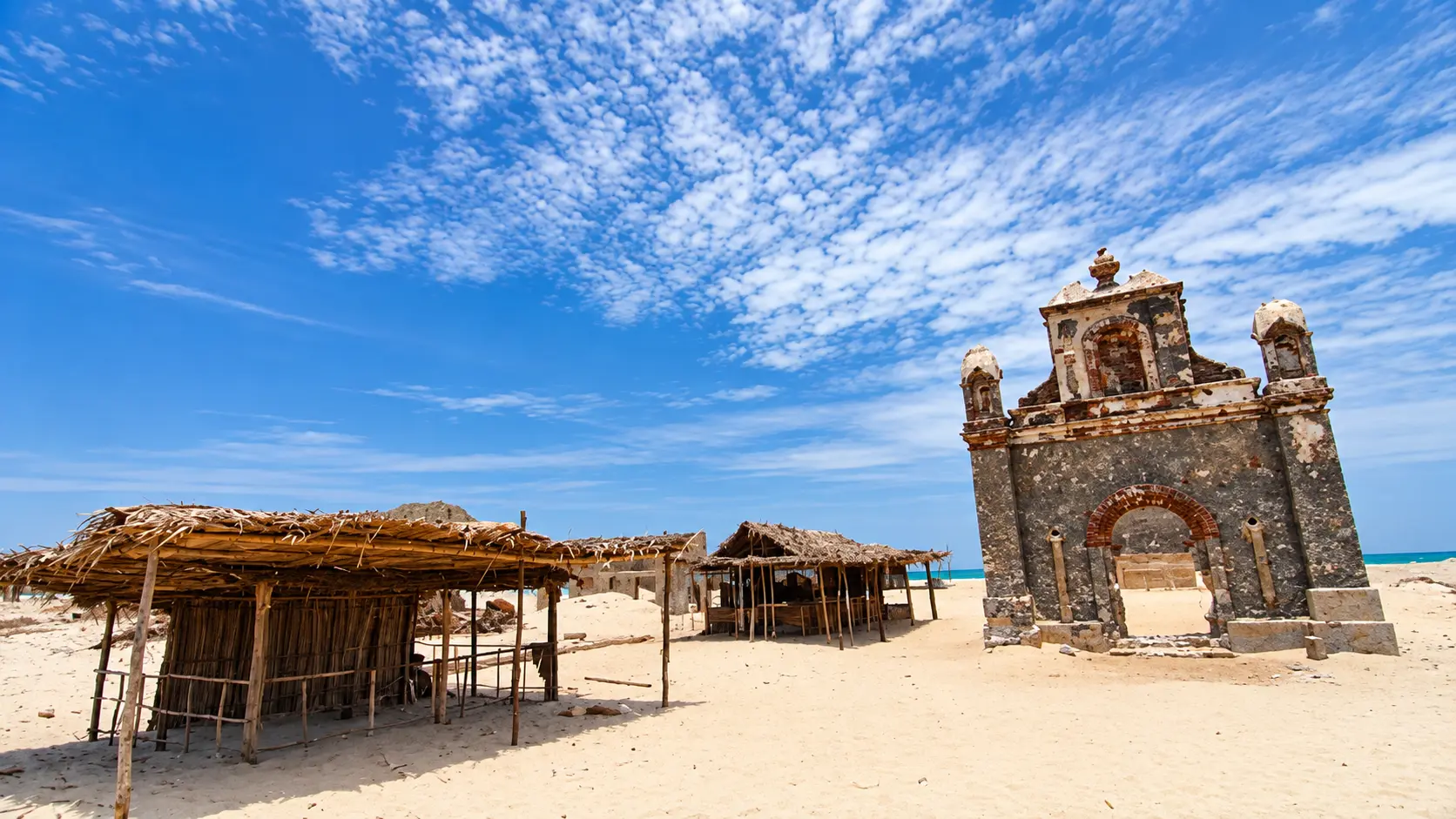
The cataclysm of December 1964 annihilated this world in a matter of hours. The most heartbreaking tragedy occurred when the Pamban-Dhanushkodi Passenger Train No. 653, carrying 110 passengers and 5 railway crew members, was engulfed by a colossal tidal wave just hundreds of yards outside Dhanushkodi station; all six coaches were washed into the sea with the tragic loss of every soul aboard. Walking among the windswept ruins today - standing inside the roofless shell of the Portuguese church with its empty Gothic window arches, inspecting the massive brick-and-iron railway water tank, and tracing the buried tracks in the sand - evokes a powerful, solemn reverence that few places on earth can match.
When to visitRead details
- Winter Season (October to March): This is unequivocally the most pleasant and rewarding window to visit Dhanushkodi. Daily temperatures range between 22°C and 29°C, accompanied by invigorating, cool oceanic sea breezes. The sky is bright blue and cloudless, providing optimal light for photography and walking among the ruins. In January and February, migrating flamingos, gulls, and terns congregate in the shallow coastal lagoons near the road.
- Summer Season (April to June): Summer along the sandspit is intensely severe. Daytime temperatures regularly exceed 38°C, and the pure white coral sands radiate blazing reflected heat. With no trees or buildings to provide shade, midday visits in summer can lead to rapid heat exhaustion. If travelling during summer, plan your journey strictly for the early morning between 06:00 and 08:30.
- Monsoon Season (October to December): The Northeast Monsoon brings heavy tropical downpours, strong gale-force winds, and rough sea conditions to Pamban Island. While the churning, stormy seas look majestic, the Coastal Police frequently close the highway to private vehicles during active depression warnings or severe windstorms.
Entry & permissionsRead details
Fees, visiting hours and entry rules may change. Confirm the latest details with the official operator or local authority before travelling.
Operating Schedule and Police Checkpoint Hours
- Highway Access: Open daily from 06:00 to 18:00.
- Mukuntharayar Chathiram Police Checkpost: Located approximately 9.5 km before Arichal Munai.
- Inbound Gate Cutoff: Vehicles and tourists are barred from passing the checkpoint after 17:00 PM.
- Outbound Departure Mandate: All visitors must exit the sandspit past the checkpost before 18:00 PM.
- Overnight Prohibition: Overnight camping, setting up tents, sleeping on the beach, and night-time driving along the sandspit are strictly prohibited by the Tamil Nadu Coastal Police and district administration for border security and visitor safety.
Entry Fees
- Highway Toll & Admission: Free. There is no entry fee or toll to drive along NH 87 or explore the ruins.
- Local Bus Fare: ₹30 to ₹40 per person one-way on TNSTC buses.
- Roadside Parking: Free open parking along designated shoulders and at the Arichal Munai roundabout.
Crucial Safety and Legal Directives
- Strict Prohibition on Swimming and Bathing: Swimming, wading into the surf, or bathing in the sea at Dhanushkodi, the ruins beach, and Arichal Munai is strictly prohibited by law. Warning signs are posted along the highway. The confluence of the Palk Strait and Gulf of Mannar generates fierce underwater undertows, shifting sandbars, and unpredictable rip currents. Multiple tragic drownings have occurred when visitors stepped into seemingly shallow water only to be swept into the open ocean. Coastal police officers patrol the waterfront and will fine violators.
- Drone Ban: Flying camera drones anywhere over Dhanushkodi, Arichal Munai, and the coastal waters is strictly illegal. The area is a sensitive high-security international maritime border zone monitored by the Indian Coast Guard and Indian Navy. Unauthorised drone operation will result in immediate equipment confiscation and detention under national security acts.
- Plastic-Free Zone: Single-use plastic bottles, non-biodegradable food wrappers, and polythene carry bags are prohibited across the island under the Gulf of Mannar Marine Biosphere protection directives.
Plan your visitRead details
Explore the full guide - choose a topic below.
Why visit?
The primary draw of Dhanushkodi is its raw historical poignancy.Explore detailsClose details
A Haunting Encounter with the 1964 Cyclone Tragedy
The primary draw of Dhanushkodi is its raw historical poignancy. Prior to December 1964, Dhanushkodi was a bustling, prosperous township. It possessed a prominent railway terminus, customs clearing offices, passenger shipping piers, schools, a hospital, post office, temples, and churches. It was the crucial hub for the fabled Boat Mail (Indo-Ceylon Express), which carried passengers seamlessly on a single ticket from Madras Egmore down through South India to Dhanushkodi pier, where passengers boarded steam ferries across the Palk Strait to Ceylon.
The cataclysm of December 1964 annihilated this world in a matter of hours. The most heartbreaking tragedy occurred when the Pamban-Dhanushkodi Passenger Train No. 653, carrying 110 passengers and 5 railway crew members, was engulfed by a colossal tidal wave just hundreds of yards outside Dhanushkodi station; all six coaches were washed into the sea with the tragic loss of every soul aboard. Walking among the windswept ruins today - standing inside the roofless shell of the Portuguese church with its empty Gothic window arches, inspecting the massive brick-and-iron railway water tank, and tracing the buried tracks in the sand - evokes a powerful, solemn reverence that few places on earth can match.
Arichal Munai: The Edge of India
At the furthest southeastern tip of the spit lies Arichal Munai (meaning "Erosion Point"), the absolute physical end of the Indian national highway network. Completed by the National Highways Authority of India (NHAI) in 2017, a 9.5-kilometre all-weather extension of National Highway 87 carries travellers across the narrow spit, flanked on both sides by open ocean waters. The road culminates at Arichal Munai in a dramatic circular roundabout crowned by a stone memorial featuring the Lion Capital of Ashoka. Standing at this geographic boundary, gazing across the shimmering turquoise shallows where the horizon fades toward Sri Lanka, gives visitors the unforgettable sensation of standing at the literal edge of the world.
The Sacred Genesis of Ram Setu (Adam's Bridge)
In Hindu mythology, Dhanushkodi holds immense spiritual significance. According to the ancient epic Ramayana, when Prince Rama sought to rescue his abducted consort Sita from the demon king Ravana in Lanka, he stood on this exact shoreline. Pointing with the tip of his sacred bow (Dhanush), Rama directed his Vanara army, led by Hanuman and Nila, to engineer a floating stone bridge across the ocean to Lanka - a geological chain of limestone shoals, coral reefs, and sandbanks now known as Ram Setu or Adam's Bridge. Upon returning victorious from Lanka, Rama struck the ocean with the tip of his bow (kodi) to dismantle the bridge at the request of Vibhishana, bestowing the town its eternal name: Dhanushkodi ("Tip of the Bow"). Orthodox Hindu pilgrims journey to Dhanushkodi to perform sacred ancestor rites (Tharpanam) and bathe in the holy confluence of the seas.
The Confluence of Two Distinct Seas
One of nature's most extraordinary spectacles unfolds along the narrow sandspit of Dhanushkodi: the dramatic juxtaposition of the Bay of Bengal (Palk Strait) to the north and the Indian Ocean (Gulf of Mannar) to the south. The two water bodies exhibit strikingly different temperaments and colors. To the north, the Palk Strait is famously rough, deep blue, and agitated by crashing, frothy waves; to the south, the Gulf of Mannar is remarkably calm, shallow, and shaded in vivid shades of emerald and turquoise. Standing on the narrow sandspit between them, you can observe the very line where their currents merge and collide.
What to expect
The approach to Dhanushkodi is one of the most cinematic road journeys in India.Explore detailsClose details
The Spectacular Drive along National Highway 87
The approach to Dhanushkodi is one of the most cinematic road journeys in India. Departing Rameswaram, the smooth asphalt road passes through coastal fishing hamlets before reaching Mukuntharayar Chathiram, where the police checkpoint is located. Beyond this gate, the modern 9.5-km highway sweeps onto the barrier sandspit. The road is built upon an elevated marine embankment, flanked on both sides by sweeping views of crashing surf, salt marshes, and pristine white sand dunes. On windy days, ocean spray mists your windshield and sea breezes whip across the open tarmac.
The Ruined Township Complex
Approximately 15 kilometres from Rameswaram, you reach the main cluster of ruins. The remnants of the historic town sit half-buried in shifting coastal sands:
- The Ruined Church: A haunting Portuguese-style Catholic church built from coral stone and red clay bricks. Its roof and bell tower have long collapsed, but the exterior walls, facade gable, and pointed Gothic archways remain standing, framed against azure skies.
- The Railway Water Tower: A massive circular masonry reservoir that once supplied boiler water to steam locomotives operating the Boat Mail. The sturdy cylindrical structure survived the 1964 surge, though its iron fittings have been corroded by salt air.
- The Customs and Port Offices: Low-lying brick foundations and eroded doorways that handled passenger passports and international freight between India and Ceylon.
- The Old Primary School and Dispensary: Crumbling brick arches and weathered wall stumps where children once studied.
The Fishermen's Hamlets
Despite its official designation as a ghost town, a small, resilient community of traditional Tamil fisherfolk inhabits the spit during the calm fishing season. Living in simple huts fashioned from woven palm fronds, driftwood, and casuarina poles, they practice sustainable shore-seine fishing. Rows of colourful wooden catamarans and traditional fishing skiffs line the beach, while women dry salted fish on open racks under the tropical sun. These hamlets have no permanent electrical grid, running water, or brick homes; their seasonal existence remains intimately tied to the rhythms of the sea.
Arichal Munai Memorial and Ocean Panoramas
Continuing 4.5 kilometres past the ruins to the very end of NH 87, you arrive at Arichal Munai. The highway terminates in an expansive circular turnaround featuring the Ashoka Pillar emblem and stone viewing benches. Walking out to the sandy shoreline, you are surrounded on three sides by water. In the distance, breaking waves reveal the shallow submerged sandbars and coral heads of Ram Setu stretching toward the horizon.
Best time to visit
Dhanushkodi is an entirely exposed maritime environment with virtually zero natural or constructed shade.Explore detailsClose details
Seasonal Weather Patterns
Dhanushkodi is an entirely exposed maritime environment with virtually zero natural or constructed shade. Selecting the proper season and time of day is paramount.
- Winter Season (October to March): This is unequivocally the most pleasant and rewarding window to visit Dhanushkodi. Daily temperatures range between 22°C and 29°C, accompanied by invigorating, cool oceanic sea breezes. The sky is bright blue and cloudless, providing optimal light for photography and walking among the ruins. In January and February, migrating flamingos, gulls, and terns congregate in the shallow coastal lagoons near the road.
- Summer Season (April to June): Summer along the sandspit is intensely severe. Daytime temperatures regularly exceed 38°C, and the pure white coral sands radiate blazing reflected heat. With no trees or buildings to provide shade, midday visits in summer can lead to rapid heat exhaustion. If travelling during summer, plan your journey strictly for the early morning between 06:00 and 08:30.
- Monsoon Season (October to December): The Northeast Monsoon brings heavy tropical downpours, strong gale-force winds, and rough sea conditions to Pamban Island. While the churning, stormy seas look majestic, the Coastal Police frequently close the highway to private vehicles during active depression warnings or severe windstorms.
Ideal Hours of the Day
- Sunrise and Early Morning (06:00 to 08:30 AM): The absolute finest time to visit. Check the current visiting hours and permitted access with the site operator before departure; ceremonies, closures and visitor sessions can affect access. The air is cool, crowds are absent, and the light across the ruins is extraordinary.
- Late Afternoon (15:30 to 17:30 PM): Ideal for sunset photography and watching the golden hour light up the red bricks of the ruined church. Check the current visiting hours and permitted access with the site operator before departure; ceremonies, closures and visitor sessions can affect access.
How to reach
Dhanushkodi is situated at the southeastern tip of Pamban Island in Ramanathapuram District, Tamil Nadu.Explore detailsClose details
Geographic Location and Route
Dhanushkodi is situated at the southeastern tip of Pamban Island in Ramanathapuram District, Tamil Nadu. It is located 20 km southeast of Rameswaram town, 195 km southeast of Madurai, and 600 km south of Chennai.
By Road via National Highway 87
Dhanushkodi is accessed directly from Rameswaram via National Highway 87 (NH 87):
- By Private Taxi or Auto-Rickshaw: Hired cabs and auto-rickshaws are readily available throughout Rameswaram town and outside the railway station. Confirm the current charge and what it includes with the operator or service provider. Visitor admission, vehicles, parking, activities and accommodation can have separate charges.
- By Public Government Bus (TNSTC Route 3): The Tamil Nadu State Transport Corporation operates very frequent, highly economical town buses (Bus Route 3) departing approximately every 30 to 45 minutes from the Rameswaram Central Bus Stand and the West Gate of the Ramanathaswamy Temple directly to Dhanushkodi and Arichal Munai. Confirm the current charge and what it includes with the operator or service provider. Visitor admission, vehicles, parking, activities and accommodation can have separate charges.
- By Private Vehicle / Motorcycle: The road is a smooth, wide 2-lane all-weather asphalt highway suitable for all cars, motorcycles, and bicycles. There are no tolls on this highway.
Nearest Railway Gateway
Rameswaram Railway Station (RMM) is located 20 km northwest of Dhanushkodi. It serves as a major terminus of the Southern Railway, with daily express trains connecting Chennai (Rameswaram Express, Sethu Express), Madurai, Tiruchirappalli, Coimbatore, Bengaluru, and Varanasi. From Rameswaram station, taxis and local buses depart directly for Dhanushkodi.
Nearest Airport Gateway
Madurai International Airport (IXM) is the closest major commercial airport, situated approximately 195 km northwest. The drive from Madurai Airport to Rameswaram takes about 3.5 to 4 hours via the newly widened four-lane NH 87 highway, crossing the iconic Pamban bridge onto the island.
Entry, timings and permissions
Fees, visiting hours and entry rules may change.Explore detailsClose details
Fees, visiting hours and entry rules may change. Confirm the latest details with the official operator or local authority before travelling.
Operating Schedule and Police Checkpoint Hours
- Highway Access: Open daily from 06:00 to 18:00.
- Mukuntharayar Chathiram Police Checkpost: Located approximately 9.5 km before Arichal Munai.
- Inbound Gate Cutoff: Vehicles and tourists are barred from passing the checkpoint after 17:00 PM.
- Outbound Departure Mandate: All visitors must exit the sandspit past the checkpost before 18:00 PM.
- Overnight Prohibition: Overnight camping, setting up tents, sleeping on the beach, and night-time driving along the sandspit are strictly prohibited by the Tamil Nadu Coastal Police and district administration for border security and visitor safety.
Entry Fees
- Highway Toll & Admission: Free. There is no entry fee or toll to drive along NH 87 or explore the ruins.
- Local Bus Fare: ₹30 to ₹40 per person one-way on TNSTC buses.
- Roadside Parking: Free open parking along designated shoulders and at the Arichal Munai roundabout.
Crucial Safety and Legal Directives
- Strict Prohibition on Swimming and Bathing: Swimming, wading into the surf, or bathing in the sea at Dhanushkodi, the ruins beach, and Arichal Munai is strictly prohibited by law. Warning signs are posted along the highway. The confluence of the Palk Strait and Gulf of Mannar generates fierce underwater undertows, shifting sandbars, and unpredictable rip currents. Multiple tragic drownings have occurred when visitors stepped into seemingly shallow water only to be swept into the open ocean. Coastal police officers patrol the waterfront and will fine violators.
- Drone Ban: Flying camera drones anywhere over Dhanushkodi, Arichal Munai, and the coastal waters is strictly illegal. The area is a sensitive high-security international maritime border zone monitored by the Indian Coast Guard and Indian Navy. Unauthorised drone operation will result in immediate equipment confiscation and detention under national security acts.
- Plastic-Free Zone: Single-use plastic bottles, non-biodegradable food wrappers, and polythene carry bags are prohibited across the island under the Gulf of Mannar Marine Biosphere protection directives.
Nearby places to consider
Located 20 km northwest in the heart of Rameswaram, this colossal 12th-century Dravidian temple is one of the…Explore detailsClose details
Ramanathaswamy Temple (Rameswaram)
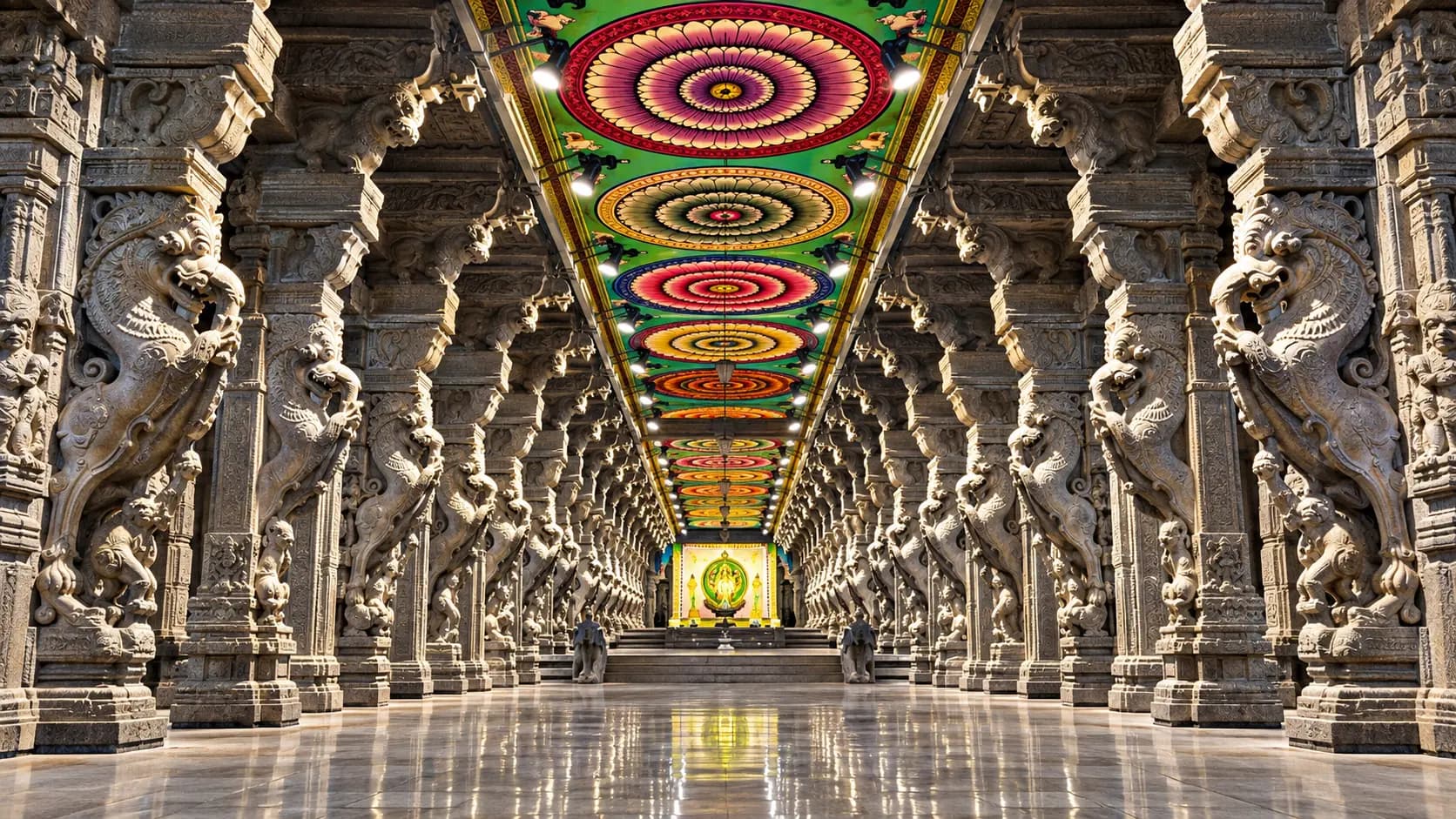
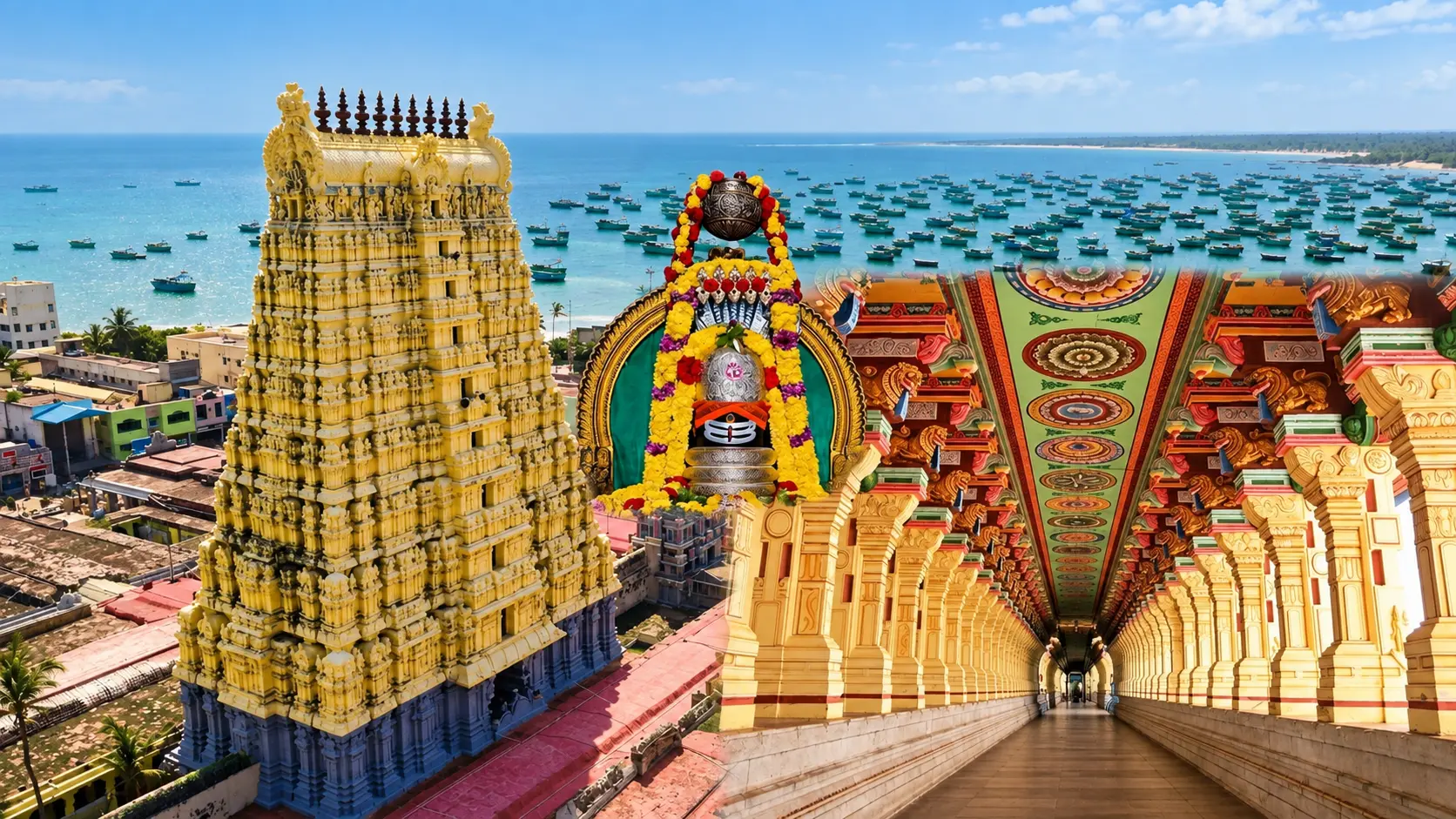
Located 20 km northwest in the heart of Rameswaram, this colossal 12th-century Dravidian temple is one of the twelve sacred Jyotirlingas of Lord Shiva and a cornerstone of the national Char Dham / Arupadai pilgrimage circuits. Admire its world-famous third outer corridor - measuring an astonishing 1,212 metres in length and supported by 1,212 intricately carved monolithic pillars - and participate in the purifying ritual bath across the 22 sacred temple tanks (theerthams).
Pamban Bridge (Rail and Road Bridges)
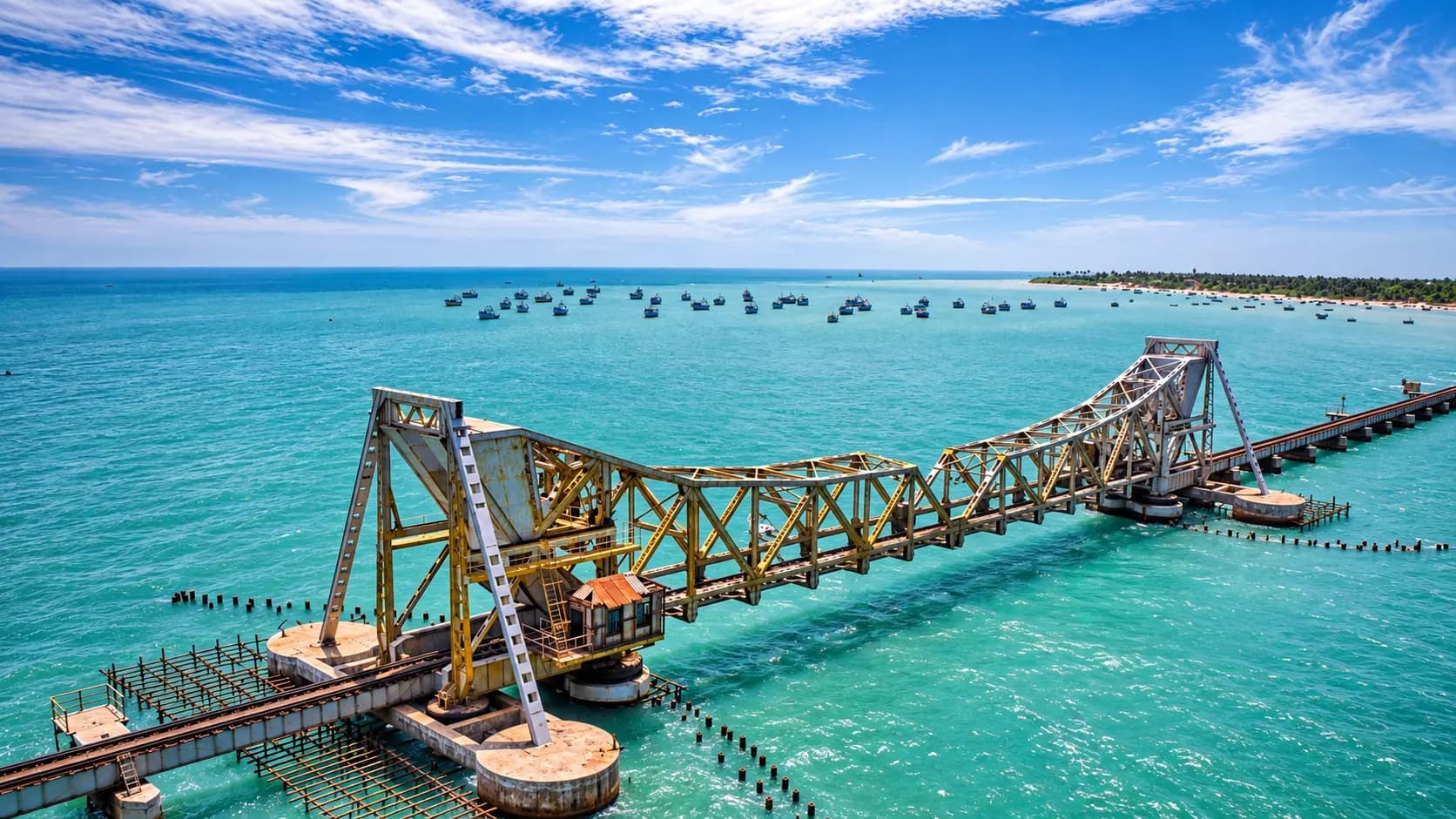
Situated 32 km northwest connecting Rameswaram Island to mainland India, the historic Pamban Railway Bridge was opened in 1914 as India's first sea bridge. Spanning 2.06 kilometres across the turquoise Palk Strait, it features the celebrated Scherzer rolling lift bascule that opens vertically to allow ships to pass. The adjacent Annai Indira Gandhi Road Bridge offers commanding elevated views of the train line and the azure sea.
Kothandaramaswamy Temple
Located 12 km southeast of Rameswaram along the highway to Dhanushkodi, this 500-year-old temple sits on a picturesque sandspit surrounded by the sea. According to the Ramayana, this is the exact spot where Vibhishana, the righteous brother of Ravana, surrendered to Lord Rama and was crowned King of Lanka before the battle. Remarkably, this temple was the only structure in the Dhanushkodi area to survive the 1964 cyclone completely intact.
Dr. A.P.J. Abdul Kalam National Memorial
Located 24 km northwest in Pei Karumbu, Rameswaram, this magnificent memorial honours India’s beloved 11th President and visionary missile scientist, Dr. A.P.J. Abdul Kalam. Designed in a blend of Mughal and Dravidian architectural styles, it houses a museum displaying Dr. Kalam’s personal belongings, scientific replicas of SLV and Agni rockets, and thousands of paintings capturing his inspirational life.
Agniteertham (Rameswaram Beach)
Situated right outside the eastern gateway of the Ramanathaswamy Temple, Agniteertham is the most sacred sea bathing ghat in Rameswaram. Pilgrims take an auspicious purifying dip in the calm waters of the Bay of Bengal before entering the temple sanctum.
In pictures
The practical bits
Before you go.
Sun and Heat Protection
The Dhanushkodi sandspit has zero natural tree canopy and no permanent sheltered structures.Explore detailsClose details
The Dhanushkodi sandspit has zero natural tree canopy and no permanent sheltered structures. The sun can be blistering, and the white coral sands reflect intense UV glare. It is imperative to wear a wide-brimmed sun hat, polarized sunglasses, and high-SPF sunscreen. Carry an umbrella for personal shade if visiting between 10:00 and 15:30.
Hydration and Supplies
There is no municipal piped drinking water, public cafeteria, or reliable grid power beyond the Mukuntharayar…Explore detailsClose details
There is no municipal piped drinking water, public cafeteria, or reliable grid power beyond the Mukuntharayar Chathiram checkpoint. You must carry ample drinking water (at least 1.5 to 2 litres per person) in reusable metal or insulated bottles. While local fisherfolk run modest thatch kiosks selling tender coconut water, sliced watermelon, and fried fish near the ruins, travellers needing formal meals or specialized medicines should purchase them in Rameswaram before departing.
Footwear Recommendations
Wear comfortable walking sandals, water shoes, or slip-on shoes with secure straps.Explore detailsClose details
Wear comfortable walking sandals, water shoes, or slip-on shoes with secure straps. Exploring the ruins involves walking through deep, soft sand and stepping over weathered coral stones and brick rubble. Avoid closed leather dress shoes or sneakers that easily fill with fine sand.
Respecting the Memorial Ruins
The ruined brick structures of the church, water tank, and customs house are fragile historical artifacts that…Explore detailsClose details
The ruined brick structures of the church, water tank, and customs house are fragile historical artifacts that have survived more than six decades of salt weathering. Visitors must refrain from climbing on crumbling brick walls, carving graffiti, or dislodging masonry. Treat the grounds with the quiet reverence due to a historic memorial and cemetery.
A few things you might wonder
Common questions about visiting Dhanushkodi Ghost Town. Fees, visiting hours and ceremonies are researched details that may change; confirm current arrangements with the operator before travelling.
Why is Dhanushkodi called a "Ghost Town"?
Can visitors travel all the way to Arichal Munai in their own private cars?
Can you swim in the sea at Dhanushkodi or Arichal Munai?
What is the significance of Arichal Munai?
What are the visiting hours and police restrictions at Dhanushkodi?
How do I get to Dhanushkodi from Rameswaram if I don't have a private car?
Are there restrooms and food facilities available at Dhanushkodi?
Can I see Sri Lanka from Arichal Munai?
Explore more in Madurai Rameswaram
Discover other destinations around this hub
More Hubs in Tamil Nadu
Continue exploring other travel hubs in this state
Planning a trip to Madurai Rameswaram?