Meenakshi Amman Temple
Essential visitor guide to Meenakshi Amman Temple in Madurai, Tamil Nadu. Explore 14 gopurams, Hall of Thousand Pillars, darshan timings, dress code & rules.
Location
Madurai & Rameswaram, Tamil Nadu
A closer look
Your visit, at a glance.
Madurai Rameswaram, Tamil Nadu
GET TO KNOW THE PLACE
Rising in breathtaking polychromatic majesty above the ancient city of Madurai on the banks of the sacred Vaigai River, Arulmigu Meenakshi Sundareswarar Temple - known across the…
The story of Meenakshi Amman Temple
Rising in breathtaking polychromatic majesty above the ancient city of Madurai on the banks of the sacred Vaigai River, Arulmigu Meenakshi Sundareswarar Temple - known across the globe as Meenakshi Amman Temple - is one of the most sublime, architecturally monumental, and spiritually vibrant living sanctuaries in the world. Situated in Madurai District, Tamil Nadu, this sprawling 14-acre citadel of Dravidian architecture has functioned as the political, cultural, and spiritual heartbeat of the Tamil country for over two and a half millennia. Madurai itself was masterfully designed according to ancient Shilpa Shastras in concentric squares radiating outward from the temple complex like the petals of a blossoming lotus, earning it the historic moniker "The Athens of the East."
Dedicated to Goddess Meenakshi (a sovereign manifestation of Goddess Parvati) and her divine consort Lord Sundareswarar ("The Beautiful Lord," a manifestation of Shiva), the temple is unique among major Shaivite complexes because it accords supreme theological and ritual primacy to the Goddess. Devotees and pilgrims worship Meenakshi first before paying homage to Sundareswarar. Punctuated by 14 monumental gateway towers (gopurams) - including the awe-inspiring Southern Gopuram soaring 51.9 metres (170 feet) into the sky and encrusted with over 1,500 brightly painted mythological sculptures - the temple houses the legendary 1569 Hall of Thousand Pillars, resonant musical granite columns, and the sacred Golden Lotus Tank (Pottramarai Kulam) where the ancient Tamil Sangam evaluated masterpieces of classical literature. A visit to Meenakshi Amman Temple is not merely a tour of stone and stucco, but a profound immersion into a living, breathing tradition of ritual, music, and art that has thrived uninterrupted across the centuries.
Start here. Open a tile for the full details.
Why goRead details
When to visitRead details
- Winter Season (October to March): By far the most comfortable and pleasant season to visit the temple and explore Madurai. Daily daytime temperatures hover between 20°C and 30°C, and evenings are delightfully breezy. Walking barefoot across the open stone flagstones of the temple courtyards is comfortable throughout the day.
- Summer Season (April to June): Midday temperatures frequently climb past 39°C to 42°C with dry, blistering heat. The bare granite stone courtyards can become painfully hot underfoot between 11:00 and 15:30. During summer, plan your temple visit strictly for the early morning between 05:30 and 08:30 or in the late evening after 17:30. Coir matting is laid along major pathways to protect barefoot pilgrims from heat.
- Monsoon Season (October to November): Madurai receives its primary rainfall from the Northeast Monsoon. Heavy afternoon downpours are common, cooling the city significantly. The rain-washed gopurams gleam brilliantly, but outdoor street transit can be wet.
Entry & permissionsRead details
Fees, visiting hours and entry rules may change. Confirm the latest details with the official operator or local authority before travelling.
Operating Schedule
- Daily Sessions:
- Morning Darshan: 05:00 to 12:30
- Evening Darshan: 16:00 to 22:00
- Midday Sanctum Closure: 12:30 to 16:00 daily.
- Hall of Thousand Pillars & Art Museum: Open daily from 06:00 to 20:00 (remains open during the midday sanctum closure, making it an excellent stop between 12:30 and 15:30).
Darshan Fees and Ticketing Categories
- General Free Darshan (Dharma Darshanam): Completely free of charge. Wait times range from 30 minutes to 1.5 hours on normal weekdays, and 2 to 4 hours on weekends, Tuesdays, Fridays, and full-moon days.
- Special Darshan Tickets (HR&CE Regulated):
- ₹50 Special Darshan Ticket: Expedited access corridor.
- ₹100 Quick Darshan Ticket: Fastest lane directly approaching the sanctum barriers.
- Hall of Thousand Pillars Admission:
- Adults: ₹50 per person
- Children: ₹20 per child
- Electronic Cloakroom Fees: ₹10 to ₹20 per locker for safe deposit of mobile phones and cameras.
Complete Electronic Device and Camera Prohibition
By order of the Hon'ble Madras High Court and state security directives, all mobile phones, cameras, smartwatches, and video recording gadgets are strictly prohibited inside the entire temple complex. There are no camera tickets available. All visitors must surrender their mobile phones at the computerized electronic cloakroom counters situated outside the four gopuram gates prior to joining the security screening queues. Metal detectors and physical commando pat-downs are strictly enforced; anyone caught carrying a concealed mobile phone inside faces immediate equipment confiscation and legal penalties.
Strict Dress Code Regulations
Under official Tamil Nadu HR&CE Department rules, conservative traditional dress is mandatory:
- Men: Must wear a traditional dhoti (veshti), pyjama, or formal pants. Shirts, vests, and upper garments must be removed and draped across the arm when entering the innermost sanctum enclosure of Lord Sundareswarar. Shorts, Bermuda shorts, lungis, ripped jeans, and sleeveless t-shirts are strictly banned.
- Women: Must wear a traditional saree, half-saree (dhavani), or salwar kameez / churidar with a properly pinned dupatta. Western shorts, miniskirts, sleeveless tops, and tight leggings are prohibited.
- Footwear: Footwear must be removed and deposited at the designated shoe stalls outside the entrance towers.
Plan your visitRead details
Explore the full guide - choose a topic below.
Why visit?
In mainstream Hindu temple architecture, the male deity typically commands the primary sanctum, with his consort…Explore detailsClose details
Supreme Sanctuary of Feminine Divinity
In mainstream Hindu temple architecture, the male deity typically commands the primary sanctum, with his consort occupying a secondary or subsidiary pavilion. Meenakshi Amman Temple upends this paradigm completely. According to ancient lore, Princess Meenakshi - born with three breasts to the Pandyan king Malayadhwaja Pandya after a grand fire sacrifice - was an invincible warrior queen who conquered the eight directions of the earth before arriving at Mount Kailash, where she beheld Lord Shiva, causing her third breast to vanish as prophesied, revealing him as her divine eternal consort. She ruled Madurai as its sovereign queen. In recognition of her celestial sovereignty, worship begins at her inner sanctum. Her idol - sculpted from gleaming green jade stone holding a sacred parrot, symbolizing sweet speech and cosmic wisdom - radiates royal majesty and maternal grace. The divine feminine energy (Shakti) that permeates every stone corridor of the temple is intense, captivating, and deeply reverent.
The Architectural Wonder of 14 Monumental Gopurams
Enclosing the 14-acre temple precinct are colossal granite boundary walls punctured by 14 multi-tiered gopurams (gateway towers). Four colossal nine-tiered gopurams stand at the cardinal entrances (East, West, North, and South), visible for miles across the Madurai urban skyline:
- The Southern Gopuram: Constructed in 1559, this is the tallest and most renowned tower in the complex, soaring to a height of 51.9 metres (170 feet). Its steeply stepped pyramidal facade is populated by over 1,500 life-sized, vividly painted stucco sculptures depicting the full pantheon of Hindu mythology - dancing devas, multi-headed demons, celestial nymphs (apsaras), and avatar narratives - interspersed with floral arabesques and fierce Yali guardians.
- The Eastern Gopuram: The oldest monumental gateway tower, built between 1216 and 1238 CE by Pandyan King Maravarman Sundara Pandyan I, rising 46.6 metres and preserving early mediaeval stone bas-reliefs.
- The Western and Northern Gopurams: Rising over 48 metres each, showcasing the sublime symmetry and structural engineering of the Madurai Nayaka period.
The Hall of Thousand Pillars (Aayiram Kaal Mandapam)
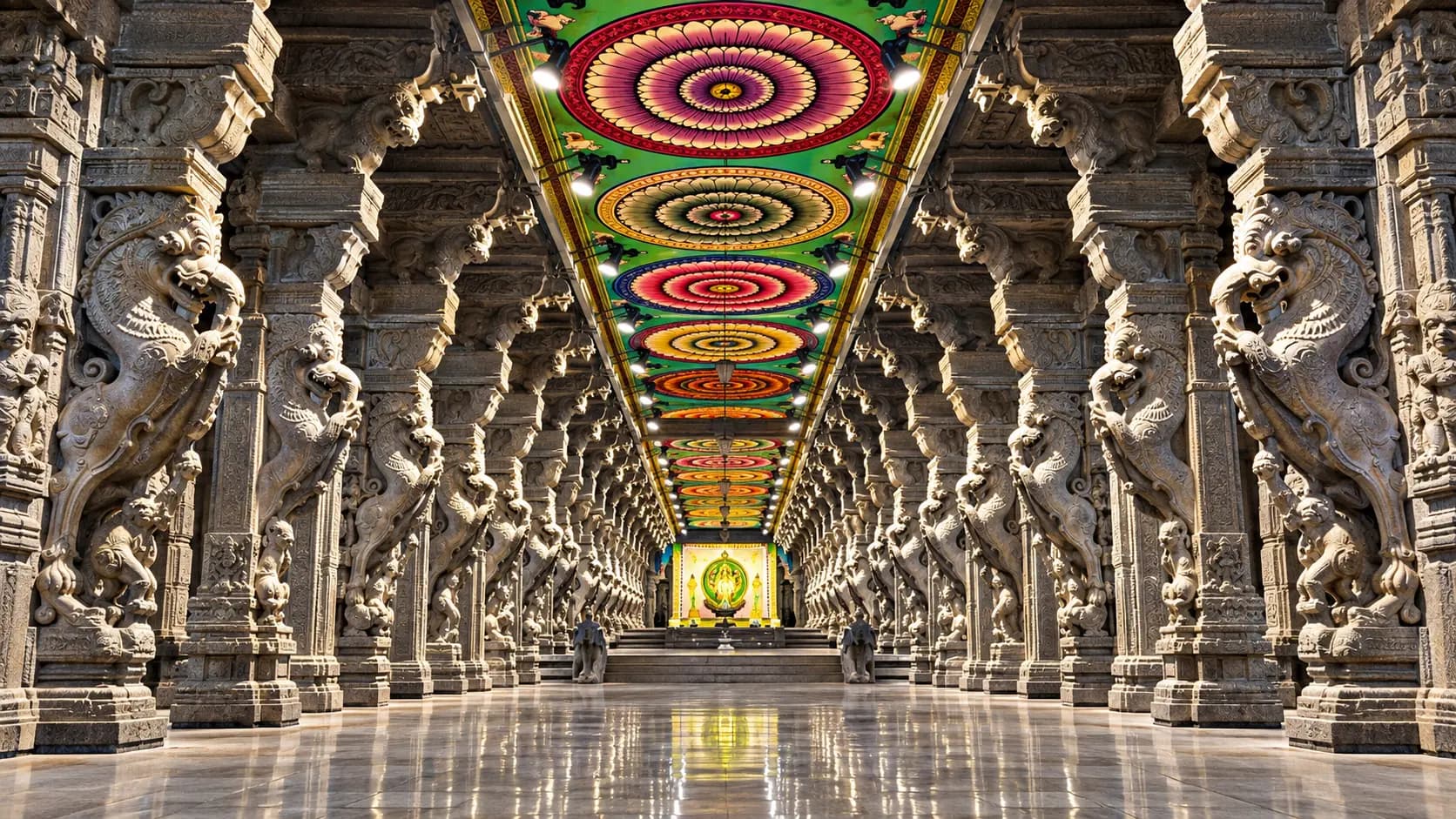
Erected in 1569 by Ariyanatha Mudaliar, the visionary prime minister and military commander of King Viswanatha Nayak, the Hall of Thousand Pillars is one of the crowning achievements of global stone craftsmanship. Spanning a vast hypostyle hall, the pavilion contains exactly 985 intricately carved monolithic granite pillars (with the remaining 15 spaces housing secondary sanctums). When viewed from any direction, the pillars form straight, perfect geometric colonnades that seem to recede into infinity. Each pillar is carved out of a single block of grey granite, sculpted into dynamic, lifelike depictions of celestial dancers, Yalis with stone balls trapped inside their roaring mouths, mythical warriors riding charging horses, and manifestations of Shiva. Within this hall is the Temple Art Museum, displaying rare bronzes, stone inscriptions, and centuries-old copper plates.
The Musical Pillars and the Golden Lotus Tank
Near the northern gate of the temple corridor stand the celebrated Musical Pillars. Carved from single blocks of resonant granite, each cluster consists of a central column encircled by slender, hollowed stone shafts. When tapped lightly with the knuckles, these granite pipes produce distinct, melodious acoustic frequencies corresponding to classical Indian musical swaras (Sa, Re, Ga, Ma, Pa, Dha, Ni). Just beyond lies the Pottramarai Kulam (Tank of the Golden Lotus), a stepped rectangular reservoir measuring 50 by 37 metres, bordered by covered colonnades adorned with 17th-century murals depicting the 64 miracles of Shiva (Thiruvilaiyadal). According to legend, the scholars of the Third Tamil Sangam evaluated poetic manuscripts by placing them on a golden lotus in this sacred water; only works of genuine literary genius remained afloat, while unworthy scrolls sank to the bottom.
What to expect
Approaching the temple through Madurai's bustling Chithirai Streets, the monumental gateway towers rise…Explore detailsClose details
The Four Gateway Approaches and Security Cloakrooms
Approaching the temple through Madurai's bustling Chithirai Streets, the monumental gateway towers rise dramatically above the rooftops. Visitors typically enter through either the East Gate (leading past the ancient Pudhu Mandapam market) or the West Gate. Because of the strict, court-mandated security protocol, all visitors must pass through automated metal detector arches and physical frisking booths operated by Tamil Nadu Police commandos. Before entering the security queues, you must deposit all mobile phones, smartwatches, and cameras in computerized electronic cloakrooms located outside each gopuram gate. Footwear must be deposited at free and nominal paid shoe stands.
The Ashta Shakti Mandapam and Meenakshi Nayakkar Mandapam
Entering through the East Gate, you pass beneath the Ashta Shakti Mandapam ("Hall of Eight Powers"), built in the 17th century by queens Rudrapathi Ammal and Tholiammai. The hall is named after sculpted pillars depicting eight manifestations of Goddess Shakti. It leads into the long Meenakshi Nayakkar Mandapam, a soaring corridor supported by 110 stone pillars featuring mythical Yalis. This covered avenue is lined with traditional temple shops selling brass oil lamps, kumkum powder, fragrant jasmine garlands, and wooden toys, filling the air with the rich aroma of burning camphor, pure cow ghee, and fresh blossoms.
Visiting the Twin Inner Sanctums
Worship inside the temple follows a traditional, sequential path:
- The Meenakshi Amman Sanctum: Devotees first proceed into the Goddess's enclosure. Entering through the Kilikoondu Mandapam ("Parrot Cage Hall," historically used to house trained green parrots that repeated the Goddess's name), you reach the sacred inner prakaram. The golden vimana (Indra Vimana) crowns the sanctum, where the serene, emerald-hued stone image of Goddess Meenakshi stands adorned in exquisite silks, gold jewels, and floral garlands.
- The Sundareswarar Sanctum: After worshipping the Goddess, visitors proceed through a connecting corridor to the larger sanctum of Lord Sundareswarar. The Shiva shrine features its own colossal Nandi statue, a grand golden flagpole (Dhwajastambha), and a high-vaulted circumambulatory corridor lined with life-sized dancing postures of Shiva. The lingam is bathed in continuous oil-lamp illumination, attended by traditional Vedic priests chanting agamic mantras.
The Nightly Palliarai Ceremony (The Divine Bedtime Ritual)
Check the current visiting hours and permitted access with the site operator before departure; ceremonies, closures and visitor sessions can affect access. Priests carry a consecrated silver idol of Lord Sundareswarar in a palanquin adorned with silk umbrellas, accompanied by the resonant music of nadaswaram (double-reed oboe), thavil (drums), and blowing conch shells. The procession moves slowly from the Shiva sanctum through the pillared corridors to the bedchamber of Goddess Meenakshi. Here, the deities are ceremonially united for cosmic rest amidst fragrant incense, soothing lullabies, and waving of camphor lamps - an enchanting ritual open to all respectful visitors.
Best time to visit
Madurai is situated in the interior plains of South Tamil Nadu and experiences a tropical semi-arid climate known…Explore detailsClose details
Seasonal Weather Patterns
Madurai is situated in the interior plains of South Tamil Nadu and experiences a tropical semi-arid climate known for hot summers.
- Winter Season (October to March): By far the most comfortable and pleasant season to visit the temple and explore Madurai. Daily daytime temperatures hover between 20°C and 30°C, and evenings are delightfully breezy. Walking barefoot across the open stone flagstones of the temple courtyards is comfortable throughout the day.
- Summer Season (April to June): Midday temperatures frequently climb past 39°C to 42°C with dry, blistering heat. The bare granite stone courtyards can become painfully hot underfoot between 11:00 and 15:30. During summer, plan your temple visit strictly for the early morning between 05:30 and 08:30 or in the late evening after 17:30. Coir matting is laid along major pathways to protect barefoot pilgrims from heat.
- Monsoon Season (October to November): Madurai receives its primary rainfall from the Northeast Monsoon. Heavy afternoon downpours are common, cooling the city significantly. The rain-washed gopurams gleam brilliantly, but outdoor street transit can be wet.
Ideal Hours of the Day
- Early Morning (05:00 to 07:30 AM): The finest time for quiet, unhurried spiritual contemplation. The temple is cool, peaceful, and uncrowded. The morning Thiruvanandal (awakening) ceremony takes place, and the sanctums are bathed in soft morning lamplight.
- Late Evening (17:30 to 21:45 PM): The atmosphere is at its most vibrant. Thousands of oil lamps flicker across the stone pillars, evening pujas fill the halls with sacred music, and you can stay to witness the unforgettable Palliarai palanquin ceremony at 21:15.
- Midday Closure Notice: Remember that the main sanctum doors close promptly at 12:30 PM and do not reopen until 16:00 PM. Ensure your morning visit concludes before noon.
Key Festivals
- The Chithirai Festival (Chithirai Thiruvizha - April/May): Spanning twelve dazzling days during the Tamil month of Chithirai, this is one of India's largest religious festivals, attracting over a million visitors. The festival reenacts the celestial coronation of Meenakshi, her divine wedding to Lord Sundareswarar (Thirukalyanam), the grand wooden chariot procession (Ther Thiruvizha), and the dramatic entry of Lord Kallazhagar (Vishnu) into the Vaigai River mounted on a golden horse. The entire city of Madurai erupts in carnival joy, traditional music, and public hospitality.
How to reach
Meenakshi Amman Temple is located at the absolute centre of Old Madurai, Tamil Nadu (pin code 625001), bordered…Explore detailsClose details
Geographic Orientation
Meenakshi Amman Temple is located at the absolute centre of Old Madurai, Tamil Nadu (pin code 625001), bordered by the North, South, East, and West Chithirai Streets. It lies approximately 1.8 km east of Madurai Junction Railway Station and 12 km north of Madurai Airport.
By Air
Madurai International Airport (IXM) is located approximately 12 km south of the temple. The drive takes about 25 to 35 minutes via the newly widened Ring Road and Avaniyaapuram highway. Prepaid taxis, app-based cab aggregators (Uber, Ola), and direct airport buses connect the terminal to the city centre. Madurai Airport operates regular domestic flights from Chennai, Bengaluru, Mumbai, Delhi, and Hyderabad, as well as direct international flights from Colombo, Dubai, and Singapore.
By Train
Madurai Junction Railway Station (MDU) is one of the busiest and best-connected railway hubs in Southern India, situated just 1.8 km west of the temple. Direct express and superfast trains connect Madurai around the clock to:
- Chennai (Tejas Express, Vaigai Express, Pandian Express)
- Rameswaram
- Bengaluru, Coimbatore, and Tiruchirappalli
- Kanyakumari, Tirunelveli, and Thiruvananthapuram
- New Delhi, Mumbai, Kolkata, and Varanasi From Madurai Junction, auto-rickshaws, cycle-rickshaws, and taxis reach the temple gates in under 8 minutes.
By Road and Intercity Bus
- Mattuthavani Integrated Bus Terminus (MGR Bus Stand): Located roughly 8 km northeast, handling intercity government (TNSTC/SETC) and private luxury sleeper buses from Chennai, Bengaluru, Coimbatore, Tiruchirappalli, Salem, and Kerala. City buses and pre-paid taxis connect Mattuthavani to the temple in 20 minutes.
- Arapalayam Bus Stand: Located 3.5 km northwest, handling buses to and from Kodaikanal, Dindigul, Theni, and Palani.
- Periyar Bus Stand: Located just 1.5 km southwest near the railway station, handling dense city bus transit throughout Madurai.
Entry, timings and permissions
Fees, visiting hours and entry rules may change.Explore detailsClose details
Fees, visiting hours and entry rules may change. Confirm the latest details with the official operator or local authority before travelling.
Operating Schedule
- Daily Sessions:
- Morning Darshan: 05:00 to 12:30
- Evening Darshan: 16:00 to 22:00
- Midday Sanctum Closure: 12:30 to 16:00 daily.
- Hall of Thousand Pillars & Art Museum: Open daily from 06:00 to 20:00 (remains open during the midday sanctum closure, making it an excellent stop between 12:30 and 15:30).
Darshan Fees and Ticketing Categories
- General Free Darshan (Dharma Darshanam): Completely free of charge. Wait times range from 30 minutes to 1.5 hours on normal weekdays, and 2 to 4 hours on weekends, Tuesdays, Fridays, and full-moon days.
- Special Darshan Tickets (HR&CE Regulated):
- ₹50 Special Darshan Ticket: Expedited access corridor.
- ₹100 Quick Darshan Ticket: Fastest lane directly approaching the sanctum barriers.
- Hall of Thousand Pillars Admission:
- Adults: ₹50 per person
- Children: ₹20 per child
- Electronic Cloakroom Fees: ₹10 to ₹20 per locker for safe deposit of mobile phones and cameras.
Complete Electronic Device and Camera Prohibition
By order of the Hon'ble Madras High Court and state security directives, all mobile phones, cameras, smartwatches, and video recording gadgets are strictly prohibited inside the entire temple complex. There are no camera tickets available. All visitors must surrender their mobile phones at the computerized electronic cloakroom counters situated outside the four gopuram gates prior to joining the security screening queues. Metal detectors and physical commando pat-downs are strictly enforced; anyone caught carrying a concealed mobile phone inside faces immediate equipment confiscation and legal penalties.
Strict Dress Code Regulations
Under official Tamil Nadu HR&CE Department rules, conservative traditional dress is mandatory:
- Men: Must wear a traditional dhoti (veshti), pyjama, or formal pants. Shirts, vests, and upper garments must be removed and draped across the arm when entering the innermost sanctum enclosure of Lord Sundareswarar. Shorts, Bermuda shorts, lungis, ripped jeans, and sleeveless t-shirts are strictly banned.
- Women: Must wear a traditional saree, half-saree (dhavani), or salwar kameez / churidar with a properly pinned dupatta. Western shorts, miniskirts, sleeveless tops, and tight leggings are prohibited.
- Footwear: Footwear must be removed and deposited at the designated shoe stalls outside the entrance towers.
Nearby places to consider
Located just 1.5 km southeast of the temple (a 5-minute auto-rickshaw ride), this magnificent 1636 CE palace was…Explore detailsClose details
Thirumalai Nayakkar Mahal
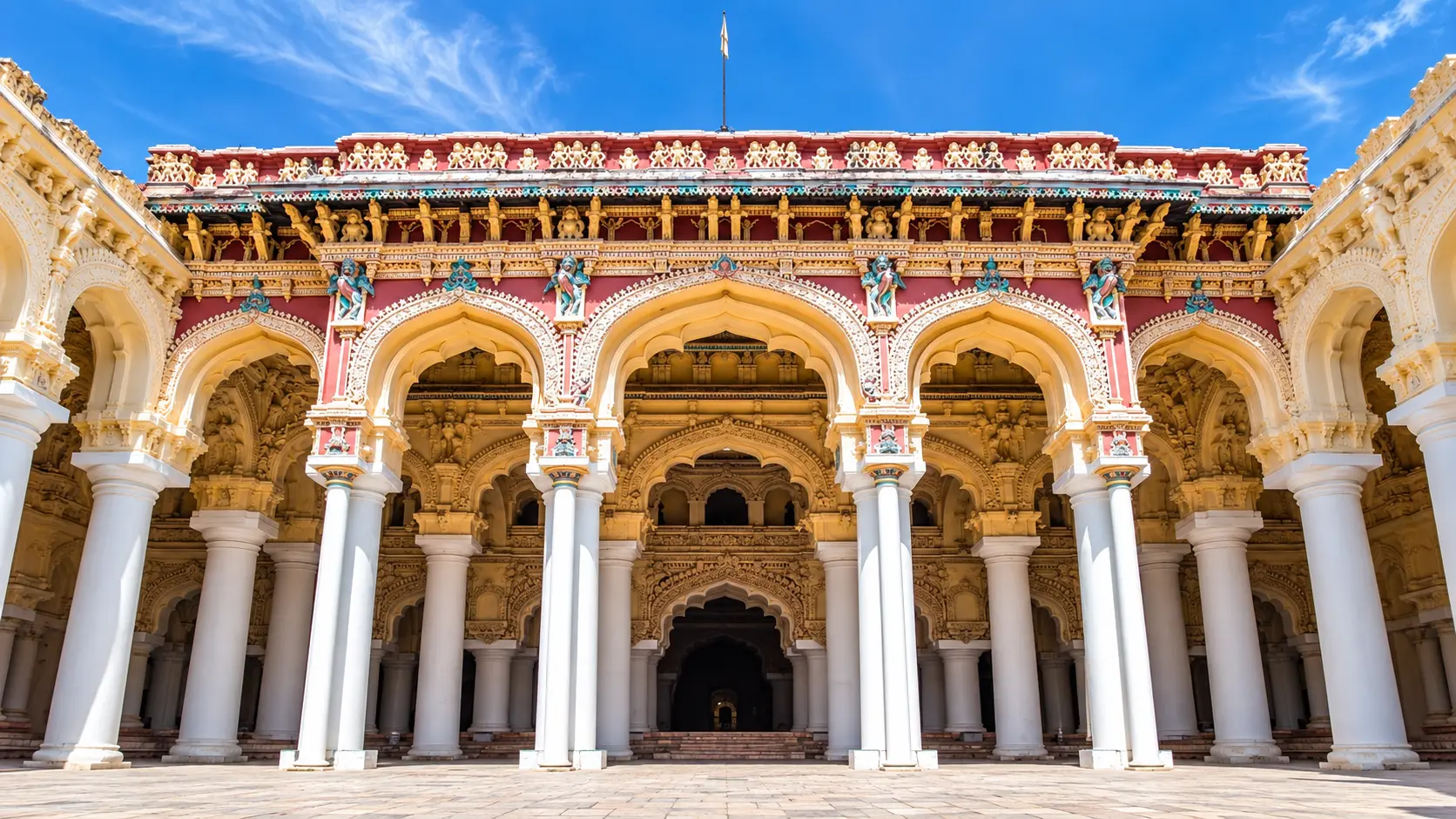
Located just 1.5 km southeast of the temple (a 5-minute auto-rickshaw ride), this magnificent 1636 CE palace was built by King Thirumalai Nayak. Designed in a breathtaking blend of Dravidian and Indo-Islamic (Saracenic) styles, it features colossal 82-foot circular pillars, arched stucco ceilings, a grand central courtyard, and an evocative evening Sound & Light show narrating the history of the Nayaka kings and the Silappadikaram.
Pudhu Mandapam
Situated right opposite the Eastern Gopuram of Meenakshi Temple, this grand 17th-century pillared hall was built by King Thirumalai Nayak as a summer resting pavilion for Lord Sundareswarar. Today, its 124 carved monolithic pillars host a bustling historic textile and tailoring bazaar where skilled tailors stitch traditional South Indian garments and craftspeople sell brass lamps, bronze idols, and handloom cotton.
Koodal Azhagar Temple
Located 1 km southwest of Meenakshi Temple, this ancient temple is one of the 108 Divya Desams dedicated to Lord Vishnu. The architectural wonder of the temple is its three-tiered sanctum displaying Vishnu in three distinct postures stacked vertically: standing (Ninraan), sitting (Irundhaan), and reclining (Kidandhaan), accessible via granite staircases.
Vandiyur Mariamman Teppakulam
Located 4 km east of the temple, this colossal stepped rectangular reservoir spans an immense 16 acres and was excavated by King Thirumalai Nayak in 1645. In the exact centre of the tank sits a picturesque island pavilion (Maiya Mandapam) crowned by a domed temple and flowering gardens. It serves as the venue for the world-famous annual Madurai Float Festival (Teppam) in January/February.
Gandhi Memorial Museum (Tamukkam Palace)
Situated 4 km north across the Vaigai River, this historic museum is housed in the 17th-century Tamukkam summer palace of Rani Mangammal. It is one of five official Gandhi museums in India, preserving the blood-stained dhoti worn by Mahatma Gandhi when he was assassinated in 1948, as well as a poignant photographic exhibition detailing the Indian Freedom Movement.
In pictures
The practical bits
Before you go.
Surrendering Electronics Seamlessly
To avoid the confusion and long queues at the mobile phone cloakrooms outside the gopurams, the best strategy is…Explore detailsClose details
To avoid the confusion and long queues at the mobile phone cloakrooms outside the gopurams, the best strategy is to leave your mobile phones, cameras, smartwatches, and excess electronic gadgets in your hotel room or locked in your vehicle. Only carry essential cash, a photo ID, and ritual offerings (such as flowers or ghee lamps) in a simple fabric bag. Traveling light allows you to breeze through the security screening checkpoints in minutes.
Hiring a Certified Temple Guide
The history, iconography, and architectural subtleties of Meenakshi Temple are extraordinarily dense.Explore detailsClose details
The history, iconography, and architectural subtleties of Meenakshi Temple are extraordinarily dense. Hiring a licensed, badged HR&CE or Ministry of Tourism guide at the entrance gate (near the East Gate or Hall of Thousand Pillars) will dramatically enhance your experience. A good guide will demonstrate the acoustic secrets of the Musical Pillars, point out hidden carvings in the Hall of Thousand Pillars, explain the Sangam lore of the Golden Lotus Tank, and navigate you smoothly through the complex. Confirm the current charge and what it includes with the operator or service provider. Visitor admission, vehicles, parking, activities and accommodation can have separate charges.
Pacing Your Exploration
A fulfilling, comprehensive visit requires at least 2.5 to 3.5 hours.Explore detailsClose details
A fulfilling, comprehensive visit requires at least 2.5 to 3.5 hours. Allocate 45 to 60 minutes for the Meenakshi Amman sanctum queue, 45 minutes for the Sundareswarar sanctum, 45 minutes for exploring the Hall of Thousand Pillars and Art Museum, and 30 minutes for sitting quietly along the cloistered steps of the Golden Lotus Tank.
Navigating the Midday Break
If you arrive in Madurai around midday, do not despair.Explore detailsClose details
If you arrive in Madurai around midday, do not despair. Check the current visiting hours and permitted access with the site operator before departure; ceremonies, closures and visitor sessions can affect access.
A few things you might wonder
Common questions about visiting Meenakshi Amman Temple. Fees, visiting hours and ceremonies are researched details that may change; confirm current arrangements with the operator before travelling.
Can non-Hindus enter Meenakshi Amman Temple?
Why are mobile phones and cameras completely banned inside the temple?
What is the significance of the Hall of Thousand Pillars?
What is the dress code for entering Meenakshi Temple?
What is the best time of day to visit the temple?
What is the Palliarai Ceremony?
How much time should I plan for exploring Meenakshi Temple?
Where can I park my car when visiting the temple?
Explore more in Madurai Rameswaram
Discover other destinations around this hub
More Hubs in Tamil Nadu
Continue exploring other travel hubs in this state
Planning a trip to Madurai Rameswaram?