Udayagiri Buddhist Complex
Comprehensive visitor guide to Udayagiri Buddhist Complex in Jajpur, Odisha.
Location
Buddhist Circuit, Odisha
A closer look
Your visit, at a glance.
Buddhist Circuit, Odisha
GET TO KNOW THE PLACE
Tucked into a tranquil horseshoe-shaped valley along the eastern flanks of the Assia hill range in coastal Odisha's Jajpur district, the Udayagiri Buddhist Complex represents the…
The story of Udayagiri Buddhist Complex
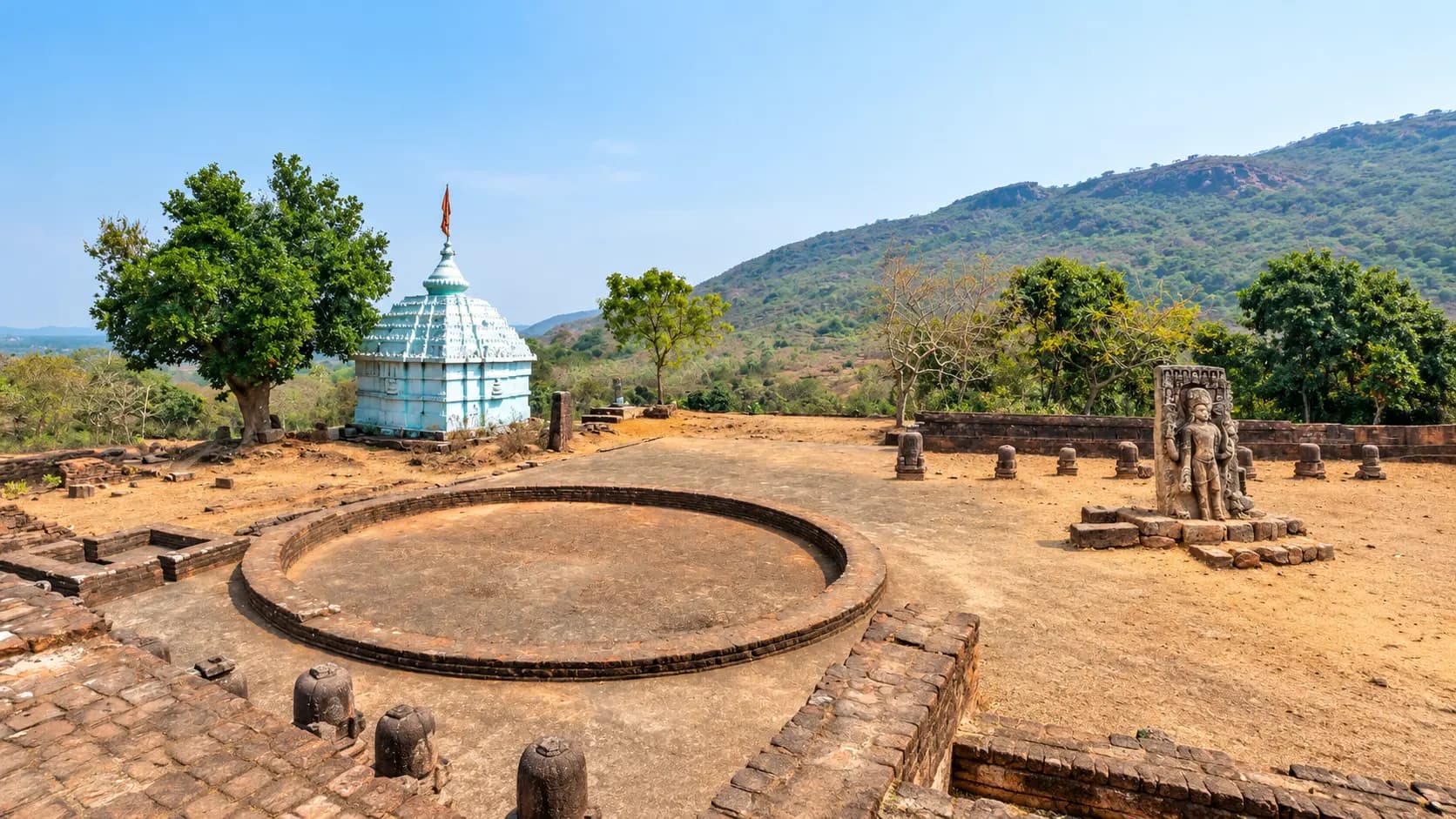
Tucked into a tranquil horseshoe-shaped valley along the eastern flanks of the Assia hill range in coastal Odisha's Jajpur district, the Udayagiri Buddhist Complex represents the most expansive archaeological excavation within Odisha's renowned Diamond Triangle (Ratnagiri, Udayagiri, and Lalitgiri). Spanning an immense landscape of rolling green meadows, excavated brick monasteries, colossal rock-cut cliff sculptures, and an ancient stepped well, Udayagiri offers an evocative journey into the golden age of Mahayana and Tantric Vajrayana Buddhism that flourished along the ancient riverbanks of the Birupa from the 7th to the 12th century CE.
Unlike its sister site Ratnagiri, which is famed for its dense clustering of hundreds of votive stupas and intricate green chlorite doorway carvings, or Lalitgiri with its ancient Asokan antiquity and sacred caskets, Udayagiri captivates travelers through its vast spatial grandeur and pastoral solitude. Here, broad excavated brick courtyards, subterranean monastic drainage systems, and colossal stone Buddhas gazing placidly across open pastures convey the sheer scale of ancient monastic university life. Historical terracotta sealings recovered during systematic Archaeological Survey of India (ASI) excavations have firmly identified this immense landscape as housing two vibrant, contiguous monastic establishments: Madhavapura Mahavihara (Udayagiri-1) and Simhaprashtha Mahavihara (Udayagiri-2).
For cultural travelers, heritage photographers, and spiritual seekers, Udayagiri delivers an unhurried, contemplative exploration far removed from commercial tourist throngs, where centuries-old stone-cut steps, monumental stupa terraces, and meditating Bodhisattvas harmonize with the gentle rhythms of rural Odisha.
Start here. Open a tile for the full details.
Why goRead details
- The Largest Buddhist Monastic Landscape in Odisha: Covering sprawling acres across two distinct monastic sectors separated by a low natural hill spur, Udayagiri is geographically the largest excavated Buddhist complex in the state, offering an unparalleled sense of ancient monastic architectural planning.
- The Twin Mahaviharas (Madhavapura & Simhaprashtha): Walk through the exposed foundations, residential monk cells, pillared assembly halls, and grand sanctums of two ancient universities authenticated by inscribed terracotta monastic seals unearthed on-site.
- The Monumental Maha Stupa of Udayagiri-1: Marvel at the grand stepped brick stupa excavated in 1987, featuring four towering stone niches aligned precisely to the cardinal directions, each preserving a colossal image of the Dhyani Buddhas: Akshobhya, Amitabha, Amoghasiddhi, and Ratnasambhava.
- The Rare Ancient Stepped Well (Vapi): Descend the stone-cut staircase into a 10th - 11th century CE rock-cut stepwell featuring a preserved single-line Nagari inscription recording its pious endowment by the local Somavamsi feudatory Ranaka Sri Vajranaga.
- The Unique Monastic Ambulatory of Udayagiri-2: Explore Monastery 2's rare brick layout, featuring an internal circumambulatory gallery (Pradakshinapatha) wrapping completely around the inner sanctum chamber where a massive seated Buddha presides.
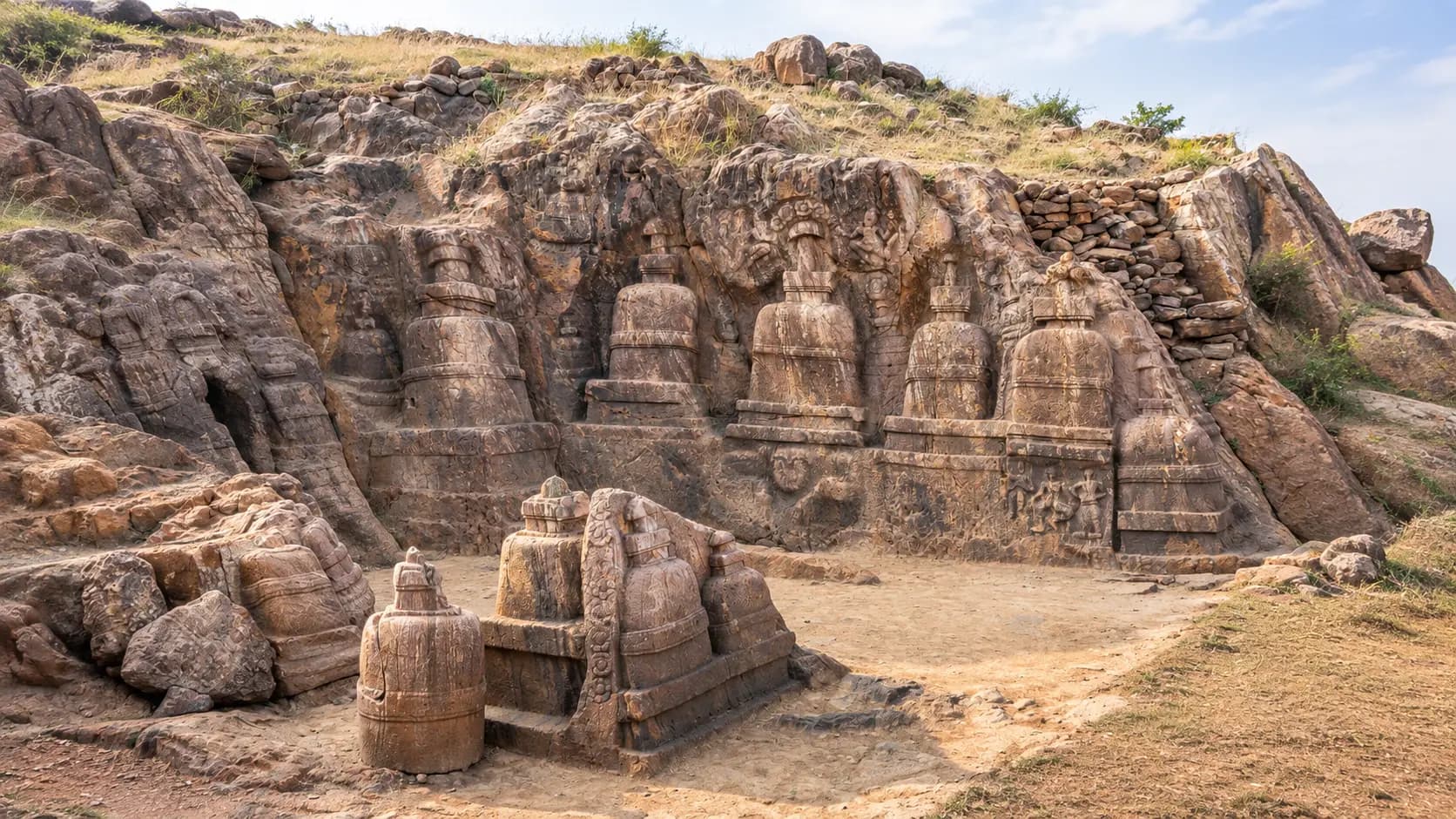
- Hillside Rock-Cut Bas-Reliefs: Trace the footpaths along the base of the hill to discover ancient rock-cut reliefs carved directly into the natural rock faces, including standing Bodhisattva Avalokiteshvara clutching a delicate lotus stalk and towering monolithic votive chaityas.
- Atmospheric Serenity and Rural Solitude: Enjoy well-kept lawns and stone-paved walkways framed by wooded hill slopes and birdsong, creating a deeply tranquil setting for mindful walking and historical reflection.
When to visitRead details
Entry & permissionsRead details
Fees, visiting hours and entry rules may change. Confirm the latest details with the official operator or local authority before travelling.
- Site Timings: Open every day of the week from sunrise to sunset (typically 06:00 AM to 06:00 PM).
- Entry Fee: Currently, there is no mandatory admission ticket fee charged for entering the open archaeological grounds of the Udayagiri Buddhist Complex. Unlike Ratnagiri and Lalitgiri, which maintain indoor ASI site museums requiring entry tickets, Udayagiri’s excavated monastic monuments are situated in an open, protected archaeological park under the Archaeological Survey of India (Bhubaneswar Circle).
- Permissions & Permits: No prior government or forest department permits are required for Indian or foreign nationals visiting the site.
- Photography & Filming Regulations: Amateur still photography and smartphone videography for personal use are permitted without fee. The use of professional movie camera rigs, commercial promotional shoots, heavy tripods, and drone flights is strictly prohibited across the protected archaeological perimeter without prior written authorization from the Superintending Archaeologist, ASI Bhubaneswar Circle.
Plan your visitRead details
The nearest operational civil airport is Biju Patnaik International Airport (BBI) in Bhubaneswar, located approximately 90 km southwest of Udayagiri. Bhubaneswar is connected with frequent direct flights to major Indian metropolitan hubs including New Delhi, Mumbai, Kolkata, Bengaluru, Hyderabad, and Chennai, as well as selected international flights. From the airport terminal, travelers can hire private tourist taxis or pre-booked rental cars to reach Udayagiri in approximately 2 hours via the 6-lane National Highway 16 (NH-16).
Explore the full guide - choose a topic below.
Why visit?
The Largest Buddhist Monastic Landscape in Odisha: Covering sprawling acres across two distinct monastic sectors…Explore detailsClose details
- The Largest Buddhist Monastic Landscape in Odisha: Covering sprawling acres across two distinct monastic sectors separated by a low natural hill spur, Udayagiri is geographically the largest excavated Buddhist complex in the state, offering an unparalleled sense of ancient monastic architectural planning.
- The Twin Mahaviharas (Madhavapura & Simhaprashtha): Walk through the exposed foundations, residential monk cells, pillared assembly halls, and grand sanctums of two ancient universities authenticated by inscribed terracotta monastic seals unearthed on-site.
- The Monumental Maha Stupa of Udayagiri-1: Marvel at the grand stepped brick stupa excavated in 1987, featuring four towering stone niches aligned precisely to the cardinal directions, each preserving a colossal image of the Dhyani Buddhas: Akshobhya, Amitabha, Amoghasiddhi, and Ratnasambhava.
- The Rare Ancient Stepped Well (Vapi): Descend the stone-cut staircase into a 10th - 11th century CE rock-cut stepwell featuring a preserved single-line Nagari inscription recording its pious endowment by the local Somavamsi feudatory Ranaka Sri Vajranaga.
- The Unique Monastic Ambulatory of Udayagiri-2: Explore Monastery 2's rare brick layout, featuring an internal circumambulatory gallery (Pradakshinapatha) wrapping completely around the inner sanctum chamber where a massive seated Buddha presides.
- Hillside Rock-Cut Bas-Reliefs: Trace the footpaths along the base of the hill to discover ancient rock-cut reliefs carved directly into the natural rock faces, including standing Bodhisattva Avalokiteshvara clutching a delicate lotus stalk and towering monolithic votive chaityas.
- Atmospheric Serenity and Rural Solitude: Enjoy well-kept lawns and stone-paved walkways framed by wooded hill slopes and birdsong, creating a deeply tranquil setting for mindful walking and historical reflection.
What to expect
The name Udayagiri translates directly from Odia and Sanskrit as the "Hill of the Rising Sun," reflecting the…Explore detailsClose details
The Geographic and Historical Setting
The name Udayagiri translates directly from Odia and Sanskrit as the "Hill of the Rising Sun," reflecting the site’s position on the easternmost ridge of the Assia range where the morning sun first touches the verdant plains of the Birupa River delta. Administratively situated in the Badachana block of Jajpur District, Udayagiri was strategically situated along ancient riparian trade arteries linking inner Odisha with maritime emporia along the Bay of Bengal.
Between the 7th and 12th centuries CE, under the enlightened governance of the Bhauma-Kara and Somavamsi dynasties, the region blossomed into an internationally renowned center of esoteric Buddhist scholarship. Chinese traveler Hiuen Tsang (Xuanzang), visiting the region in the 7th century CE, recorded the existence of the magnificent Puspagiri Mahavihara in the region of Wu-Cha (ancient Odisha). While early scholars speculated that Udayagiri or Lalitgiri represented Puspagiri, subsequent excavations at Langudi Hill and the discovery of specific sealings at Udayagiri confirmed that this site flourished under its own distinct identities: Madhavapura Mahavihara and Simhaprashtha Mahavihara.
                           [ Assia Hill Range / Ridge ]
                                        │
           ┌────────────────────────────┴────────────────────────────┐
           │                                                         │
   [ Udayagiri-1 ]                                           [ Udayagiri-2 ]
 (Madhavapura Mahavihara)                                  (Simhaprashtha Mahavihara)
           │                                                         │
   ├── Maha Stupa (Dhyani Buddhas)                           ├── Monastery 2 (Ambulatory)
   ├── Monastery 1 (Bhumisparsha Buddha)                     ├── Shrine of Tara & Bodhisattvas
   └── Ancient Stepped Well (Ranaka Vajranaga Vapi)          └── Rock-Cut Avalokiteshvara Reliefs
Udayagiri-1: Madhavapura Mahavihara and the Grand Maha Stupa
Approaching the complex from the main visitor pathway, you first enter the archaeological zone designated as Udayagiri-1. Excavated systematically by the ASI between 1985 and 1989, this sector encompasses the high spiritual and residential core of Madhavapura Mahavihara.
- The Maha Stupa: Dominating the northeastern terrace of Udayagiri-1 is a colossal brick-built stupa standing upon a raised square plinth. Excavated in 1987, this stupa preserves four monumental arched stone niches oriented towards the cardinal points. Each niche houses a meticulously sculpted image of a transcendental Buddha seated upon a double-lotus pedestal:
- East: Akshobhya Buddha seated in Bhumisparsha Mudra (earth-touching gesture), symbolizing the moment of enlightenment and steadfast resolve against Mara.
- West: Amitabha Buddha resting in Dhyana Mudra (meditative contemplation), representing pure discernment and spiritual light.
- North: Amoghasiddhi Buddha displaying Abhaya Mudra (gesture of fearlessness and protection), embodying unhindered action.
- South: Ratnasambhava Buddha bestowing Varada Mudra (gesture of boon-giving and supreme charity), symbolizing equanimity and spiritual wealth.
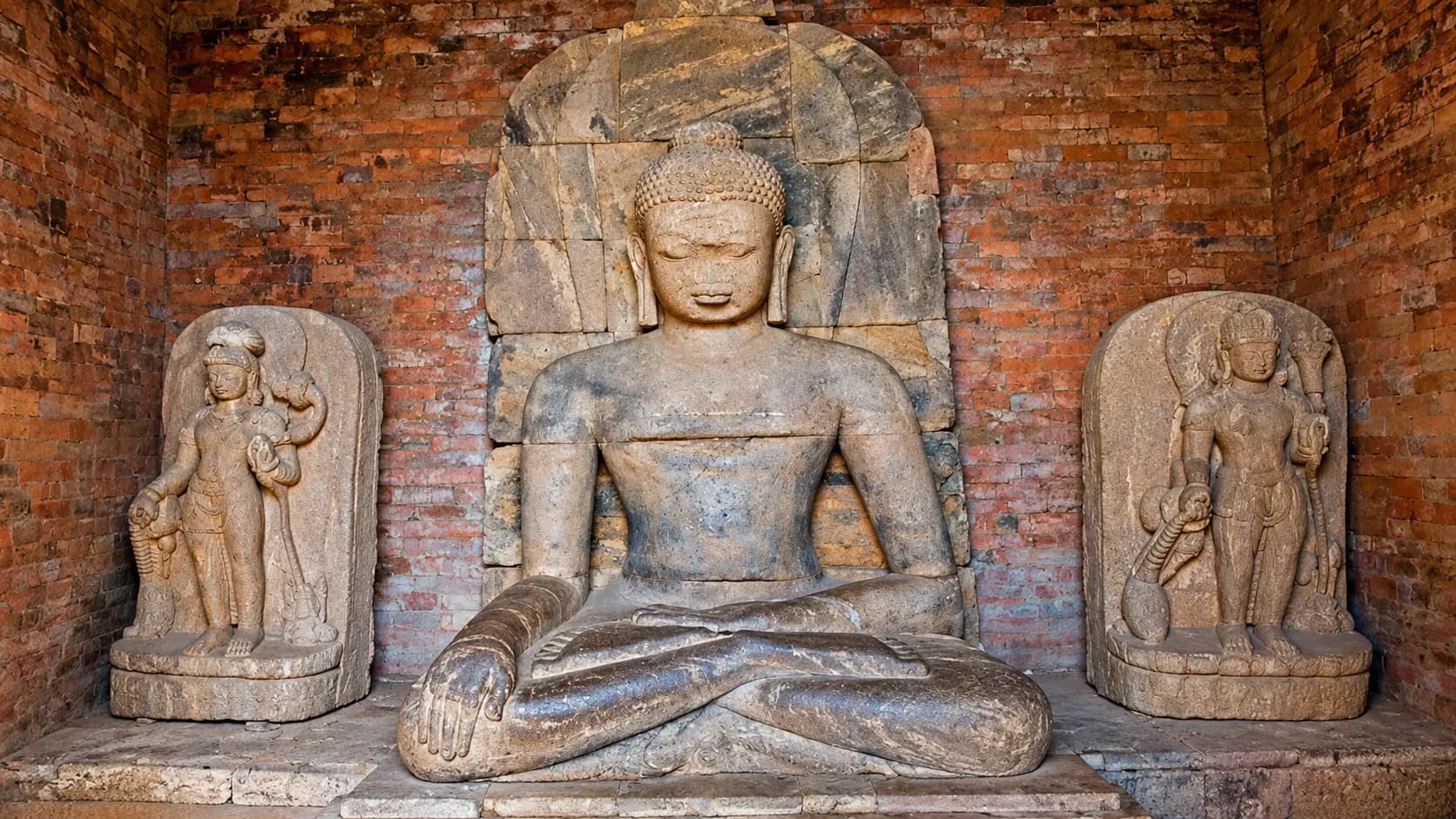
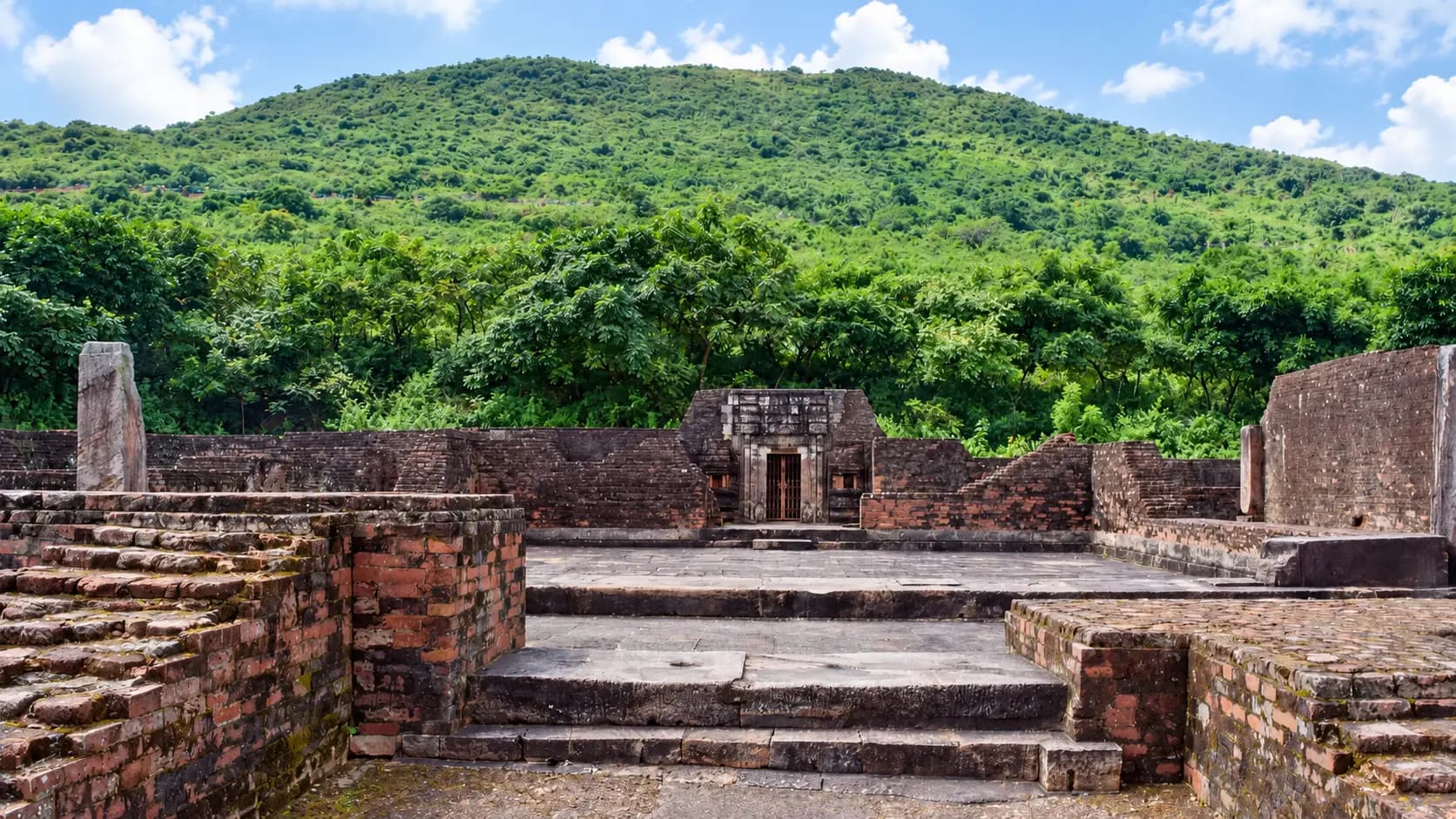
- Monastery 1: Situated adjacent to the stupa terrace, Monastery 1 is a sprawling square monastic quadrangle constructed of finely fired red bricks with stone pillars and stone doorframes. Passing through an ornamental carved entrance porch, visitors emerge onto a wide stone-paved central open-air courtyard surrounded on all four sides by a pillared verandah and 18 residential monk cells. Each cell contains a sleeping platform, lamp niches, and ventilation apertures. At the far rear of the courtyard lies the inner sanctum, guarded by stone doorjambs and enshrining a colossal 2.5-metre-tall seated stone Buddha in Bhumisparsha mudra, surrounded by finely rendered stone attendant deities and celestial figures.
- Monastic Infrastructure: Between the stupa and monastery lie exposed brick drainage channels, subterranean soak pits, grain storage enclosures, and brick cooking platforms, offering an extraordinary window into how monastic communities sustained hundreds of resident monks, novices, and scholars.
The Ancient Rock-Cut Stepped Well (Vapi)
A short walk along the shaded base of the hill within Udayagiri-1 brings you to one of the most distinctive archaeological treasures in coastal eastern India: the ancient rock-cut stepped well (Vapi).
Excavated deep into the natural khondalite bedrock and reinforced with heavy stone masonry, the well measures approximately 9.4 metres square at its rim. A broad, straight stone staircase descends 31 steps directly into the subterranean water table, allowing monks and pilgrims to fetch cool water throughout the blistering summer months.
Above the entrance archway of the stepped well is an impeccably preserved single-line inscription carved in early medieval Nagari characters. The epigraph reads: "Om Ranaka sri Vajranagasya vapi" This inscription explicitly identifies the well as the pious endowment of Ranaka Sri Vajranaga, an influential local feudatory ruler under the imperial Somavamsi dynasty, dating the civic structure to the late 10th or early 11th century CE. The well stands as remarkable proof that regional secular nobility actively financed public utility and water infrastructure to support the Buddhist monastic colleges.
Udayagiri-2: Simhaprashtha Mahavihara and Monastery 2
Crossing a low, grassy natural spur and walking approximately 400 metres southwest of Udayagiri-1 leads to Udayagiri-2, brought to light through major excavation campaigns conducted by the ASI between 1997 and 2004.
- Monastery 2: Even larger in footprint than Monastery 1, this massive monastic complex served as the headquarters of the Simhaprashtha Mahavihara. The structure features a grand entrance portal, a spacious flagged stone courtyard, residential monk chambers, and specialized ceremonial shrines.
- The Internal Circumambulatory Gallery (Pradakshinapatha): What sets Monastery 2 apart architecturally from almost every other monastic ruin in Odisha is the inclusion of an internal brick-paved ambulatory passage wrapping entirely around the main sanctum chamber. This allowed resident monks and visiting pilgrims to perform ritual clockwise circumambulation (pradakshina) around the enshrined Buddha icon within the secure enclosure of the monastery, even during the torrential monsoon storms characteristic of the coastal delta.
- Sculptural Mastery: Excavations in Udayagiri-2 unearthed a wealth of stone sculptures representing the high water mark of late Buddhist iconography. Masterpieces discovered here include radiant standing and seated images of Bodhisattva Avalokiteshvara, Tara (the compassionate saviouress), Manjushri (the deity of transcendent wisdom), Arya Saraswati, Marici, and Vasudhara (the goddess of abundance). Many of these sculptures remain displayed in on-site shrine niches or are preserved within the ASI conservation reserves.
Hillside Rock-Cut Sculptures
Beyond the excavated brick quadrangles, the rocky scarps and cliff faces rising immediately behind Udayagiri-2 feature ancient rock-cut art carved directly into living stone.
A marked footpath ascends gently along the hillside, passing monumental rock-cut bas-reliefs:
- Standing Bodhisattva Avalokiteshvara: A commanding figure carved into an open cliff face, depicted with graceful posture, holding the slender stalk of a blooming lotus in his left hand while displaying the boon-bestowing Varada mudra with his right.
- Rock-Cut Votive Chaityas: Multiple small monolithic stupas chiseled directly out of the bedrock outcrop, created by visiting pilgrims and resident monks as acts of lasting religious merit.
- Panoramic Hilltop Vista: From the upper hillside trails above the rock-cut reliefs, travelers enjoy a commanding panoramic vista across the entire valley: the geometric brick squares of Monastery 1 and 2, the rounded dome of the Maha Stupa, and the emerald expanse of surrounding paddy fields extending toward the distant Birupa River.
Best time to visit
Explore detailsClose details
Seasonal breakdown
Season | Months | Daytime Temp (°C) | Nighttime Temp (°C) | Conditions & Travel Experience |
|---|---|---|---|---|
Peak Winter | November - February | 24°C - 28°C | 14°C - 18°C | Optimal. Pleasant sunny days, cool morning breezes, and ideal conditions for traversing the extensive unshaded walking trails between Udayagiri-1 and Udayagiri-2. |
Early Spring | October & March | 29°C - 33°C | 19°C - 22°C | Good. Moderate heat; mornings and late afternoons are very pleasant for heritage exploration. Carry sun protection for midday hours. |
Pre-Monsoon Summer | April - June | 36°C - 42°C | 26°C - 30°C | Challenging. Intense tropical heat, high humidity, and burning laterite ground glare. Outdoor walking between 11:30 AM and 03:30 PM is exhausting and unshaded. |
Monsoon Season | July - September | 30°C - 34°C | 25°C - 28°C | Lush but Damp. Monsoonal downpours turn the Assia hills brilliantly green, but unpaved pathways become muddy and exposed stone steps can be slippery. |
How to reach
The nearest operational civil airport is Biju Patnaik International Airport (BBI) in Bhubaneswar, located…Explore detailsClose details
By air
The nearest operational civil airport is Biju Patnaik International Airport (BBI) in Bhubaneswar, located approximately 90 km southwest of Udayagiri. Bhubaneswar is connected with frequent direct flights to major Indian metropolitan hubs including New Delhi, Mumbai, Kolkata, Bengaluru, Hyderabad, and Chennai, as well as selected international flights. From the airport terminal, travelers can hire private tourist taxis or pre-booked rental cars to reach Udayagiri in approximately 2 hours via the 6-lane National Highway 16 (NH-16).
By train
Multiple railway stations provide access to Udayagiri depending on your route and train type:
- Dhanmandal Railway Station (DNM): Located about 20 km west of Udayagiri on the Howrah - Chennai mainline, this small station handles local passenger and selected express trains.
- Jajpur Keonjhar Road Railway Station (JJKR): Situated approximately 45 km north of Udayagiri, this major station serves numerous superfast and mail trains traversing the East Coast Railway route.
- Cuttack Junction Railway Station (CTC): Situated approximately 65 km southwest, Cuttack Junction is a premier railway terminus served by high-speed Vande Bharat, Rajdhani, Shatabdi, and express trains from across India. Taxis are easily hired outside Cuttack station for the direct drive to the Buddhist Circuit.
By road
Udayagiri is exceptionally well-connected by road via the Kolkata - Chennai corridor:
- From Bhubaneswar (90 km / 2 hours): Take NH-16 north through Cuttack, crossing the Mahanadi and Birupa bridges, up to the bustling junction town of Chandikhole (approx. 72 km). From Chandikhole, turn east onto the state arterial road toward Balichandrapur for approximately 12 km to reach the Udayagiri turnoff.
- From Cuttack (65 km / 1.5 hours): Follow NH-16 north past Jagatpur and Tangi to Chandikhole, then branch east toward Balichandrapur and Udayagiri.
- From Ratnagiri (11 km / 20 minutes): A well-paved, scenic rural road connects Ratnagiri directly to Udayagiri, winding past peaceful agricultural fields and minor river distributaries.
Circuit connectivity
Most travelers explore Udayagiri as part of the celebrated Diamond Triangle circuit. The geographical proximity of the three premier sites makes them exceptionally easy to combine into a seamless day itinerary:
- Ratnagiri to Udayagiri: ~11 km (approx. 20 minutes drive).
- Udayagiri to Lalitgiri: ~15 km (approx. 25 minutes drive via Balichandrapur).
- Lalitgiri to Ratnagiri: ~14 km (approx. 25 minutes drive across the Birupa River).
Entry, timings and permissions
Fees, visiting hours and entry rules may change.Explore detailsClose details
Fees, visiting hours and entry rules may change. Confirm the latest details with the official operator or local authority before travelling.
- Site Timings: Open every day of the week from sunrise to sunset (typically 06:00 AM to 06:00 PM).
- Entry Fee: Currently, there is no mandatory admission ticket fee charged for entering the open archaeological grounds of the Udayagiri Buddhist Complex. Unlike Ratnagiri and Lalitgiri, which maintain indoor ASI site museums requiring entry tickets, Udayagiri’s excavated monastic monuments are situated in an open, protected archaeological park under the Archaeological Survey of India (Bhubaneswar Circle).
- Permissions & Permits: No prior government or forest department permits are required for Indian or foreign nationals visiting the site.
- Photography & Filming Regulations: Amateur still photography and smartphone videography for personal use are permitted without fee. The use of professional movie camera rigs, commercial promotional shoots, heavy tripods, and drone flights is strictly prohibited across the protected archaeological perimeter without prior written authorization from the Superintending Archaeologist, ASI Bhubaneswar Circle.
Nearby places to consider
Ratnagiri Mahavihara (11 km northeast): The jewel of the Diamond Triangle, featuring Monastery 1's famous carved…Explore detailsClose details
- Ratnagiri Mahavihara (11 km northeast): The jewel of the Diamond Triangle, featuring Monastery 1's famous carved green chlorite doorway, a vast necropolis of over 700 votive stupas, and a magnificent 4-gallery ASI Archaeological Museum displaying over 3,400 unearthed artifacts.
- Lalitgiri Buddhist Complex (15 km south): The earliest Buddhist settlement in the region (dating from the 3rd Century BCE Mauryan era), renowned for its hilltop Mahastupa where sacred relics of Lord Buddha were discovered inside multi-tiered stone caskets, an ancient apsidal brick chaitya hall, and a dedicated ASI museum.
- Langudi Hill (30 km northwest): A fascinating, tranquil rock-cut Buddhist hill site in Jajpur District featuring early rock-cut stupas, rock relief carvings of Emperor Asoka, and panoramic vistas over the alluvial plains.
- Mahavinayak Temple, Chandikhole (14 km west): A revered hillside Hindu temple complex dedicated to the composite worship of five deities (Ganesha, Shiva, Vishnu, Surya, and Durga), surrounded by perennial forest streams and dense woodland.
- Chhatia Bata (22 km southwest): A renowned pilgrimage shrine along NH-16 dedicated to Lord Jagannath, deeply revered across Odisha for its association with the prophetic scriptures (Malika) of the saint Hadi Das.
In pictures
The practical bits
Before you go.
Footwear and Walking Preparation
The Udayagiri archaeological park spans several square kilometres.Explore detailsClose details
The Udayagiri archaeological park spans several square kilometres. Exploring Udayagiri-1, the ancient stepped well, Udayagiri-2, and the hillside cliff reliefs requires between 2.5 and 3.5 km of outdoor walking over unshaded stone paths, manicured lawns, and uneven earthen tracks. Wear sturdy, broken-in walking shoes or cushioned sports shoes. A broad-brimmed sun hat, UV-protective sunglasses, and high-SPF sunscreen are strongly recommended year-round, as there is virtually no tree canopy over the excavated monastic courtyards.
Hydration and Refreshment Management
There are no full-service restaurants, cafeterias, or bottled drink vendors inside the archaeological gates.Explore detailsClose details
There are no full-service restaurants, cafeterias, or bottled drink vendors inside the archaeological gates. A small village kiosk near the vehicle parking area occasionally stocks packaged drinking water and biscuits, but supplies can be unpredictable. Always bring at least 1.5 to 2 litres of drinking water per person in reusable bottles before leaving the highway at Chandikhole. For sit-down dining, travel 11 km to the OTDC Panthanivas or Panthasala at Ratnagiri, or visit the multi-cuisine family dhabas located along NH-16 at Chandikhole.
Circuit Timing and Itinerary Sequencing
Because Udayagiri’s vast grounds require extensive walking under direct sunlight, it is best visited either…Explore detailsClose details
Because Udayagiri’s vast grounds require extensive walking under direct sunlight, it is best visited either during the early morning hours (07:00 AM to 10:00 AM) or late in the afternoon (03:30 PM to 05:30 PM). An ideal full-day Diamond Triangle itinerary begins early at Lalitgiri (8:30 AM), continues to Ratnagiri for mid-day exploration and its air-conditioned ASI museum (11:00 AM to 02:00 PM), and concludes at Udayagiri in the soft golden late-afternoon light (03:30 PM to 05:30 PM), when the western sunlight bathes the Maha Stupa and hill slopes in radiant warm hues.
Restroom and Logistics Advice
Basic public toilet facilities maintained by the ASI are located near the main entrance gate and parking zone.Explore detailsClose details
Basic public toilet facilities maintained by the ASI are located near the main entrance gate and parking zone. However, there are no interior restrooms across the distant Udayagiri-2 or hillside sectors. Mobile cellular reception on Airtel and Jio networks is generally stable across the main ruins (3G/4G), though signal quality can degrade slightly along the rocky cliff bases. Hiring a private chauffeur-driven car for the full day from Cuttack or Bhubaneswar is the most reliable transit strategy, as finding on-demand auto-rickshaws or app-based cabs for the return journey from rural Jajpur is nearly impossible.
A few things you might wonder
Common questions about visiting Udayagiri Buddhist Complex. Fees, visiting hours and ceremonies are researched details that may change; confirm current arrangements with the operator before travelling.
Is Udayagiri Buddhist Complex the same as Udayagiri and Khandagiri Caves in Bhubaneswar?
Is there an entry ticket fee to visit the Udayagiri Buddhist Complex?
How much walking is required to explore Udayagiri thoroughly?
What is the significance of the ancient stepped well at Udayagiri?
Can all three Diamond Triangle sites (Ratnagiri, Udayagiri, and Lalitgiri) be visited in a single day?
Are food and dining options available at Udayagiri?
What makes Monastery 2 at Udayagiri architecturally unique?
What are the best hours of the day to photograph Udayagiri?
Explore more in Buddhist Circuit
Discover other destinations around this hub
More Hubs in Odisha
Continue exploring other travel hubs in this state
Planning a trip to Buddhist Circuit?