Langudi Hill
Comprehensive visitor guide to Langudi Hill in Jajpur, Odisha. Discover the ancient Pushpagiri Mahavihara, 34 rock-cut stupas, Ashokan relics, and timings.
Location
Buddhist Circuit, Odisha
Duration
2 to 3 hours is required to find a local guide, hike up the hill, locate the various scattered rock cut panels, and carefully hike back down to the village.
Best Time
Check current access and weather; no season guarantees safe trail conditions.
Difficulty
Current paths, walking difficulty and step-free access have not been verified.
A closer look
Your visit, at a glance.
Buddhist Circuit, Odisha
GET TO KNOW THE PLACE
Nestled in the quiet, undulating countryside of Jajpur District in eastern Odisha, Langudi Hill (ଲଙ୍ଗୁଡ଼ି ପାହାଡ଼) represents one of the most consequential archaeological…
The story of Langudi Hill
Nestled in the quiet, undulating countryside of Jajpur District in eastern Odisha, Langudi Hill (ଲଙ୍ଗୁଡ଼ି ପାହାଡ଼) represents one of the most consequential archaeological revelations in modern Indian historiography. Rising as an isolated, trapezoidal sandstone ridge between the Kelua and Birupa river distributaries, approximately 8 kilometres west of Jaraka, Langudi was long known to surrounding villagers merely as an overgrown scrub hill bearing ancient carved rocks. However, comprehensive scientific excavations carried out between 1996 and 2006 by the Odisha State Archaeology and the Odishan Institute of Maritime and South East Asian Studies (OIMSEAS) shattered conventional assumptions, establishing Langudi as a monumental Buddhist monastic citadel with deep roots reaching directly into the 3rd Century BCE.
Most famously, Langudi Hill provided the definitive archaeological answer to one of Asian history’s greatest geographic mysteries: the true identity of Pushpagiri Mahavihara. When the revered 7th-century Chinese pilgrim-scholar Xuanzang (Hiuen Tsang) travelled through the kingdom of Wu-t'u (Odra/Odisha) in 639 CE, he documented an illustrious Buddhist university-monastery named Pu-sie-p'o-k'i-li (Pushpagiri). Xuanzang described it as a grand spiritual establishment crowning high mountain crests, where stone stupas emitted miraculous lights and attracted scholars from across the Buddhist world. For over a century, colonial and Indian antiquarians searched in vain for epigraphic proof among the hills of coastal Odisha. The breakthrough came at Langudi, where archaeologists unearthed an ancient terracotta seal and stone fragments bearing early Brahmi inscriptions explicitly reading puṣpa sabhar giriya ("of the flower-adorned mountain") and khamara, conclusively linking the site to Xuanzang’s famed university.
Equally profound is Langudi’s extraordinary material connection to the Mauryan Emperor Ashoka the Great. Following the traumatic Kalinga War of 261 BCE, in which hundreds of thousands perished on the bloody battlefields along the Daya River, Ashoka renounced aggressive warfare (Vijaya) in favour of moral conquest (Dharmavijaya). While rock edicts were carved at Dhauli and Jaugada, material structural evidence of early Ashokan stupa construction in Odisha remained elusive until Langudi was uncovered. Excavators discovered a rare fragmented stone inscription written in early Prakrit and Brahmi characters referencing Upasaka Asokasa ("the lay-disciple Ashoka"), carved alongside a stylized royal relief figure. This monument strongly supports historical traditions that Ashoka personally patronized the foundation of major Buddhist stupas across coastal Kalinga.
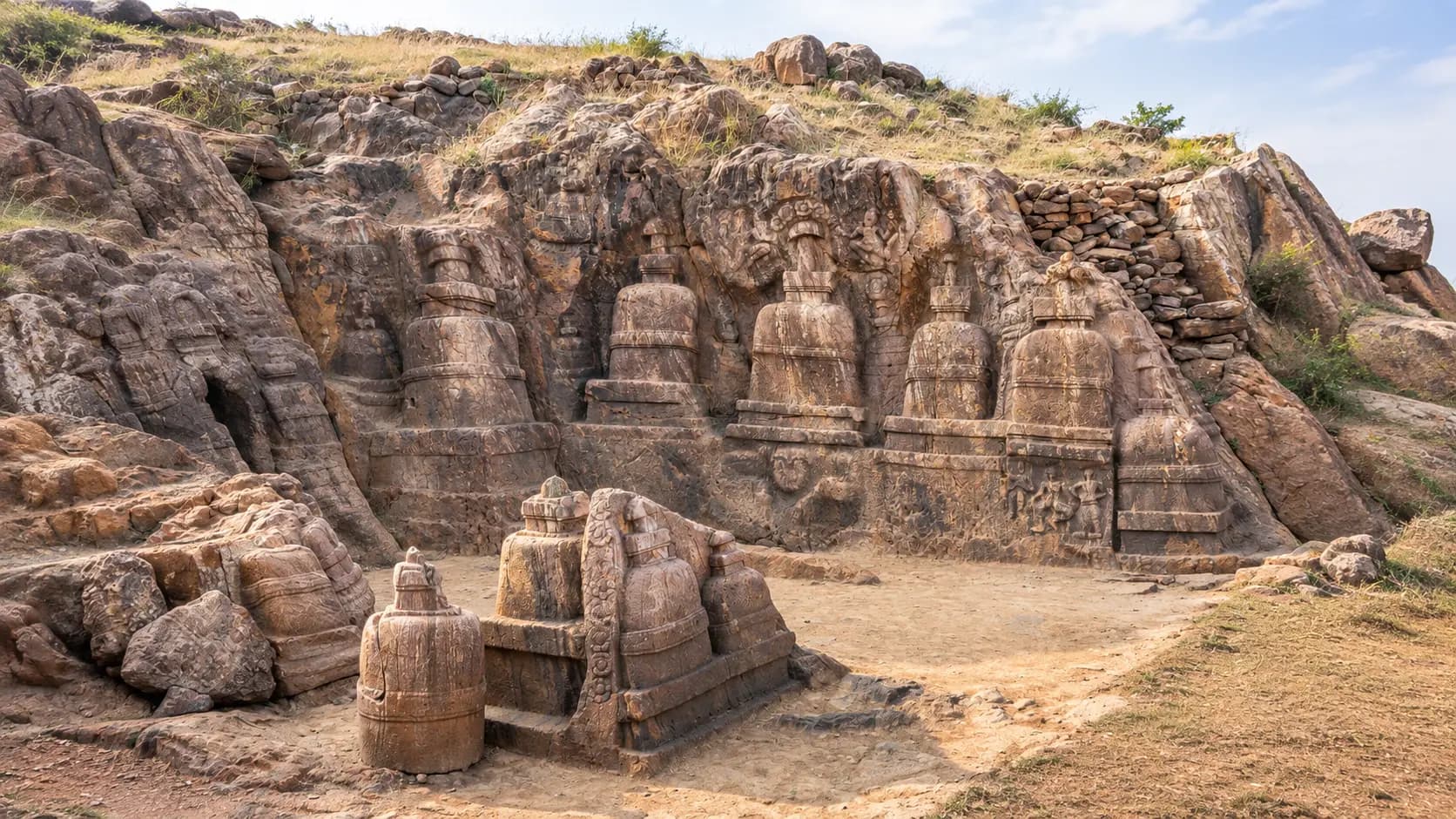
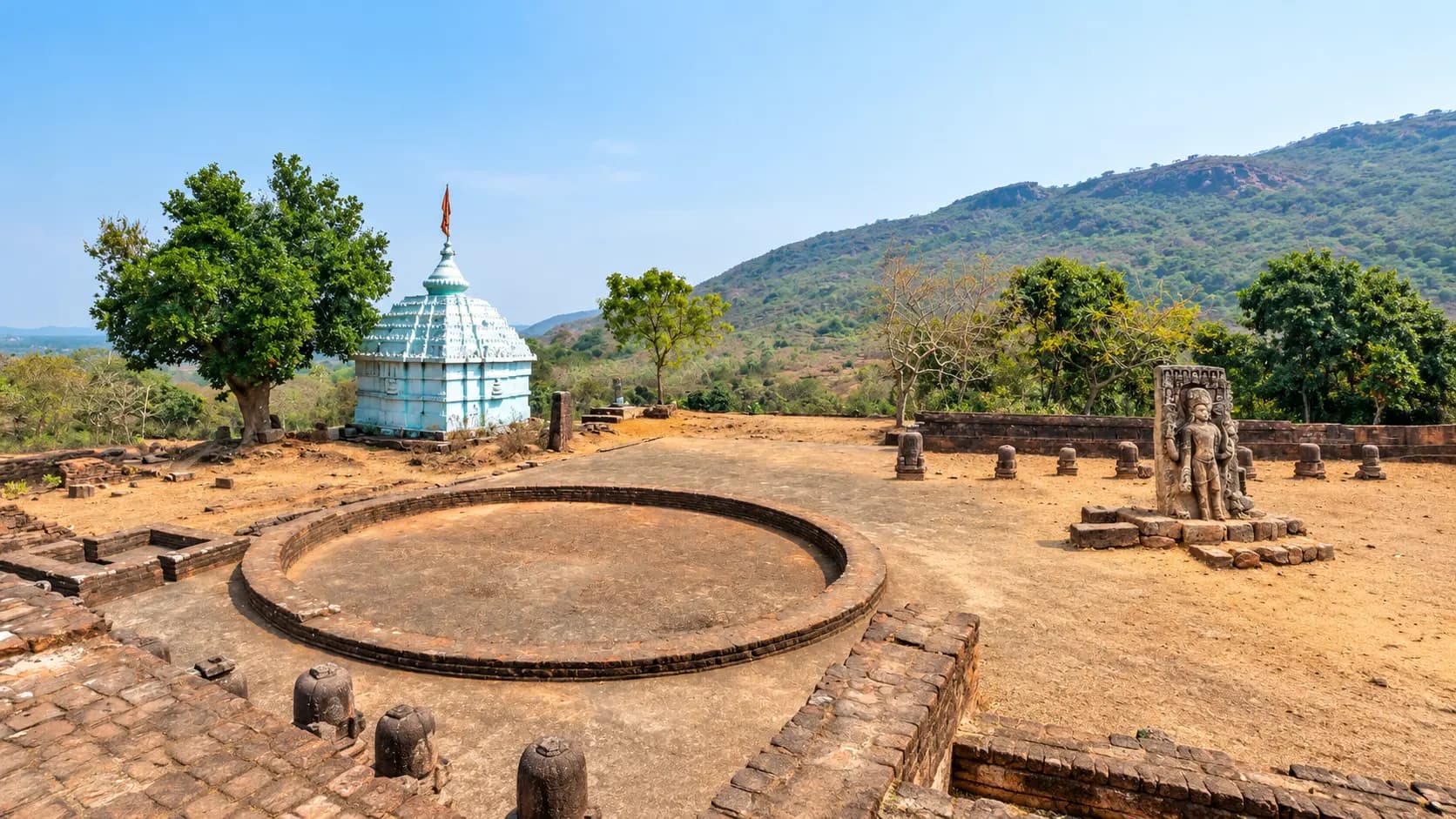
Today, Langudi Hill offers visitors an authentic, evocative open-air archaeological encounter far removed from commercial tourist throngs. Over 34 rock-cut monolithic stupas stand sculpted in continuous friezes along the weathered sandstone cliffs, showcasing early Hinayana symbolic veneration alongside later Mahayana and Vajrayana masterworks. Crowning the hill’s breezy summit plateau are the extensive brick-and-laterite ruins of a central Maha Stupa, apsidal chaityas, and monastic residential halls overlooking endless vistas of emerald paddy fields and meandering river streams.
Start here. Open a tile for the full details.
Why goRead details
Unlike modern reconstruction sites, Langudi retains its raw, untouched archaeological authenticity. Standing on the quiet summit plateau, one can easily visualize the bustling monastic academy described by Xuanzang, where hundreds of yellow-robed monks engaged in vigorous debates on Abhidharma, Yogachara, and early Vajrayana theology amid the natural solitude of the Assia hills.
When to visitRead details
Because Langudi Hill is an open-air natural archaeological monument without covered modern galleries, timing your visit according to seasonal conditions is essential:
Entry & permissionsRead details
Fees, visiting hours and entry rules may change. Confirm the latest details with the official operator or local authority before travelling.
Visiting Langudi Hill is straightforward and completely barrier-free, maintained under state heritage preservation protocols:
+-----------------------------------------------------------------------------------+
|                        LANGUDI HILL OPERATIONAL POLICIES                          |
+------------------------+----------------------------------------------------------+
| Category               | Operational Policy / Guidelines                          |
+------------------------+----------------------------------------------------------+
| Opening Hours          | Open daily from 06:00 AM to 18:00 PM (Sunrise to Sunset) |
+------------------------+----------------------------------------------------------+
| Admission Fees         | 100% FREE ADMISSION for all domestic and foreign visitors|
+------------------------+----------------------------------------------------------+
| Advance Bookings       | No permits or advance online booking required            |
+------------------------+----------------------------------------------------------+
| Photography Policy     | Personal still and mobile photography completely allowed;|
|                        | Commercial film crews require written state clearance    |
+------------------------+----------------------------------------------------------+
| Drone Regulations      | Operating civilian drones/UAVs strictly PROHIBITED       |
|                        | without prior written permission from State Archaeology  |
+------------------------+----------------------------------------------------------+
| Vehicle Parking        | Free open parking space at the base in Mirzapur village  |
+-----------------------------------------------------------------------------------+
Free Public Access
Unlike the centrally ticketed monuments of Lalitgiri and Ratnagiri, admission to Langudi Hill is completely free of charge. There are no ticket kiosks, barrier gates, or admission fees. Visitors can freely enter through the main archaeological gate and ascend the stone stairway at their own pace.
Operational Hours and Daylight Advice
The site is accessible seven days a week from 06:00 AM to 18:00 PM (sunrise to sunset). Because there is no electrical illumination along the hillside stairs or atop the plateau, all visitors must conclude their descent to the base before nightfall for safety reasons.
Monument Protection Regulations
Under the Odisha Ancient Monuments and Archaeological Sites and Remains Act, defacing ancient rock carvings, scratching graffiti on sandstone, removing loose bricks from stupas, or disturbing archaeological layers is a punishable legal offense. Visitors are requested to treat this ancient sanctuary with utmost reverence.
Plan your visitRead details
Langudi Hill is located in the Dharmasala administrative sector of Jajpur District, easily accessible from National Highway 16:
Explore the full guide - choose a topic below.
Why visit?
For travelers, historians, and pilgrims, walking upon Langudi Hill is a journey to a site that solved an ancient…Explore detailsClose details
The Historic Epigraphic Discovery of Pushpagiri Mahavihara
For travelers, historians, and pilgrims, walking upon Langudi Hill is a journey to a site that solved an ancient geographical puzzle. Visiting the excavated terraces where the puṣpa sabhar giriya seal was unearthed connects travelers directly with the classical age of Buddhist intellectual history, when Kalinga stood shoulder-to-shoulder with Nalanda, Taxila, and Vikramashila as a premier university of Buddhist philosophy.
Unlike modern reconstruction sites, Langudi retains its raw, untouched archaeological authenticity. Standing on the quiet summit plateau, one can easily visualize the bustling monastic academy described by Xuanzang, where hundreds of yellow-robed monks engaged in vigorous debates on Abhidharma, Yogachara, and early Vajrayana theology amid the natural solitude of the Assia hills.
The Phenomenal Array of 34 Rock-Cut Cliff Stupas
The definitive visual hallmark of Langudi Hill is its breathtaking collection of 34 rock-cut monolithic stupas sculpted directly out of the living sandstone cliffs. Ranging in height from 1 metre to over 3 metres, these stupas are carved along both the southern and northern escarpments of the hill, presenting an almost continuous horizontal gallery of Buddhist sacred art.
The stupas exhibit a clear stylistic and chronological evolution:
- Early Hinayana Stupas (3rd - 1st Century BCE): Characterized by simple, unadorned cylindrical drums, hemispherical domes (Andas), and flat square railings (Harmikas) topped by stylized umbrella shafts (Chhatras). These early stupas were worshipped aniconically, representing the Buddha through sacred geometric architectural form rather than anthropomorphic figures.
- Later Mahayana and Vajrayana Stupas (5th - 9th Century CE): Adorned with intricately carved niches harboring miniature reliefs of seated Dhyani Buddhas, lotus medallions, beaded borders, and celestial flying gandharvas bearing floral garlands.
The Rare Ashokan Inscription and Royal Relief
Langudi preserves one of the rarest historical curiosities in eastern Indian archaeology: an early Brahmi epigraphic inscription and rock-cut panel widely interpreted as depicting Emperor Ashoka. Located on the southern cliff face, the inscription reads Upasaka Asokasa Samchiamana agra eka thupe, commemorating the consecration or conservation of a premier stupa by the royal lay devotee Ashoka.
Adjacent to the inscription is a weathered rock-cut relief carving depicting an aristocratic royal figure attended by two chauri-bearing female servitors. While Ashoka’s edicts are well documented across India, figurative contemporary or near-contemporary stone depictions associated with his name are extraordinarily rare, making this panel a site of immense pilgrimage and academic significance.
Masterworks of Rock-Cut Buddhist Sculpture
Along with stupas, the natural sandstone rock shelters and quarry terraces of Langudi feature monumental high-relief sculptures carved by master Odishan sculptors during the Bhauma-Kara dynasty:
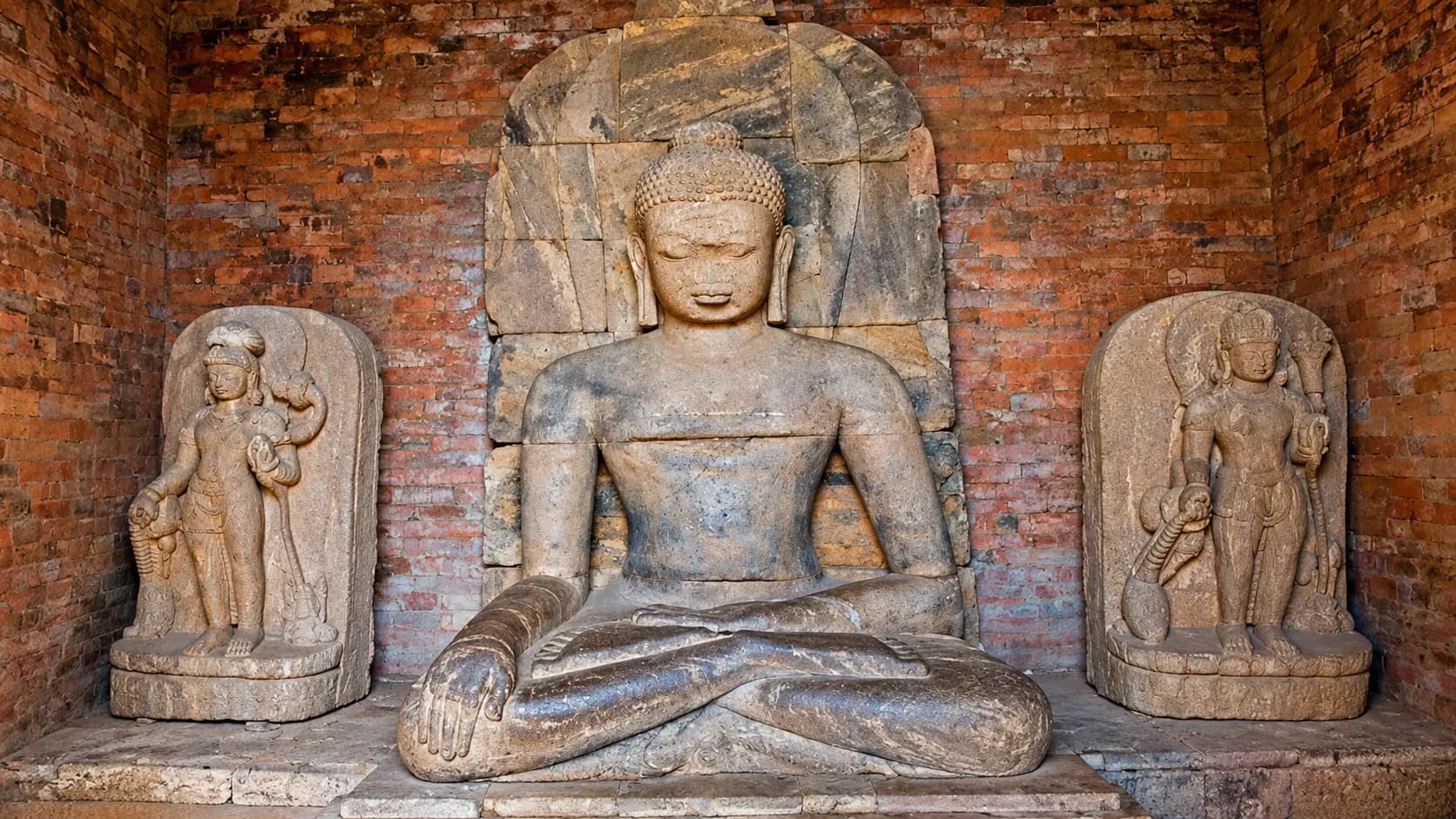
- Buddha in Dhyana Mudra: A magnificent, deeply serene seated Buddha figure carved in a natural cliff recess, depicted with hands resting gently in his lap in the posture of profound meditation (Samadhi), flanked by hovering celestial garland-bearers.
- Bodhisattva Avalokiteshvara: A graceful standing Bodhisattva holding the stalk of a blossoming lotus (Padmapani), embodying universal compassion.
- Goddess Prajnaparamita: The personification of transcendent wisdom, depicted with four arms holding sacred palm-leaf manuscripts and displaying divine gestures.
- Goddess Tara: Represented in several relief panels as the saviouress from earthly and oceanic perils, reflecting the close ties between Odishan Buddhist monasteries and maritime merchants navigating the Bay of Bengal.
The Summit Monastic Complex and Maha Stupa
Ascending to the central crest of the hill reveals the vast structural foundations of the residential university:
- The Brick Maha Stupa: A colossal brick-built circular stupa with a wide circumambulatory pathway (Pradakshina Patha) that once dominated the entire skyline of the Birupa valley.
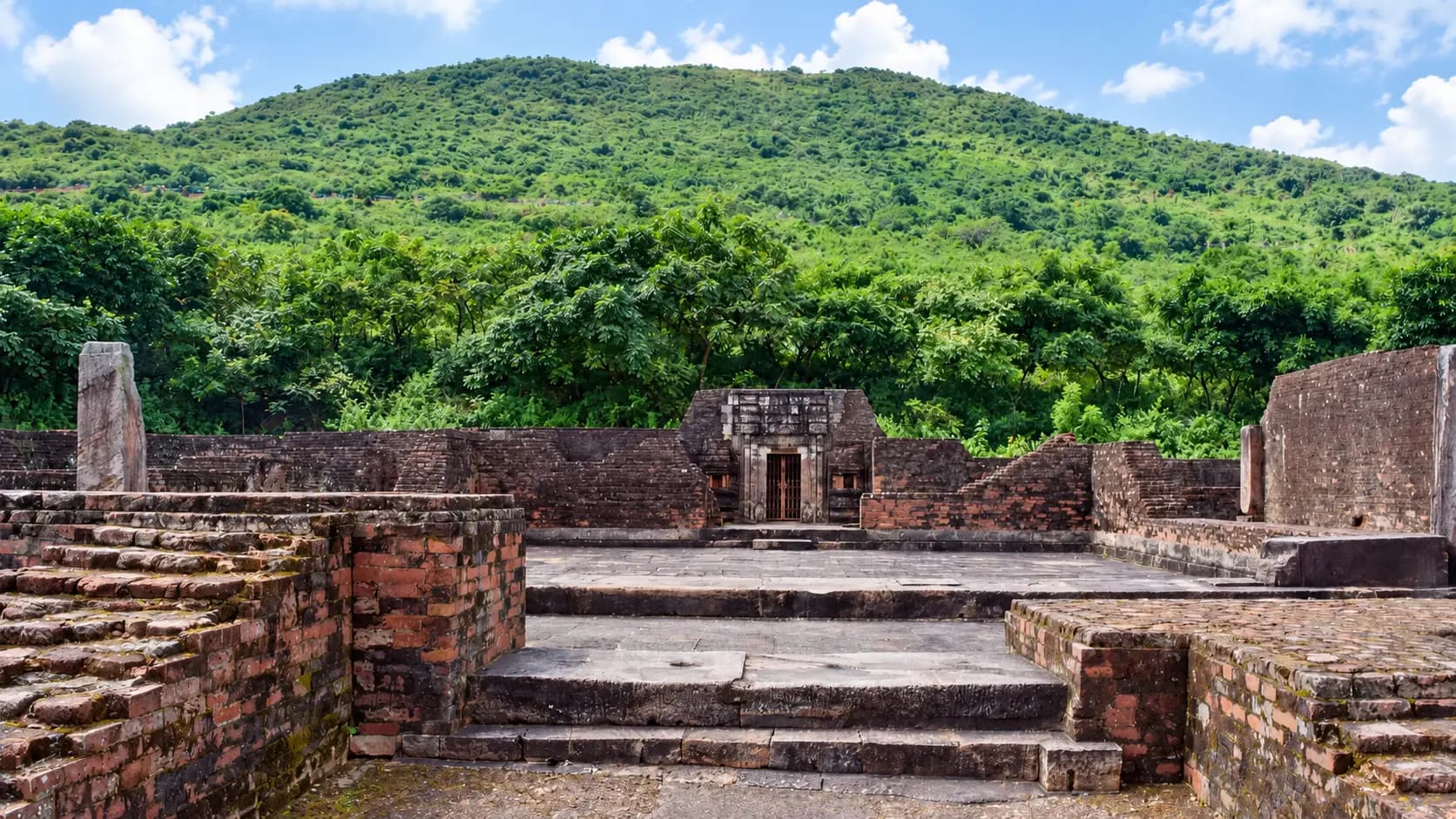
- Monastic Quadrangles: Excavated brick foundations displaying monk dormitories, pillared meeting halls, communal prayer chambers, brick-lined drainage conduits, and a deep circular rock-cut water cistern engineered to harvest monsoon rainwater for the monastic community.
What to expect
Visiting Langudi Hill is an open-air archaeological exploration across an untamed, natural hill setting…Explore detailsClose details
Visiting Langudi Hill is an open-air archaeological exploration across an untamed, natural hill setting:
+-----------------------------------------------------------------------------------+
|                        LANGUDI HILL MONUMENT HIGHLIGHTS                           |
+-----------------------------------------------------------------------------------+
| Section                    | Key Features & Sights                                |
+----------------------------+------------------------------------------------------+
| Base Parking & Entry Gate  | Open parking area in Mirzapur village, state         |
|                            | archaeology boundary gate, and historical signage.   |
+----------------------------+------------------------------------------------------+
| Southern Rock-Cut Terrace  | Frieze of 34 rock-cut stupas, the Ashokan relief,    |
| (Main Cliff Pathway)       | early Brahmi epigraphs, and Bodhisattva niches.      |
+----------------------------+------------------------------------------------------+
| Summit Plateau Ruins       | Brick foundations of the central Maha Stupa,         |
| (Pushpagiri Vihara)        | apsidal chaitya hall, monk cells, and water cistern. |
+----------------------------+------------------------------------------------------+
| Northern Rock Shelters     | Secluded meditation caves, rock-cut Dhyani Buddhas   |
| (Meditation Caves)         | in Samadhi mudra, and scenic Birupa River views.     |
+-----------------------------------------------------------------------------------+
Arrival and Ascent
Visitors arrive at the southern base of Langudi Hill via a peaceful rural road winding through the agricultural hamlet of Mirzapur. A modest boundary wall and gate maintained by the Odisha State Archaeology mark the entrance to the protected site.
From the base, a stone-paved stairway with protective iron railings ascends gently up the southern rock terrace. The climb is easy to moderate, rising roughly 30 to 45 metres above the valley floor over a 10-to-15-minute walk. As you climb, the low scrub gives way to exposed sandstone cliffs where the ancient rock-cut stupas suddenly come into view.
The Rock-Cut Stupa Frieze and Sculptures
The lower cliff trail brings you face-to-face with the spectacular rock-cut stupa panels. The stupas are carved directly into the living red-and-buff sandstone rock face, standing side-by-side in rhythmic progression. Looking closely at the rock surfaces reveals ancient chisel marks and fine decorative details - such as miniature umbrella finials, floral lotus rosettes, and early Brahmi lettering - that have miraculously survived two thousand years of monsoon weathering.
Continuing along the cliff terrace, visitors encounter the carved shrines harboring peaceful stone Buddhas and Bodhisattvas. The natural shade of the overhanging rock ledges provides a cool, tranquil respite where visitors can sit and study the remarkable carving techniques.
The Hilltop Plateau and Panoramic Delta Vistas
Reaching the flat summit of the hill reveals the expansive layout of the excavated monastery. Here, the red-brick foundations of the Maha Stupa and residential cells spread across the open hilltop. From this elevated vantage point, the view across the surrounding landscape is breathtaking: the winding silver ribbons of the Kelua and Birupa rivers glisten in the distance, bordered by endless emerald-green rice paddies and distant blue hill ranges, creating a profound sense of peaceful isolation.
Best time to visit
Because Langudi Hill is an open-air natural archaeological monument without covered modern galleries, timing your…Explore detailsClose details
Because Langudi Hill is an open-air natural archaeological monument without covered modern galleries, timing your visit according to seasonal conditions is essential:
Season | Months | Weather, Trail Conditions & Visitor Experience |
|---|---|---|
Winter Peak (Best Time) | October to March | Temperature: 15°C - 28°C. Mild sunshine, cool pleasant hill breezes. Ideal for walking cliff trails, examining rock inscriptions, and exploring the summit plateau. |
Summer Season (Hot & Arid) | April to June | Temperature: 28°C - 42°C. Intense radiant heat on sandstone rock and zero shade on summit. Visit strictly at 06:30 AM; avoid all midday travel due to extreme solar radiation. |
Monsoon Season (Scenic Greens & Slippery) | July to September | Temperature: 25°C - 33°C. Dramatic overcast skies, lush verdant foliage. Rock steps can be slick; carry an umbrella and wear sturdy shoes with deep rubber traction treads. |
Winter Season (October to March) - The Golden Window
The winter months offer the ideal climate for visiting Langudi Hill. Temperatures remain exceptionally comfortable, rarely exceeding 26°C to 28°C during midday and dropping to a refreshing 15°C in the morning and evening. The air is dry and clear, providing magnificent panoramic visibility across the river valleys.
This is the perfect season to combine Langudi with a broader day tour of Jajpur’s Buddhist and Shakta landmarks, including the Diamond Triangle sites of Ratnagiri, Udayagiri, and Lalitgiri, or the historic temple city of Jajpur Town (Biraja Temple).
Summer Season (April to June) - Scorching Heat
Summer in inland Jajpur brings intense heatwaves with daytime temperatures routinely soaring to 40°C or 42°C. The bare sandstone cliffs and brick ruins absorb intense heat, creating punishing thermal glare.
If visiting during summer, arrive immediately at 06:00 or 06:30 AM at sunrise to explore the rock-cut panels in the cool early dawn, and depart the hill by 08:30 AM before the sun climbs high in the sky. Carry ample drinking water and electrolyte solutions.
Monsoon Season (July to September) - Lush Riverine Greenery
The monsoon transforms the dusty countryside into an intensely green tropical landscape. The Kelua and Birupa rivers run full, and the vegetation surrounding Langudi Hill bursts into vivid life. Rain-washed sandstone displays deep reddish-ochre tones, making the rock carvings stand out with dramatic photographic clarity.
However, visitors must exercise caution on the stone pathways and rocky cliff ledges, which develop a thin sheen of slippery green algae during wet periods. Sturdy trekking shoes with aggressive rubber treads are essential.
How to reach
Langudi Hill is located in the Dharmasala administrative sector of Jajpur District, easily accessible from…Explore detailsClose details
Langudi Hill is located in the Dharmasala administrative sector of Jajpur District, easily accessible from National Highway 16:
+-----------------------------------------------------------------------------------+
|                        REGIONAL GATEWAYS & HIGHWAY ACCESS                         |
|                                                                                   |
|   Biju Patnaik Airport (BBI), Bhubaneswar          Cuttack Junction Railway (CTC) |
|            (~90 km / 2.0 hrs via NH-16)                 (~65 km / 1.5 hrs drive)  |
+------------------------------------------+----------------------------------------+
                                           |
                                           v
+-----------------------------------------------------------------------------------+
|                           MAJOR HIGHWAY HUB: JARAKA                               |
|   Situated along NH-16 (Kolkata-Chennai) ~18 km north of Chandikhole              |
+------------------------------------------+----------------------------------------+
                                           |
                                           | (8 km west on paved rural road)
                                           v
+-----------------------------------------------------------------------------------+
|                         MIRZAPUR VILLAGE & LANGUDI BASE                           |
|   Turn toward Mirzapur hamlet; direct paved approach terminating at hill base     |
+------------------------------------------+----------------------------------------+
                                           |
                                           | (10-minute stone staircase walk)
                                           v
+-----------------------------------------------------------------------------------+
|                              LANGUDI HILL MONUMENT                                |
|        Rock-Cut Stupa Frieze | Ashoka Relief | Summit Pushpagiri Mahastupa        |
+-----------------------------------------------------------------------------------+
By Air
The closest airport offering regular domestic and international commercial flights is Biju Patnaik International Airport (BBI) in Bhubaneswar, located approximately 90 kilometres south of Langudi. Bhubaneswar is connected by direct flights to major Indian cities including New Delhi, Mumbai, Kolkata, Bengaluru, Hyderabad, and Chennai. Pre-booked air-conditioned taxis or rental cars take approximately 2 hours to reach Langudi via National Highway 16 through Cuttack and Chandikhole.
By Rail
Travelers arriving by train can utilize two major mainline railway stations:
- Jajpur Keonjhar Road Railway Station (station code: JJKR): Situated approximately 35 kilometres north, JJKR is a major junction on the South Eastern Railway / East Coast Railway trunk line, served by numerous express and superfast trains connecting Kolkata with southern and western India. Taxis from JJKR reach Langudi in about 45 to 50 minutes via NH-16.
- Cuttack Junction Railway Station (station code: CTC): Located approximately 65 kilometres southwest, Cuttack offers comprehensive connectivity across the entire Indian Railways network. Taxis reach Langudi in approximately 1.5 hours.
- Local Railheads: Local passenger trains halt at nearby stations like Haridaspur (15 km) and Dhanmandal (20 km), from where local auto-rickshaws can be hired to Jaraka and Langudi.
By Road
Road connectivity to Langudi Hill is straightforward:
- Driving from Bhubaneswar / Cuttack (65 - 90 km): Travel north along the multi-lane divided National Highway 16 (NH-16). Pass Cuttack and continue past Chandikhole for 18 kilometres until you reach the bustling town of Jaraka (Dharmasala). At Jaraka junction, turn west onto the well-paved rural road leading toward Mirzapur. Follow the road through peaceful villages for 8 kilometres to the open parking area at the base of Langudi Hill.
- Connecting with the Diamond Triangle: Langudi Hill is situated just 20 to 25 kilometres northwest of Udayagiri and Ratnagiri, making it seamless to include as the fourth jewel in an extended Buddhist circuit itinerary.
Entry, timings and permissions
Fees, visiting hours and entry rules may change.Explore detailsClose details
Fees, visiting hours and entry rules may change. Confirm the latest details with the official operator or local authority before travelling.
Visiting Langudi Hill is straightforward and completely barrier-free, maintained under state heritage preservation protocols:
+-----------------------------------------------------------------------------------+
|                        LANGUDI HILL OPERATIONAL POLICIES                          |
+------------------------+----------------------------------------------------------+
| Category               | Operational Policy / Guidelines                          |
+------------------------+----------------------------------------------------------+
| Opening Hours          | Open daily from 06:00 AM to 18:00 PM (Sunrise to Sunset) |
+------------------------+----------------------------------------------------------+
| Admission Fees         | 100% FREE ADMISSION for all domestic and foreign visitors|
+------------------------+----------------------------------------------------------+
| Advance Bookings       | No permits or advance online booking required            |
+------------------------+----------------------------------------------------------+
| Photography Policy     | Personal still and mobile photography completely allowed;|
|                        | Commercial film crews require written state clearance    |
+------------------------+----------------------------------------------------------+
| Drone Regulations      | Operating civilian drones/UAVs strictly PROHIBITED       |
|                        | without prior written permission from State Archaeology  |
+------------------------+----------------------------------------------------------+
| Vehicle Parking        | Free open parking space at the base in Mirzapur village  |
+-----------------------------------------------------------------------------------+
Free Public Access
Unlike the centrally ticketed monuments of Lalitgiri and Ratnagiri, admission to Langudi Hill is completely free of charge. There are no ticket kiosks, barrier gates, or admission fees. Visitors can freely enter through the main archaeological gate and ascend the stone stairway at their own pace.
Operational Hours and Daylight Advice
The site is accessible seven days a week from 06:00 AM to 18:00 PM (sunrise to sunset). Because there is no electrical illumination along the hillside stairs or atop the plateau, all visitors must conclude their descent to the base before nightfall for safety reasons.
Monument Protection Regulations
Under the Odisha Ancient Monuments and Archaeological Sites and Remains Act, defacing ancient rock carvings, scratching graffiti on sandstone, removing loose bricks from stupas, or disturbing archaeological layers is a punishable legal offense. Visitors are requested to treat this ancient sanctuary with utmost reverence.
Nearby places to consider
Langudi Hill is situated within a dense corridor of monumental Buddhist monasteries, ancient river ports, and…Explore detailsClose details
Langudi Hill is situated within a dense corridor of monumental Buddhist monasteries, ancient river ports, and Shakti pilgrimage centres:
                            [ Historic Jajpur Town & Biraja Temple ]
                          (Ancient capital of Kalinga & Shakti Peetha,
                                       30 km northeast)
                                             ▲
                                             │
[ Chandikhole & Mahavinayak ] ◄─────── [ Langudi Hill ] ───────► [ Ratnagiri & Udayagiri ]
(Sacred valley Ganesha shrine,               │                  (Premier Buddhist Mahaviharas,
  18 km southwest)                           │                     20 to 25 km southeast)
                                             ▼
                                  [ Gokarneswar Temple ]
                                (Historic 9th-century Shiva
shrine in Dharmasala, 8 km)- Udayagiri Buddhist Complex (~20 km southeast): The largest excavated monastic valley in Odisha, featuring a colossal 3-metre-tall stone Buddha, stepped wells (Vapi), stupa terraces, and Monasteries 1 and 2 (Madhavapura Mahavihara).
- Ratnagiri Buddhist Mahavihara (~25 km southeast): The world-famous jewel of the Diamond Triangle, celebrated for its magnificent carved emerald-green chlorite doorway, monumental seated Buddha, hundreds of stone votive stupas, and a rich ASI museum.
- Lalitgiri Buddhist Complex (~28 km south): The oldest monastic settlement in the region, featuring the hilltop Maha Stupa where sacred golden relic caskets of Lord Buddha were discovered, a rare apsidal chaitya, and an ASI museum.
- Maa Biraja Temple, Jajpur Town (~30 km northeast): The supreme spiritual landmark of Jajpur, this revered Shakta shrine is one of India’s most ancient Shakti Peethas (the Nabhi Gaya), venerating the two-armed Goddess Durga spearing the demon Mahishasura.
- Mahavinayak Temple, Chandikhole (~18 km southwest): A historic Shaivite and Ganapatya pilgrimage shrine nestled in a forested ravine near Chandikhole, famous for a sacred swayambhu stone embodying five Hindu deities.
- Gokarneswar Temple, Jaraka (~8 km east): A picturesque 9th-century Bhauma-Kara era Shiva temple situated along the sandy banks of the Brahmani River near Dharmasala.
In pictures
The practical bits
Before you go.
Plan ahead
To make your trip to Langudi Hill comfortable and culturally enriching, observe these practical preparation…Explore detailsClose details
To make your trip to Langudi Hill comfortable and culturally enriching, observe these practical preparation recommendations:
Self-sufficiency and hydration
Langudi is an undeveloped rural heritage site with zero commercial shops, running drinking water kiosks, or…Explore detailsClose details
Langudi is an undeveloped rural heritage site with zero commercial shops, running drinking water kiosks, or modern restrooms on the hill; carry at least two litres of drinking water per person, dry snacks, and personal medication from Jaraka.
Footwear and trail navigation
Wear sturdy walking shoes or hiking sandals with dependable rubber tread; exploring the rock-cut stupa cliff…Explore detailsClose details
Wear sturdy walking shoes or hiking sandals with dependable rubber tread; exploring the rock-cut stupa cliff trail and the upper plateau involves navigating rough stone staircases, gravel pathways, and exposed sandstone ridges.
Sun protection essentials
The summit plateau and cliff terraces face direct sunlight throughout the day with minimal canopy shade; equip…Explore detailsClose details
The summit plateau and cliff terraces face direct sunlight throughout the day with minimal canopy shade; equip yourself with a wide-brimmed sun hat, UV sunglasses, and high-SPF sunscreen, particularly if visiting outside the winter peak.
Timing your photography
For the finest photographic results, visit in the morning between 07:30 and 10:30 AM when the soft morning light…Explore detailsClose details
For the finest photographic results, visit in the morning between 07:30 and 10:30 AM when the soft morning light strikes the south-facing rock-cut stupas and Buddha reliefs, highlighting fine chisel textures and Brahmi inscriptions without harsh vertical shadows.
Pair with the Diamond Triangle and Jajpur heritage
Combine Langudi with nearby heritage gems in Jajpur District: start early at Langudi Hill (08:00 AM), explore the…Explore detailsClose details
Combine Langudi with nearby heritage gems in Jajpur District: start early at Langudi Hill (08:00 AM), explore the colossal monasteries of Ratnagiri and Udayagiri (midday), and conclude your afternoon at the sacred Maa Biraja Temple in historic Jajpur town.
A few things you might wonder
Common questions about visiting Langudi Hill. Fees, visiting hours and ceremonies are researched details that may change; confirm current arrangements with the operator before travelling.
What is the historical connection between Langudi Hill and the ancient Pushpagiri university?
How many rock-cut stupas are carved at Langudi Hill, and what are their features?
Is there an entrance fee to visit Langudi Hill, and what are the operating hours?
What is the significance of the Ashokan inscription found on the hill?
What facilities are available for tourists at Langudi Hill?
How far is Langudi Hill from Bhubaneswar, Cuttack, and the Diamond Triangle?
Is climbing Langudi Hill difficult for elderly visitors or children?
Can tourists combine Langudi Hill with other attractions in Jajpur District?
Explore more in Buddhist Circuit
Discover other destinations around this hub
More Hubs in Odisha
Continue exploring other travel hubs in this state
Planning a trip to Buddhist Circuit?