Lalitgiri
Comprehensive visitor guide to Lalitgiri in Cuttack, Odisha. Explore the ancient Mahastupa, sacred bone relics, apsidal chaitya, monasteries, and ASI museum.
Location
Buddhist Circuit, Odisha
A closer look
Your visit, at a glance.
Buddhist Circuit, Odisha
GET TO KNOW THE PLACE
Rising serenely above the fertile alluvial plains of the Birupa and Chitrotpala rivers in Cuttack District, Lalitgiri (historically recorded as Lalitagiri or Nalitgiri) stands as…
The story of Lalitgiri
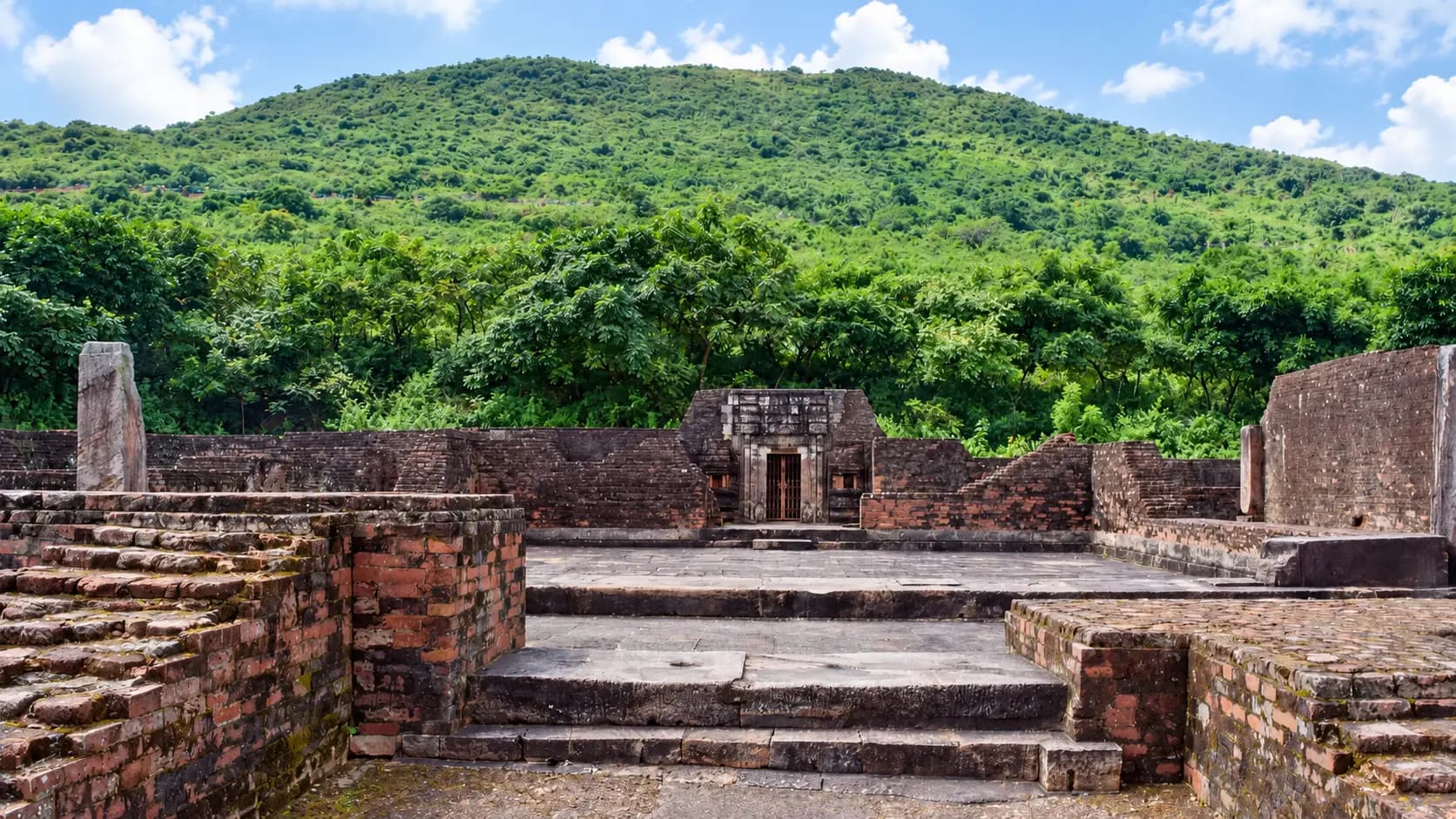
Rising serenely above the fertile alluvial plains of the Birupa and Chitrotpala rivers in Cuttack District, Lalitgiri (historically recorded as Lalitagiri or Nalitgiri) stands as one of the most venerable and historically profound Buddhist archaeological sanctuaries in South Asia. Occupying the gentle undulating slopes and rocky crest of Landa Hill, Lalitgiri forms the premier and oldest anchor of Odisha’s celebrated "Diamond Triangle" (Ratnagiri - Udayagiri - Lalitgiri). While neighbouring Ratnagiri flourished as a dazzling centre of Tantric Vajrayana art in the early medieval era and Udayagiri sprawled as an immense stepped monastic valley, Lalitgiri possesses a continuous, unbroken chronology of Buddhist life extending from the post-Mauryan and Sunga-Kushana eras (3rd - 2nd Century BCE) all the way to the 13th Century CE - a remarkable millennium-and-a-half of living Dhamma.
Lalitgiri captured global archaeological and spiritual attention between 1985 and 1991, when systematic excavations conducted by the Archaeological Survey of India (ASI) yielded an extraordinary discovery within the core masonry of the hilltop Maha Stupa. Deep inside the stone fabric, archaeologists unearthed three monumental stone caskets. Nestled inside one of these khondalite outer containers was an exquisite series of nested boxes - a steatite casket holding a silver box, which in turn protected a miniature solid gold casket. Inside this golden receptacle lay tiny sacred charred bone fragments preserved in resin: the bodily relics (Saririka Dhatu) of Lord Buddha or his foremost disciples. This stupendous discovery elevated Lalitgiri into the rarefied league of Piprahwa, Vaishali, and Amaravati, establishing beyond doubt that ancient Kalinga was a pivotal crucible of early Buddhist pilgrimage.
Historically, many leading historians and epigraphists identify the Diamond Triangle complex with the glorious monastic university chronicled by Chinese pilgrim-monk Xuanzang (Hiuen Tsang), who traversed coastal Odra in 639 CE. Xuanzang wrote of Pu-sie-p'o-k'i-li (Pushpagiri), a grand mountain monastery where magnificent stone stupas stood atop isolated hill peaks, emitting miraculous lights and attracting pilgrims from across Asia. Excavations at Lalitgiri have yielded monastic clay sealings reading Sri Chandraditya Vihara Samagragyata Bhikshu Sanghasya, demonstrating that the hill supported multiple flourishing viharas subsidized by royal land grants from the Gupta, Bhauma-Kara, and Somavamsi monarchs.
Today, Lalitgiri offers travelers and pilgrims an exceptionally tranquil, uncrowded archaeological experience. Spanning landscaped hillside terraces maintained by the Archaeological Survey of India, the complex encompasses the monumental hilltop Maha Stupa with panoramic vistas of the surrounding delta, an exceedingly rare 2nd-century apsidal Chaityagriha, four excavated monastic quadrangles with stone monk cells, and the state-of-the-art Archaeological Museum at Lalitgiri, inaugurated in December 2018 to house the sacred relic caskets in a secure vault alongside masterworks of Buddhist sculpture.
Start here. Open a tile for the full details.
Why goRead details
Today, visitors to the newly constructed on-site Archaeological Museum can view these sacred caskets - from the massive outer khondalite containers to the delicate inner silver and gold capsules - displayed within a specialized bulletproof, climate-controlled sanctum. Standing before these caskets offers a deeply moving encounter with the tangible physical antiquity of the Buddhist faith.
When to visitRead details
Because Lalitgiri involves walking along open-air stone pathways and climbing the exposed rocky terraces of Landa Hill, choosing the right time of year is essential for a comfortable and rewarding visit:
Entry & permissionsRead details
Fees, visiting hours and entry rules may change. Confirm the latest details with the official operator or local authority before travelling.
Visitor access to Lalitgiri is regulated by the Archaeological Survey of India (ASI) under the Ancient Monuments and Archaeological Sites and Remains (AMASR) Act:
+-----------------------------------------------------------------------------------+
|                        LALITGIRI OPERATIONAL RULES & TARIFFS                      |
+------------------------+----------------------------------------------------------+
| Category               | Regulatory Policy / Guidelines                           |
+------------------------+----------------------------------------------------------+
| Excavated Site Hours   | Open daily from 09:00 AM to 17:00 PM (Sunrise to Sunset) |
+------------------------+----------------------------------------------------------+
| ASI Museum Hours       | Open 09:00 AM to 17:00 PM; STRICTLY CLOSED ON FRIDAYS    |
+------------------------+----------------------------------------------------------+
| Combined Entry Ticket  | ₹15 - ₹25 per Indian adult / SAARC / BIMSTEC visitors;     |
| (Site & Museum)        | Free for children under 15; ₹200 - ₹300 for foreigners     |
+------------------------+----------------------------------------------------------+
| Photography Policy     | Still camera: Allowed (No flash permitted in relic room);|
|                        | Video tripods require prior written ASI authorization    |
+------------------------+----------------------------------------------------------+
| Drone Regulations      | Flying drones or UAVs strictly PROHIBITED across the     |
|                        | protected monument perimeter without ASI clearances      |
+------------------------+----------------------------------------------------------+
| Vehicle Parking        | Gated parking area outside monument entrance (nominal fee|
|                        | of ₹10 - ₹20 for private cars and two-wheelers)            |
+-----------------------------------------------------------------------------------+
Combined Admission Tariffs
The ASI operates a single integrated ticket that covers admission to both the open-air archaeological ruins on Landa Hill and the indoor Archaeological Museum. Entry fees are exceptionally modest:
- Indian Citizens & Visitors from SAARC / BIMSTEC Nations: ₹15 to ₹25 (discounted when paid digitally via UPI / QR code at the counter).
- Children (under 15 years): Free entry upon presenting proof of age if requested.
- Foreign Tourists: ₹200 to ₹300.
Tickets can be purchased on the spot at the entrance pavilion or booked in advance through the official ASI monument portal (asi.nic.in).
Crucial Notice: Friday Museum Closure
Travelers planning their itinerary must note that while the outdoor archaeological site and hilltop stupa are open every single day of the week, the indoor Archaeological Museum at Lalitgiri is strictly closed on Fridays. Because viewing the sacred relic caskets in the museum is one of the premier highlights of Lalitgiri, visiting on Saturday through Thursday is strongly recommended.
Plan your visitRead details
Lalitgiri is located in the Mahanga sector of Cuttack District, well connected to the state capital and trunk transportation routes:
Explore the full guide - choose a topic below.
Why visit?
The crowning spiritual distinction of Lalitgiri is its status as a genuine relic depository (Dhatu Chaitya) of…Explore detailsClose details
The Sacred Relic Discovery of Lord Buddha
The crowning spiritual distinction of Lalitgiri is its status as a genuine relic depository (Dhatu Chaitya) of the Enlightened One. In Buddhist cosmology, stupas housing bodily remains (Saririka) are endowed with the highest sanctity, representing the living presence of the Tathagata. During the 1985 - 1991 ASI excavations, the discovery of the three nested stone caskets placed Lalitgiri at the pinnacle of Buddhist pilgrimage in eastern India.
Today, visitors to the newly constructed on-site Archaeological Museum can view these sacred caskets - from the massive outer khondalite containers to the delicate inner silver and gold capsules - displayed within a specialized bulletproof, climate-controlled sanctum. Standing before these caskets offers a deeply moving encounter with the tangible physical antiquity of the Buddhist faith.
The Monumental Hilltop Maha Stupa
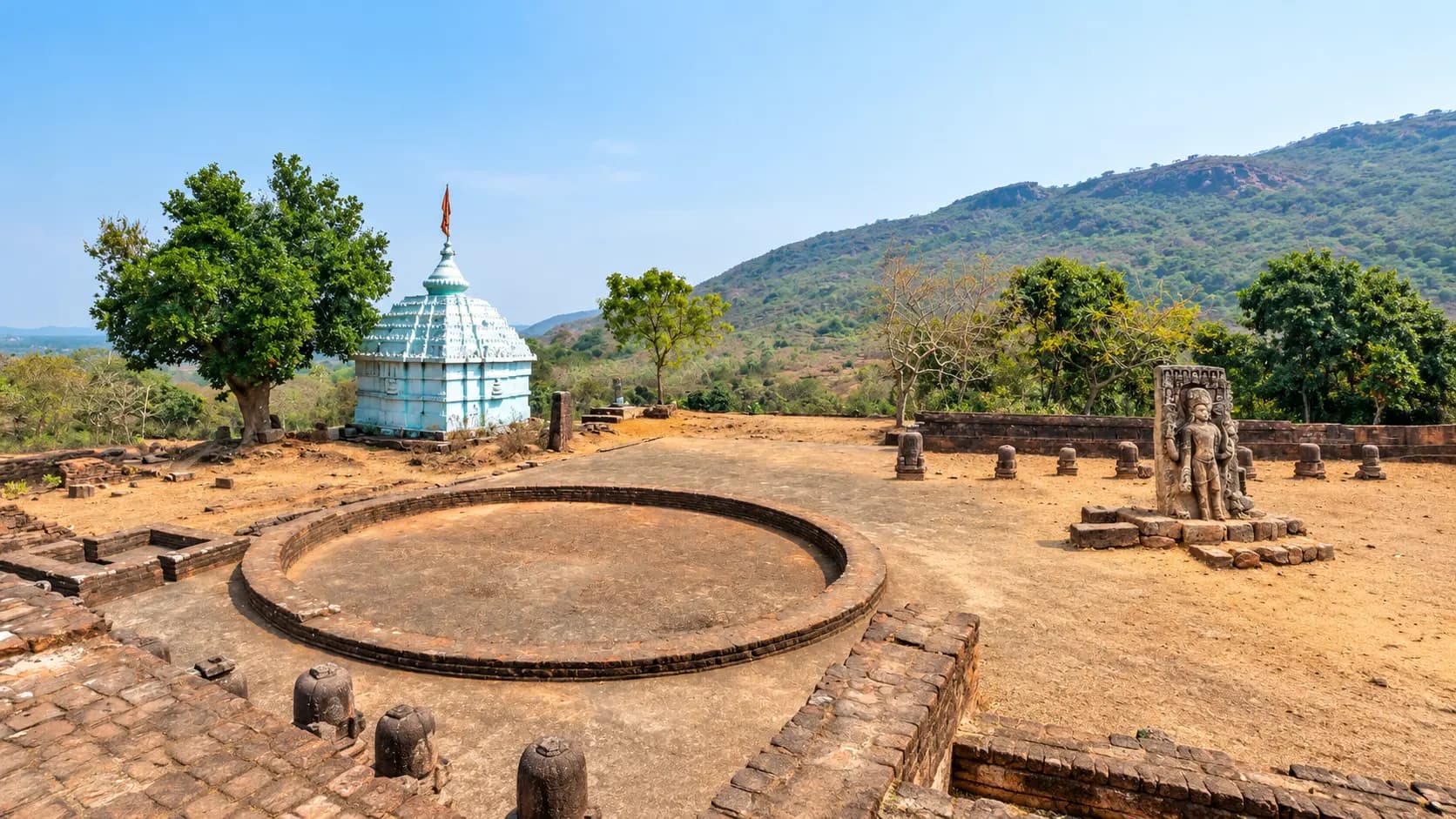
Perched majestically at an elevation of 85 metres atop the summit of Landa Hill, the Maha Stupa serves as Lalitgiri’s geographic and visual compass. Constructed originally around the 2nd to 1st Century BCE and later enlarged with stone casing during the Gupta period, the stupa features a massive circular khondalite base measuring 15 metres in diameter.
A paved stone pathway and a flight of well-graded stone steps lead visitors from the valley floor up through shaded trees to the stupa terrace. From the summit, the eye sweeps across 360-degree panoramas of emerald-green paddy fields, meandering river channels, and the distant purplish ridges of the Assia hills. Sitting in the cool, silent hill breeze beside this ancient stone dome provides an atmosphere of timeless meditative solitude rarely found at busier tourist monuments.
The Rare Apsidal Chaityagriha
Archaeologically, Lalitgiri boasts one of the very few surviving structural apsidal prayer halls (Chaityagrihas) in eastern India. While rock-cut apsidal chaityas are famous in western Indian caves like Karle, Bhaja, and Ajanta, free-standing structural brick-and-stone apsidal temples from the early centuries of the Common Era are exceedingly rare in northern and eastern India.
Excavated on an elevated terrace between the monasteries, the Chaityagriha measures over 33 metres in length and features an elongated rectangular nave terminating in a semicircular apse that encloses a circular stone stupa. Inscriptions engraved in early Kushana Brahmi characters confirm that this sacred hall was active during the 2nd Century CE, demonstrating the monumental architectural sophistication achieved by early Kalingan builders.
Four Sprawling Monastic Complexes (Viharas)
Lalitgiri preserves four distinct excavated monasteries (designated Monasteries 1, 2, 3, and 4), providing exceptional insight into the daily liturgical and residential life of ancient Buddhist monks:
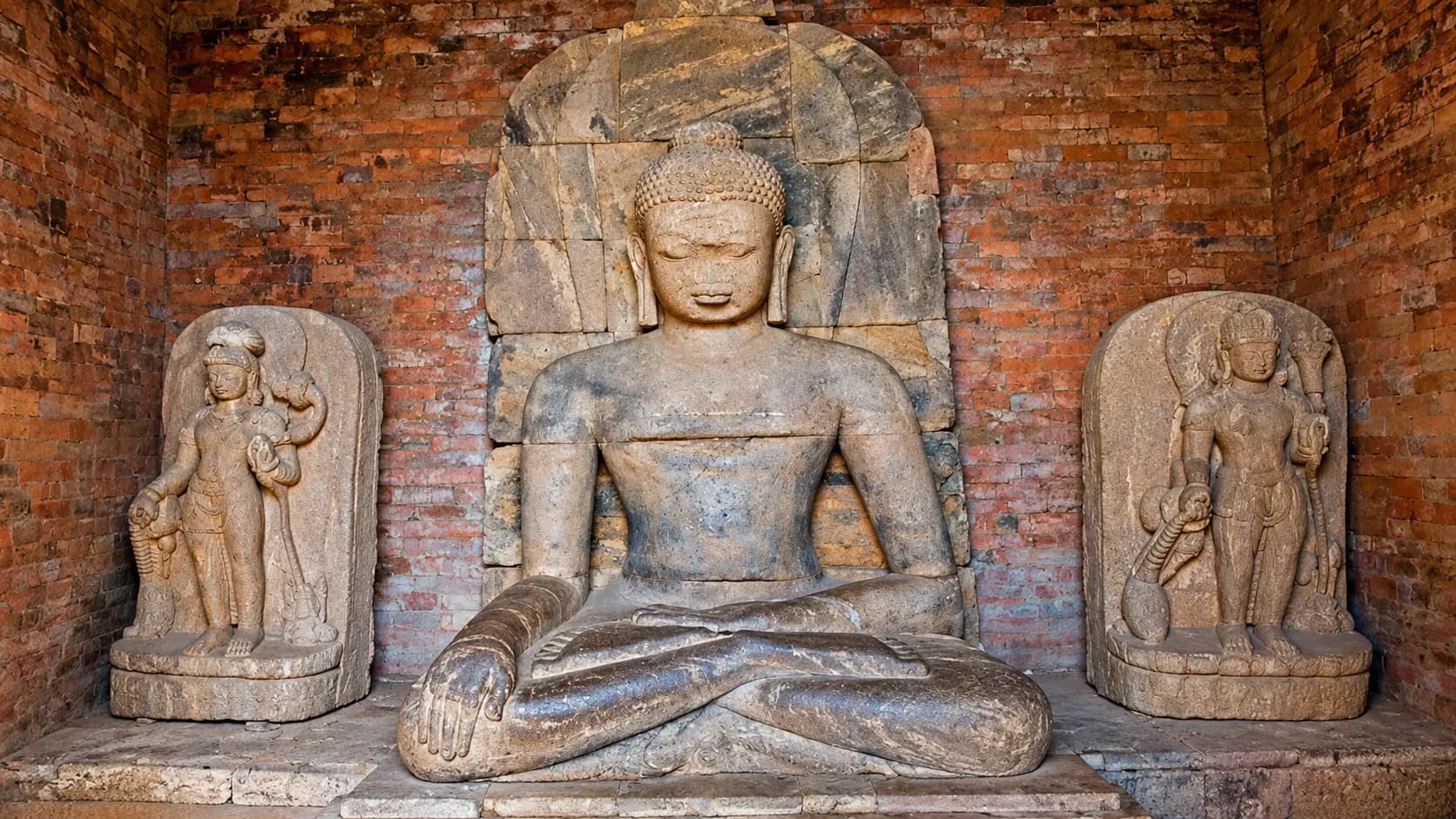
- Monastery 1: The largest and most elaborate vihara, constructed as a two-storeyed structure with a spacious open-air stone-paved central courtyard surrounded by 20 residential monk cells (Bhikshu Grihas), a pillared verandah, a stone water reservoir, and a main sanctum enshrining a monumental seated Buddha.
- Monastery 2 & 3: Feature stepped drainage channels, monastic kitchens, storage granaries, and specialized meditation rooms dating from the post-Gupta and Bhauma-Kara eras.
- Monastery 4: Situated near the hill base, this complex preserves monumental stone sculptures, decorative floral doorway lintels, and structural plinths showing continuous architectural renovations over eight centuries.
Masterworks of Buddhist Sculpture
The sculptures recovered from Lalitgiri rank among the finest artistic achievements of classical Indian stone art. Carved from fine-grained khondalite, the statues reflect the graceful transition from early Mahayana iconographic restraint to the intricate, multi-armed pantheon of Vajrayana (Tantric) Buddhism.
Visitors can admire colossal standing Buddhas draped in diaphanous, clinging monastic robes (Sanghati) reminiscent of Sarnath Gupta aesthetics, along with splendid representations of Bodhisattva Avalokiteshvara holding a lotus, eight-armed Tara, four-armed Manjushri, Prajnaparamita (Goddess of Transcendent Wisdom), ferocious Aparajita trampling Ganesha, and benign wealth deities like Jambhala and Hariti.
What to expect
Visiting Lalitgiri offers an unhurried, deeply contemplative archaeological journey spread across open-air…Explore detailsClose details
Visiting Lalitgiri offers an unhurried, deeply contemplative archaeological journey spread across open-air terraces and a world-class site museum:
+-----------------------------------------------------------------------------------+
|                        LALITGIRI COMPLEX VISITOR HIGHLIGHTS                       |
+-----------------------------------------------------------------------------------+
| Section                    | Key Features & Architectural Sights                  |
+----------------------------+------------------------------------------------------+
| Entry Plaza & ASI Counter  | Ticket booth, vehicle parking plaza, shaded gardens, |
|                            | and orientation display boards outlining site history|
+----------------------------+------------------------------------------------------+
| Archaeological Site Museum | 3 modern galleries housing the golden relic caskets, |
| (Closed on Fridays)        | masterwork Bodhisattva statues, seals, and coins.    |
+----------------------------+------------------------------------------------------+
| Monastic Quadrangles       | Monasteries 1 - 4 featuring stone courtyards, monk     |
| (Viharas 1, 2, 3 & 4)      | cells, ancient water drainage, and sanctum shrines.  |
+----------------------------+------------------------------------------------------+
| Apsidal Chaityagriha       | Rare 2nd-century structural apsidal prayer hall with |
|                            | Kushana Brahmi inscriptions and an interior stupa.   |
+----------------------------+------------------------------------------------------+
| Summit Maha Stupa          | Circular khondalite stupa atop Landa Hill (85 m)     |
| (Landa Hill Peak)          | offering panoramic 360-degree views of river delta.  |
+-----------------------------------------------------------------------------------+
Arrival and Garden Pathways
Upon arriving at Lalitgiri, visitors park in a peaceful rural grove just outside the ASI boundary wall. The complex is immaculately maintained with sprawling green lawns, paved stone pathways, flowering frangipani trees, and decorative hedges framing the base of Landa Hill.
After purchasing tickets at the ASI counter, visitors can choose to begin with the indoor museum or ascend the stone pathways leading toward the excavated ruins. Audio-visual kiosks and high-resolution interpretive boards positioned along the walkways describe each structural layer with architectural plan diagrams.
Exploring the Excavated Ruins on Landa Hill
The walking circuit winds upward through the monastic complexes:
- The Lower Monasteries (Monasteries 3 & 4): Located near the lower slope, these ruins showcase the massive stone threshold slabs, drainage spouts, and monk dormitories where thousands of resident scholars lived and studied.
- The Apsidal Chaitya: Situated on a flat terrace halfway up the hill, the semicircular curving walls of this structural temple immediately catch the eye. Walking through the open brick nave toward the central stone stupa reveals the serene architectural balance of early Hinayana and Mahayana worship.
- Monastery 1: The grand central vihara impresses with its massive stone gateway, beautifully carved guardian figures, and expansive flagstone courtyard where communal monastic assemblies were held.
- The Hilltop Maha Stupa: A stone-stepped stairway with protective handrails ascends to the crest of Landa Hill. Standing beside the massive khondalite drum of the stupa, visitors can perform a traditional silent circumambulation (Pradakshina) while admiring the wide, green horizon of the Birupa valley.
The ASI Site Museum Experience
The Archaeological Museum at Lalitgiri, inaugurated in December 2018, is a world-class facility spanning three expansive, climate-controlled galleries:
- Central Relic Gallery: The focal point of the museum, featuring the four-tier nested relic caskets displayed in a secure bulletproof glass vitrine with specialized illumination and detailed cross-sectional archaeological drawings explaining their nested discovery inside the Maha Stupa.
- Sculpture Galleries: Showcase dozens of exquisitely preserved life-size stone statues of Buddha, Tara, Maitreya, and Avalokiteshvara, along with votive stone stupas, terracotta monastic seals, Gupta-era pottery, and iron implements.
Best time to visit
Because Lalitgiri involves walking along open-air stone pathways and climbing the exposed rocky terraces of Landa…Explore detailsClose details
Because Lalitgiri involves walking along open-air stone pathways and climbing the exposed rocky terraces of Landa Hill, choosing the right time of year is essential for a comfortable and rewarding visit:
Season | Months | Weather, Hill Conditions & Travel Advice |
|---|---|---|
Winter Peak (Best Time) | October to March | Temperature: 15°C - 28°C. Clear skies, mild sunshine, cool hill breezes. Ideal for walking ruins, climbing to the stupa, and touring the Diamond Triangle circuit. |
Summer Season (Avoid Midday) | April to June | Temperature: 28°C - 42°C. Intense radiant heat on stone ruins and hill rocks. If visiting, arrive strictly at 09:00 AM; tour the indoor museum during peak midday hours. |
Monsoon Season (Scenic Greens & Slippery) | July to September | Temperature: 25°C - 32°C. Intermittent heavy rainfall, lush verdant hills and dramatic clouds. Stone stairs can be slick; carry an umbrella and sturdy slip-resistant footwear. |
Winter Season (October to March) - The Golden Window
The winter months represent the undisputed premier season to experience Lalitgiri. Daytime temperatures range from a pleasant 20°C to 28°C, while mornings and evenings are comfortably crisp at 15°C. The air is dry and clear, allowing stunning long-distance visibility across the Birupa and Mahanadi plains from the hilltop stupa.
This is the optimal season to undertake a comprehensive full-day exploration of the Diamond Triangle, comfortably combining Lalitgiri with the nearby monastic complexes of Ratnagiri (18 km north) and Udayagiri (13 km north) without experiencing heat exhaustion.
Summer Season (April to June) - Intense Heat
Summer in inland coastal Odisha is characterized by scorching temperatures exceeding 38°C to 42°C, accompanied by dry inland winds. The exposed stone courtyards, laterite foundations, and rocky slopes of Landa Hill absorb solar radiation, making walking outdoors during the afternoon hours punishing.
Check the current visiting hours and permitted access with the site operator before departure; ceremonies, closures and visitor sessions can affect access.
Monsoon Season (July to September) - Verdant Splendour
The southwest monsoon washes the Assia hills in vibrant emerald greens. The surrounding paddy fields are submerged in sparkling water, and low monsoon rainclouds frequently drift across the summit of the Maha Stupa, creating an extraordinarily atmospheric, poetic setting.
However, monsoon travelers must exercise caution when walking on ancient stone flagstones and moss-covered rock steps, which become slick when wet. Wear footwear with deep rubber treads and carry a reliable rain umbrella.
How to reach
Lalitgiri is located in the Mahanga sector of Cuttack District, well connected to the state capital and trunk…Explore detailsClose details
Lalitgiri is located in the Mahanga sector of Cuttack District, well connected to the state capital and trunk transportation routes:
+-----------------------------------------------------------------------------------+
|                        REGIONAL GATEWAYS & HIGHWAY ACCESS                         |
|                                                                                   |
|   Biju Patnaik Airport (BBI), Bhubaneswar          Cuttack Junction Railway (CTC) |
|            (~95 km / 2.0 hrs via NH-16)                 (~55 km / 1.25 hrs drive) |
+------------------------------------------+----------------------------------------+
                                           |
                                           v
+-----------------------------------------------------------------------------------+
|                           MAJOR HIGHWAY HUB: CHANDIKHOLE                          |
|   Intersection of NH-16 (Kolkata-Chennai) & NH-5A (Paradip Port Expressway)       |
+------------------------------------------+----------------------------------------+
                                           |
                                           | (12 km east on NH-5A to Balichandrapur)
                                           v
+-----------------------------------------------------------------------------------+
|                         SUB-DISTRICT ROAD: BALICHANDRAPUR                         |
|   Turn south-east onto rural asphalt road through picturesque village hamlets     |
+------------------------------------------+----------------------------------------+
                                           |
                                           | (6 km paved rural road / 10 mins)
                                           v
+-----------------------------------------------------------------------------------+
|                            LALITGIRI BUDDHIST COMPLEX                             |
|        Gated Parking Plaza | ASI Ticket Counter | Museum | Landa Hill Stupa       |
+-----------------------------------------------------------------------------------+
By Air
The closest airport offering regular domestic and international flight connectivity is Biju Patnaik International Airport (BBI) in Bhubaneswar, located approximately 95 kilometres southwest of Lalitgiri. Bhubaneswar connects directly to New Delhi, Mumbai, Kolkata, Bengaluru, Hyderabad, Chennai, and Pune, as well as international destinations like Dubai, Singapore, and Bangkok. From the airport terminal, pre-paid taxis and rental cars take approximately 2 hours to reach Lalitgiri via National Highway 16 and NH-5A.
By Rail
Lalitgiri is conveniently approached from two mainline railway junctions:
- Cuttack Junction Railway Station (station code: CTC): Located 55 kilometres southwest, Cuttack is a major hub on the Howrah - Chennai trunk route served by premier express trains (Vande Bharat, Shatabdi, Coromandel Express). Taxis from Cuttack reach Lalitgiri in about 1 hour and 15 minutes via NH-16.
- Jajpur Keonjhar Road Railway Station (station code: JJKR): Situated 50 kilometres northwest, this station is convenient for travelers arriving from northern Odisha and West Bengal, with road access taking approximately 1 hour via Chandikhole.
By Road
The road network connecting Lalitgiri is smooth and predominantly four-lane divided highway:
- Driving from Bhubaneswar / Cuttack (55 - 95 km): Follow National Highway 16 (NH-16) north past Cuttack to the major transportation junction of Chandikhole (40 km north of Cuttack). At Chandikhole, branch east onto National Highway 5A (NH-5A, the Paradip Expressway) and proceed for 12 kilometres to the bustling rural market of Balichandrapur. At Balichandrapur, turn southeast onto the well-paved district road and follow signposts for 6 kilometres directly to Lalitgiri.
- Circuit Route from Ratnagiri and Udayagiri: Lalitgiri connects seamlessly with the other two jewels of the Diamond Triangle. A scenic rural road crosses the Birupa River bridge, linking Lalitgiri to Udayagiri (13 km north) and onward to Ratnagiri (18 km north), allowing travelers to easily complete all three major Buddhist sites in a single day.
Entry, timings and permissions
Fees, visiting hours and entry rules may change.Explore detailsClose details
Fees, visiting hours and entry rules may change. Confirm the latest details with the official operator or local authority before travelling.
Visitor access to Lalitgiri is regulated by the Archaeological Survey of India (ASI) under the Ancient Monuments and Archaeological Sites and Remains (AMASR) Act:
+-----------------------------------------------------------------------------------+
|                        LALITGIRI OPERATIONAL RULES & TARIFFS                      |
+------------------------+----------------------------------------------------------+
| Category               | Regulatory Policy / Guidelines                           |
+------------------------+----------------------------------------------------------+
| Excavated Site Hours   | Open daily from 09:00 AM to 17:00 PM (Sunrise to Sunset) |
+------------------------+----------------------------------------------------------+
| ASI Museum Hours       | Open 09:00 AM to 17:00 PM; STRICTLY CLOSED ON FRIDAYS    |
+------------------------+----------------------------------------------------------+
| Combined Entry Ticket  | ₹15 - ₹25 per Indian adult / SAARC / BIMSTEC visitors;     |
| (Site & Museum)        | Free for children under 15; ₹200 - ₹300 for foreigners     |
+------------------------+----------------------------------------------------------+
| Photography Policy     | Still camera: Allowed (No flash permitted in relic room);|
|                        | Video tripods require prior written ASI authorization    |
+------------------------+----------------------------------------------------------+
| Drone Regulations      | Flying drones or UAVs strictly PROHIBITED across the     |
|                        | protected monument perimeter without ASI clearances      |
+------------------------+----------------------------------------------------------+
| Vehicle Parking        | Gated parking area outside monument entrance (nominal fee|
|                        | of ₹10 - ₹20 for private cars and two-wheelers)            |
+-----------------------------------------------------------------------------------+
Combined Admission Tariffs
The ASI operates a single integrated ticket that covers admission to both the open-air archaeological ruins on Landa Hill and the indoor Archaeological Museum. Entry fees are exceptionally modest:
- Indian Citizens & Visitors from SAARC / BIMSTEC Nations: ₹15 to ₹25 (discounted when paid digitally via UPI / QR code at the counter).
- Children (under 15 years): Free entry upon presenting proof of age if requested.
- Foreign Tourists: ₹200 to ₹300.
Tickets can be purchased on the spot at the entrance pavilion or booked in advance through the official ASI monument portal (asi.nic.in).
Crucial Notice: Friday Museum Closure
Travelers planning their itinerary must note that while the outdoor archaeological site and hilltop stupa are open every single day of the week, the indoor Archaeological Museum at Lalitgiri is strictly closed on Fridays. Because viewing the sacred relic caskets in the museum is one of the premier highlights of Lalitgiri, visiting on Saturday through Thursday is strongly recommended.
Nearby places to consider
Lalitgiri is situated at the gateway to eastern Odisha’s premier Buddhist and medieval cultural landscape: […Explore detailsClose details
Lalitgiri is situated at the gateway to eastern Odisha’s premier Buddhist and medieval cultural landscape:
                            [ Ratnagiri Monastery & Museum ]
                          (Magnificent green chlorite portal & stupas,
                                    18 km north)
                                       ▲
                                       │
[ Chandikhole & Mahavinayak ] ◄─── [ Lalitgiri ] ───► [ Udayagiri Monastic Complex ]
(Sacred Ganesha shrine,               │               (Colossal rock-cut Buddha & wells,
  18 km west)                         │                 13 km northeast)
                                      ▼
                           [ Olasuni Hill & Gumpha ]
                         (Saint Arakhita Dasa ashram,
12 km southeast)- Udayagiri Buddhist Complex (~13 km northeast): The largest excavated Buddhist monastic complex in Odisha, sprawling across the foothills of the Assia range. Features a colossal 3-metre-tall stone Buddha, rock-cut stepped wells (Vapi), stupa terraces, and Monasteries 1 and 2 (Madhavapura Mahavihara).
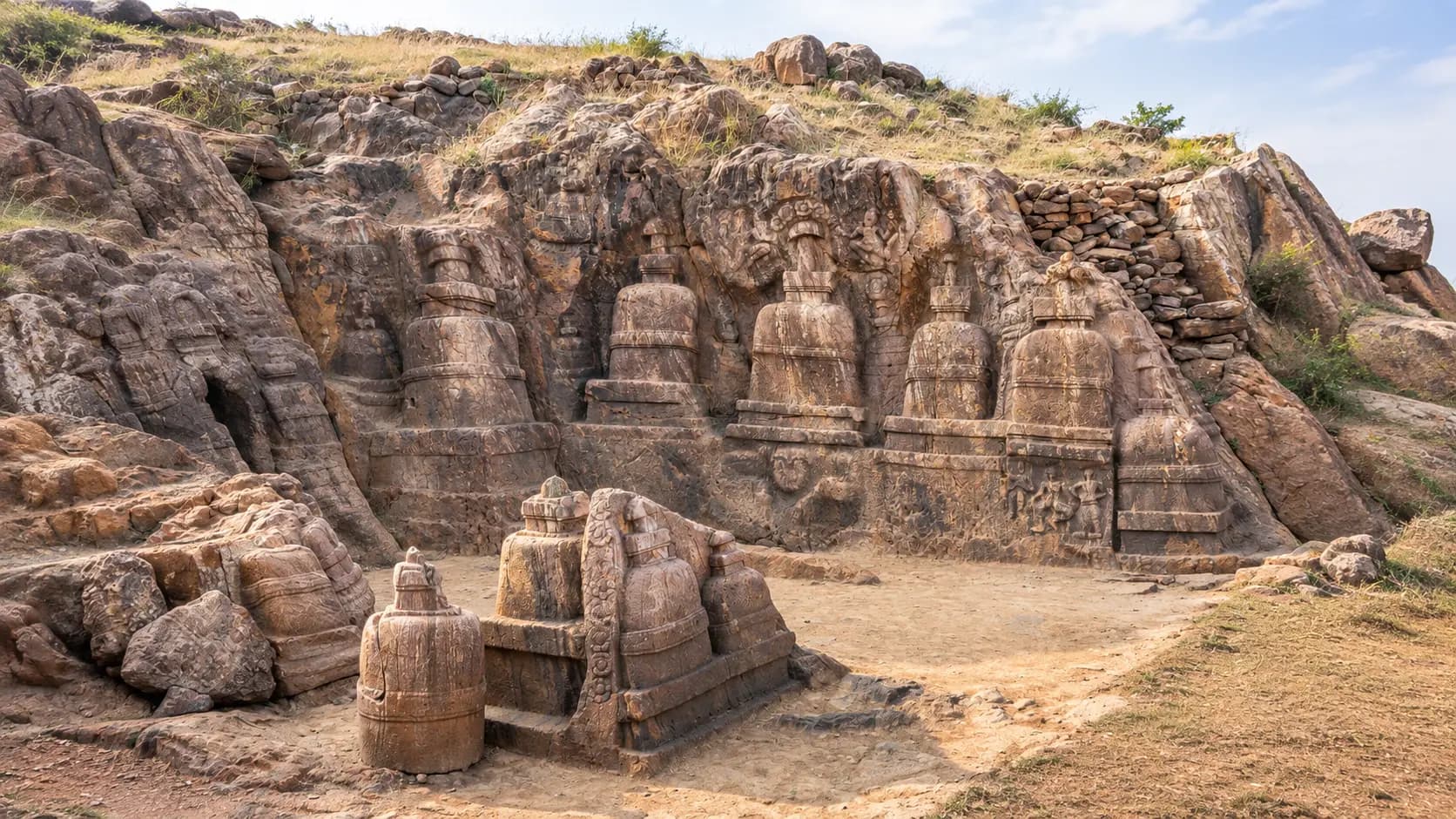
- Ratnagiri Buddhist Mahavihara (~18 km north): The jewel of the Diamond Triangle, world-renowned for its breathtakingly ornate emerald-green chlorite entrance doorway, monumental seated Buddha in Bhumisparsha mudra, hundreds of votive stone stupas, and a rich museum of Tantric Vajrayana art.
- Olasuni Hill & Temple (~12 km southeast): A sacred hill pilgrimage shrine dedicated to the 18th-century mystic saint Arakhita Dasa. Celebrated for its natural cave (Gumpha) where the saint meditated and the annual Olasuni Gumpha Mela held during Magha Ekadasi.
- Mahavinayak Temple, Chandikhole (~18 km west): A revered ancient Hindu shrine situated in a lush valley near Chandikhole, famous for a unique single stone idol embodying the five deities: Shiva, Vishnu, Durga, Surya, and Ganesha.
- Cuttack Heritage City (~55 km southwest): The historic millennium city featuring the 13th-century Barabati Fort, Maa Cuttack Chandi Temple, Netaji Birthplace Museum, and the Odisha State Maritime Museum at Jobra.
In pictures
The practical bits
Before you go.
Plan ahead
To maximize your experience of Lalitgiri’s ancient monastic heritage, observe these practical preparation…Explore detailsClose details
To maximize your experience of Lalitgiri’s ancient monastic heritage, observe these practical preparation guidelines:
Friday closure planning
Schedule your trip between Saturday and Thursday to ensure that the on-site ASI Archaeological Museum is open…Explore detailsClose details
Schedule your trip between Saturday and Thursday to ensure that the on-site ASI Archaeological Museum is open; visiting on a Friday means you will miss the golden relic caskets, even though the outdoor hill ruins remain accessible.
Footwear and hill climbing
Wear comfortable, closed-toe walking shoes with reliable rubber traction; exploring the four monastic complexes…Explore detailsClose details
Wear comfortable, closed-toe walking shoes with reliable rubber traction; exploring the four monastic complexes and ascending the stone steps to the summit Maha Stupa involves moderate uphill walking across uneven stone and gravel paths.
Hydration and sun protection
Carry a refillable water bottle, a wide-brimmed sun hat, and UV sunglasses; the stone ruins and hilltop stupa are…Explore detailsClose details
Carry a refillable water bottle, a wide-brimmed sun hat, and UV sunglasses; the stone ruins and hilltop stupa are completely open to direct sunlight with minimal tree shade on the upper terraces.
Combine with Ratnagiri and Udayagiri
Plan a full-day "Diamond Triangle" excursion by starting early at Lalitgiri (09:00 AM), exploring Udayagiri’s…Explore detailsClose details
Plan a full-day "Diamond Triangle" excursion by starting early at Lalitgiri (09:00 AM), exploring Udayagiri’s rock-cut caves and colossal Buddha (12:00 PM), and dedicating the afternoon to Ratnagiri’s magnificent carved green chlorite portal and stupa field (14:30 PM).
Respect sacred monument etiquette
Lalitgiri is a consecrated historical sanctuary revered by Buddhist pilgrims worldwide; maintain quiet decorum…Explore detailsClose details
Lalitgiri is a consecrated historical sanctuary revered by Buddhist pilgrims worldwide; maintain quiet decorum near the stupa, do not climb onto fragile monastic brick walls, and never touch ancient carved relief sculptures.
A few things you might wonder
Common questions about visiting Lalitgiri. Fees, visiting hours and ceremonies are researched details that may change; confirm current arrangements with the operator before travelling.
What are the primary visiting hours of Lalitgiri, and is the museum open every day?
What is the significance of the sacred relic caskets found at Lalitgiri?
What is the "Diamond Triangle" of Odisha, and how is Lalitgiri related to it?
How much is the admission fee to visit Lalitgiri and its site museum?
Can visitors climb to the top of the Maha Stupa on Landa Hill?
Are food and dining facilities available at the Lalitgiri complex?
How far is Lalitgiri from Bhubaneswar and Cuttack?
Can tourists complete Lalitgiri, Ratnagiri, and Udayagiri in a single day?
Explore more in Buddhist Circuit
Discover other destinations around this hub
More Hubs in Odisha
Continue exploring other travel hubs in this state
Planning a trip to Buddhist Circuit?