Pattadakal
Complete guide to the UNESCO World Heritage monuments at Pattadakal in Bagalkot. Explore Virupaksha, Mallikarjuna, Nagara & Dravidian temples, timings, and routes.
Location
Hampi Badami, Karnataka
A closer look
Your visit, at a glance.
Hampi Badami, Karnataka
GET TO KNOW THE PLACE
Nestled along a tranquil, auspicious northward bend (uttaravahini) of the sacred Malaprabha River in northern Karnataka's Bagalkot district, Pattadakal stands as one of the most…
The story of Pattadakal
Nestled along a tranquil, auspicious northward bend (uttaravahini) of the sacred Malaprabha River in northern Karnataka's Bagalkot district, Pattadakal stands as one of the most intellectually thrilling and aesthetically supreme sanctuaries of ancient Indian sacred architecture. Consecrated by the monarchs of the Early Chalukya dynasty (also known as the Badami Chalukyas) during the 7th and 8th centuries CE, Pattadakal was not a sprawling political capital or a fortified garrison town. That administrative role was held by nearby Vatapi (modern Badami), nestled 17 kilometres to the southwest among defensive sandstone cliffs.
Instead, Pattadakal - known anciently as Kisuvolal ("the valley of red soil"), Raktapura ("the blood-red city"), and later as Pattada Kisuvolal ("the coronation city of red soil") - was chosen specifically as the sacred, ceremonial theater of the realm. Here, upon the holy riverbank where water flowed back toward the Himalayas, Chalukyan emperors were anointed with the royal fillet (patta) during coronation rites, celebrated decisive military triumphs over their southern rivals, the Pallavas of Kanchipuram, and sponsored monumental stone temples that would forever alter the trajectory of Asian art.
Inscribed as a UNESCO World Heritage Site in 1987, the Group of Monuments at Pattadakal preserves an ensemble of nine monumental Hindu temples and a contemporary 9th-century Jain sanctuary. What elevates Pattadakal into a category entirely its own in world architectural history is its extraordinary role as a deliberate, imperial architectural laboratory. Within a single shared sacred precinct enclosed by manicured riverside lawns, Chalukyan master architects brought together the two supreme, divergent architectural traditions of ancient India:
- The Dravida (Southern Indian) architectural idiom, defined by terraced, stepped-pyramidal towers (vimanas) crowned by octagonal, square, or circular dome-like shikharas; and
- The Rekha-Nagara (Northern Indian) architectural idiom, characterized by soaring, curvilinear towers (shikharas) adorned with central vertical bands (latas) and intricate geometric meshes of miniature chaitya-arches (gavakshas).
Rather than existing in isolation or provincial rivalry, northern and southern temple styles were built directly alongside one another by royal royal patrons - often queens celebrating the victories of their king-consorts - resulting in a breathtaking dialogue of forms that culminated in the birth of the hybrid Vesara style and directly inspired subsequent architectural masterpieces across the subcontinent, most notably the rock-cut Kailasa Temple at Ellora.
Start here. Open a tile for the full details.
Why goRead details
Pattadakal provides an unparalleled journey into the golden age of classical Indian temple design, where aesthetic genius, epigraphical transparency, and sacred geography unite:
When to visitRead details
Because Pattadakal is located on the semi-arid northern Deccan Plateau, its local weather is characterized by intense daytime sunshine, dry winds, and low humidity throughout most of the year. Choosing the right month and daily timing is essential for fully appreciating the open-air stone monuments.
Entry & permissionsRead details
Fees, visiting hours and entry rules may change. Confirm the latest details with the official operator or local authority before travelling.
The monuments at Pattadakal are strictly protected under federal conservation law administered by the Archaeological Survey of India (ASI, Dharwad Circle):
+-----------------------------------------------------------------------------------+
|                        PATTADAKAL ADMISSION & OPERATIONAL RULES                   |
+-----------------------------------------------------------------------------------+
| Operational Category   | Regulation / Policy Details                              |
+------------------------+----------------------------------------------------------+
| Monument Opening Hours | 06:00 to 18:00 daily (Sunrise to Sunset) throughout the  |
|                        | year, including Sundays and national public holidays     |
+------------------------+----------------------------------------------------------+
| Entry Tariff (Indians) | ₹40 per person at counter; ₹35 when booked digitally via |
| (SAARC & BIMSTEC)      | official ASI portal; Free for children under 15 years    |
+------------------------+----------------------------------------------------------+
| Entry Tariff (Foreign) | ₹600 per person at counter; ₹550 when booked digitally   |
+------------------------+----------------------------------------------------------+
| Ticket Validity        | Valid for single calendar-day admission to both the main |
|                        | riverside temple enclosure and outlying Papanatha Temple |
+------------------------+----------------------------------------------------------+
| Drone Regulations      | Commercial and recreational drone flights are strictly   |
|                        | prohibited without advance written permit from ASI & DGCA|
+------------------------+----------------------------------------------------------+
| Photography Guidelines | Handheld amateur photography and mobile phone cameras are|
|                        | permitted free of charge; tripods require prior permit   |
+-----------------------------------------------------------------------------------+
Ticketing Details, QR Codes, and Site Protocols
Ticket counters at the entrance gate operate under a cashless digital system. Visitors purchase entry passes either by scanning official UPI QR codes displayed at the booth using smartphone banking applications (Google Pay, PhonePe, Paytm) or by reserving e-tickets in advance via the official ASI national portal (https://asi.nic.in/). Retain your digital QR pass on your mobile device, as security personnel scan the code at both the main enclosure gate and at the southern Papanatha Temple.
Visitors should dress respectfully: while the temples no longer have active daily worship rituals (with the exception of small commemorative pujas during annual festivals), conservative attire covering shoulders and knees demonstrates cultural sensitivity. Footwear must be removed before stepping onto the raised plinths and inner sanctum mantapas of Virupaksha and Mallikarjuna temples; paid shoe-minding stalls operate near the main lawn entrance.
Plan your visitRead details
Pattadakal is situated in northern Karnataka's Bagalkot district, positioned centrally within the celebrated Chalukyan Heritage Triangle between Badami and Aihole.
Explore the full guide - choose a topic below.
Why visit?
Pattadakal provides an unparalleled journey into the golden age of classical Indian temple design, where…Explore detailsClose details
Pattadakal provides an unparalleled journey into the golden age of classical Indian temple design, where aesthetic genius, epigraphical transparency, and sacred geography unite:
- The Ultimate Meeting Ground of Northern and Southern Architecture: Nowhere else on the Indian subcontinent can visitors witness northern Nagara curvilinear spires and southern Dravidian stepped-pyramidal vimanas standing side-by-side within a single, cohesive temple garden. Pattadakal represents the living textbook where India's two great temple styles met, cross-pollinated, and reached absolute classical maturity.
- Virupaksha Temple: Prototype of Ellora's Kailasa: Consecrated around 740 - 745 CE by Queen Lokamahadevi to commemorate King Vikramaditya II's victory over Kanchipuram, the Virupaksha Temple is one of the most influential structures ever built in Asia. With its monumental four-tiered vimana, carved narrative pillars, and intricate pierced-stone lattice windows, it served as the direct architectural blueprint for the world's largest monolithic rock-cut monument: the Kailasa Temple (Cave 16) at Ellora.
- The Sibling Temples of Victory (Virupaksha and Mallikarjuna): Erected simultaneously by two sisters - Lokamahadevi and Trailokyamahadevi, both queens of King Vikramaditya II - these adjacent Dravidian sanctuaries celebrate marital devotion and imperial triumph. Comparing Virupaksha's square shikhara with Mallikarjuna's gracefully curved, circular hemispherical shikhara demonstrates the subtle nuances of 8th-century stone design.
- Authentic Epigraphical Tributes to Ancient Master Architects: In a civilization where ancient artists rarely signed their creations, Pattadakal preserves extraordinary 8th-century stone inscriptions that explicitly honour the master builders. Inscriptions at Virupaksha celebrate the chief architect Gundan Anivaritachari, who was conferred the supreme royal title of Tribhuvanachari ("Master Architect of the Three Worlds") and honoured with a ceremonial golden crown.
- Monumental Sculptural Masterpieces in Deep Relief: The walls and columned halls of Pattadakal are adorned with some of the most dynamic, expressive high-relief carvings in Indian art history. Highlights include the dramatic, eight-armed Shiva slaying the demon Andhaka (Andhakasuramardana) at Galaganatha Temple, the complete sequential visual narratives of the Ramayana, Mahabharata, and Panchatantra on interior pillars, and majestic life-sized Dvarapalas guarding sanctum portals.
- The Bold Hybrid Experiment of Papanatha Temple: Situated just south of the main compound, the Papanatha Temple represents an audacious architectural experiment: master builders attempted to fuse a northern curvilinear Nagara shikhara with an elongated southern Dravidian floor plan, producing an eccentric, highly ornate masterpiece encrusted with hundreds of narrative Ramayana relief panels.
- The Auspicious Uttaravahini Setting along the Malaprabha River: The tranquil setting of Pattadakal on the western banks of the Malaprabha River - where the sacred stream makes a rare northward turn (uttaravahini) - infuses the stone ruins with serene natural beauty, especially in early morning and late afternoon when golden light reflects off warm red sandstone into the water.
What to expect
Exploring the monuments of Pattadakal is a relaxed, deeply rewarding experience conducted within a compact…Explore detailsClose details
Exploring the monuments of Pattadakal is a relaxed, deeply rewarding experience conducted within a compact, beautifully landscaped park maintained by the Archaeological Survey of India. The primary monument compound sits on the western riverbank, containing eight major temples arranged on a south-to-north axis, while the Papanatha Temple sits approximately 200 metres to the south, and the Rashtrakuta Jain Temple lies one kilometre to the west along the Badami road.
+-----------------------------------------------------------------------------------+
|                        MALAPRABHA RIVER (NORTHWARD FLOW)                          |
+-----------------------------------------------------------------------------------+
       |                                       |                               |
[Kadasiddheshwara]                      [Galaganatha]                    [Sangameshwara]
 (Nagara Shikhara)                   (Rekha-Nagara Tower)              (Dravida Vimana)
       |                                       |                               |
[Jambulingeshwara]                     [Kashi Vishwanath]                      |
 (Dancing Shiva Sukanasa)             (Nagara / Rashtrakuta)                   |
       |                                       |                               |
       +--------------------+------------------+-------------------------------+
                            |
                 [Mallikarjuna Temple] <==== 50 m ====> [Virupaksha Temple]
              (Circular Shikhara Vimana)              (Square Shikhara Vimana /
                            |                          Kailasa Prototype)
                            |                                  |
                            |                          [Nandi Mandapa]
                            |                                  |
                            +-----------------+----------------+
                                              |
                                     [ASI Entrance Gate]
                                              |
                          (200 m South along Village Lane)
                                              |
                                    [Papanatha Temple]
                              (Hybrid Nagara-Dravida Form)
                                              |
                            (1 km West along Badami Road)
                                              |
                               [Jain Narayana Temple]
The Sacred River Alignment and Imperial Coronation Geography
To understand why Pattadakal emerged as the ceremonial heart of the Early Chalukya Empire, one must examine its geographical and cosmological setting. While Badami was founded among defensible canyon walls and fortified hilltops to serve as the political and military capital (rajadhani), Pattadakal occupied an open, fertile alluvial plain along the Malaprabha River. Crucially, the river here alters its generally easterly course to flow due northward (uttaravahini). In classical Hindu river symbolism, a river flowing north toward the holy source of the Ganges and Mount Kailasha is considered immensely sacred, transforming the riverbank into a potent spiritual threshold (teertha).
Consequently, the Chalukyan monarchs selected this specific bank as the site of their imperial coronations (pattabhisheka). When a king ascended the throne, priests and royal astrologers assembled here to crown him with the royal fillet (patta), giving the settlement its enduring dynastic name, Pattada Kisuvolal. When kings returned victorious from protracted military expeditions across the Deccan, they did not commemorate their triumphs in Badami's narrow canyons; instead, they returned to the broad sacred banks of Pattadakal to perform solemn thanksgiving sacrifices and commission monumental victory temples built with stone, artisans, and wealth acquired during their campaigns.
The Virupaksha Temple (Lokeshwara): Masterpiece of Dravidian Architecture
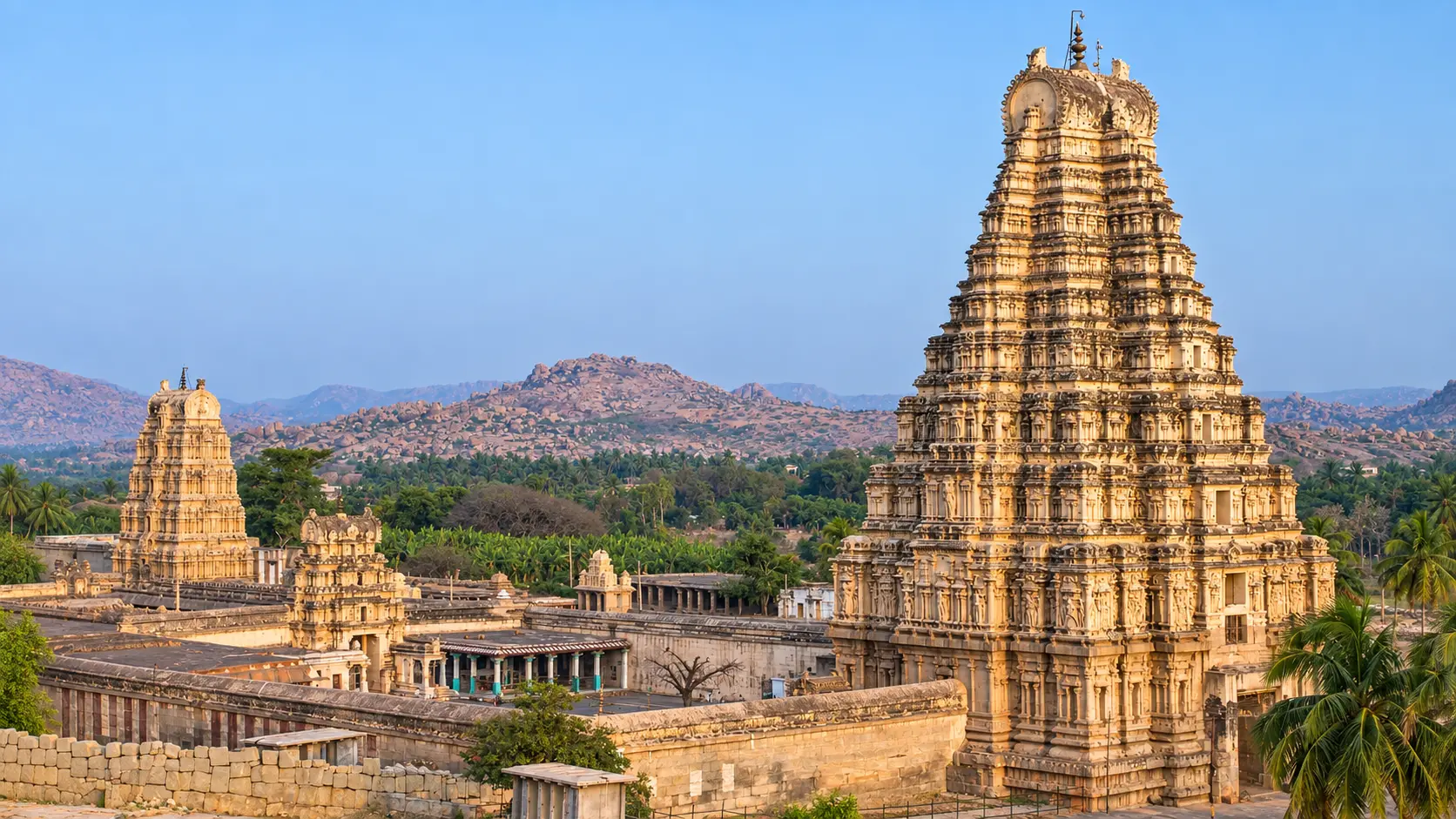
Standing proudly as the grandest, most architecturally complex, and spiritually imposing monument at Pattadakal, the Virupaksha Temple - originally designated Lokeshwara after its royal patron - was consecrated around 740 - 745 CE by Queen Lokamahadevi. The queen commissioned this monumental sanctuary to celebrate the military triumph of her husband, King Vikramaditya II, who had marched his imperial Chalukyan armies south into Tamil country, captured the Pallava capital of Kanchipuram three times without plundering its holy shrines, and returned with master stone sculptors, royal tribute, and immense prestige.
+-----------------------------------------------------------------------------------+
|                        VIRUPAKSHA TEMPLE ARCHITECTURAL LAYOUT                     |
+-----------------------------------------------------------------------------------+
|  1. East & West Gopuras       | Stone gateway entrances piercing outer wall       |
+-------------------------------+---------------------------------------------------+
|  2. Monolithic Nandi Mandapa  | Four-pillared open pavilion housing a massive     |
|                               | polished black stone Nandi bull                   |
+-------------------------------+---------------------------------------------------+
|  3. Sabha Mantapa             | Grand columned assembly hall supported by 16      |
|                               | square monolithic pillars with narrative reliefs  |
+-------------------------------+---------------------------------------------------+
|  4. Pierced Stone Jalis       | Intricately perforated stone lattice windows      |
|                               | illuminating hall with soft, dappled light        |
+-------------------------------+---------------------------------------------------+
|  5. Antarala & Garbhagriha    | Sanctum antechamber leading to inner sanctum      |
|                               | housing a massive black stone linga               |
+-------------------------------+---------------------------------------------------+
|  6. Pradakshinapatha          | Enclosed circumambulatory passage around sanctum  |
+-------------------------------+---------------------------------------------------+
|  7. Four-Tiered Vimana        | Soaring stepped Dravida superstructure crowned    |
|                               | by a majestic square shikhara and kalasha finial  |
+-----------------------------------------------------------------------------------+
Ground Plan and Outer Precinct
The Virupaksha Temple is situated within a spacious rectangular stone enclosure wall (prakara), entered through two monumental gateway towers (gopuras) on the east and west. Approaching the temple from the eastern gopura, visitors immediately encounter a detached, open-sided Nandi Mandapa resting upon a moulded stone plinth. Inside rests a colossal, beautifully preserved Nandi bull sculpted from fine-grained black stone, adorned with ornamental neck-chains, ringing bells, and detailed saddle girths, gazing reverently westward toward the inner sanctum.
The Columned Assembly Hall (Sabha Mantapa)
Stepping up onto the main temple platform, visitors enter the grand Sabha Mantapa, an expansive covered hall supported by sixteen massive square granite-and-sandstone pillars arranged in four central rows. The hall is illuminated naturally through exquisitely carved pierced stone lattice windows (jalis), which feature floral rosettes, swastika spirals, and geometric meanders that cast enchanting patterns of soft, dappled sunlight across the cool stone floor.
What makes the interior of Virupaksha world-renowned is its dense sculptural narrative program. The square faces of the central pillars are carved in deep, crisp bas-relief with sequential, multi-scene storyboards drawn from ancient epics and folklore:
- The Valmiki Ramayana: Panels illustrate the golden deer Maricha deceiving Rama, Ravana abducting Sita in his airborne chariot while the heroic bird Jatayu battles valiantly, Rama striking down the seven sala trees with a single arrow to prove his prowess to Sugriva, Hanuman presenting Rama's signet ring to a captive Sita in the Ashoka grove, and the construction of the floating stone bridge (Setu) across the ocean to Lanka.
- The Mahabharata: Dramatic compositions depict the archery contest at Draupadi's swayamvara, the dice game played by the Pandavas, the duel between Arjuna and Shiva disguised as a mountain hunter (Kirata), and the venerable patriarch Bhishma lying mortally wounded upon his bed of arrows during the catastrophic battle of Kurukshetra.
- Puranic & Folk Tales: Sculpted medallions showcase scenes from the Bhagavata Purana illustrating Krishna subduing the multi-hooded serpent Kaliya, alongside beloved moral fables from the Panchatantra, such as the foolish monkey and the wedge.
Sanctum and the Dravida Vimana
Passing through the pillared hall and the antechamber (antarala), guarded by monumental, four-armed river goddesses and guardian dvarapalas, one reaches the innermost sanctum (garbhagriha), which houses a massive, polished black stone Shiva Linga set within a stone yoni-pitha. Surrounding the sanctum is an enclosed, dark circumambulatory passage (pradakshinapatha) designed for silent, ritual circumambulation.
Above the sanctum rises the temple's architectural crown: a magnificent four-tiered Dravida vimana soaring more than 16 metres high. Each ascending storey (tala) is decorated with miniature pavilion roofs - alternating between barrel-vaulted shalas and square kutas - interlinked by decorative balustrades. The entire superstructure terminates in a heavy, well-proportioned square dome-like shikhara, topped by a kalasha finial.
The Inscriptions of Gundan Anivaritachari
Near the eastern entrance of Virupaksha Temple, two historic stone inscriptions offer an extraordinarily rare glimpse into the professional recognition accorded to ancient Indian architects. The epigraph records that King Vikramaditya II and Queen Lokamahadevi formally conferred the title Tribhuvanachari ("Master Architect of the Three Worlds") upon the temple's chief architect, whose personal name was Gundan Anivaritachari. The king awarded him a ceremonial golden headband (patta) and granted his guild lifelong exemptions from imperial taxes. A companion inscription honours another master sculptor, Baladeva, highlighting the proud artistic self-consciousness that flourished at the 8th-century Chalukyan court.
Mallikarjuna Temple (Trailokyeshwara): Sister Shrine of Victory
Standing just fifty metres north of Virupaksha Temple, the Mallikarjuna Temple was consecrated contemporaneously with Virupaksha by Queen Trailokyamahadevi. Trailokyamahadevi was the younger biological sister of Queen Lokamahadevi and also a co-queen of King Vikramaditya II. Inspired by her elder sister's architectural piety, she commissioned this temple - originally named Trailokyeshwara - to celebrate the identical victory over the Pallavas of Kanchipuram.
While the Mallikarjuna Temple closely follows the overall spatial layout of Virupaksha - featuring a detached Nandi pavilion, a pillared sabha mantapa, an enclosed pradakshinapatha, and a multi-tiered Dravidian vimana - it exhibits distinct architectural refinements that make direct comparison fascinating:
- Circular Hemispherical Shikhara: Unlike Virupaksha's vimana, which terminates in a square shikhara, Mallikarjuna's four-tiered vimana is crowned by a graceful circular (hemispherical) dome-like shikhara (griva-shikhara). This subtle design choice softens the visual silhouette of the tower, lending it an air of delicate feminine grace compared to the muscular angularity of Virupaksha.
- Narrative Pillar Sculptures: The interior pillars of Mallikarjuna are adorned with exquisite relief panels highlighting episodes from the childhood of Krishna (Krishna Leela), including the butter thief, the lifting of Mount Govardhana, and the cosmic churning of the milk ocean (Samudra Manthan), where gods and demons tug at the body of the serpent Vasuki.
- Intimate Scale and Proportions: Slightly more compact than its elder sister temple, Mallikarjuna feels noticeably more intimate, allowing visitors to inspect wall carvings, dynamic ceiling lotus medallions, and ornamental pilasters at close range without visual overwhelm.
Sangameshwara Temple (Vijayeshwara): Pure Chalukyan Dravidian Classicism
The Sangameshwara Temple, originally consecrated as the Vijayeshwara Temple, is the oldest surviving large-scale stone temple within the primary Pattadakal compound. Commissioned by King Vijayaditya during his long and peaceful reign between 696 and 733 CE, the temple represents Early Chalukyan Dravidian architecture in its most austere, unadorned, and classical expression. When King Vijayaditya passed away in 733 CE, the temple was left partially unfinished, providing modern architectural conservators with invaluable structural insight into the sequential stages of 8th-century temple construction.
Key highlights of Sangameshwara include:
- Monumental Moulded Basement Plinth (Adhishthana): The temple rests upon an exceptionally tall, crisply sculpted plinth adorned with courses of projecting elephants, roaring lions, and floral scrollwork.
- Pure Dravida Proportions: The temple consists of a three-storeyed stepped vimana resting above an inner sanctum with an ambulatory passage, preceded by a spacious, partially open vestibule. The exterior walls are articulated with rhythmically spaced pilasters framing deep niches that were intended to house sculpted deities, many of which remain uncarved, showcasing the pristine geometry of the dressing stone.
- Restful Ambience: Because it lacks the dense narrative friezes of Virupaksha and Mallikarjuna, Sangameshwara allows visitors to focus on pure structural line, volumetric balance, and the subtle interaction of light and shadow on weathered golden sandstone.
The Northern Nagara Temples: Galaganatha, Kashi Vishwanath, and Twin Shrines
Directly contrasting with the stepped Dravidian vimanas are four exquisite temples built in the classical northern Indian Rekha-Nagara style, distinguished by their tall, curvilinear spires (shikharas):
+-----------------------------------------------------------------------------------+
|                        PATTADAKAL NORTHERN NAGARA TEMPLES                         |
+-----------------------------------------------------------------------------------+
|  Galaganatha Temple      | 8th-century complete curvilinear shikhara on riverbank |
|                          | High-relief sculpture of Shiva slaying demon Andhaka   |
+--------------------------+--------------------------------------------------------+
|  Kashi Vishwanath        | Late 8th-century Rashtrakuta-era Nagara temple         |
|                          | Intricate geometric mesh of miniature chaitya arches   |
+--------------------------+--------------------------------------------------------+
|  Kadasiddheshwara        | 7th-century modest Nagara shrine; projecting sukanasa  |
|                          | arch displaying Shiva dancing with his consort Parvati |
+--------------------------+--------------------------------------------------------+
|  Jambulingeshwara        | 7th-century Nagara temple with dancing Shiva medallion |
|                          | and detached open Nandi mandapa on stone terrace       |
+-----------------------------------------------------------------------------------+
Galaganatha Temple
Situated at the northern edge of the landscaped park directly along the riverbank, the Galaganatha Temple is the most complete and visually striking Nagara-style temple at Pattadakal. Built in the first half of the 8th century CE, its curvilinear tower (shikhara) is remarkably intact, displaying a central vertical band (lata) framed by stepped corner bands (bhumis) adorned with tiered ribbed fruit motifs (amalakas).
The undisputed artistic masterpiece of Galaganatha is a breathtaking, monumental high-relief carving situated in an exterior niche on the southern wall: Shiva as Andhakasuramardana (the Slayer of the Demon Andhaka). In this dramatic composition, an eight-armed Shiva lunges forward with terrifying martial vitality, his lower foot stepping forcefully onto a prostrate foe, while his upper hands thrust a three-pronged trident (trishula) directly through the belly of the demon Andhaka, who dangles suspended in mid-air. Shiva wears a long, rhythmic garland of human skulls (mundamala) that loops down to his knees, while dynamic celestial attendants watch from above in awe.
Kashi Vishwanath Temple
Located immediately north of the Mallikarjuna Temple, the Kashi Vishwanath Temple was erected in the late 8th century CE. Most architectural historians attribute its construction to the early Rashtrakuta dynasty, which ousted the Chalukyas around 753 CE but continued to employ local master guilds at Pattadakal.
The temple features an exquisitely proportioned Rekha-Nagara shikhara covered with an intricate, lace-like mesh of miniature chaitya-arches (jalas). The sanctum doorway is carved with exceptional delicacy, displaying personifications of the sacred river goddesses Ganga and Yamuna standing upon their respective animal mounts (the makara and the tortoise) at the base of the doorjambs, while the lintel carries a fine relief of Garuda supporting the divine canopy.
Kadasiddheshwara & Jambulingeshwara Temples
Positioned near the western boundary of the complex, these twin 7th-century shrines represent early, compact experiments with the Nagara idiom:
- Kadasiddheshwara: A modest, unadorned stone shrine featuring a curvilinear shikhara with an elegantly projecting arched gable (sukanasa) over its front porch. The frontal medallion of the sukanasa encloses an energetic carving of Shiva performing the cosmic dance with Parvati by his side.
- Jambulingeshwara: Sits on a shared terrace facing east, featuring a well-preserved curvilinear spire and an arched sukanasa carrying a dynamic image of Nataraja dancing upon the dwarf of ignorance (Apasmara). Directly in front of the shrine rests a small open Nandi mandapa preserving an endearing black stone bull.
Papanatha Temple: The Bold Hybrid Experiment
Located approximately 200 metres south of the main enclosed park, along a dusty village pathway winding toward the Malaprabha riverbank, stands the Papanatha Temple. Consecrated around 740 CE, Papanatha is widely regarded by art historians as one of the most intriguing and eccentric transitional monuments in ancient India - a bold, experimental attempt to fuse a northern Nagara shikhara with a southern Dravidian ground plan.
+-----------------------------------------------------------------------------------+
|                        PAPANATHA TEMPLE HYBRID ARCHITECTURE                       |
+-----------------------------------------------------------------------------------+
|  Curvilinear Nagara Shikhara  | Northern curvilinear tower built over inner sanctum|
|                               | terminating in a prominent amalaka fruit finial   |
+-------------------------------+---------------------------------------------------+
|  Elongated Double Mantapa     | Unusually long, southern Dravidian interior layout |
|                               | featuring two sequential halls with 16 pillars    |
+-------------------------------+---------------------------------------------------+
|  Exhaustive Ramayana Friezes  | Exterior plinths encrusted with continuous multi- |
|                               | tier narrative panels depicting the entire epic   |
+-------------------------------+---------------------------------------------------+
|  Master Sculptor Inscriptions | Inscribed signatures of master carver Baladeva    |
|                               | and Revadi Ovajja celebrating their artistry      |
+-----------------------------------------------------------------------------------+
Architectural Peculiarities and Double Hall Layout
When approaching Papanatha, the visual profile immediately strikes the eye as unusual: while its soaring curvilinear tower is unmistakably northern Nagara in inspiration, its low-slung, elongated body stretches out horizontally like a southern Dravidian hall. Archaeological analysis reveals that the master builders initially designed a standard, compact temple, but mid-way through construction, imperial patrons demanded a grander ceremonial space.
Consequently, the architects extended the structure forward by adding a second, large columned assembly hall (sabhamantapa) to the front of the existing antechamber (ardhamantapa). This created an extraordinarily long, atmospheric interior supported by sixteen square pillars, whose dim, shadowy ambiance contrasts sharply with the airy, light-filled halls of Virupaksha.
The Epic Narrative Reliefs
Papanatha's exterior walls represent an open-air stone encyclopedia of Hindu mythology. Every square metre of the outer stone facade is carved with dense horizontal friezes depicting the complete narrative of the Valmiki Ramayana, accompanied by short labels in old Kannada script identifying key characters. Visitors can trace sequential panels showing King Dasharatha performing the putrakameshti yajna, Rama breaking Shiva's divine bow at Janaka's court, Sita's golden deer chase, the fatal battle between Vali and Sugriva, and the final siege of Lanka where monkey warriors hurled boulders at demon chariots.
The Rashtrakuta Jain Narayana Temple
Located approximately one kilometre west of the village on the outskirts of Pattadakal along the road to Badami, the Jain Narayana Temple offers a serene, contemplative contrast to the vibrant Shaivite and Vaishnavite monuments on the riverbank. Erected in the 9th century CE under the imperial patronage of the Rashtrakuta dynasty - most likely during the reign of King Amoghavarsha I (reigned 814 - 878 CE) or his son Krishna II - this monument proves that the artistic traditions perfected by the Chalukyas continued to thrive under their dynastic successors.
Built entirely of fine greyish-buff sandstone, the temple features:
- A handsome, three-tiered Dravidian vimana displaying clean horizontal profiles, unadorned wall pilasters, and a well-proportioned octagonal dome-like shikhara.
- A wide front porch guarded by two magnificent, partially ruined monolithic stone elephants, upon whose massive shoulders seated royal riders once sat.
- An austere, columned interior hall leading to an inner sanctum enshrining a serene, colossal seated stone sculpture of a Jain Tirthankara (identified as Parshvanatha or Mahavira), seated in the meditative padmasana posture with a calm, transcendent facial expression.
Best time to visit
Because Pattadakal is located on the semi-arid northern Deccan Plateau, its local weather is characterized by…Explore detailsClose details
Because Pattadakal is located on the semi-arid northern Deccan Plateau, its local weather is characterized by intense daytime sunshine, dry winds, and low humidity throughout most of the year. Choosing the right month and daily timing is essential for fully appreciating the open-air stone monuments.
+-----------------------------------------------------------------------------------+
|                        PATTADAKAL SEASONAL VISITING MATRIX                        |
+-----------------------------------------------------------------------------------+
| Season        | Months          | Conditions                  | Travel Advice     |
+---------------+-----------------+-----------------------------+-------------------+
| Peak Winter   | October to      | Crisp, sunny days           | Prime season;     |
|               | February        | 18°C - 28°C; cool nights      | ideal for walking |
|               |                 | (12°C - 16°C); clear skies    | & dance festival  |
+---------------+-----------------+-----------------------------+-------------------+
| Hot Summer    | March to        | Scorching Deccan heat       | Avoid mid-day sun;|
|               | May             | 38°C - 42°C; blinding stone   | tour 06:00-09:30  |
|               |                 | radiation; high dehydration | & 16:30-18:00 only|
+---------------+-----------------+-----------------------------+-------------------+
| Southwest     | June to         | Intermittent rainfall;      | Refreshing greens;|
| Monsoon       | September       | swollen Malaprabha river;   | slippery stone;   |
|               |                 | dramatic cloud formations   | atmospheric light |
+-----------------------------------------------------------------------------------+
Winter Season & The Pattadakallu Dance Festival (October to February)
The cooler winter months represent the undisputed ideal window for visiting Pattadakal. Daytime temperatures hover pleasantly between 18°C and 28°C, accompanied by gentle dry breezes and azure skies, while nighttime temperatures drop to a refreshing 12°C to 16°C. The manicured emerald lawns surrounding the temples are lush, and visitors can spend hours leisurely strolling between shrines, examining microscopic pillar carvings, and photographing the play of golden morning light across the sandstone spires without suffering physical fatigue.
During January or early February, the Department of Tourism and the Karnataka state government organize the prestigious Pattadakallu Utsava (National Dance Festival). Against the illuminated, floodlit backdrop of the 8th-century Virupaksha and Mallikarjuna temples, India's most celebrated classical dancers perform Bharatanatyam, Kathak, Odissi, Mohiniyattam, and Kuchipudi on open-air stages. Attending this cultural festival, where classical rhythm and ancient sculpture merge under a starlit Deccan sky, is an unforgettable cultural experience.
Summer Season: Arid Deccan Heat (March to May)
From early March through late May, the Deccan summer intensifies rapidly. Maximum daytime temperatures routinely surge past 40°C, and the open stone courtyards absorb and re-radiate intense solar heat. Walking between temples barefoot becomes impossible without protective cotton socks, and the harsh midday glare flattens the deep shadows necessary for architectural photography.
If visiting during summer months:
- Plan your monument visit strictly between 06:00 and 09:30 AM or between 16:00 and 18:00 PM.
- Carry at least two litres of drinking water per person, apply high-SPF sunscreen, and wear wide-brimmed sun protection.
- Spend the scorching midday hours resting in an air-conditioned hotel in Badami or exploring the shaded rock caves of Badami.
Southwest Monsoon: The Swelling Malaprabha (June to September)
The arrival of the southwest monsoon in June brings welcome relief from the summer heat, moderating temperatures to a comfortable 26°C to 32°C. The Malaprabha River, reduced to a trickle in summer, swells into a broad, flowing brown river that laps gently against the stone steps of the temple revetments. The dusty red soil of Kisuvolal turns rich and dark, and dramatic monsoon thunderclouds create spectacular, moody backdrops for wide-angle landscape photography.
Visitors must exercise caution along stone surfaces during the monsoon: moisture encourages the growth of microscopic black lichen and slippery green algae on ancient steps, particularly at Sangameshwara and along the river ghats. Sturdy shoes with textured rubber soles are essential.
How to reach
Pattadakal is situated in northern Karnataka's Bagalkot district, positioned centrally within the celebrated…Explore detailsClose details
Pattadakal is situated in northern Karnataka's Bagalkot district, positioned centrally within the celebrated Chalukyan Heritage Triangle between Badami and Aihole.
+-----------------------------------------------------------------------------------+
|                        PATTADAKAL TRANSIT & DISTANCE MATRIX                       |
+-----------------------------------------------------------------------------------+
| Hub / Gateway               | Distance | Transit Mode & Travel Time               |
+-----------------------------+----------+------------------------------------------+
| Badami Town & Station (BDM) | 17 km    | 20 - 25 mins via SH-14; frequent KSRTC bus |
|                             |          |Confirm the current charge and what it includes with the operator or service provider. Visitor admission, vehicles, parking, activities and accommodation can have separate charges.|
+-----------------------------+----------+------------------------------------------+
| Aihole Historic Complex     | 14 km    | 15 - 20 mins via SH-14; local KSRTC buses  |
|                             |          |Confirm the current charge and what it includes with the operator or service provider. Visitor admission, vehicles, parking, activities and accommodation can have separate charges.|
+-----------------------------+----------+------------------------------------------+
| Bagalkot District HQ (BGK)  | 45 km    | 50 - 60 mins via SH-14 / NH-52; express    |
|                             |          | KSRTC buses and private taxis            |
+-----------------------------+----------+------------------------------------------+
| Hubballi Airport (HBX)      | 125 km   | 2.5 - 3 hours via NH-67 and SH-14;         |
|                             |          | major regional commercial airport        |
+-----------------------------+----------+------------------------------------------+
| Belagavi Airport (IXG)      | 155 km   | 3 - 3.5 hours via State Highway network;   |
|                             |          | connections to Mumbai, Bengaluru, Delhi  |
+-----------------------------+----------+------------------------------------------+
| Goa (Madgaon Junction MAO)  | 270 km   | 5.5 - 6 hours drive via Castle Rock ghats  |
+-----------------------------------------------------------------------------------+
Rail Access via Badami and Bagalkot
The closest railway station to Pattadakal is Badami Railway Station (station code: BDM), located just 17 kilometres to the southwest. Badami is well-connected on the South Western Railway network, served by regular express trains:
- Gol Gumbaz Express: Connects Mysuru, Bengaluru (KSR Bengaluru), Hubballi, and Badami daily.
- Direct Expresses: Regular services link Badami with Vijayapura (Bijapur), Solapur, Hyderabad, and Mumbai (via Gadag and Miraj junctions).
- Bagalkot Railway Station (BGK): Located 45 kilometres north, Bagalkot offers additional broad-gauge express train connections across western and northern India.
From Badami Railway Station or the central bus stand, local KSRTC buses depart every 30 to 45 minutes directly toward Pattadakal and Aihole. Confirm the current charge and what it includes with the operator or service provider. Visitor admission, vehicles, parking, activities and accommodation can have separate charges.
Road Routing along the Chalukyan Triangle
Pattadakal is positioned directly on State Highway 14 (SH-14), a well-surfaced two-lane rural highway that forms the primary artery linking Badami, Pattadakal, and Aihole.
- From Badami (17 km): Drive northeast along SH-14 across flat, scenic agricultural plains bordered by low red sandstone hills; travel time is roughly 20 to 25 minutes.
- From Aihole (14 km): Continue southwest along SH-14 crossing the Malaprabha basin; travel time is approximately 15 to 20 minutes.
- From Bengaluru (455 km): Drive north along the 4-lane divided NH-48 past Tumakuru and Chitradurga, continue onto NH-50 toward Hosapete, then take SH-14 via Badami directly into Pattadakal (total driving time: 7.5 to 8.5 hours).
- Interstate Bus Services: KSRTC operates regular Rajahamsa and non-AC sleeper buses from Bengaluru, Mysuru, Hubballi, and Belagavi into Badami and Bagalkot, from where local connecting shuttles run continually throughout the day.
Air Connectivity Options
- Hubballi Airport (HBX): The nearest major commercial airport, located approximately 125 kilometres southwest. Hubballi hosts daily nonstop flights operated by IndiGo and Star Air connecting directly to Bengaluru, Mumbai, Delhi, Hyderabad, and Chennai. Pre-arranged private taxis from Hubballi Airport to Pattadakal take approximately 2.5 to 3 hours.
- Belagavi Airport (IXG): Situated 155 kilometres to the west, offering domestic connections to major Indian cities.
- Goa Dabolim Airport (GOI / GOX): Located roughly 270 kilometres west, making Pattadakal an attractive 2-day heritage extension for international travelers holidaying in Goa.
Entry, timings and permissions
Fees, visiting hours and entry rules may change.Explore detailsClose details
Fees, visiting hours and entry rules may change. Confirm the latest details with the official operator or local authority before travelling.
The monuments at Pattadakal are strictly protected under federal conservation law administered by the Archaeological Survey of India (ASI, Dharwad Circle):
+-----------------------------------------------------------------------------------+
|                        PATTADAKAL ADMISSION & OPERATIONAL RULES                   |
+-----------------------------------------------------------------------------------+
| Operational Category   | Regulation / Policy Details                              |
+------------------------+----------------------------------------------------------+
| Monument Opening Hours | 06:00 to 18:00 daily (Sunrise to Sunset) throughout the  |
|                        | year, including Sundays and national public holidays     |
+------------------------+----------------------------------------------------------+
| Entry Tariff (Indians) | ₹40 per person at counter; ₹35 when booked digitally via |
| (SAARC & BIMSTEC)      | official ASI portal; Free for children under 15 years    |
+------------------------+----------------------------------------------------------+
| Entry Tariff (Foreign) | ₹600 per person at counter; ₹550 when booked digitally   |
+------------------------+----------------------------------------------------------+
| Ticket Validity        | Valid for single calendar-day admission to both the main |
|                        | riverside temple enclosure and outlying Papanatha Temple |
+------------------------+----------------------------------------------------------+
| Drone Regulations      | Commercial and recreational drone flights are strictly   |
|                        | prohibited without advance written permit from ASI & DGCA|
+------------------------+----------------------------------------------------------+
| Photography Guidelines | Handheld amateur photography and mobile phone cameras are|
|                        | permitted free of charge; tripods require prior permit   |
+-----------------------------------------------------------------------------------+
Ticketing Details, QR Codes, and Site Protocols
Ticket counters at the entrance gate operate under a cashless digital system. Visitors purchase entry passes either by scanning official UPI QR codes displayed at the booth using smartphone banking applications (Google Pay, PhonePe, Paytm) or by reserving e-tickets in advance via the official ASI national portal (https://asi.nic.in/). Retain your digital QR pass on your mobile device, as security personnel scan the code at both the main enclosure gate and at the southern Papanatha Temple.
Visitors should dress respectfully: while the temples no longer have active daily worship rituals (with the exception of small commemorative pujas during annual festivals), conservative attire covering shoulders and knees demonstrates cultural sensitivity. Footwear must be removed before stepping onto the raised plinths and inner sanctum mantapas of Virupaksha and Mallikarjuna temples; paid shoe-minding stalls operate near the main lawn entrance.
Nearby places to consider
Pattadakal is the architectural keystone of a rich cultural corridor spanning ancient dynastic capitals, rock-cut…Explore detailsClose details
Pattadakal is the architectural keystone of a rich cultural corridor spanning ancient dynastic capitals, rock-cut shrines, and sacred river gorges:
                          [ Bagalkot Town & Almatti Dam ]
                        (District hub & gardens, 45 - 65 km N)
                                     ▲
                                     │
[ Badami Cave Temples ] ◄──── [ Pattadakal ] ────► [ Aihole Temple Complex ]
(Rock-cut caves, Agastya Lake,       │             (Cradle of temple architecture,
  17 km southwest)                   │               14 km northeast)
                                     ▼
                          [ Mahakuta & Banashankari ]
                        (Spring pushkarini & royal stepwell,
14 - 22 km southwest)- Aihole Temple Complex (~14 km northeast): Renowned globally as the "Cradle of Indian Temple Architecture," this sprawling open-air museum contains more than 125 stone temples dating from the 5th to 12th centuries CE. Key monuments include the iconic apsidal Durga Temple with its peripteral colonnade, the rock-cut Ravana Phadi cave, and the hilltop Meguti Jain Temple carrying the famous 634 CE Aihole Prashasti inscription composed by poet Ravikirti.
- Badami Cave Temples & Fort (~17 km southwest): The dramatic 6th-century capital of the Early Chalukyas, nestled in a red sandstone canyon around the emerald waters of Agastya Lake. Features four magnificent rock-cut cave sanctuaries (celebrated for the 18-armed Dancing Nataraja and Vishnu on Adisesha), the water-lapped 7th-century Bhutanatha Temples, and the scenic Northern Fort trek.
- Mahakuta Temple Complex (~14 km southwest): An active, deeply atmospheric Shaivite pilgrimage sanctuary hidden in a lush forest grove of ancient banyan trees. Features dozens of 7th-century Chalukyan shrines gathered around two natural freshwater spring pools (Vishnu Pushkarini) where crystal-clear water wells up continually from underground aquifers.
- Banashankari Amma Temple (~22 km southwest): A revered historic shrine dedicated to Goddess Shakambhari (an incarnation of Parvati), featuring the massive Haridra Teertha, an extraordinary multi-tiered royal stepwell enclosed on all four sides by carved stone colonnades and defensive watchtowers.
- Almatti Dam & Rock Gardens (~65 km north): Located along the Krishna River near Nidagundi, this massive hydroelectric reservoir features expansive terraced Mughal-style gardens, musical dancing fountains, boating facilities, and illuminated promenades that make a delightful evening family excursion.
In pictures
The practical bits
Before you go.
Plan ahead
To make the most of your journey through Pattadakal's monumental sanctuary, incorporate the following practical…Explore detailsClose details
To make the most of your journey through Pattadakal's monumental sanctuary, incorporate the following practical field recommendations:
Integrated circuit routing and logistics
Pattadakal should ideally be explored as part of northern Karnataka's classic Chalukyan Heritage Triangle…Explore detailsClose details
Pattadakal should ideally be explored as part of northern Karnataka's classic Chalukyan Heritage Triangle alongside Badami and Aihole. Because Pattadakal lies centrally between Badami (17 km) and Aihole (14 km), the ideal day itinerary involves touring the rock-cut cave temples of Badami in the early morning (07:00 to 10:00 AM), driving to Pattadakal for a thorough two-to-three-hour midday architectural walk (10:30 AM to 1:30 PM), enjoying a traditional North Karnataka jowar roti lunch in Badami or Pattadakal, and spending the golden afternoon hours exploring the 125 experimental temple ruins of Aihole (03:00 to 06:00 PM).
Thermal management and barefoot foot protection
Check the current visiting hours and permitted access with the site operator before departure; ceremonies…Explore detailsClose details
Check the current visiting hours and permitted access with the site operator before departure; ceremonies, closures and visitor sessions can affect access. Because visitors are required to remove their shoes when ascending the plinths of Virupaksha, Mallikarjuna, and Sangameshwara temples, the bare sandstone slabs can become intensely hot and uncomfortable to walk on. Always pack a pair of thick, white cotton socks in your daypack; wearing socks protects your feet from thermal burns while adhering strictly to temple barefoot protocols. Carry at least 1.5 litres of water per person, as there are few shaded refreshments once inside the monument perimeter.
Pillar narrative photography and lighting strategy
The greatest sculptural marvels of Pattadakal - the detailed narrative friezes of the Ramayana and Mahabharata -…Explore detailsClose details
The greatest sculptural marvels of Pattadakal - the detailed narrative friezes of the Ramayana and Mahabharata - are carved upon the interior pillars of the Sabha Mantapa inside the Virupaksha and Mallikarjuna temples. Because these covered halls are illuminated only through pierced stone lattice windows, natural interior light is soft, dim, and directional. To capture clear photographs of these intricate stone carvings without violating ASI tripod restrictions, carry a camera with high ISO capability or utilize your smartphone's dedicated night/low-light mode. Never use harsh external flash directly against fragile ancient pigment traces.
Outlying monument exploration (Papanatha and Jain Temples)
Over seventy percent of casual tourists visit only the primary enclosed riverside park, entirely missing two of…Explore detailsClose details
Over seventy percent of casual tourists visit only the primary enclosed riverside park, entirely missing two of Pattadakal's most significant monuments. After completing your tour of Virupaksha and Galaganatha, take the 5-minute walk south along the village lane to explore the extraordinary Papanatha Temple, where the outer walls preserve hundreds of Ramayana friezes. Furthermore, if you have private transport, stop 1 km west along the Badami road to inspect the 9th-century Rashtrakuta Jain Narayana Temple with its majestic guardian elephants and serene Tirthankara sanctum.
A few things you might wonder
Common questions about visiting Pattadakal. Fees, visiting hours and ceremonies are researched details that may change; confirm current arrangements with the operator before travelling.
Why is Pattadakal considered an architectural turning point in Indian history?
Who built the Virupaksha Temple at Pattadakal and what was its purpose?
How is the Virupaksha Temple connected to the Kailasa Temple at Ellora?
What is the significance of the Malaprabha River at Pattadakal?
What are the opening hours and entry ticket charges for Pattadakal?
Can you visit Badami, Pattadakal, and Aihole in a single day?
Are there good restaurants and hotels located in Pattadakal?
What is the annual Pattadakallu Dance Festival?
Explore more in Hampi Badami
Discover other destinations around this hub
More Hubs in Karnataka
Continue exploring other travel hubs in this state
Planning a trip to Hampi Badami?