Badami Cave Temples
Comprehensive visitor guide to the Badami Cave Temples in Bagalkot. Explore Caves 1 to 4, 18-armed Nataraja, 578 CE Mangalesha inscription, Agastya Lake, and fort.
Location
Hampi Badami, Karnataka
A closer look
Your visit, at a glance.
Hampi Badami, Karnataka
GET TO KNOW THE PLACE
Hewn with astonishing sculptural virtuosity directly from the massive red sandstone cliffs of a rugged canyon in northern Karnataka's Bagalkot district, the Badami Cave Temples…
The story of Badami Cave Temples
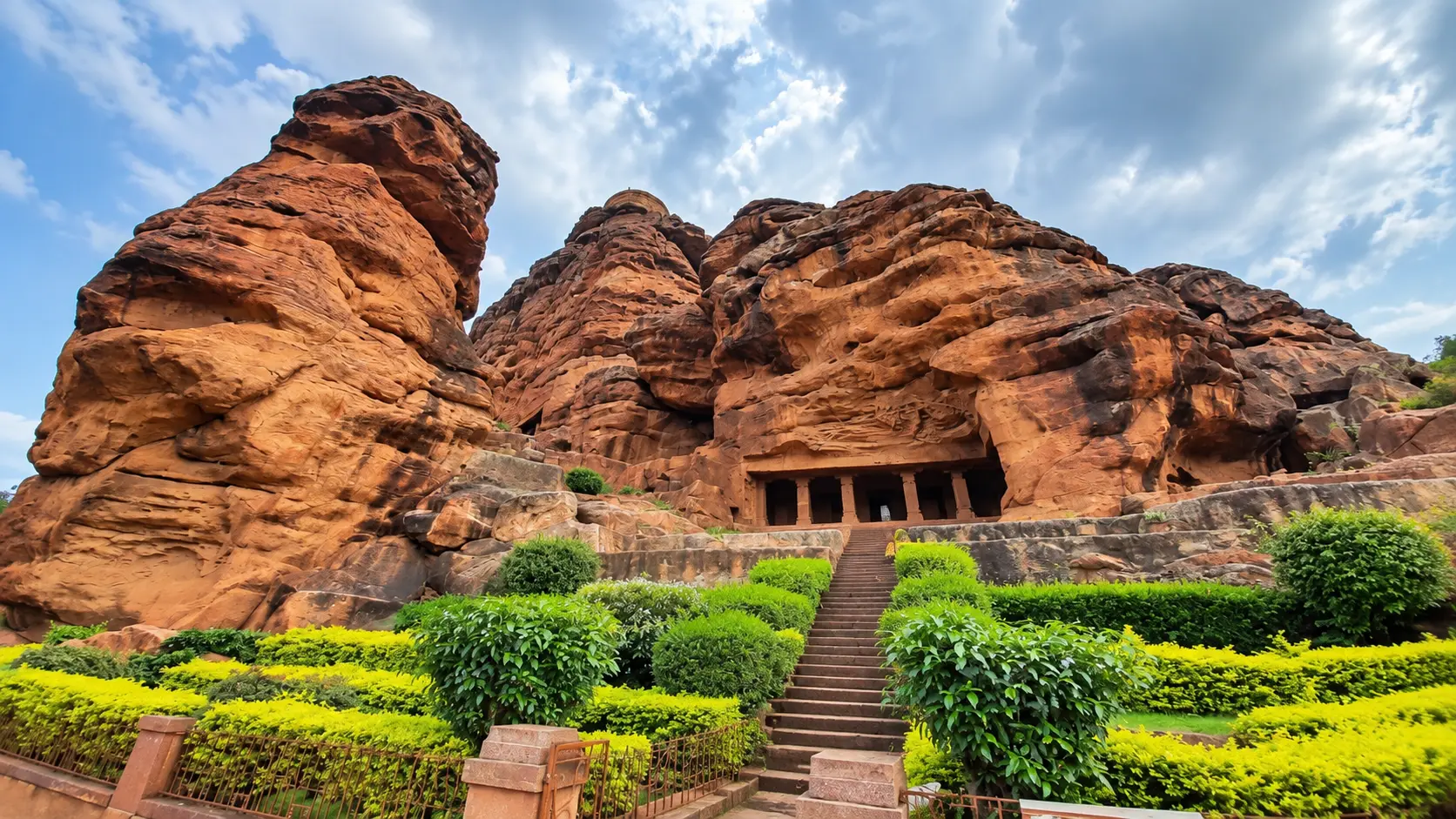
Hewn with astonishing sculptural virtuosity directly from the massive red sandstone cliffs of a rugged canyon in northern Karnataka's Bagalkot district, the Badami Cave Temples represent one of the crowning triumphs of ancient Indian rock-cut architecture. Founded as Vatapi in 540 CE by King Pulakeshin I, Badami served for more than two centuries as the imperial capital of the Early Chalukya dynasty (Badami Chalukyas). Here, in a dramatic natural amphitheater flanking the emerald waters of the ancient man-made Agastya Lake (Agastya Teertha), Chalukyan royal patrons and master artisans transformed sheer stone precipices into four magnificent rock-cut cave sanctuaries between the 6th and 8th centuries CE.
Arranged in an ascending tier along the southern cliff face, each of the four numbered caves embodies a distinct theological and architectural world. Cave 1 is dedicated to Lord Shiva and celebrated globally for its dynamic, 18-armed relief of Dancing Shiva (Nataraja); Cave 2 celebrates the cosmic incarnations of Lord Vishnu; Cave 3, consecrated in 578 CE under King Mangalesha, is an enormous Vaishnavite masterwork housing a colossal seated Vishnu on the serpent Adisesha alongside the earliest surviving classical Hindu ceiling frescoes; and Cave 4 exudes serene, ascetic contemplation dedicated to the Jain Tirthankaras. Overlooking the water opposite the caves rise the formidable bastions of the Northern Badami Fort and the 7th-century Bhutanatha temples, creating an ensemble where stone, water, and dynastic power unite in unforgettable visual harmony.
Start here. Open a tile for the full details.
Why goRead details
The Badami Cave Temples offer an unmatched immersion into 6th-century imperial Indian art, geological grandeur, and sacred iconography:
When to visitRead details
Visiting Badami requires walking across open sandstone cliffs, climbing hundreds of stone steps, and exploring unshaded lake paths; timing your visit to avoid the harsh Deccan summer heat is paramount:
Entry & permissionsRead details
Fees, visiting hours and entry rules may change. Confirm the latest details with the official operator or local authority before travelling.
A complete summary of visiting hours, entry fees, and archaeological preservation regulations:
Monument / Area | Operating Hours | Admission Tariff | Key Visitor Notes |
|---|---|---|---|
Badami Cave Temples (Caves 1 - 4) | Sunrise to Sunset (06:00 to 18:00) Daily | ₹25 (Indians) / ₹300 (Foreigners) | Single ticket covers all four caves and the Northern Fort trail. Free for children under 15. |
Badami Northern Fort Trail | Sunrise to Sunset (06:00 to 18:00) | Included with Cave Ticket | Stone-step trek up the northern hill past Shivalaya temples and granaries. |
Bhutanatha Group of Temples | Sunrise to Sunset (06:00 to 18:00) | Free Entry (₹0) | Located on eastern shore of Agastya Lake. Open freely to all visitors. |
ASI Archaeological Museum | 09:00 to 17:00 (Closed Fridays) | ₹5 per adult | Located near northern cliff base. Houses excavated sculptures and Lajja Gauri relief. |
Cashless Ticketing and Monument Etiquette
- Cashless Digital Booking: Entry tickets for the Badami Cave Temples must be purchased digitally through the Archaeological Survey of India (ASI) cashless ticketing portal or by scanning the official ASI QR code displayed at the entrance gate using any UPI smartphone app. Because internet mobile data at the cliff base can occasionally experience network congestion, purchasing your ticket online prior to arriving is recommended.
- Sanctum Footwear Rules: Shoes and sandals may be worn while climbing the outdoor stone staircases between the caves. However, before stepping onto the carved sanctum plinths of Cave 1, Cave 2, Cave 3, and Cave 4, visitors are traditionally requested to remove footwear or wipe feet clean to protect the delicate ancient sandstone floors.
- Drone and Preservation Prohibitions: Flying drones or unmanned aerial vehicles (UAVs) across the cave cliffs, Agastya Lake, or the town is strictly prohibited without written clearance from the ASI and district police. Touching ancient frescoes, scratching graffiti on sandstone pillars, and climbing on ruined parapets are severe offenses under the AMASR Act.
Plan your visitRead details
Badami is centrally located in northern Karnataka, offering smooth road, rail, and regional air connections.
Explore the full guide - choose a topic below.
Why visit?
The Badami Cave Temples offer an unmatched immersion into 6th-century imperial Indian art, geological grandeur…Explore detailsClose details
The Badami Cave Temples offer an unmatched immersion into 6th-century imperial Indian art, geological grandeur, and sacred iconography:
- Mastery of 6th-Century Rock-Cut Architecture: Carved directly into living, iron-rich sandstone bedrock without mortar or bricks, the four caves illustrate the absolute pinnacle of Early Chalukyan stonecraft. Their deep pillared verandahs (mukhamantapa), columned halls (sabhamantapa), and innermost rock-cut sanctums (garbhagriha) laid the structural and artistic foundation for later monumental Indian caves, including the Kailasa temple at Ellora.
- The 18-Armed Dancing Nataraja of Cave 1: The iconic centerpiece of Cave 1 is a magnificent, larger-than-life high-relief carving of an eighteen-armed Dancing Shiva. Sculpted with mathematical precision, the statue’s eighteen arms are positioned so that any pair of arms forms one of the 81 classical Bharatanatyam dance postures (karanas), accompanied by Lord Ganesha and a miniature Nandi looking on in adoration.
- The Monumental 578 CE Epigraphical Marvel of Cave 3: Cave 3 is one of the rare, securely dated ancient monuments in India. An authentic 6th-century Sanskrit rock inscription carved on an interior pillar explicitly dates its consecration by King Mangalesha to the full moon day of the month of Kartika in Saka 500 (578 CE), providing an immutable chronological anchor for the history of South Indian art and epigraphy.
- Magnificent Sculptural Pantheon: Across the four caves, visitors encounter monumental, deeply undercut bas-reliefs of peerless artistic sophistication: the cosmic stride of Trivikrama measuring the universe in three steps, Bhuvaraha rescuing the Earth Goddess, colossal seated Vishnu reclining upon the multi-hooded serpent Adisesha, Narasimha, Harihara, Ardhanarishwara, and Jain Tirthankaras Parshvanatha and Bahubali wrapped in forest vines.
- Surreal Landscape Framing Agastya Lake: The physical setting of Badami is unmatched. The four caves gaze directly across the still, reflective waters of Agastya Lake toward the eastern shoreline where the ancient Bhutanatha Temples sit submerged to their plinths during post-monsoon months, and the soaring red cliffs of the Northern Fort rise into the azure sky.
- The Complete Chalukyan Golden Triangle: Serving as the imperial political capital, Badami anchors the premier heritage corridor of northern Karnataka alongside the coronation temple-city of Pattadakal (17 km northeast) and the architectural laboratory of Aihole (35 km northeast).
What to expect
Visiting the Badami Cave Temples is an active, multi-sensory ascent up a series of broad stone staircases carved…Explore detailsClose details
Visiting the Badami Cave Temples is an active, multi-sensory ascent up a series of broad stone staircases carved directly into the red sandstone cliffside. Beginning at the central ticketed entrance near the base of the southern ridge, visitors climb from one cave terrace to the next, with panoramic views over Badami town and Agastya Lake expanding with every step:
[ ASI Ticketing Entrance & Landscaped Base ]
                     │
                     ▼
[ Cave 1: The Shaivite Sanctuary ]
      ├── 18-Armed Dancing Nataraja (81 Dance Karanas)
      ├── Harihara & Ardhanarishwara Wall Reliefs
      └── Coiled Nagaraja Ceiling Medallion
                     │
                     ▼ (64 Stone Steps Climb)
[ Cave 2: The Vaishnavite Sanctuary ]
      ├── Monumental Trivikrama Cosmic Stride Relief
      ├── Bhuvaraha Rescuing Bhudevi
      └── Celestial Apsaras & Swastika Ceiling Panels
                     │
                     ▼ (60 Steps Climb)
[ Cave 3: The Imperial 578 CE Vaishnavite Masterpiece ]
      ├── Colossal Seated Vishnu on Adisesha Serpent
      ├── Royal Mangalesha 578 CE Sanskrit Inscription
      ├── Traces of 6th-Century Classical Ceiling Frescoes
      └── Standing Narasimha & Eight-Armed Vishnu
                     │
                     ▼ (Short Upward Stairway)
[ Cave 4: The Jain Sanctuary ]
      ├── Seated Lord Mahavira on Lion Throne Sanctum
      ├── Tirthankara Parshvanatha under 5-Hooded Cobra
      └── Standing Gommateshwara (Bahubali) in Forest Vines
                     │
                     ▼
[ Descent to Agastya Lake & Bhutanatha Temples ]
The Imperial Capital of Vatapi and Sandstone Canyon Topography
To fully appreciate the caves, one must visualize Badami in the 6th century CE, when it was known as Vatapi. According to the epic Ramayana and local sthala-purana, the town was named after the demon Vatapi, who was slain alongside his brother Ilvala by the sage Agastya (for whom the sacred central lake is named).
In 540 CE, the visionary ruler Pulakeshin I recognized the peerless defensive topography of the site: a secluded, natural bowl-shaped canyon flanked by soaring, sheer sandstone cliffs with a natural gorge that could be dammed to store millions of gallons of freshwater. Pulakeshin I fortified the northern and southern cliffs, constructed a stone bund to create Agastya Lake, and established Vatapi as the imperial seat of the Chalukyas. Over the next two centuries, as the Chalukyas expanded their empire from the Arabian Sea to the Bay of Bengal, their monarchs channeled their royal treasury into commissioning these breathtaking cliffside sanctuaries.
The red sandstone of Badami possesses a unique, warm hue that shifts dramatically throughout the day. In the early morning, the stone appears soft ochre and rose; under the midday sun, it bleaches to pale rust; and during the golden hour before sunset, the cliffs blaze in rich, fiery vermilion and burnished gold.
Cave 1: The Shaivite Masterpiece and the 18-Armed Dancing Nataraja
Carved into the lowest level of the southern cliff approximately 15 meters above the lake plain, Cave 1 is dedicated to Lord Shiva and dates to the late 6th century CE. Passing through an open forecourt, visitors step onto a verandah supported by massive, square-section sandstone pillars.
The artistic glory of Cave 1 is immediate:
- 18-Armed Dancing Shiva (Nataraja): Carved on the right wall of the verandah, this 5-foot-tall high-relief sculpture is widely considered one of the finest depictions of Shiva in Indian art. Depicting the cosmic dance of creation and destruction, Shiva's eighteen arms radiate in a circular wheel of divine energy. Intricately carved by master sculptors, any combination of two hands forms an authentic karana (dance gesture) from the Natyashastra, illustrating 81 distinct poses. Beside him, Lord Ganesha mirrors his father's dance, while a miniature Nandi bull gazes up in adoration.
- Harihara Relief: On the opposite wall stands an imposing relief of Harihara - the composite divinity who is half-Shiva (holding the axe, wearing matted dreadlocks and a serpent earring) and half-Vishnu (holding the conch shell, wearing an elaborate cylindrical crown). He is flanked by Goddess Parvati and Goddess Lakshmi.
- Ardhanarishwara: Another monumental panel depicts Shiva and Parvati merged into a single androgynous body (Ardhanarishwara), symbolizing the indivisible unity of the masculine and feminine cosmic principles.
- Ceiling Sculptures: Peering upward at the verandah roof, visitors can admire a masterfully carved coiled serpent king (Nagaraja) with an undulating body and five hoods spread wide, alongside medallions of flying celestial gandharvas and vidyadharas.
Cave 2: The Vaishnavite Sanctuary of Trivikrama
Ascending a flight of 64 stone steps eastward along the cliff, visitors reach Cave 2, excavated in the late 6th century CE and dedicated to Lord Vishnu. Guarded by two fierce celestial door-keepers (dwarapalas) holding clubs, the verandah opens into an pillared hall decorated with elaborate ceiling friezes.
The defining sculptural masterpieces of Cave 2 include:
- Trivikrama (The Three Cosmic Strides): On the eastern wall of the verandah looms a colossal, dynamic relief of Vishnu in his Trivikrama manifestation. The narrative depicts the dwarf Brahmin Vamana expanding into a cosmic giant: with one mighty foot planted upon the earth, his left leg is swung high into the heavens, claiming the entire cosmos from the demon king Bali. Celestial musicians, soaring demi-gods, and defeated asuras frame the composition, conveying immense dramatic motion.
- Bhuvaraha (The Boar Incarnation): On the western wall, Vishnu is sculpted in his zoomorphic Varaha (boar) avatar, stepping forward from the primordial cosmic ocean. His muscular arms cradle the Earth Goddess Bhudevi, whom he has rescued from the depths of the underworld, with the serpent king Sesha prostrating below in worship.
- Ceiling Friezes: The ceiling of Cave 2 is richly embellished with carved geometric medallions, swastika patterns, and narrative friezes illustrating scenes from the life of young Lord Krishna, including the churning of the ocean (Samudra Manthana).
Cave 3: The 578 CE Imperial Vaishnavite Masterpiece of Mangalesha
Ascending another 60 stone steps brings travelers to the magnificent terrace of Cave 3, universally acknowledged as the largest, most ornate, and architecturally sophisticated cave temple in Badami. Carved into the sheer face of the cliff with a facade spanning over 21 meters, Cave 3 is a monumental royal sanctuary excavated under the direct patronage of Chalukyan Prince Mangalesha (who later ruled as king from 598 to 610 CE).
Cave 3 is of profound historical and artistic consequence:
- The 578 CE Mangalesha Inscription: Carved into the front face of a massive verandah pillar, an authentic Sanskrit inscription in archaic Kannada-Telugu script records that on the sacred full moon day of Kartika in the Saka year 500 (corresponding to 31 October 578 CE), Mangalesha consecrated this temple (Maha-Vishnu-Griha) in memory of his elder brother, King Kirtivarman I, and endowed it with the revenue of a nearby village. This inscription provides one of the absolute chronological benchmarks for South Indian art history.
- Colossal Seated Vishnu on Adisesha: The most iconic sculpture in Cave 3 is an immense, deeply undercut carving of Lord Vishnu seated in majestic royal ease (sukhasana) upon the coiled body of the five-hooded cosmic serpent Adisesha. The serpent’s flared hoods form a protective canopy over Vishnu's crowned head. The deity holds the conch (shankha), discus (chakra), and mace (gada), while celestial attendants, winged vidyadharas, and royal dwarfs hover around the throne.
- Traces of Ancient Classical Ceiling Frescoes: On the curved bracket capital of the front verandah roof, visitors can still discern faint, precious remnants of 6th-century classical wall paintings. Contemporaneous with the late murals of Ajanta, these paintings depict a royal palace court scene with Chalukyan courtiers, women wearing delicate pearl jewelry, and celestial beings. They represent the oldest surviving classical Hindu frescoes in India.
- Standing Narasimha and Eight-Armed Vishnu: Other monumental wall niches showcase an imposing, muscular four-armed Narasimha leaning casually upon his heavy war club, an eight-armed cosmic Vishnu (Vaikuntha Narayana), and an exquisitely rendered Harihara.
Cave 4: The Serene Jain Sanctuary of Mahavira and Bahubali
Located slightly further east and approached by a final short stone stairway, Cave 4 is the youngest and highest cave in the primary sequence, dating to the late 6th or 7th century CE (with later additions continuing into the 8th century). In contrast to the dramatic martial energy of the Hindu caves, Cave 4 exudes quiet, meditative serenity, dedicated entirely to the Tirthankaras of the Jain faith.
Key artistic features of Cave 4 include:
- Sanctum Image of Lord Mahavira: Within the dark, rock-cut inner sanctum sits a polished stone murti of the 24th Tirthankara, Lord Mahavira, seated in deep dhyanasana meditation upon an elevated lion throne (simhasana), shaded by a triple-tiered celestial umbrella (chhatri).
- Tirthankara Parshvanatha: On the western wall of the verandah stands a serene, towering high-relief image of Parshvanatha, the 23rd Tirthankara. He stands in deep, unmoving kayotsarga meditation, while the five-hooded serpent Dharanendra spreads its broad hoods over his head to shield him from the violent thunderstorm unleashed by the demon Kamatha.
- Gommateshwara (Bahubali): On the opposite wall stands Bahubali (Gommateshwara), the son of the first Tirthankara Rishabhanatha. Depicted in standing meditation, Bahubali is lost in absolute detachment from the material world, so motionless that creeping forest vines have entwined around his legs and arms, and ant-hills have grown at his feet.
- The cave walls and pillar brackets are filled with dozens of smaller carved figures of seated Tirthankaras, yakshas, and yakshis, reflecting the rich flourishing of Jainism under royal Chalukyan patronage.
Agastya Lake, the Bhutanatha Temples, and the Badami Fort Trek
After exploring the four cave temples, the Badami experience is far from complete. Descending the steps back to the lake plain, travelers can wander around the perimeter of Agastya Lake:
- The Bhutanatha Group of Temples: Situated on a low sandstone promontory jutting into the eastern waters of the lake, these 7th-to-11th-century sandstone shrines are dedicated to Lord Shiva as Bhutanatha (Lord of Spirits). Built right at the water’s edge, during and after the monsoon the rising lake waters submerge the outer steps and plinths of the temple, creating an unforgettable golden reflection on the calm lake surface that has become one of Karnataka's most iconic postcards.
- The Badami Northern Fort Trek: Across the lake from the caves rises the northern cliff, crowned by the Badami Fort. A scenic, moderately demanding 30-to-45-minute stone-step trek ascends through narrow rock fissures past ancient defensive bastions built by the Chalukyas and later refortified by Tipu Sultan. Highlights atop the mesa include massive 16th-century stone granaries, an ancient stepwell, Tipu Sultan’s iron cannon battery, and two exquisitely carved 7th-century shrines: the Upper Shivalaya and Lower Shivalaya, offering bird's-eye views over the entire valley.
- The ASI Badami Archaeological Museum: Situated near the base of the northern cliff, this museum houses an exceptional collection of excavated sculptures, including the famous 7th-century Lajja Gauri fertility goddess relief, hero stones, and detailed architectural models of the caves.
Best time to visit
Visiting Badami requires walking across open sandstone cliffs, climbing hundreds of stone steps, and exploring…Explore detailsClose details
Visiting Badami requires walking across open sandstone cliffs, climbing hundreds of stone steps, and exploring unshaded lake paths; timing your visit to avoid the harsh Deccan summer heat is paramount:
[ October to February: Peak Season ]
Pleasant Deccan weather (18°C - 28°C), soft golden sunlight, comfortable hiking.
Optimal for exploring all four caves, fort trekking, and lake photography.
                │
                ▼
[ March to May: Summer Season ]
Intensely hot (up to 42°C) with dry, blazing afternoon heat.
Early morning (06:00 - 09:30) and late afternoon (16:30 - 18:00) visits essential.
                │
                ▼
[ June to September: Southwest Monsoon ]
Moderate rainfall, Agastya Lake fills, dramatic red cliffs turn lush green.
Atmospheric photography; requires caution on wet, slick sandstone steps.
Post-Monsoon and Winter Season (October to February)
This is the undisputed premier window to visit Badami. With the conclusion of the monsoon rains by early October, the climate across Bagalkot district turns dry, crisp, and delightfully mild. Daytime temperatures hover comfortably between 18°C and 28°C, with cool, refreshing morning and evening breezes.
The sandstone cliffs catch the low winter sun, illuminating the intricate details of the cave carvings in warm, flattering golden light. Climbing the staircases between Caves 1, 2, 3, and 4 and undertaking the uphill trek to the Northern Fort can be accomplished with minimal physical fatigue. Agastya Lake remains full and clear, providing serene reflections of the Bhutanatha temples. This is also the period of the vibrant Banashankari Temple Festival (in January/February), which draws tens of thousands of rural pilgrims for a month-long cultural fair near Badami.
Summer Season (March to May)
Summer in northern Karnataka is fiercely hot and arid. Daytime highs routinely climb between 38°C and 42°C, and the sun radiates intense heat off the bare sandstone cliffs and paved stone steps between 11:00 and 16:00.
Check the current visiting hours and permitted access with the site operator before departure; ceremonies, closures and visitor sessions can affect access. Retreat to air-conditioned hotels or dining halls during the blazing midday hours, and return after 16:30 to walk around Agastya Lake and watch the sunset illuminate the cliffs. Sun hats, polarized sunglasses, sunscreen, and ample bottled drinking water are mandatory requirements.
Southwest Monsoon (June to September)
Bagalkot district receives moderate monsoon precipitation, averaging around 600 mm across the season. The rains breathe extraordinary new life into the arid red sandstone canyon. Agastya Lake fills to its brim, sometimes lapping against the outer walls of the Bhutanatha temple, and seasonal waterfalls cascade down the red sandstone cliffs behind the caves.
The red sandstone deepens to a rich, dramatic terracotta hue, while patches of bright green moss and wild grass carpet the cliff terraces. Temperatures drop to a pleasant 22°C to 30°C. While rain showers can be intermittent, the caves themselves are completely sheltered from rain. Travelers must exercise caution when walking on wet, algae-covered stone staircases and carrying umbrellas for sudden showers.
How to reach
Badami is centrally located in northern Karnataka, offering smooth road, rail, and regional air connections.Explore detailsClose details
Badami is centrally located in northern Karnataka, offering smooth road, rail, and regional air connections.
Rail Network Connectivity
The South Western Railway provides direct, comfortable rail connections directly into Badami town:
- Badami Railway Station (Station Code: BDM): Situated approximately 4.5 km east of the cave complex. A well-connected station on the Gadag - Hotgi rail line receiving scheduled daily halts from major express trains, including the Gol Gumbaz Express (connecting Mysuru, Bengaluru, Hubballi, Badami, and Solapur), the Basava Express, and local passenger shuttles. Confirm the current charge and what it includes with the operator or service provider. Visitor admission, vehicles, parking, activities and accommodation can have separate charges.
- Bagalkot Railway Station (Station Code: BGK): Located approximately 45 km northwest, serving as a larger district railway junction with additional halts for long-distance superfast trains.
Road Routes and the Chalukyan Golden Triangle
Badami is well-served by smooth state and national highways, forming the base for exploring the famous Chalukyan heritage circuit:
- From Pattadakal (~17 km, 25 minutes) & Aihole (~35 km, 45 minutes): State Highway 14 connects Badami directly to Pattadakal and Aihole through scenic red sandstone hills and rural farmland. Local KSRTC buses and shared auto-rickshaws ply this route every 30 minutes.
- From Hubballi (~105 km, 2.5 hours): Travel northeast via State Highway 34 and NH-52 through Navalgund and Ron to Badami. A smooth two-lane highway with scenic countryside views.
- From Hampi / Hosapete (~140 km, 3 to 3.5 hours): Drive north via NH-50 through Kushtagi and Ilkal, branching west onto state highways to Badami. This forms the quintessential northern Karnataka heritage road trip.
- From Bengaluru (~450 km, 8 to 9 hours): Follow National Highway 48 (NH-48) northwest past Tumakuru, Chitradurga, and Davanagere, connecting via NH-50 through Kushtagi to Badami. KSRTC operates multiple daily Non-AC Sleeper and luxury Airavat Club Class overnight buses from Majestic Bus Station directly to Badami.
Air Travel Access
Travelers flying to Badami can utilize several regional domestic airports:
- Hubballi Airport (HBX): Located approximately 105 km southwest of Badami. Hubballi is the closest and most convenient domestic airport, operating regular daily flights connecting to Bengaluru, Mumbai, Hyderabad, and Delhi. Pre-paid taxis reach Badami in approximately 2.5 hours.
- Belagavi Airport (IXG): Situated approximately 140 km west of Badami. Operates regular domestic flights to major metros; driving time via Bagalkot is roughly 3 hours.
- Goa Dabolim Airport (GOI): Located approximately 250 km west of Badami. Taxis drive east through the Western Ghats via Belagavi, requiring approximately 5.5 hours.
Entry, timings and permissions
Fees, visiting hours and entry rules may change.Explore detailsClose details
Fees, visiting hours and entry rules may change. Confirm the latest details with the official operator or local authority before travelling.
A complete summary of visiting hours, entry fees, and archaeological preservation regulations:
Monument / Area | Operating Hours | Admission Tariff | Key Visitor Notes |
|---|---|---|---|
Badami Cave Temples (Caves 1 - 4) | Sunrise to Sunset (06:00 to 18:00) Daily | ₹25 (Indians) / ₹300 (Foreigners) | Single ticket covers all four caves and the Northern Fort trail. Free for children under 15. |
Badami Northern Fort Trail | Sunrise to Sunset (06:00 to 18:00) | Included with Cave Ticket | Stone-step trek up the northern hill past Shivalaya temples and granaries. |
Bhutanatha Group of Temples | Sunrise to Sunset (06:00 to 18:00) | Free Entry (₹0) | Located on eastern shore of Agastya Lake. Open freely to all visitors. |
ASI Archaeological Museum | 09:00 to 17:00 (Closed Fridays) | ₹5 per adult | Located near northern cliff base. Houses excavated sculptures and Lajja Gauri relief. |
Cashless Ticketing and Monument Etiquette
- Cashless Digital Booking: Entry tickets for the Badami Cave Temples must be purchased digitally through the Archaeological Survey of India (ASI) cashless ticketing portal or by scanning the official ASI QR code displayed at the entrance gate using any UPI smartphone app. Because internet mobile data at the cliff base can occasionally experience network congestion, purchasing your ticket online prior to arriving is recommended.
- Sanctum Footwear Rules: Shoes and sandals may be worn while climbing the outdoor stone staircases between the caves. However, before stepping onto the carved sanctum plinths of Cave 1, Cave 2, Cave 3, and Cave 4, visitors are traditionally requested to remove footwear or wipe feet clean to protect the delicate ancient sandstone floors.
- Drone and Preservation Prohibitions: Flying drones or unmanned aerial vehicles (UAVs) across the cave cliffs, Agastya Lake, or the town is strictly prohibited without written clearance from the ASI and district police. Touching ancient frescoes, scratching graffiti on sandstone pillars, and climbing on ruined parapets are severe offenses under the AMASR Act.
Nearby places to consider
Badami is the bustling cultural epicentre of northern Karnataka's heritage landscape, offering access to stunning…Explore detailsClose details
Badami is the bustling cultural epicentre of northern Karnataka's heritage landscape, offering access to stunning temples, ancient lakes, and sacred pilgrimage centers:
                         [ Bagalkot Town & Almatti ]
                       (District hub & gardens, 45 - 60 km N)
                                    ▲
                                    │
[ Banashankari Temple ] ◄─── [ Badami ] ───► [ Mahakuta Temple ]
(Haridra Teertha tank,              │         (Spring pushkarini & Shiva,
  5 km south)                       │               14 km east)
                                    ▼
                         [ Pattadakal UNESCO Site ]
                       (Chalukyan coronation city, 17 km NE)
                                    │
                                    ▼
                         [ Aihole & Hampi ]
(Temple cradle & Vijayanagara, 35 - 140 km)- Agastya Lake & Bhutanatha Temples (Directly Adjacent): The ancient 5th-century artificial reservoir cradled between Badami's sandstone cliffs, featuring the serene 7th-century Bhutanatha temples perched directly at the water's edge, creating unforgettable golden reflections at dawn and dusk.
- Badami Northern Fort & Upper Shivalaya (~1 km trek): An imposing mesa-top citadel featuring ancient stone granaries, an underground treasury, Tipu Sultan's cannon battery, and two 7th-century Dravidian shrines offering 360-degree aerial views across the town and lake.
- ASI Badami Archaeological Museum (~1 km near lake): Houses an outstanding collection of excavated Chalukyan stone sculptures, hero stones, inscriptions, and the celebrated 7th-century Lajja Gauri fertility relief.
- Banashankari Amma Temple (~5 km south): A revered 8th-century temple dedicated to Goddess Shakambhari (Parvati), featuring an extraordinary multi-tiered royal stepwell tank (Haridra Teertha) enclosed by carved stone colonnades and watchtowers, drawing vast crowds during the annual January/February Rathotsava.
- Mahakuta Temple Complex (~14 km east): A tranquil, active Shaivite pilgrimage sanctuary hidden in a lush banyan grove. Houses dozens of 7th-century stone shrines gathered around two natural freshwater spring pools (Vishnu Pushkarini) where pilgrims take purifying dips.
- Pattadakal UNESCO World Heritage Site (~17 km northeast): The grand ceremonial coronation city of the Chalukyas, featuring a magnificent complex of ten 8th-century temples where northern Nagara and southern Dravidian architecture reached their ultimate harmonious zenith.
- Aihole Temple Complex (~35 km northeast): Renowned as the "Cradle of Indian Temple Architecture," boasting over 125 stone temples including the iconic apsidal Durga Temple and the 634 CE Meguti inscription.
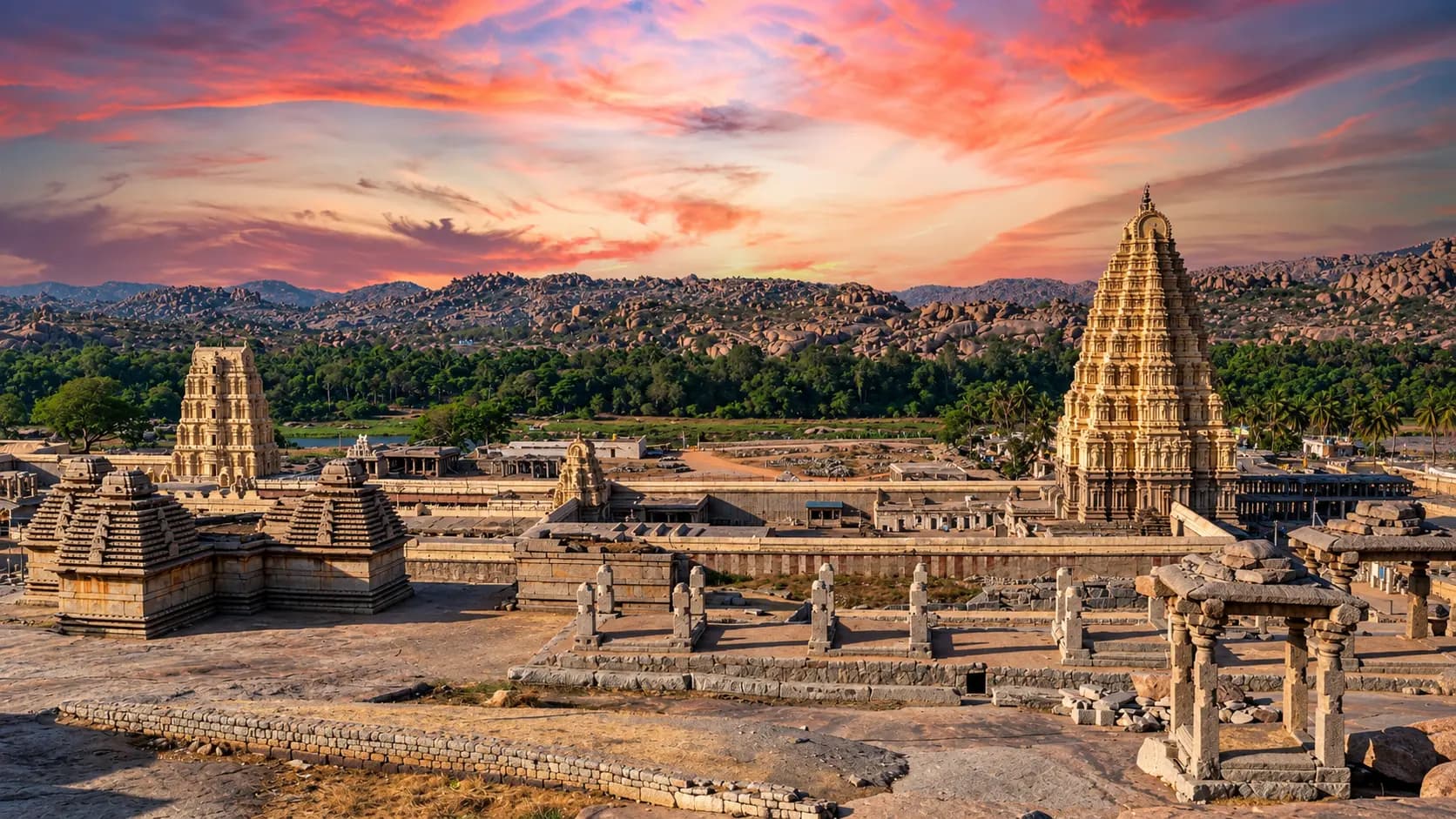
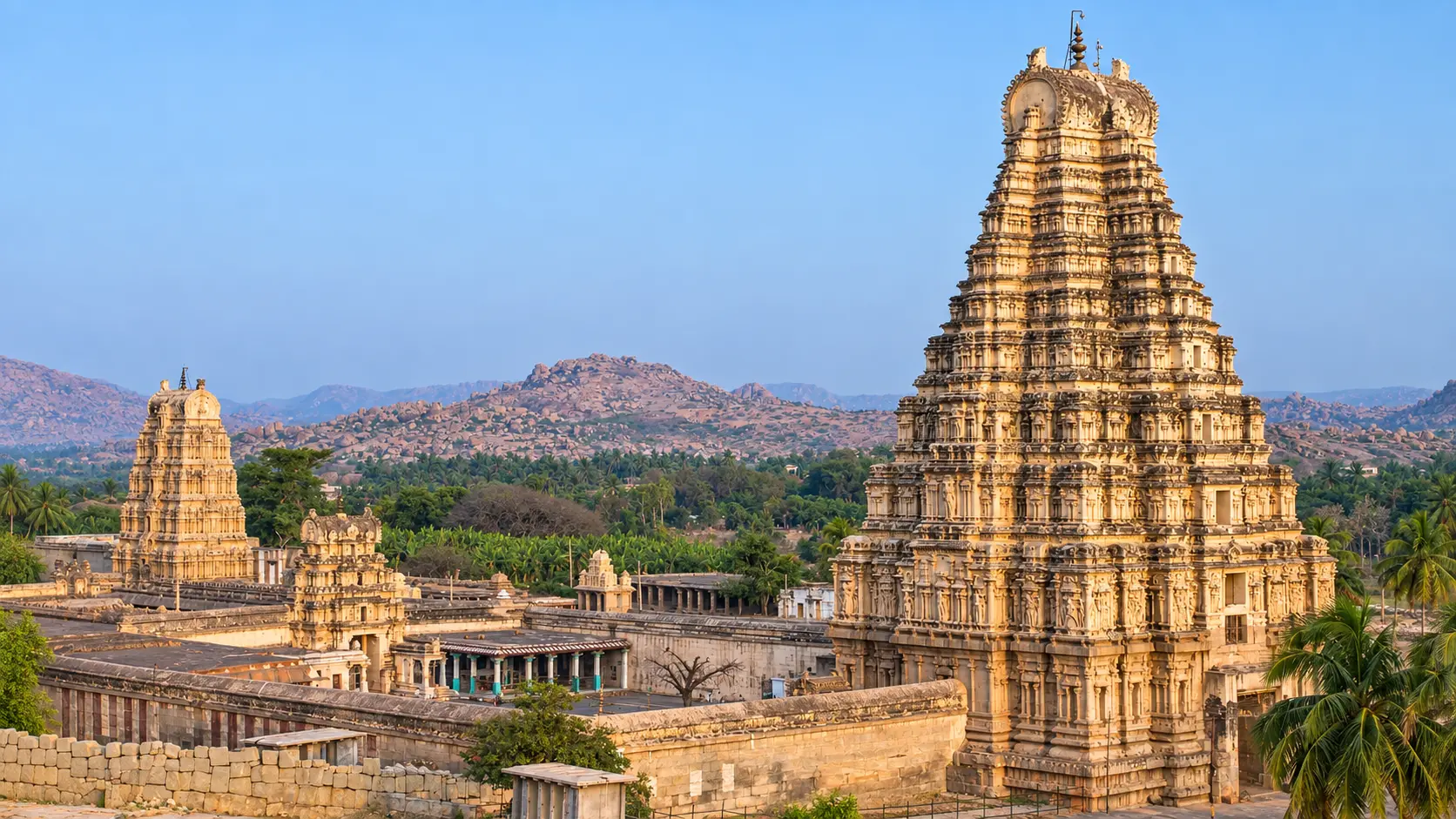
- Hampi UNESCO World Heritage Site (~140 km southeast): The legendary 14th-century capital of the Vijayanagara Empire, sprawling across 4,100 hectares of surreal boulder hills, riverside shrines, and monumental complexes such as the Virupaksha and Vijaya Vittala temples.
In pictures
The practical bits
Before you go.
Plan ahead
To make the most of your excursion to the Badami Cave Temples, keep these five essential preparation guidelines…Explore detailsClose details
To make the most of your excursion to the Badami Cave Temples, keep these five essential preparation guidelines in mind:
Aggressive Macaque Monkey Alert
Habituated bonnet macaques (Macaca radiata) congregate along the stone stairways connecting Caves 1 through 4…Explore detailsClose details
Habituated bonnet macaques (Macaca radiata) congregate along the stone stairways connecting Caves 1 through 4; visitors must strictly avoid carrying open food, plastic snack bags, or juice bottles, and keep smartphones, cameras, and sunglasses securely held or zipped inside backpacks.
Staircase Climbing and Footwear Preparation
Navigating all four caves and the optional trek up Badami Fort involves climbing more than 300 uneven stone…Explore detailsClose details
Navigating all four caves and the optional trek up Badami Fort involves climbing more than 300 uneven stone steps; visitors should wear lightweight walking shoes with good rubber traction, carry at least 1.5 liters of drinking water, and pace their climb.
Photography Lighting and Sunset Scheduling
Photographers should plan their visits to Cave 1 and Cave 3 in the morning when ambient daylight illuminates the…Explore detailsClose details
Photographers should plan their visits to Cave 1 and Cave 3 in the morning when ambient daylight illuminates the deep verandah carvings, while scheduling visits to the Bhutanatha temples and Agastya Lake for late afternoon (16:30 to 18:00) to capture fiery red sandstone reflections during the golden hour.
Combined Chalukyan Triangle Logistics
To gain a complete historical appreciation of the Early Chalukya dynasty, allocate two full days to the region…Explore detailsClose details
To gain a complete historical appreciation of the Early Chalukya dynasty, allocate two full days to the region: Day 1 dedicated to the Badami caves, Northern Fort, and Agastya Lake; Day 2 dedicated to the royal temples of Pattadakal (17 km) and the architectural design laboratory of Aihole (35 km).
Cashless Ticket Booking Preregistration
Because mobile internet speeds near the cliff base can fluctuate during peak holiday surges, visitors should…Explore detailsClose details
Because mobile internet speeds near the cliff base can fluctuate during peak holiday surges, visitors should purchase their ASI digital entry tickets online prior to leaving their hotel to avoid waiting in physical verification lines at the gate.
A few things you might wonder
Common questions about visiting Badami Cave Temples. Fees, visiting hours and ceremonies are researched details that may change; confirm current arrangements with the operator before travelling.
How many cave temples are there in Badami and who built them?
What is the historical significance of Cave 3 in Badami?
What are the religious affiliations of the four Badami caves?
What is the meaning behind the 18-armed Nataraja in Cave 1?
What are the opening timings and entry ticket fees for the Badami Cave Temples?
How physically demanding is the climb to the Badami caves?
Are monkeys a hazard at the Badami Cave Temples?
Can I visit Badami, Pattadakal, and Aihole together?
Explore more in Hampi Badami
Discover other destinations around this hub
More Hubs in Karnataka
Continue exploring other travel hubs in this state
Planning a trip to Hampi Badami?