Hampi
Comprehensive visitor guide to Hampi in Vijayanagara district. Explore the Stone Chariot, Virupaksha Temple, Lotus Mahal, timings, entry fees, and travel routes.
Location
Hampi Badami, Karnataka
A closer look
Your visit, at a glance.
Hampi Badami, Karnataka
GET TO KNOW THE PLACE
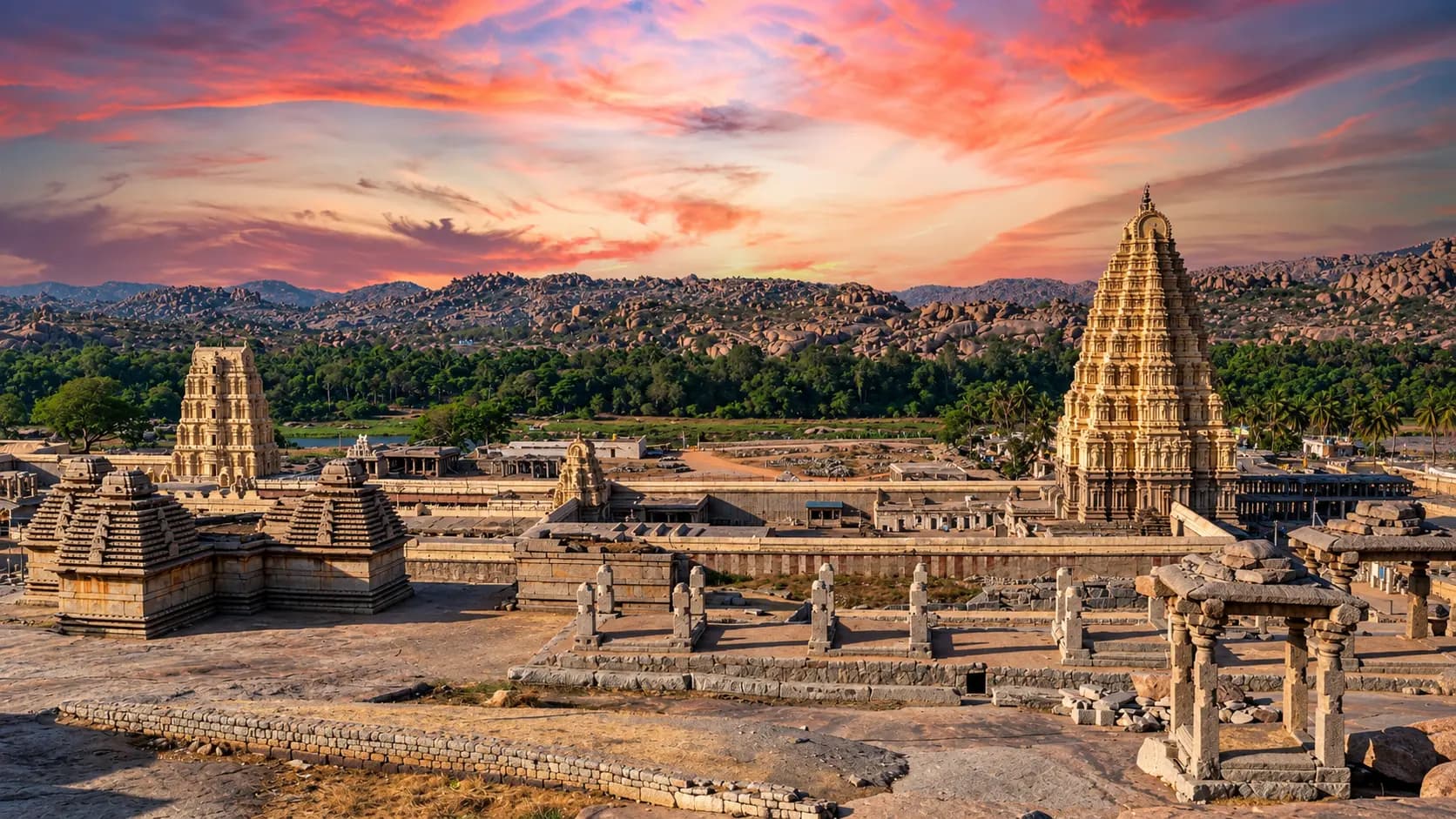
Rising dramatically from the rugged granite hills and lush irrigated valleys of the Tungabhadra River basin, Hampi stands as one of the most astonishing archaeological landscapes…
The story of Hampi
Rising dramatically from the rugged granite hills and lush irrigated valleys of the Tungabhadra River basin, Hampi stands as one of the most astonishing archaeological landscapes in Asia. Serving as the imperial capital of the Vijayanagara Empire from 1336 until its catastrophic sack following the Battle of Talikota in 1565, this ancient city was known to medieval world travellers - such as the Portuguese horse merchant Domingo Paes, the Persian ambassador Abdur Razzaq, and the Italian merchant Niccolò de' Conti - as a metropolis of unimaginable opulence, rivalling Rome and Peking in size, grandeur, and commercial vibrancy. At its peak during the early 16th century under the celebrated warrior-scholar king Krishna Deva Raya, Vijayanagara commanded an empire spanning nearly the entire Indian peninsula south of the Krishna River, trading diamonds, Arabian war horses, rubies, fine Chinese silks, and spices across international maritime networks.
Today, designated a UNESCO World Heritage Site in 1986, the Group of Monuments at Hampi preserves more than 1,600 surviving architectural structures across an expanse of over 41.87 square kilometres. Administratively located within the Vijayanagara district of Karnataka (carved out of Ballari district in October 2021 with its administrative headquarters at nearby Hosapete), Hampi is not merely an open-air museum of stone. It is a living sacred geography where ancient Hindu mythologies, medieval royal court rituals, and timeless riverside life converge amidst an otherworldly terrain of giant russet granite boulders, jade-green banana plantations, and turquoise water channels that still function five centuries after their hydraulic engineering.
Whether you are walking along the colonnaded bazaar streets where medieval merchants once weighed gems by the basket, marvelling at the acoustic genius of the musical pillars in the Vitthala Temple, watching the sunrise illuminate the monolithic gopuras from the windswept summit of Matanga Hill, or exploring the Indo-Islamic pleasure palaces of the Royal Enclosure, Hampi demands thoughtful planning, keen geographic awareness, and comfortable pacing. This guide provides an exhaustive, field-tested resource detailing the historical context, architectural highlights, seasonal dynamics, navigational routes, and practical travel strategies essential for exploring this imperial masterpiece.
Start here. Open a tile for the full details.
Why goRead details
The Group of Monuments at Hampi offers a travel experience that has few parallels anywhere in the world, combining monumental stone architecture, epic mythology, and surreal geology:
When to visitRead details
Hampi is situated on the arid Deccan Plateau, where the local microclimate is dictated by intense solar radiation off bare granite surfaces, low ambient humidity, and distinct seasonal monsoon cycles. Understanding these dynamics is critical for planning daily sightseeing schedules.
Entry & permissionsRead details
Fees, visiting hours and entry rules may change. Confirm the latest details with the official operator or local authority before travelling.
Visiting the monuments of Hampi is governed by clear ticketing policies and heritage regulations established by the Archaeological Survey of India (ASI) and the local administration:
+-----------------------------------------------------------------------------------+
|                        TICKETING & OPERATIONAL SCHEDULE                           |
+-----------------------------------------------------------------------------------+
| Monument Sector       | Opening Hours          | Entry Fee / Access Policy        |
+-----------------------+------------------------+----------------------------------+
| Vitthala Temple &     | 06:00 to 18:00 daily   | ₹40 (Indian/SAARC/BIMSTEC; ₹35   |
| Zenana Enclosure      | (Sunrise to Sunset)    | online); ₹600 (Foreign; ₹550     |
| (Lotus Mahal/Stables) |                        | online). Single unified pass.    |
+-----------------------+------------------------+----------------------------------+
| Virupaksha Temple     | 06:00 to 13:00 and     | ₹25 entry ticket (managed by     |
|                       | 17:00 to 21:00 daily   | temple trust); ₹50 camera fee    |
+-----------------------+------------------------+----------------------------------+
| Unenclosed Monuments  | Daylight hours         | Free public access               |
| (Mahanavami Dibba,    | (06:00 to 18:00)       | (Mahanavami Dibba, Stepped Tank, |
| Hemakuta, Matanga)    |                        | Hazara Rama, Queen's Bath)       |
+-----------------------+------------------------+----------------------------------+
| Archaeological Museum | 10:00 to 17:00         | ₹5 per person;                   |
| (Kamalapur)           | (Closed on Fridays)    | Children under 15 free           |
+-----------------------------------------------------------------------------------+
Cashless Ticketing and Monument Etiquette
Under Archaeological Survey of India regulations, ticket counters at the Vitthala Temple and the Lotus Mahal are predominantly cashless. Visitors purchase passes by scanning official UPI QR codes displayed at the ticket booths or by booking in advance through the official ASI national booking portal (https://asi.nic.in/).
Visitors should note that the single ASI ticket is valid only on the date of purchase. Ensure you retain your physical ticket or digital QR code on your smartphone, as staff will scan it at both the Vitthala Temple entrance and the Zenana Enclosure gate. Modest dress covering shoulders and knees is mandatory inside the active sanctum of Virupaksha Temple, and visitors must remove their footwear before stepping onto sanctum stone platforms.
Plan your visitRead details
Hampi's location in central-northern Karnataka places it within straightforward reach of major transport corridors connecting Bengaluru, Hyderabad, Goa, and Mumbai.
Explore the full guide - choose a topic below.
Why visit?
The Group of Monuments at Hampi offers a travel experience that has few parallels anywhere in the world…Explore detailsClose details
The Group of Monuments at Hampi offers a travel experience that has few parallels anywhere in the world, combining monumental stone architecture, epic mythology, and surreal geology:
- Epic Scale of a Medieval Global Capital: Spanning over 4,100 hectares with more than 1,600 catalogued monuments, Hampi is one of the largest archaeological complexes in existence. Exploring its ruined palaces, fortified bastions, gateway portals, and sacred temples provides an immersive, tactile window into the wealth and administrative sophistication of the 14th-to-16th-century Vijayanagara Empire.
- The Iconic Stone Chariot of the Vitthala Temple: The world-famous Stone Chariot is one of the crowning symbols of Indian heritage, immortalized on the reverse of the modern Reserve Bank of India 50-rupee currency note. Carved from fine-grained granite to resemble an imperial ceremonial temple car, it enshrines Garuda with extraordinary ornamental precision.
- Acoustic Engineering of the 56 Musical Pillars: Inside the Maha Mantapa of the Vitthala Temple, medieval stonecraft achieved unprecedented acoustic mastery. Fifty-six monolithic granite pillars were hand-chiselled with clusters of slender stone colonnettes that resonate with musical frequencies corresponding to classical Indian notes (sa-re-ga-ma) and temple bells.
- Living Sacred Traditions at Virupaksha Temple: Unlike most archaeological sites that exist purely as preserved ruins, the 7th-century Virupaksha Temple has maintained an unbroken continuum of daily worship for over 1,300 years. Its soaring 50-metre Rajagopura, vibrant ceiling frescoes, temple elephant blessings, and active riverside rituals offer a direct encounter with living Hindu heritage.
- Brilliant Synthesis of Indo-Islamic Secular Architecture: The monuments of the Royal Centre - including the graceful two-storeyed Lotus Mahal with its cusped plaster arches, the monumental 11-domed Elephant Stables, and the subterranean Queen's Bath - showcase an extraordinary intercultural fusion where southern Dravidian stone construction blended seamlessly with Sultanate Islamic vaults and domes.
- Otherworldly Boulder-Strewn Landscape: The geological canvas of Hampi is breathtaking in its own right. Ancient plutonic granite hills have weathered over millions of years into jagged inselbergs, precariously balanced boulder fields, and narrow river canyons that frame green rice paddies and swaying coconut palms.
- Sacred Geography of the Ramayana (Kishkindha): The northern riverbanks and surrounding hills are intimately identified with Kishkindha, the monkey kingdom of the epic Ramayana. Climbing the 575 steps of Anjanadri Hill to the birthplace of Lord Hanuman, crossing the sacred swirls of Chakratirtha, or visiting the secluded lotus waters of Pampa Sarovar weaves sacred legend into every vista.
What to expect
Visiting Hampi is an active, multi-sensory journey through five centuries of imperial history and thousands of…Explore detailsClose details
Visiting Hampi is an active, multi-sensory journey through five centuries of imperial history and thousands of years of geological formation. The ruins are broadly divided into five principal geographic sectors: the Sacred Centre along the southern riverfront; the Royal Centre in the Kamalapur basin; the Vitthala Temple Complex and its riverside trail; the Vantage Summits (Matanga, Hemakuta, and Malyavanta hills); and the Northern Bank (Anegundi / Kishkindha) across the Tungabhadra River.
+-----------------------------------------------------------------------------------+
|                        TUNGABHADRA RIVER (CHAKRATIRTHA GORGE)                     |
+-----------------------------------------------------------------------------------+
       |                                       |                               |
[Virupaksha Temple] <==== Riverside Path ====> [Achyutaraya] <==== Path ====> [Vitthala Complex]
       |                                       |                           (Stone Chariot &
 [Hemakuta Hill]                               |                            Musical Pillars)
 (Monolithic Ganeshas)                  [Matanga Hill]                             |
       |                              (Panoramic Summit)                   [King's Balance]
 [Hampi Bazaar]                                                                    |
       |                                                                    [EV Shuttle Path]
       +---------------------------- Hampi-Kamalapur Road -------------------------+
                                               |
                                     [ROYAL CENTRE BASIN]
                                               |
                        +----------------------+----------------------+
                        |                      |                      |
                 [Hazara Rama]         [Mahanavami Dibba]      [Zenana Enclosure]
              (Carved Ramayana)        (Imperial Platform)     (Lotus Mahal & Stables)
                        |                      |                      |
                 [Stepped Tank]         [Royal Aqueducts]       [Queen's Bath]
The Sacred Centre & Virupaksha Temple
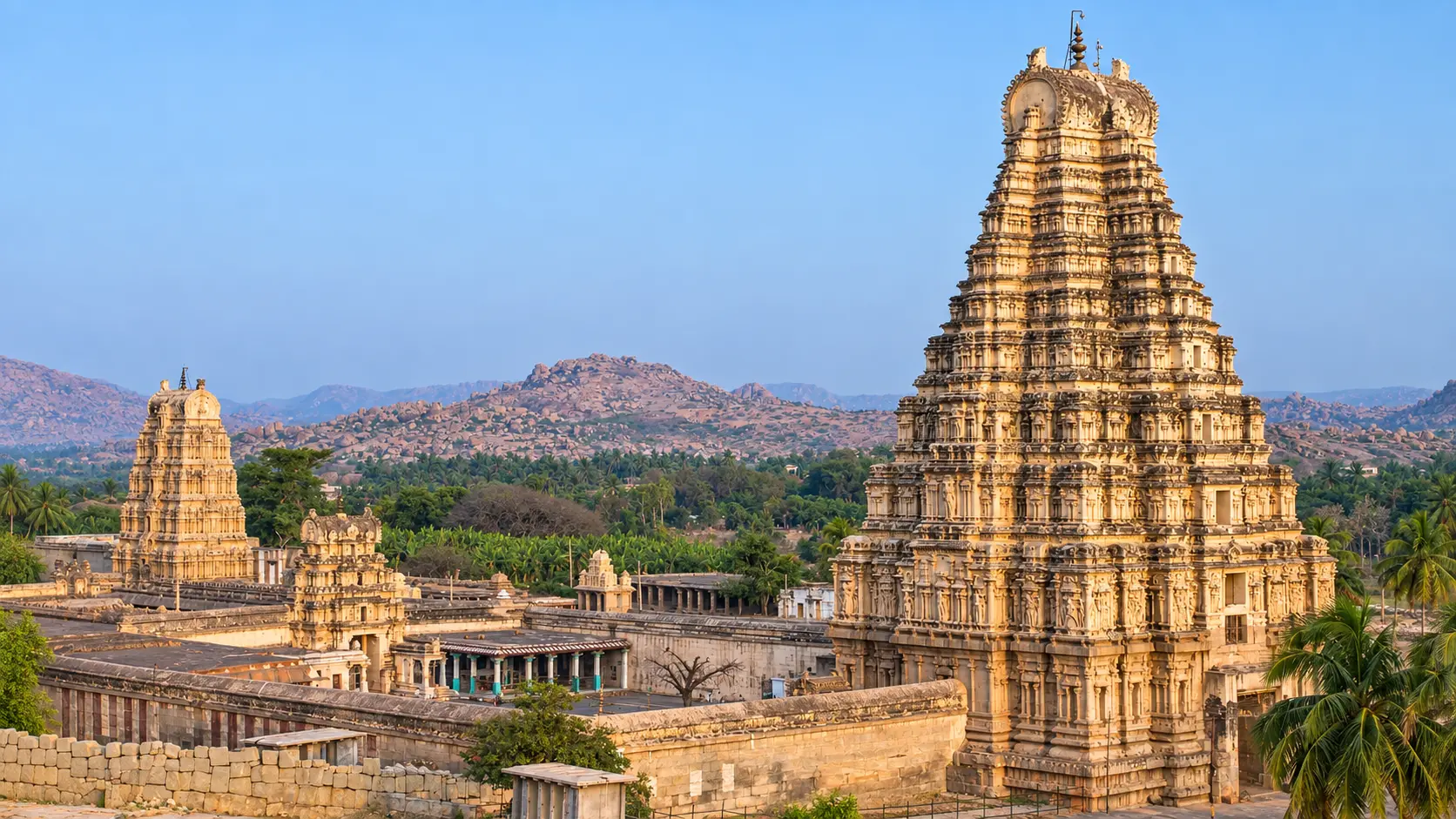
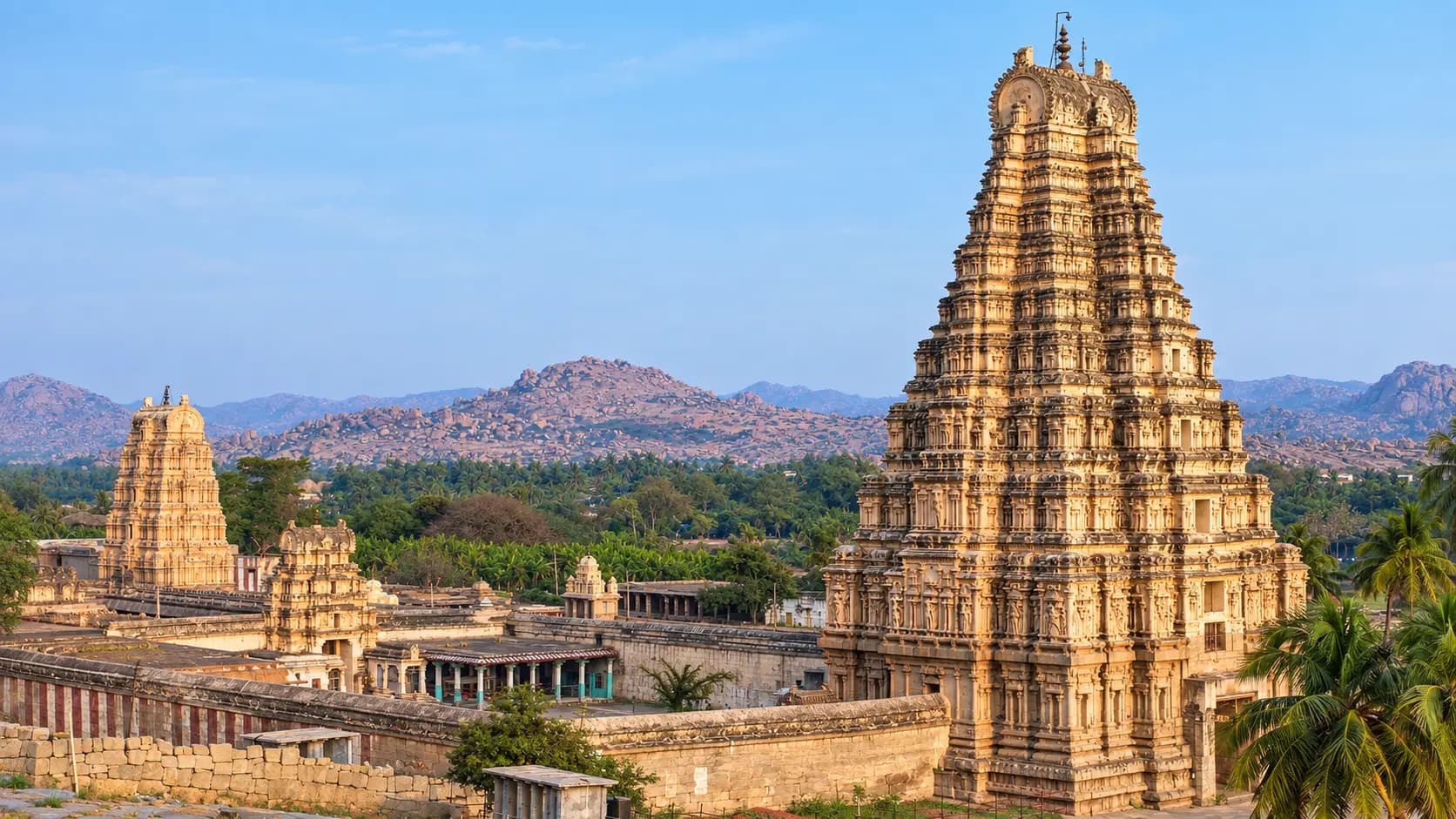
The spiritual heart of Hampi is the Virupaksha Temple, also known as the Pampapati Temple, situated at the western end of the Hampi Bazaar. Dedicated to Lord Shiva and his divine consort Pampa, the local goddess of the Tungabhadra River, Virupaksha is one of the oldest continuously functioning Hindu temples in South India. In continuous worship since at least the 7th century CE, the complex was dramatically expanded by successive Vijayanagara monarchs, reaching its architectural zenith under King Krishna Deva Raya in the early 16th century.
The main entrance is heralded by an imposing 50-metre-high, nine-tiered eastern entrance gateway (Rajagopura), constructed with a massive dressed granite base that supports an intricately sculpted brick-and-stucco superstructure. Walking through the outer courtyard, visitors enter an inner enclosure via the Kanakagiri Gopura, which opens directly onto the Manmatha Tank, a stepped water reservoir framed by ancient pre-Vijayanagara shrines dating to the 9th-century Chalukyan era.
Inside the primary temple compound stands the Ranga Mantapa (pillared assembly hall), consecrated by Krishna Deva Raya in 1509 - 1510 CE to commemorate his imperial coronation. Supported by monolithic granite columns carved with rampant composite yalis carrying warrior riders, the high ceiling preserves rare, vibrant 16th-century tempera frescoes. These medieval paintings illustrate dynamic mythological episodes, including Arjuna shooting the revolving fish target at Draupadi's swayamvara, the sage Vidyaranya proceeding in royal state, and the divine wedding procession of Shiva and Pampa.
At the western rear of the inner sanctum, an unadorned stone antechamber conceals an ingenious piece of medieval optical engineering: an inverted pinhole camera effect (camera obscura). Sunlight filtering through a small aperture in the double-layered exterior stone wall casts an inverted, upside-down shadow of the towering eastern Rajagopura onto the interior whitewashed wall. In the main courtyard, visitors frequently receive blessings from Lakshmi, the revered temple elephant, who gently taps pilgrims' heads with her trunk.
Hemakuta Hill & Monolithic Ganesha Shrines
Directly overlooking the southern flank of Virupaksha Temple rises Hemakuta Hill, a sloping expanse of solid granite bedrock crowned with more than thirty ancient shrines, pavilions, and gateway arches dating from the 9th to the early 14th centuries CE. Puranic legend recounts that upon this hill, Shiva engaged in deep ascetic penance before marrying Pampa, prompting the gods to shower the ridge with gold (hema). Architecturally, these compact shrines display stepped-pyramidal superstructures (kadamba nagara) characteristic of the Later Chalukyas and Kadambas, pre-dating the grand Dravidian style of the imperial era.
Hemakuta Hill is also home to two of Hampi's most celebrated monolithic stone sculptures:
- Sasivekalu Ganesha: Situated on the southern terrace of the hill, this monumental four-armed image of the elephant-headed deity stands 2.4 metres tall, carved out of a single enormous granite boulder. The local moniker Sasivekalu translates to "mustard seed," referencing the rounded, seed-like curvature of the deity's belly. In accordance with Puranic mythology, a large snake is sculpted coiled around Ganesha's abdomen, serving as a belt to prevent his stomach from bursting after an excessive feast of modaks. The statue is housed within an open pillared granite pavilion (mandapa) whose slender pillars offer unobstructed views toward Virupaksha.
- Kadalekalu Ganesha: Located slightly further northeast on the slope, this colossal sculpture measures 4.5 metres in height, carved directly from a massive vertical bedrock boulder. The name Kadalekalu translates to "Bengal gram" (chickpea), reflecting the rough, textured resemblance of the deity's massive rounded belly. The shrine features an extraordinarily elegant front porch with tall, slender granite pillars adorned with finely carved bas-reliefs of mythological deities, dancers, and floral scrollwork. From the front steps of Kadalekalu Ganesha, visitors enjoy an exceptional elevated perspective over the length of the Hampi Bazaar street and the soaring Virupaksha gopura.
Hampi Bazaar & The Monolithic Nandi
Extending eastward from the front entrance of Virupaksha Temple for precisely 730 metres is the Hampi Bazaar, historically known as the Virupaksha Vithi. Averaging 35 metres in width, this wide, dead-straight avenue was the primary ceremonial processional highway of the empire, along which the temple's massive wooden temple car (ratha) was pulled during annual festive pageants. Both flanks of the street are lined with continuous two-storeyed open granite colonnades and pillared verandas. During the 15th and 16th centuries, these stone arcades served as imperial commercial stalls where international traders transacted in gold coins (pagodas), rubies, sapphires, pearls, raw silk, and spices.
At the eastern terminus of the bazaar, resting at the base of Matanga Hill, stands a grand two-storeyed open pavilion housing the colossal Yeduru Basavanna (Monolithic Nandi). Carved from a massive single outcrop of blackish granite, this sacred bull of Shiva sits calmly facing westward toward the distant sanctum of Virupaksha Temple. The carving exudes powerful, dignified restraint, adorned with ornamental bell collars, ornate saddle cloths, and smooth, muscular contours. Nearby stone platforms frequently serve as performance stages during the annual Hampi Utsava cultural celebrations.
Achyutaraya Temple & Sule Bazaar
Nestled in a secluded amphitheatre between the northern precipice of Matanga Hill and the Tungabhadra River lies the Achyutaraya Temple, officially consecrated in 1534 CE as the Tiruvengalanatha Temple during the reign of King Achyuta Deva Raya (successor to Krishna Deva Raya). Because of its hidden geographic position, protected behind towering granite ridges, this temple complex was spared the immediate brunt of destruction in 1565, leaving its perimeter enclosures remarkably intact.
The temple is arranged within two concentric rectangular courtyard enclosures (prakaras), entered through towering granite gateway foundations that once carried elaborate brick superstructures. Within the inner courtyard stands the main sanctum dedicated to Venkateshwara (Tiruvengalanatha), fronted by a breathtaking Kalyana Mantapa (marriage pavilion). The pillars of this ceremonial hall represent some of the highest achievements of late Vijayanagara sculpture, featuring dynamic multi-faceted carvings of celestial nymphs, leaping yalis, riders subduing mythical beasts, and narrative depictions of Krishna stealing the clothes of the gopis.
Leading directly northward from the outer gopura of the Achyutaraya Temple toward the Tungabhadra River is an imposing, 500-metre-long colonnaded processional street known historically as Sule Bazaar (Courtesans' Street). Lined on both sides by weathered stone arcades, this avenue was documented by foreign chroniclers as the residence and commercial quarter of the empire's wealthy temple dancers (devadasis), musicians, and luxury gem merchants. Today, wildflowers and wild grasses grow between the stone paving slabs, creating one of the most evocative, atmospheric ruins in all of Hampi.
Chakratirtha & The Riverside Heritage Walk
Connecting the Hampi Bazaar to the Vitthala Temple complex along the southern shore of the river is the Riverside Heritage Path, a dramatic two-kilometre stone trail that winds along the edge of the Tungabhadra. The path passes through Chakratirtha, recognized as the most sacred water body in Hampi. Here, the river makes a sharp, turbulent bend, swirling through a narrow, deep granite chasm between towering rock walls. According to local belief, this is the holy spot where the river waters swirl in the shape of Vishnu's divine discus (chakra).
Along this riverside walk, the granite boulders are carved with hundreds of sacred reliefs:
- Kodandarama Temple: Located directly above the Chakratirtha whirlpool, this functioning shrine houses rectangular relief carvings of Rama, Sita, and Lakshmana, marking the spot where Rama is believed to have crowned Sugriva as the king of Kishkindha after slaying Vali.
- Koti Linga Boulders: In the riverbed flatrocks near Chakratirtha, ancient ascetics meticulously carved arrays of 1,008 miniature Shiva Lingas arranged in perfect mathematical grids, which become submerged during monsoon flood releases and re-emerge as the water recedes in winter.
- Varaha Temple & Sugriva's Cave: Further downriver, the trail passes a natural cleft beneath giant leaning boulders identified in local folklore as the cave where Sugriva hid Sita's dropped jewellery bundle when she was carried across the skies by Ravana. Nearby stands the Varaha Temple, bearing the official royal boar insignia (varaha-lanchana) of the Vijayanagara dynasty.
The Royal Centre: Core of Imperial Governance
Located approximately two kilometres south of the Sacred Centre, beyond a protective ring of natural granite ridges and defensive fortification walls, lies the Royal Centre. Covering several square kilometres, this was the fortified administrative, ceremonial, and domestic heart of the empire, containing the king's private audience chambers, military headquarters, treasury, ceremonial parade grounds, and secluded royal residential quarters.
+-----------------------------------------------------------------------------------+
|                           ROYAL CENTRE ARCHITECTURE                               |
+-----------------------------------------------------------------------------------+
|  1. Mahanavami Dibba      | 12-metre high, 3-tiered imperial victory platform     |
|                           | Deep bas-relief friezes of war elephants & dancers    |
+---------------------------+-------------------------------------------------------+
|  2. Stepped Tank          | Precision-cut chlorite schist interlocking masonry    |
|                           | Fed by gravity-flow dressed granite aqueducts         |
+---------------------------+-------------------------------------------------------+
|  3. Hazara Rama Temple    | Royal private chapel with 1,000 baseline reliefs       |
|                           | Narrative Valmiki Ramayana carved on inner stone walls|
+---------------------------+-------------------------------------------------------+
|  4. Lotus Mahal           | Two-storey secular Indo-Islamic pleasure pavilion      |
|                           | Cusped plaster arches & internal terracotta cooling   |
+---------------------------+-------------------------------------------------------+
|  5. Elephant Stables      | 11 monumental domed chambers for imperial tuskers     |
|                           | Alternating circular and fluted Islamic vault domes   |
+---------------------------+-------------------------------------------------------+
|  6. Queen's Bath          | Rectangular pavilion enclosing a sunken private pool  |
|                           | Cantilevered jharokhas and decorative stucco work     |
+-----------------------------------------------------------------------------------+
Mahanavami Dibba (The Great Platform)
Dominating the Royal Enclosure is the Mahanavami Dibba, also known as the Dasara Dibba or the House of Victory. Standing over 12 metres tall on a 35-metre square footprint, this colossal three-tiered granite platform was erected by King Krishna Deva Raya after his successful military campaign against the Gajapati rulers of Udayagiri in 1513. The structure served as the supreme imperial stage during the annual nine-night autumn festival of Mahanavami (Navaratri/Dasara), during which the emperor sat upon a jewel-encrusted golden throne to review imperial cavalry regiments, inspect tribute brought by provincial governors (nayakas), watch wrestling duels, and witness elaborate animal sacrifices.
The vertical stone surfaces of the lower tiers are covered in deep narrative bas-relief carvings that provide an invaluable documentary record of 16th-century court life. The horizontal registers depict royal hunting scenes where hunters armed with bows pursue wild boars, file after file of caparisoned war elephants, Arabian horse traders in conical Turkish caps presenting steeds to royal inspectors, foreign ambassadors in elaborate drapery, acrobats, and courtly dancing women wearing intricate jewellery and sheer textiles. From the flat summit of the platform, reached via two grand stone staircases, visitors command an exceptional view of the entire royal compound, including the foundations of the King's Audience Hall (hundred-pillared hall), where 100 square stone pillar bases stand in symmetrical ranks.
The Stepped Tank (Pushkarini)
Directly east of the Mahanavami Dibba lies one of Hampi's most photogenic engineering marvels: the Stepped Tank (Pushkarini). Unearthed during extensive excavations conducted by the Archaeological Survey of India in the 1980s, this perfectly symmetrical subterranean water reservoir was constructed using precision-cut blocks of dark-green chlorite schist (soapstone) that interlock without mortar. The tank descends through five distinct stepped terraces, creating an exquisite optical pattern of inverted pyramidal stone steps.
Surrounding the tank are the preserved remains of an elaborate hydraulic network. Dressed granite stone aqueducts, supported on monolithic stone piers, transported fresh water across kilometres from the Kamalapur reservoir into the royal enclosure, utilizing gravity-flow channels to feed fountains, ceremonial bathing tanks, and royal palace pools.
Hazara Rama Temple
Positioned at the geometric center of the royal administrative sector, the Hazara Rama Temple ("Temple of the Thousand Ramas") functioned as the private consecrated chapel of the Vijayanagara royal family. Because ordinary subjects were excluded from this enclosure, the temple features an unparalleled density of intimate, exquisitely detailed stone sculpture.
The exterior enclosure walls are lined with five continuous horizontal bands of bas-relief sculptures depicting royal pageantry: marching infantry armed with swords and shields, galloping cavalry, royal tuskers, and troupes of female musicians playing cymbals and drums. The interior walls of the temple courtyard and sanctum carry an exhaustive, sequential narrative frieze illustrating the complete story of the Valmiki Ramayana, from Rama's divine birth to his coronation in Ayodhya. Inside the main assembly hall (Ardha Mantapa), four massive monolithic pillars crafted from polished black basalt stone gleam like obsidian, adorned with microscopic relief carvings of Ganesha, Vishnu, and celestial maidens.
Zenana Enclosure: Lotus Mahal & Elephant Stables
Enclosed within high, inward-tapering stone curtain walls (zenana), this secluded sector was traditionally interpreted as the private residential quarters of the imperial women and queen consorts, though recent architectural historians also suggest it may have served as a high-security military command post. The enclosure contains two of Hampi's best-preserved and stylistically unique monuments, both showcasing the brilliant cross-cultural synthesis of indigenous Dravidian and Sultanate Islamic architecture (Indo-Islamic secular style):
- Lotus Mahal (Kamal Mahal): This two-storeyed pleasure pavilion stands completely intact amidst manicured lawns. Built of brick, mortar, and dressed stone coated in fine lime plaster (chunam), the structure is open on all four sides through multi-foil cusped arches supported on twenty-four stepped square pillars. The roofline features nine pyramidal stepped towers crowned with lotus finials that mirror the contours of a blossoming lotus bud. Deep inside the thick brick piers, archaeologists discovered the remains of hollow terracotta water pipes that once circulated cool water through the walls and ceilings, functioning as an ingenious medieval air-conditioning system during scorching summer months.
- Elephant Stables (Gajashala): Standing immediately outside the eastern perimeter wall of the Zenana Enclosure, this monumental 11-chambered rectangular pavilion is among the grandest military structures surviving from medieval India. Built to stable the eleven premier ceremonial war elephants of the royal household, each chamber is entered through a soaring cusped arch and capped with a unique roof vault. The central chamber features a grand second-storey pavilion where royal musicians and military drummers were stationed, flanked by alternating circular Islamic ribbed domes and fluted vaults. Iron rings still embedded in the high stone ceilings illustrate how the massive royal tuskers were tethered with chains.
Queen's Bath
Positioned along the main royal road approaching the Royal Enclosure from Kamalapur, the Queen's Bath is a striking example of secular leisure architecture. Deceptively austere on its exterior - appearing from outside as a plain rectangular stone structure surrounded by a protective water moat - the interior opens into a spectacular square courtyard centered around a 1.8-metre-deep sunken swimming pool. Surrounding the water basin is a vaulted corridor lined with cantilevered overhanging balconies (jharokhas) supported on ornate corbelled brackets. Traces of vibrant stucco floral decorations, geometric medallions, and multi-foil arched ceilings demonstrate the luxury that defined private court life.
The Vitthala Temple Complex & The Iconic Stone Chariot
Located in the northeastern sector along the riverbank, the Vitthala Temple represents the absolute architectural and sculptural zenith of the Vijayanagara Empire. Begun during the reign of King Deva Raya II (1422 - 1446) and substantially expanded and embellished under Krishna Deva Raya and his successors, the temple was dedicated to Vitthala, a beloved devotional form of Lord Vishnu worshipped widely across Maharashtra and Karnataka. Although the temple's central sanctum was never officially consecrated with an idol before the empire fell, the complex stands as a monumental masterpiece of Indian stone carving.
+-----------------------------------------------------------------------------------+
|                        VITTHALA TEMPLE HIGHLIGHTS                                 |
+-----------------------------------------------------------------------------------+
|  Stone Chariot (Garuda Shrine)  | Carved monolithic granite vehicle, depicted     |
|                                 |Confirm the current charge and what it includes with the operator or service provider. Visitor admission, vehicles, parking, activities and accommodation can have separate charges.|
|                                 | Rotating stone wheels (now stabilized by ASI)   |
+---------------------------------+-------------------------------------------------+
|  Maha Mantapa (Acoustic Hall)   | 56 monolithic granite pillars engineered with   |
|                                 | clustered resonant musical shafts (sa-re-ga-ma) |
|                                 | Acoustic resonance tuned to microtonal notes    |
+---------------------------------+-------------------------------------------------+
|  Kalyana Mantapa (Marriage Hall)| Open pavilion with rampant composite yali piers |
|                                 | Ceiling panels depicting cosmic lotus blossoms  |
+---------------------------------+-------------------------------------------------+
|  King's Balance (Tula-bhara)    | 5-metre ceremonial gantry for weighing monarchs |
|                                 | Gold and gems weighed against king for charity  |
+-----------------------------------------------------------------------------------+
The Stone Chariot
Standing prominently in the courtyard facing the main temple mandapa, the Stone Chariot is Hampi's most universally recognized architectural icon, celebrated nationwide and immortalized on the reverse face of the Indian 50-rupee currency note. Though appearing to the naked eye as a single monolithic block, the chariot is actually an ingenious composite assembly of intricately carved granite slabs joined with concealed mortise-and-tenon joints. Designed as a ceremonial vehicle (ratha) functioning as a shrine for Garuda, the divine eagle mount of Vishnu, it features four solid granite wheels carved with floral spokes and hubcaps.
Historically, these stone wheels were mounted on axles and could be manually rotated; however, the Archaeological Survey of India has permanently stabilized them in cement collars to preserve the structural integrity of the monument from erosion and vandalism. In front of the chariot, two beautifully sculpted stone elephants stand as if drawing the divine vehicle forward - these were brought from another monument in the 19th century to replace the chariot's original carved stone horses, whose hind legs are still visible beneath the front platform.
Acoustic Architecture: The Musical Pillars
Fronting the sanctum is the Maha Mantapa (Great Assembly Hall), resting on a high, ornately moulded plinth sculpted with friezes of marching soldiers, horses, and heraldic mythical creatures (makaras). The hall's primary structural marvel is its 56 monolithic granite pillars, each carved with astonishing virtuosity. Rather than being solid cylindrical columns, each main load-bearing pillar is sculpted with a central core column surrounded by a cluster of seven or eight slender, fluted stone shafts (colonnettes).
When tapped gently by trained musicologists, these slender outer stone shafts resonate with distinct musical frequencies, producing clear acoustic notes that correspond to classical Indian musical intervals (sa-re-ga-ma) and simulate the sounds of percussion instruments such as the mridangam, damaru, and ghanta (temple bell). Physicists and architectural conservators studying the pillars have discovered that the ancient master sculptors achieved these specific acoustic vibrations by varying the thickness, density, and tension of the granite shafts during hand-channelling.
[!CAUTION] Due to centuries of unguided visitor tapping that caused micro-fractures and surface chipping in the crystalline granite, the Archaeological Survey of India has erected protective metal railings around the Maha Mantapa. Striking, rapping, or touching the musical pillars is strictly prohibited by federal law and monitored continuously by on-site heritage guards.
The King's Balance (Tula-bhara) & Purandara Mantapa
Exiting the Vitthala Temple through its western gate toward the riverbank, visitors reach the King's Balance (Tula-bhara). This striking monument consists of two towering five-metre-tall granite pillars supporting an ornate, sculpted horizontal stone crossbeam equipped with circular iron suspension rings. On auspicious ceremonial occasions - such as imperial coronations, royal birthdays, solar and lunar eclipses, or major military triumphs - the emperor sat on one suspended golden balance scale, while the other side was piled with gold bullion, silver coins, diamonds, pearls, or precious grains until the scale leveled. This royal treasure was subsequently distributed among Brahmins, charitable trusts, and the city's destitute subjects.
Just downriver along the rocky waterline stands the Purandara Dasa Mantapa, an open four-pillared stone pavilion resting on granite boulders directly above the current. This sacred spot honours Purandara Dasa (c. 1484 - 1564), the revered composer and saint acknowledged as the father of Carnatic classical music (Karnataka Sangeeta Pitamaha), who composed thousands of devotional kirtanas celebrating Lord Vitthala while residing in Hampi.
Vantage Points & Defensive Summits
To truly comprehend the strategic brilliance and vast spatial scale of Vijayanagara, one must ascend the boulder hills that form the city's natural fortress walls.
Matanga Hill: The Grand Panorama
Rising abruptly from the center of the monument zone to an elevation of approximately 515 metres above sea level, Matanga Hill is the undisputed supreme vantage point in Hampi. Mentioned in the Ramayana as the hermitage of the sage Matanga - where Sugriva took sanctuary because his estranged brother Vali was cursed never to set foot upon its slopes - this granite inselberg provides an unobstructed 360-degree aerial panorama over the entire landscape.
The ascent to the summit requires a vigorous 30-to-40-minute trek, climbing hundreds of uneven, hand-cut stone steps and navigating steep granite ramps from either the eastern end of Hampi Bazaar (near the Monolithic Nandi) or from the Achyutaraya Temple valley. The summit is crowned by the modest, whitewashed Veerabhadra Temple and a flat stone rooftop terrace.
Watching the sunrise from Matanga Hill is widely considered an essential Hampi experience: as the morning mist lifts from the winding Tungabhadra River, the rising sun illuminates the soaring Virupaksha gopura to the west, the isolated courtyards of Achyutaraya Temple nestled in the valley below, the distant domes of the Elephant Stables to the south, and endless miles of ochre granite boulders stretching into the hazy Deccan horizon.
Malyavanta Hill & Raghunatha Temple
Situated two kilometres east of Kamalapur along the road to Toranagallu, Malyavanta Hill is another sacred ridge intimately tied to the epic Ramayana. Tradition holds that Rama and Lakshmana camped on this high boulder outcrop for four months during the monsoon season while waiting for Sugriva's monkey army to mobilize search parties for the abducted Sita.
Perched atop the ridge is the Malyavanta Raghunatha Temple, a walled fortress-like sanctuary built around massive natural granite boulders that project through the ceiling of the inner sanctum. The sanctum encloses vivid stone reliefs of Rama, Lakshmana, and a kneeling Hanuman. What makes this temple uniquely memorable is its unbroken devotional atmosphere: in the outer pillared pavilion, resident sadhus and devotees maintain an uninterrupted, round-the-clock chanting of the Hindi epic poem Ramcharitmanas, a continuous musical recitation that has persisted day and night for decades without cessation. The wide, breezy rock terraces behind the temple offer an exceptionally peaceful sunset alternative to the more crowded viewpoints of Hemakuta and Matanga.
The Northern Bank: Anegundi & Kishkindha
Directly across the Tungabhadra River lies the northern bank, centered around the ancient fortified settlement of Anegundi. Predating Hampi by several centuries, Anegundi served as the initial administrative seat of the regional chiefs before the Vijayanagara capital was formally founded on the more easily defended southern bank in 1336. Today, Anegundi is renowned both for its tranquil rural lifestyle - surrounded by emerald rice paddies and jagged boulder ridges - and for its deep associations with the mythical kingdom of Kishkindha.
+-----------------------------------------------------------------------------------+
|                           NORTHERN BANK LANDMARKS                                 |
+-----------------------------------------------------------------------------------+
|  Anjaneya Hill (Monkey Temple)  | 575 whitewashed steps ascending Anjanadri Hill  |
|                                 | Revered birthplace of Lord Hanuman; sunset view |
+---------------------------------+-------------------------------------------------+
|  Sanapur Lake                   | Picturesque freshwater reservoir in granite basin|
|                                 | Traditional coracle boating; cliff jumping banned|
+---------------------------------+-------------------------------------------------+
|  Pampa Sarovar                  | Sacred lotus pond of Shabari; tranquil shrine    |
+---------------------------------+-------------------------------------------------+
|  Chintamani Complex             | Riverside cave where Rama met Sugriva & shot Vali|
+-----------------------------------------------------------------------------------+
Anjaneya Hill (Anjanadri Parvatha)
Crowning the summit of Anjanadri Hill is the whitewashed Anjaneya Temple, revered across India as the mythical birthplace of Lord Hanuman, the monkey god celebrated for his devotion, strength, and courage. The summit is accessed via a stairway of precisely 575 concrete-and-granite steps that wind steeply up the bare rock face. While the climb takes roughly 30 to 45 minutes and can be taxing during midday heat, the reward at the top is extraordinary: a breezy temple courtyard, an active shrine where priests perform continuous aarti, and a breathtaking, unobstructed western vista overlooking the winding curves of the Tungabhadra, lush green paddy fields, and the rugged skyline of Hampi's southern ruins.
[!WARNING] Troops of wild bonnet macaques and grey langurs heavily populate the stairway of Anjaneya Hill. They are exceptionally bold and frequently snatch food items, unsealed plastic bottles, sunglasses, and handheld phones directly from hikers' hands. Keep all personal belongings, snacks, and water bottles zipped securely inside backpacks before beginning the climb.
Sanapur Lake & Coracle Boating
Located four kilometres northwest of Anegundi, Sanapur Lake is an idyllic, serene freshwater reservoir enclosed by towering granite boulders and scrub forests. Fed by a high-level irrigation canal diverted from the Tungabhadra Dam, the lake is a popular haven for travellers seeking respite from temple touring. Local boatmen operate traditional round coracles (dongis or parisas) - circular saucer-shaped boats constructed of woven bamboo ribs covered with waterproofed tarpaulin or animal hides - offering relaxing 30-minute rides gliding silently along the base of the sheer granite cliffs.
Visitors must observe strict caution here: swimming and cliff-jumping into Sanapur Lake are strictly prohibited by local police and revenue authorities. The reservoir hides submerged granite crags, sharp underwater boulders, and strong siphon currents near the sluice gates, and fatal drowning accidents have occurred when travellers leapt into the deceptively calm waters.
Kamalapur Heritage Zone & Archaeological Museum
The modern administrative hub on Hampi's southern edge is the village of Kamalapur, built on the shores of the massive 16th-century Kamalapur Tank. This enormous reservoir was commissioned by King Krishna Deva Raya to store seasonal monsoon runoff, and its dressed-stone sluice gates continue to irrigate surrounding sugarcane and banana fields today.
Located in Kamalapur is the Archaeological Museum of the ASI, which provides an essential orienting foundation for anyone exploring the ruins. The museum features four well-curated galleries exhibiting:
- An extraordinary scaled three-dimensional topological plaster model of the complete Hampi World Heritage Site, displaying every hill, valley, river bend, and monument in precise spatial relationship.
- Masterpiece Vijayanagara stone sculptures, including exquisitely carved images of Shiva, Parvati, Narasimha, and Jain tirthankaras recovered during regional field excavations.
- Rare medieval weaponry, armaments, iron cannonballs, and royal gold and copper coins (varahas and pagodas) bearing the royal emblem of the double-headed mythical eagle (Gandaberunda).
- Important epigraphical stone slabs and copper-plate land-grant inscriptions (shasanas) written in classical Kannada, Telugu, and Sanskrit scripts.
Check the current visiting hours and permitted access with the site operator before departure; ceremonies, closures and visitor sessions can affect access.
Best time to visit
Hampi is situated on the arid Deccan Plateau, where the local microclimate is dictated by intense solar radiation…Explore detailsClose details
Hampi is situated on the arid Deccan Plateau, where the local microclimate is dictated by intense solar radiation off bare granite surfaces, low ambient humidity, and distinct seasonal monsoon cycles. Understanding these dynamics is critical for planning daily sightseeing schedules.
+-----------------------------------------------------------------------------------+
|                        SEASONAL VISITING MATRIX FOR HAMPI                         |
+-----------------------------------------------------------------------------------+
| Season        | Months          | Conditions                  | Travel Advice     |
+---------------+-----------------+-----------------------------+-------------------+
| Peak Winter   | October to      | Dry, pleasant sunny days    | Prime season;     |
|               | February        | 25°C - 32°C; cool nights      | ideal for walking |
|               |                 | (15°C - 18°C); clear skies    | & monument climbs |
+---------------+-----------------+-----------------------------+-------------------+
| Hot Summer    | March to        | Scorching Deccan heat       | Avoid mid-day sun;|
|               | June            | 38°C - 43°C; extreme boulder  | tour 06:00-09:30  |
|               |                 | thermal glare; dehydrating  | & 16:30-18:30 only|
+---------------+-----------------+-----------------------------+-------------------+
| Monsoon       | July to         | Intermittent heavy rains;   | Scenic green hues;|
|               | September       | swollen Tungabhadra river;  | slippery granite; |
|               |                 | lush paddy transformations  | coracles regulated|
+-----------------------------------------------------------------------------------+
Winter Comfort (October to February)
The winter months represent the undisputed peak tourist season across Hampi. Daytime temperatures range comfortably between 25°C and 32°C, accompanied by dry breezes and minimal cloud cover, while nighttime temperatures drop to a refreshing 15°C to 18°C. This period offers ideal physical conditions for long walking circuits, multi-hour explorations of sprawling complexes like the Royal Enclosure, and demanding summit ascents up Matanga and Anjanadri hills.
During early November (or occasionally January/February, subject to state government notifications), the district administration hosts the grand Hampi Utsava (the Festival of Victory). During this three-day state cultural extravaganza, Hampi's primary monuments are illuminated with sophisticated dynamic multi-coloured lighting systems, while national classical dancers, Carnatic musicians, traditional wrestlers, and folk troupes perform on open-air stages erected beside the Monolithic Nandi and the royal enclosures.
Summer Extreme Heat & Thermal Radiation (March to June)
From early March through late June, the Deccan summer asserts itself with relentless intensity. Daily maximum temperatures routinely climb between 38°C and 43°C. The landscape - dominated by square miles of exposed, vegetation-free granite boulders - absorbs immense amounts of solar radiation throughout the morning and radiates blinding heat back into the surrounding air until late into the night.
Visitors attempting to explore Hampi during these months must drastically recalibrate their daily itinerary:
- Complete all physical monument walks strictly between 06:00 and 09:30 in the morning and from 16:30 to 18:30 in the late afternoon.
- Spend the blistering midday hours (10:30 to 16:00) resting indoors, visiting the air-conditioned galleries of the Kamalapur Museum, or taking shade beneath the deep stone porticos of Kamalapur.
- Carry broad-brimmed sun hats, UV-filtering sunglasses to mitigate blinding rock glare, and electrolyte rehydration salts.
Monsoon Transformation & River Flooding Hazards (July to September)
The arrival of the southwest monsoon in July transforms the arid, dusty landscape into an astonishing green paradise. Rains fill ancient stone channels, emerald-green rice paddies carpet the valleys, and fresh streams cascade over granite precipices. Daytime temperatures moderate to a pleasant 28°C to 33°C, offering overcast skies that provide natural relief from intense direct sunlight.
However, the monsoon brings specific logistical challenges and safety hazards:
- Slippery Granite: Rain washes over bare granite slopes and stone steps, causing algae and lichen to bloom rapidly. Footpaths up Hemakuta, Matanga, and Anjanadri become exceptionally slick and treacherous; sturdy footwear with high-traction rubber lugs is essential.
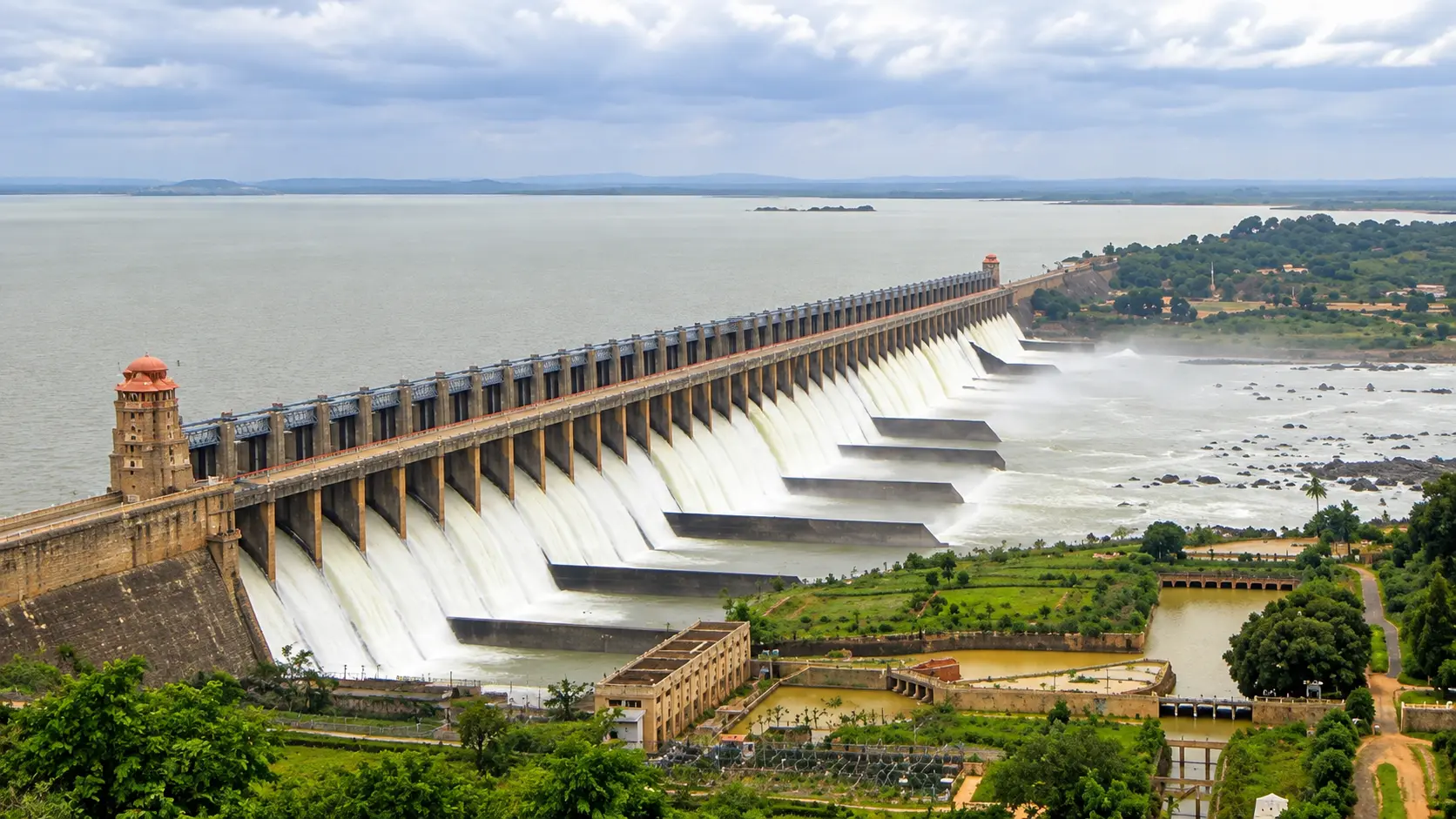
- Tungabhadra River Surges: Upstream releases from the massive Tungabhadra Dam at Munirabad can cause the river level to rise by several metres within hours. During peak dam discharge, low-lying riverside monuments such as Purandara Mantapa become completely submerged, and passenger coracle operations across the river are strictly halted by district safety authorities.
How to reach
Hampi's location in central-northern Karnataka places it within straightforward reach of major transport…Explore detailsClose details
Hampi's location in central-northern Karnataka places it within straightforward reach of major transport corridors connecting Bengaluru, Hyderabad, Goa, and Mumbai.
+-----------------------------------------------------------------------------------+
|                        CONNECTIVITY & DISTANCE MATRIX                             |
+-----------------------------------------------------------------------------------+
| Gateway Point               | Distance | Transit Mode                             |
+-----------------------------+----------+------------------------------------------+
| Hosapete Junction (HPT)     | 13 km    | Nearest major railway head; regular auto |
|                             |          |Confirm the current charge and what it includes with the operator or service provider. Visitor admission, vehicles, parking, activities and accommodation can have separate charges.|
+-----------------------------+----------+------------------------------------------+
| Jindal Vijayanagar Airport  | 38 km    | Nearest domestic airstrip (Toranagallu); |
| (VDY - Vidyanagar)          |          | direct commercial flights to Bengaluru   |
+-----------------------------+----------+------------------------------------------+
| Hubballi Airport (HBX)      | 145 km   | Major regional airport; connections to   |
|                             |          | Mumbai, Delhi, Bengaluru, Chennai        |
+-----------------------------+----------+------------------------------------------+
| Kempegowda Intl Airport BLR | 350 km   | Primary international hub; 6 - 7 hr drive  |
|                             |          | via 4-lane National Highway NH-50        |
+-----------------------------+----------+------------------------------------------+
| Goa (Madgaon Junction MAO)  | 315 km   | Direct railway line via Vasco-da-Gama    |
|                             |          | and Castle Rock ghat section             |
+-----------------------------------------------------------------------------------+
Rail Network Connectivity
The primary railway gateway for visiting Hampi is Hosapete Junction (station code: HPT), located just 13 kilometres southwest of Hampi Bazaar. Hosapete is a major railway junction on South Western Railway, serviced by numerous daily express and passenger trains:
- Hampi Express (Train 16591/16592): Operates overnight daily between Mysuru, Bengaluru City (KSR Bengaluru), and Hosapete, arriving early in the morning and departing Hosapete in the late evening - making it the most convenient rail option for travellers originating in southern Karnataka.
- Vande Bharat Express: Modern semi-high-speed daytime rail service connecting Bengaluru (Yesvantpur) to Hosapete in approximately 5 hours.
- Goa Connectivity (Amaravathi Express / Vasco Da Gama Express): Connects Hosapete directly with Margao and Vasco da Gama in Goa, traversing the scenic Dudhsagar Waterfalls rail route through the Western Ghats.
- Hyderabad Connectivity: Several direct weekly express trains link Hyderabad (Kacheguda/Secunderabad) to Hosapete in roughly 9 to 10 hours.
Confirm the current charge and what it includes with the operator or service provider. Visitor admission, vehicles, parking, activities and accommodation can have separate charges.
Road Routes & Highway Access
Hosapete sits at the junction of National Highway 50 (NH-50), running north-south between Solapur and Chitradurga, and National Highway 67 (NH-67), connecting Hubballi and Ballari.
- From Bengaluru (350 km): Follow NH-48 past Tumakuru to Chitradurga, then branch onto the 4-lane divided NH-50 straight into Hosapete (travel time: ~6 hours by car).
- Bus Services: The Karnataka State Road Transport Corporation (KSRTC) operates numerous premier overnight services, including Airavat Club Class (multi-axle luxury Volvo coaches) and Non-AC Sleeper buses from Bengaluru, Mysuru, Hubballi, Belagavi, and Gokarna directly into Hosapete. Private sleeper operators (such as VRL and SRS) also run extensive overnight services from Goa, Pune, and Mumbai.
Air Travel Access
- Jindal Vijayanagar Airport (VDY / Vidyanagar): Located approximately 38 kilometres southeast of Hampi at Toranagallu, this private airstrip operated by JSW Steel hosts scheduled regional commercial flights (operated by carriers such as Alliance Air) connecting directly to Bengaluru and Hyderabad. Pre-booked private taxis to Hampi take roughly 50 minutes.
- Hubballi Airport (HBX): Situated 145 kilometres west of Hampi, Hubballi is a well-equipped regional commercial airport with daily nonstop flights to major Indian metros, including Bengaluru, Mumbai, Delhi, and Hyderabad. Taxis from Hubballi Airport to Hampi take approximately 3 to 3.5 hours via NH-67.
- Kempegowda International Airport Bengaluru (BLR): Located 350 kilometres to the south, Bengaluru serves as the primary international gateway. Travellers can connect from Bengaluru to Hosapete via daily express trains, luxury overnight sleeper buses, or a 6-to-7-hour drive along the well-surfaced NH-48 / NH-50 corridor.
Entry, timings and permissions
Fees, visiting hours and entry rules may change.Explore detailsClose details
Fees, visiting hours and entry rules may change. Confirm the latest details with the official operator or local authority before travelling.
Visiting the monuments of Hampi is governed by clear ticketing policies and heritage regulations established by the Archaeological Survey of India (ASI) and the local administration:
+-----------------------------------------------------------------------------------+
|                        TICKETING & OPERATIONAL SCHEDULE                           |
+-----------------------------------------------------------------------------------+
| Monument Sector       | Opening Hours          | Entry Fee / Access Policy        |
+-----------------------+------------------------+----------------------------------+
| Vitthala Temple &     | 06:00 to 18:00 daily   | ₹40 (Indian/SAARC/BIMSTEC; ₹35   |
| Zenana Enclosure      | (Sunrise to Sunset)    | online); ₹600 (Foreign; ₹550     |
| (Lotus Mahal/Stables) |                        | online). Single unified pass.    |
+-----------------------+------------------------+----------------------------------+
| Virupaksha Temple     | 06:00 to 13:00 and     | ₹25 entry ticket (managed by     |
|                       | 17:00 to 21:00 daily   | temple trust); ₹50 camera fee    |
+-----------------------+------------------------+----------------------------------+
| Unenclosed Monuments  | Daylight hours         | Free public access               |
| (Mahanavami Dibba,    | (06:00 to 18:00)       | (Mahanavami Dibba, Stepped Tank, |
| Hemakuta, Matanga)    |                        | Hazara Rama, Queen's Bath)       |
+-----------------------+------------------------+----------------------------------+
| Archaeological Museum | 10:00 to 17:00         | ₹5 per person;                   |
| (Kamalapur)           | (Closed on Fridays)    | Children under 15 free           |
+-----------------------------------------------------------------------------------+
Cashless Ticketing and Monument Etiquette
Under Archaeological Survey of India regulations, ticket counters at the Vitthala Temple and the Lotus Mahal are predominantly cashless. Visitors purchase passes by scanning official UPI QR codes displayed at the ticket booths or by booking in advance through the official ASI national booking portal (https://asi.nic.in/).
Visitors should note that the single ASI ticket is valid only on the date of purchase. Ensure you retain your physical ticket or digital QR code on your smartphone, as staff will scan it at both the Vitthala Temple entrance and the Zenana Enclosure gate. Modest dress covering shoulders and knees is mandatory inside the active sanctum of Virupaksha Temple, and visitors must remove their footwear before stepping onto sanctum stone platforms.
Nearby places to consider
Hampi forms the cultural epicentre of northern Karnataka, surrounded by historic forts, wildlife sanctuaries, and…Explore detailsClose details
Hampi forms the cultural epicentre of northern Karnataka, surrounded by historic forts, wildlife sanctuaries, and Chalukyan rock-cut temple sites:
                          [ Badami, Pattadakal & Aihole ]
                        (Chalukyan rock caves & cradle, 130 - 140 km NW)
                                     ▲
                                     │
[ Tungabhadra Dam & Gardens ] ◄─── [ Hampi ] ───► [ Daroji Sloth Bear Sanctuary ]
(Reservoir, musical fountains,       │            (Protected scrubland habitat,
  20 km southwest)                   │                  18 km southeast)
                                     ▼
                          [ Hosapete & Chitradurga ]
(Railway junction & 7-walled fort, 13 - 135 km S)- Tungabhadra Dam & Japanese Gardens (~20 km southwest): Located near Hosapete at Munirabad, this colossal multi-purpose masonry dam spans the Tungabhadra River. The surrounding landscape features landscaped Mughal-style gardens, a deer park, musical dancing fountains illuminated in the evenings, and high viewpoint towers overlooking the vast inland reservoir.
- Daroji Sloth Bear Sanctuary (~18 km southeast): Established in 1994, this 82-square-kilometre protected wilderness encompasses rugged granite boulder scrubland designed specifically for the conservation of the Indian sloth bear (Melursus ursinus). A watchtower perched on a high rocky cliff offers excellent viewing opportunities between 14:00 and 18:00, when bears emerge from natural boulder caves to feed on honey and sweet mahua paste placed by forest guards.
- Anegundi & Kishkindha Heritage Village (Directly Opposite North Bank): The charming rural hamlet across the river featuring 14th-century stone fortification gateways, ancient houses, the Navabrindavana island tombs of Madhwa saints, and local craft cooperatives producing banana-fibre textiles.
- Chitradurga Fort (~135 km south): A breathtaking 17th-century fortress known as the "Stone Fortress of Seven Circles" (Elusuttina Kote). Built by the Nayaka rulers, the citadel incorporates eighteen ancient temples, colossal granaries, ingenious rainwater harvesting cisterns, and hidden secret escape passages built amidst massive granite boulders.
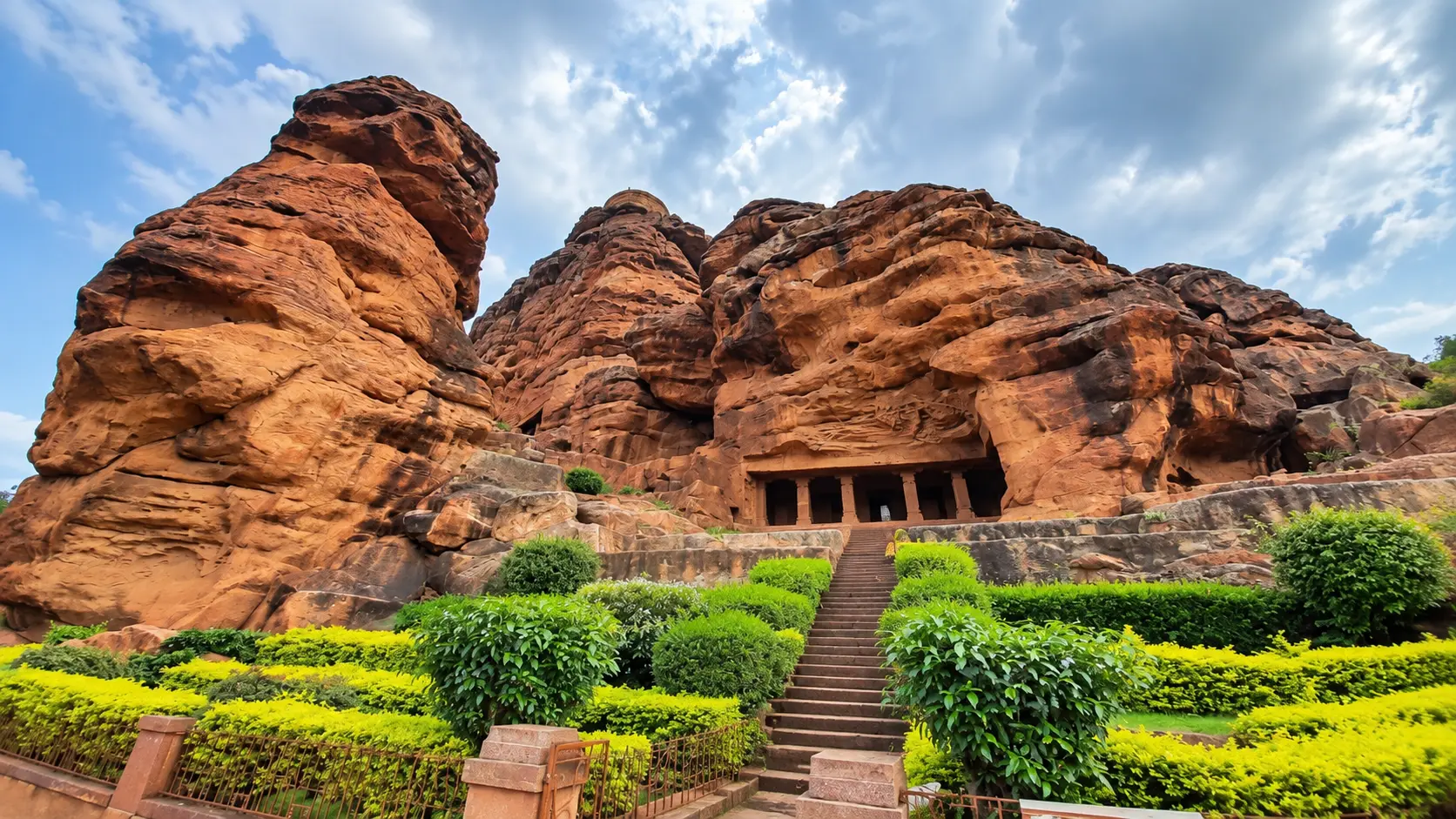
- Badami, Pattadakal, and Aihole (~130 - 140 km northwest): The celebrated 6th-to-8th-century Early Chalukyan circuit in Bagalkot district. Highlights include Badami's four rock-cut sandstone cave temples, the UNESCO-listed ceremonial coronation temple group at Pattadakal, and the 125 experimental temple laboratories of Aihole.
In pictures
The practical bits
Before you go.
Plan ahead
A successful journey through Hampi requires thoughtful preparation to balance the immense scale of the ruins with…Explore detailsClose details
A successful journey through Hampi requires thoughtful preparation to balance the immense scale of the ruins with environmental, cultural, and logistical considerations.
Ticketing and ASI unified passes
A single unified entry ticket issued by the Archaeological Survey of India covers both the Vitthala Temple…Explore detailsClose details
A single unified entry ticket issued by the Archaeological Survey of India covers both the Vitthala Temple complex and the Zenana Enclosure (Lotus Mahal and Elephant Stables) when visited on the same calendar day. Confirm the current charge and what it includes with the operator or service provider. Visitor admission, vehicles, parking, activities and accommodation can have separate charges. Keep the physical paper ticket or the digital QR code on your mobile phone readily accessible, as guards will scan it at both monument entry gates. All other major monuments - including the Mahanavami Dibba, Queen's Bath, Hazara Rama Temple, Achyutaraya Temple, and Hemakuta Hill - are open without ticket charges.
Thermal exposure and hydration strategy
The bare granite inselbergs and expansive stone courtyards of Hampi create an intense microclimate that reflects…Explore detailsClose details
The bare granite inselbergs and expansive stone courtyards of Hampi create an intense microclimate that reflects heat and ultraviolet rays. Even in mid-winter, midday solar radiation can lead to rapid dehydration and heat exhaustion. Carry a minimum of two litres of drinking water per person whenever leaving your hotel. Reusable water bottles can be refilled at filtered RO water kiosks maintained by the ASI near the Vitthala parking area and the Kamalapur Museum. Wear a wide-brimmed hat, apply high-SPF broad-spectrum sunscreen, and wear polarized sunglasses to protect your eyes from the intense glare reflecting off pale sandstone and granite surfaces.
Footwear and sacred bare-rock etiquette
Because Hampi involves a mixture of rugged boulder scrambling and active religious temple worship, footwear…Explore detailsClose details
Because Hampi involves a mixture of rugged boulder scrambling and active religious temple worship, footwear selection is critical. Choose sturdy, breathable walking shoes or trekking sandals equipped with high-grip rubber soles to navigate dusty gravel trails, unpaved royal paths, and slippery granite steps. However, be prepared to remove your footwear frequently: shoes must be taken off before entering the active sanctum of Virupaksha Temple, the consecrated courtyard of Malyavanta Raghunatha, and several smaller functional shrines. Confirm the current charge and what it includes with the operator or service provider. Visitor admission, vehicles, parking, activities and accommodation can have separate charges. If visiting during warm months, carry a pair of thick cotton socks in your daypack; stone courtyards become scorching hot by midday, making walking in bare feet agonizing. Modest attire covering shoulders and knees is mandatory inside Virupaksha Temple and highly recommended throughout the sacred heritage zone.
Heritage preservation and drone regulations
As a UNESCO World Heritage Site of global significance, Hampi's ancient structures are protected under the…Explore detailsClose details
As a UNESCO World Heritage Site of global significance, Hampi's ancient structures are protected under the Ancient Monuments and Archaeological Sites and Remains (AMASR) Act. Visitors must strictly refrain from climbing, leaning, or sitting on fragile stone walls, carved balustrades, or the stone chariot. Striking the acoustic pillars in Vitthala Temple is strictly prohibited and subject to immediate eviction by security personnel. Crucially, the flying of unmanned aerial vehicles (drones) is strictly banned across the entire Hampi World Heritage perimeter by the Archaeological Survey of India and the local police administration without prior written clearance from the Directorate General of Civil Aviation (DGCA) and the Ministry of Culture. Unauthorized drones will be confiscated, and operators face criminal prosecution.
River navigation and boulder hazard awareness
The Tungabhadra River, while serene and picturesque, is characterized by treacherous underwater currents, deep…Explore detailsClose details
The Tungabhadra River, while serene and picturesque, is characterized by treacherous underwater currents, deep submerged granite chasms, and sudden water releases from the upstream Tungabhadra Dam. Swimming in the river at Chakratirtha, Kodandarama Temple, or Sanapur Lake is strictly prohibited by district order. When undertaking traditional coracle rides at Sanapur or near the Anegundi bank, always wear an approved lifejacket provided by the boat operator, even if you are an experienced swimmer. Avoid trekking alone along isolated boulder trails after dark, as unlit rock paths have steep sudden drops, and local fauna including venomous pit vipers and sloth bears inhabit the rocky scrubland surrounding Daroji and the outlying hills.
A few things you might wonder
Common questions about visiting Hampi. Fees, visiting hours and ceremonies are researched details that may change; confirm current arrangements with the operator before travelling.
How many days are needed to see Hampi properly?
Can you visit both the Vitthala Temple and the Lotus Mahal on a single ticket?
Is Hampi safe for solo travellers and backpackers?
What is the best way to cross the Tungabhadra River from Hampi to Anegundi?
Are there ATMs, card payment facilities, and mobile network coverage across Hampi?
What is the dress code for visiting the temples and monuments in Hampi?
Can you fly a camera drone to film the ruins and boulder landscape?
Where is the best place to stay when visiting Hampi?
Explore more in Hampi Badami
Discover other destinations around this hub
More Hubs in Karnataka
Continue exploring other travel hubs in this state
Planning a trip to Hampi Badami?