Dubare Elephant Camp
Comprehensive visitor guide to Dubare Elephant Camp in Kodagu near Kushalnagar. Details on river crossing, morning bathing, feeding times, rafting, and tickets.
Location
Coorg & Chikmagalur, Karnataka
A closer look
Your visit, at a glance.
Coorg Chikmagalur, Karnataka
GET TO KNOW THE PLACE
Nestled along the southern wooded banks of the sacred Cauvery (Kaveri) River in the lush foothills of Kodagu (Coorg), Dubare Elephant Camp is one of India's most celebrated and…
The story of Dubare Elephant Camp
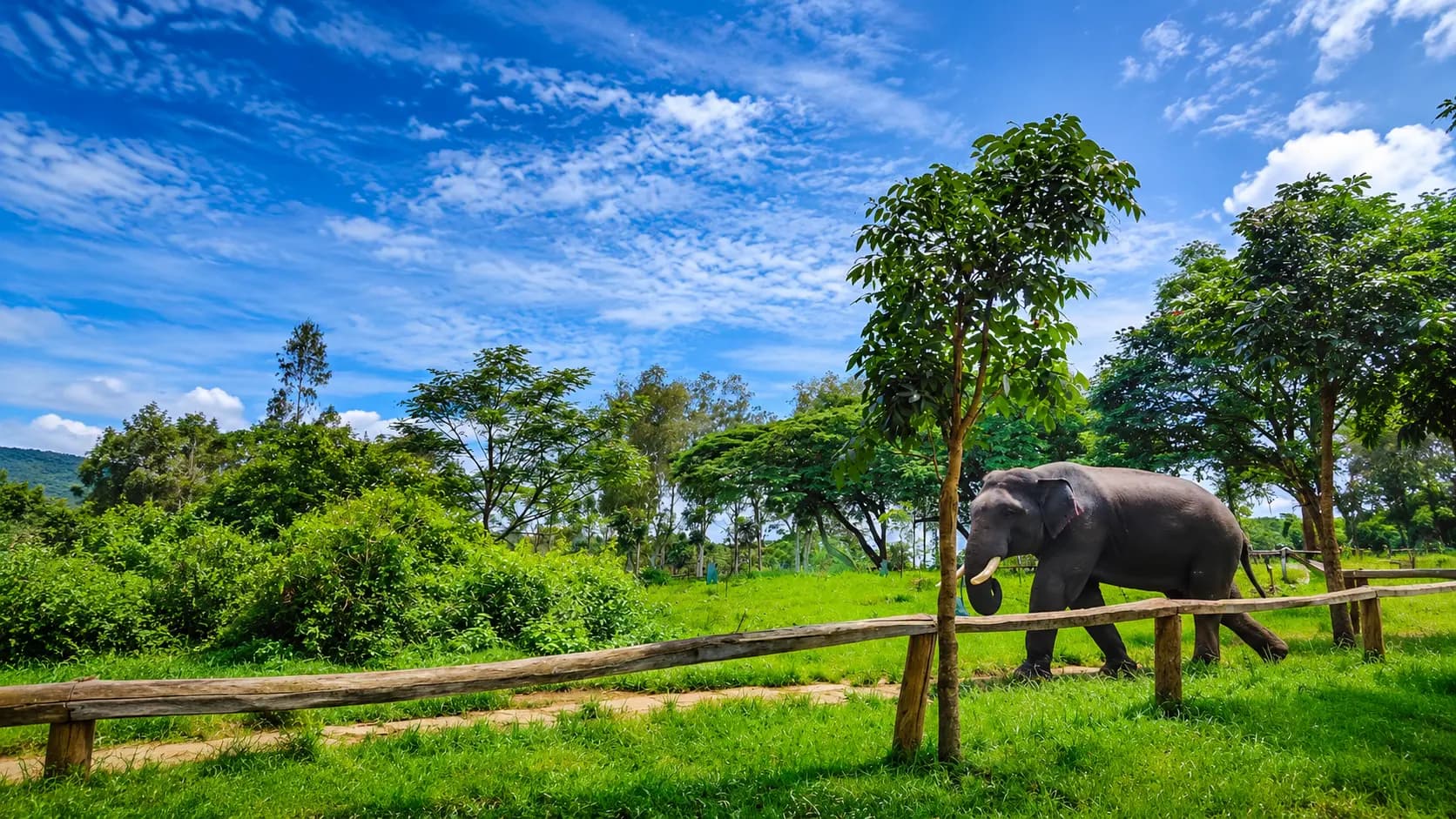
Nestled along the southern wooded banks of the sacred Cauvery (Kaveri) River in the lush foothills of Kodagu (Coorg), Dubare Elephant Camp is one of India's most celebrated and scientifically respected elephant conservation and ecotourism destinations. Situated within the Kushalnagar Taluk of Kodagu District in southern Karnataka - approximately 15 kilometers southwest of Kushalnagar and 28 kilometers east of Madikeri - this historic riverside sanctuary sits at an elevation of 825 meters (2,707 feet) above mean sea level. Surrounded by the dense, moist deciduous canopy of the Dubare Reserve Forest, the camp offers an unparalleled opportunity to witness, understand, and respectfully interact with the endangered Asian elephant (Elephas maximus) in a natural riverine environment.
Start here. Open a tile for the full details.
Why goRead details
Few wildlife encounters in southern India rival the magic of standing on the pebbled shores of the Cauvery River at morning mist, watching a herd of majestic Asian elephants emerge from the teak forests to bathe in the cool, flowing waters. Historically, Dubare served as a premier training and logging camp for the Karnataka Forest Department. In earlier centuries, wild elephants captured through the traditional khedda operations were brought here to be trained for heavy timber extraction and to serve in royal state pageantry - most famously the world-renowned Mysuru Dasara Jamboo Savari procession, where celebrated lead tuskers like Drona, Balarama, and Arjuna trained and lived before carrying the 84-kg solid gold Golden Howdah through the streets of Mysuru.
When to visitRead details
Entry & permissionsRead details
Fees, visiting hours and entry rules may change. Confirm the latest details with the official operator or local authority before travelling.
Dubare Elephant Camp operates under strict conservation and wildlife welfare protocols formulated by the Karnataka Forest Department and implemented on-site by Jungle Lodges & Resorts Ltd. (JLR).
+----------------------------------------------------------------------------------------------------+
|                                    ADMISSION AND TIMINGS SUMMARY                                   |
|                                                                                                    |
|  [OPERATIONAL SESSIONS]                                                                            |
|  - Morning Session (Full Interaction & Bathing): 09:00 AM to 11:00 AM daily.                       |
|  - Evening Session (Feeding & Observation Only): 16:30 PM to 17:30 PM daily.                       |
|  - Midday Closure: Camp is STRICTLY CLOSED to daytime visitors from 11:30 AM to 16:30 PM.         |
|                                                                                                    |
|  [ENTRANCE & ACTIVITY TARIFFS]                                                                     |
|  - General Daytime Entrance Fee: ₹100 per adult.                                                   |
|  - Cauvery River Ferry Boat Crossing: Approx. ₹30 to ₹50 per person each way (monsoon/high water). |
|  - Elephant Bathing Activity: Approx. ₹100 per person (morning session only).                      |
|  - Elephant Feeding Activity: Approx. ₹50 per person.                                              |
|  - Children Below 5 Years: Free admission.                                                         |
|                                                                                                    |
|  [VEHICULAR PARKING CHARGES]                                                                       |
|  - Four-Wheelers (Cars, Jeeps, SUVs): ₹50 per vehicle.                                             |
|  - Two-Wheelers (Motorcycles, Scooters): ₹20 per vehicle.                                          |
|                                                                                                    |
|  [ETHICAL & SAFETY RESTRICTIONS]                                                                   |
|  - Obey Mahouts: Strict adherence to mahout commands is mandatory at all times.                   |
|  - Prohibited: Outside food feeding, touching tusks, approaching behind animals, camera flashes.  |
|  - Ecological Protection: Strictly plastic-free and alcohol-free zone; smoking banned.             |
|  - Drones: Flying drones over the elephant camp or river is strictly prohibited.                   |
+----------------------------------------------------------------------------------------------------+
Elephant Welfare and Visitor Safety Protocols
The primary mandate of Dubare is the physical and emotional welfare of the elephants. To ensure visitor safety around animals weighing between three and five tons, strict behavioral rules are enforced:
- Never Approach Unaccompanied: Always remain within designated visitor zones. Never approach an elephant unless an active mahout or kavadi is standing immediately beside the animal and has given explicit permission.
- Keep Away from Calves and Tusks: Mother elephants are fiercely protective of young calves. Never attempt to touch or photograph calves without direct mahout supervision. Never attempt to touch, grab, or lean against the ivory tusks of male elephants.
- No Flash Photography: Electronic camera flashes and bright mobile video lights can startle or irritate elephants. Flash photography is strictly prohibited inside the camp and bathing shallows.
- No Outside Food: Feeding outside food items - such as biscuits, chips, bread, or packaged snacks - is strictly illegal. Elephants have sensitive digestive tracts, and foreign foods or discarded plastic packaging pose fatal health hazards.
River Crossing Safety and Lifejacket Mandates
During months when the Cauvery is flowing high and boats are operated, the Karnataka Forest Department enforces mandatory safety protocols:
- Wear Lifejackets: All passengers boarding Forest Department ferry boats or rafts must fasten lifejackets securely before departure.
- Do Not Wade in Deep Channels: Never attempt to swim across the river or wade through unauthorized channels where deep underwater currents and submerged slippery boulders exist. Use only the designated boat service or official shallow stepping-stone routes.
Plan your visitRead details
Dubare Elephant Camp is located in the eastern lowlands of Kodagu District, easily accessible from the major transport corridors connecting Mysuru, Bengaluru, and Madikeri.
Explore the full guide - choose a topic below.
Why visit?
Few wildlife encounters in southern India rival the magic of standing on the pebbled shores of the Cauvery River…Explore detailsClose details
Few wildlife encounters in southern India rival the magic of standing on the pebbled shores of the Cauvery River at morning mist, watching a herd of majestic Asian elephants emerge from the teak forests to bathe in the cool, flowing waters. Historically, Dubare served as a premier training and logging camp for the Karnataka Forest Department. In earlier centuries, wild elephants captured through the traditional khedda operations were brought here to be trained for heavy timber extraction and to serve in royal state pageantry - most famously the world-renowned Mysuru Dasara Jamboo Savari procession, where celebrated lead tuskers like Drona, Balarama, and Arjuna trained and lived before carrying the 84-kg solid gold Golden Howdah through the streets of Mysuru.
Following the nationwide ban on commercial timber logging in natural forests and the enactment of rigorous wildlife protection laws in the late 20th century, the role of Dubare underwent an enlightened transformation. In 1998, the Karnataka Forest Department joined forces with Jungle Lodges & Resorts Ltd. (JLR) to convert the working logging station into a pioneering elephant rehabilitation center, veterinary clinic, and conservation education camp. Today, the camp provides a peaceful, lifelong sanctuary for retired working elephants, orphaned calves rescued from human-wildlife conflict zones, and captive pachyderms requiring specialized medical care.
Visiting Dubare is an active, immersive educational journey rather than a passive zoo display. Your adventure begins with an exhilarating crossing of the Cauvery River - either by motorized passenger ferry or by wading across sun-dappled pebble shoals during the dry season. During the signature morning bathing session (09:00 AM to 11:00 AM), visitors can watch mahouts and kavadis gently guide the massive animals into the river shallows. As the elephants recline contentedly on their sides, snorting water from their trunks, visitors are invited to step into the knee-deep river to assist in scrubbing their thick, wrinkled hides with smooth river stones and natural coconut-husk brushes.
Beyond bathing, guests observe the preparation and feeding of traditional nutritional rations - giant steamed balls of finger millet (ragi mudde) stuffed with jaggery, boiled pulses, raw turmeric, and sugarcane - and attend fascinating educational briefings led by certified JLR naturalists. Here, visitors learn about elephant biology, infrasonic communication, the intricate matriarchal herd structure, and the complex conservation challenges of managing elephant corridors amidst Karnataka's expanding coffee estates. Combined with seasonal white-water river rafting, serene coracle rides, and forest birdwatching, Dubare Elephant Camp is an essential, heart-warming wildlife excursion.
What to expect
A visit to Dubare Elephant Camp is structured around two distinct operational sessions each day, with the morning…Explore detailsClose details
A visit to Dubare Elephant Camp is structured around two distinct operational sessions each day, with the morning session offering the most comprehensive array of activities. Visitors should anticipate an active outdoor experience involving water crossings, riverbank walking on uneven pebbles, and up-close observation of large mammals under expert supervision.
+----------------------------------------------------------------------------------------------------+
|                                    DUBARE ELEPHANT CAMP PRECINCT MAP                               |
|                                                                                                    |
|  [North Bank / Roadhead Parking Terminal]                                                          |
|  - Pay-and-park lot for cars, buses, and two-wheelers. Ticket counter and restroom facilities.     |
|  - River jetty for passenger motorboats and coracles.                                              |
|                                                  |                                                 |
|                                                  v                                                 |
|  ============================== [THE CAUVERY (KAVERI) RIVER CROSSING] ============================= |
|  - High Water / Monsoon (June - Nov): Forest Dept motorized ferry boats / rafts (approx. 5 mins).    |
|  - Low Water / Summer (Dec - May): Wading across shallow pebble beds and stepping stones.            |
|                                                  |                                                 |
|                                                  v                                                 |
|  ============================== [SOUTH BANK: DUBARE ELEPHANT CAMP COMPLEX] ======================== |
|                                                  |                                                 |
|                   +------------------------------+------------------------------+                  |
|                   |                                                             |                  |
|         +---------+---------+                                         +---------+---------+        |
|         | RIVER SHALLOWS &  |                                         | ELEPHANT FEEDING  |        |
|         | BATHING GHATS     |                                         | & PREPARATION KRAAL|       |
|         | (09:00-11:00 AM)  |                                         | (Ragi Mudde Balls)|        |
|         +---------+---------+                                         +---------+---------+        |
|                   |                                                             |                  |
|                   +------------------------------+------------------------------+                  |
|                                                  |                                                 |
|                                        +---------+---------+                                       |
|                                        | JLR NATURALIST    |                                       |
|                                        | INTERPRETATION    |                                       |
|                                        | CENTER & SHEDS    |                                       |
|                                        +---------+---------+                                       |
|                                                  |                                                 |
|                                        +---------+---------+                                       |
|                                        | JUNGLE LODGES     |                                       |
|                                        | ECO-COTTAGES &    |                                       |
|                                        | GOL GHAR DINING   |                                       |
|                                        +---------+---------+                                       |
|                                                  |                                                 |
|  [South / East: Dubare Reserve Forest] <------------------------------------> [River Rafting Run:  |
|  (Nature Trails, Sambar, Hornbills, Spotted Deer)                              12 km down Cauvery] |
+----------------------------------------------------------------------------------------------------+
The Cauvery River Crossing
The arrival at Dubare begins with a memorable physical transition. The road from Kushalnagar terminates on the northern bank of the Cauvery River, while the elephant camp itself is situated on the forested southern bank. Accessing the camp requires crossing the river:
- Monsoon and Post-Monsoon Season (June to November): Driven by heavy rains in the catchment hills of Tala Cauvery, the river flows wide, deep, and swift. The Forest Department and JLR operate sturdy motorized passenger boats and large bamboo rafts equipped with outboard motors to ferry visitors across the 100-meter river channel in roughly five minutes. Lifejackets are strictly mandatory for all passengers.
- Winter and Dry Summer Season (December to May): As reservoir gates upstream regulate the flow, the water level recedes dramatically. The river transforms into an exposed expanse of smooth granite boulders, sandy shoals, and shallow, ankle-to-knee-deep pools. Visitors can take off their shoes and wade across the cool riverbed, stepping across natural rock pathways while schools of freshwater fish dart past their feet.
Check the current visiting hours and permitted access with the site operator before departure; ceremonies, closures and visitor sessions can affect access. Around 09:00 AM, the mahouts unchain the elephants from their night shelters and guide them down the forested riverbank into the shallow, flowing waters of the Cauvery.
Elephants adore water; it cools their massive bodies, soothes their skin, and relieves joint pressure. As they reach the shallows, the elephants deliberately lie down on their sides in the water, submerging their heads and blowing playful streams of water from their trunks.
Under the watchful eye of the mahouts, visiting travelers are permitted to step into the knee-deep river shallows beside the animals. Equipped with natural flat river stones and stiff coconut-fiber brushes provided by the staff, visitors assist in scrubbing the elephants' thick, wrinkled skin. The elephants lean into the scrub, visibly relishing the friction, flapping their large ears in contentment. This interactive grooming session lasts roughly 45 minutes, creating an extraordinary sense of connection between human and pachyderm.
The Feeding Demonstration: Giant Ragi Mudde
Once the elephants emerge glistening and refreshed from their bath, they are led to the central covered kraal and feeding platform. Elephants are hindgut fermenters with massive nutritional requirements, consuming up to 150 to 200 kilograms of forage and grain daily.
Visitors gather around the preparation area to watch mahouts prepare the daily supplementary feed:
- Colossal spherical balls of steamed finger millet (ragi mudde), each weighing several kilograms.
- The center of each ragi ball is hollowed out and stuffed with chunks of raw jaggery (unrefined cane sugar), boiled pulses, raw ginger, whole turmeric roots (a natural antiseptic and digestive aid), and coarse mineral rock salt.
- Elephants line up patiently, lifting their trunks on command with mouth wide open. Under the mahout’s guidance, visitors can step forward and place a giant ragi ball directly onto the elephant’s pink, velvety tongue. The elephant curls its tongue, closes its mouth, and swallows the treat with obvious delight.
The Indigenous Kuruba Mahout Community
A vital, often underappreciated dimension of Dubare is the human culture that sustains it. The mahouts (primary handlers) and kavadis (assistants) belong almost exclusively to the Jenu Kuruba ("honey gatherers") and Betta Kuruba ("hill people") tribes, indigenous forest communities who have inhabited the forests of Coorg and Nilgiris for thousands of years.
Each mahout is paired with a specific elephant from an early age, forming a profound, lifelong bond based on trust, body language, vocal commands (sholkas and oral instructions in a specialized forest dialect), and mutual respect. The mahouts possess deep ancestral knowledge of traditional herbal veterinary medicine (Hasti Chikitsa), using wild forest barks, leaves, and roots to treat elephant ailments. Watching the effortless communication between a 50-kilogram tribal elder and a 5,000-kilogram bull tusker is a humbling masterclass in human-animal symbiosis.
Educational Interaction & Elephant Information Center
Jungle Lodges & Resorts employs certified naturalists stationed at the camp's Elephant Information Center. Through educational posters, skeletal displays, and interactive Q&A sessions, naturalists educate visitors on critical conservation topics:
- The physiological differences between Asian (Elephas maximus) and African (Loxodonta africana) elephants.
- The tragic history of ivory poaching and why only male Asian elephants possess tusks (and why some males, known as makhnas, are naturally tuskless).
- The alarming shrinkage of natural migration corridors in Kodagu due to the expansion of commercial coffee estates, resorts, and highways, leading to frequent crop raiding and dangerous human-elephant conflict.
- The vital ecological role of elephants as ecosystem engineers and seed dispersers who shape the forest canopy and create water holes for other wildlife.
Adventure Activities: River Rafting and Coracle Boating
In addition to elephant interactions, Dubare is a popular hub for river adventure:
- Monsoon River Rafting (July to November): When the Cauvery is swollen with monsoon rains, licensed adventure operators and JLR organize white-water river rafting along a thrilling 12-kilometer stretch from Dubare down to Valnoor. The river features mild, enjoyable Grade I and Grade II rapids, making it safe and exciting for beginners and families with children.
- Coracle Rides: Throughout the year, visitors can hire traditional round woven coracles (harigolu) piloted by local boatmen, gently spinning along the calm backwaters of the Cauvery while spotting river terns, cormorants, kingfishers, and basking marsh crocodiles.
- Forest Nature Walks: Guided nature walks through the Dubare Reserve Forest reveal an abundance of flora and fauna, including chital (spotted deer), sambar, Indian muntjac (barking deer), Malabar giant squirrels, and diverse butterflies.
Best time to visit
Dubare’s location on the riverbank means that seasonal water levels fundamentally dictate the visitor experience…Explore detailsClose details
Seasonal Weather and River Water Dynamics
Dubare’s location on the riverbank means that seasonal water levels fundamentally dictate the visitor experience:
+----------------------------------------------------------------------------------------------------+
|                                    SEASONAL VISITING CLIMATE & RIVER GUIDE                         |
|                                                                                                    |
|  [OCTOBER TO MARCH: THE IDEAL VISITOR SEASON (RECOMMENDED)]                                        |
|  - Temperatures: 16°C to 28°C. Cool, pleasant mornings; sunny, comfortable afternoons.             |
|  - River Status: Cauvery water levels are moderate, crystal-clear, and safe for river wading.      |
|  - Experience: Elephant bathing is calm, pleasant, and fully interactive; excellent birdwatching.  |
|Check the current visiting hours and permitted access with the site operator before departure; ceremonies, closures and visitor sessions can affect access.|
|                                                                                                    |
|  [JULY TO SEPTEMBER: THUNDEROUS MONSOON & RAFTING]                                                 |
|  - Temperatures: 18°C to 24°C. Heavy tropical rains, lush green forest canopy, high humidity.      |
|  - River Status: Cauvery runs deep, swift, and swollen; boat crossing is mandatory with lifejackets|
|  - Experience: White-water rafting is at its peak; bathing may be restricted to riverbanks.        |
|  - Caution: River currents can be turbulent; follow all safety warnings from boat operators.       |
|                                                                                                    |
|  [APRIL TO MAY: WARM SUMMER SHINE]                                                                 |
|  - Temperatures: 22°C to 34°C. Warm mid-day sunshine; clear skies; pleasant river breezes.         |
|  - River Status: River levels drop to low shoals; easy pebble wading across the riverbed.          |
|  - Experience: Elephants spend extended hours wallowing in the water to escape the heat.           |
|  - Tip: Wear light cotton clothing and sun hats; morning session is far more comfortable than noon.|
+----------------------------------------------------------------------------------------------------+
Navigating the Structured Daily Timing
Dubare Elephant Camp does not operate as an all-day open walk-in facility. The elephants spend the mid-day hours (11:30 AM to 16:30 PM) resting, foraging freely in the deep reserve forest, and socializing away from tourist presence.
- The Ultimate Visitor Window: The Morning Session (09:00 AM to 11:00 AM) is by far the most rewarding. You must plan to arrive at the northern roadhead parking terminal between 08:15 AM and 08:30 AM. Check the current visiting hours and permitted access with the site operator before departure; ceremonies, closures and visitor sessions can affect access.
- The Evening Session (16:30 PM to 17:30 PM): A shorter, more subdued one-hour session focused exclusively on observing feeding and natural behavior. Elephants are not bathed in the river during the evening session.
How to reach
Dubare Elephant Camp is located in the eastern lowlands of Kodagu District, easily accessible from the major…Explore detailsClose details
Dubare Elephant Camp is located in the eastern lowlands of Kodagu District, easily accessible from the major transport corridors connecting Mysuru, Bengaluru, and Madikeri.
+----------------------------------------------------------------------------------------------------+
|                                      REGIONAL TRANSIT CONNECTIONS                                  |
|                                                                                                    |
|  [Kempegowda Int'l Airport (BLR): 255 km E]  <--- NH-275 Expressway & State Highway (approx. 5 hrs)|
|  [Kannur International Airport (CNN): 105 km SW] <--- Virajpet-Siddapur Road (approx. 2.5 hrs)     |
|  [Mangaluru International Airport (IXE): 165 km W] <--- NH-275 via Madikeri (approx. 4 hrs)        |
|                                                                                                    |
|                                                  |                                                 |
|                                                  v                                                 |
|  ============================== [MYSURU JUNCTION RAILWAY STATION (MYS)] ========================== |
|  - Located 95 km East (approx. 2 to 2.5 hours by car or express bus).                             |
|  - Direct Vande Bharat and Shatabdi express trains connecting to Bengaluru and Chennai.            |
|                                                  |                                                 |
|                                                  v                                                 |
|  ============================== [KUSHALNAGAR TOWN / NH-275 JUNCTION] ============================== |
|  - Primary transit hub on the Bengaluru-Madikeri highway corridor.                                 |
|  - Turn south at Guddehosur junction onto Kushalnagar-Siddapur Road (12 km to camp).               |
|                                                  |                                                 |
|                                                  v                                                 |
|  ============================== [DUBARE ROADHEAD & RIVER JETTY TERMINAL] ========================== |
|  - Paved road terminates at riverbank parking lot; ticket booth; ferry boat crossing.              |
+----------------------------------------------------------------------------------------------------+
By Road: Driving from Kushalnagar and Madikeri
- From Kushalnagar (15 km): From Kushalnagar town on NH-275, drive approximately 3 kilometers southwest toward Madikeri to the Guddehosur junction. Turn left (south) onto the Kushalnagar-Siddapur Road and follow the directional signboards through rural countryside and eucalyptus plantations for approximately 12 kilometers until reaching the Dubare roadhead. Driving time is roughly 25 minutes.
- From Madikeri (28 km): Depart Madikeri heading east along NH-275 past Suntikoppa. Before reaching Kushalnagar, turn right at the Guddehosur junction onto the road to Dubare. Driving time is roughly 45 minutes.
- From Mysuru (95 km): Drive west via NH-275 past Hunsur and Bylakuppe. At Guddehosur, turn south toward Dubare. Driving time is approximately 2 to 2.5 hours.
- Road Condition: The access road from Guddehosur to the Dubare parking lot is fully paved with tarmac, suitable for hatchbacks, sedans, SUVs, motorcycles, and tourist coaches.
By Public Bus (KSRTC)
- Regular KSRTC express and non-stop buses running between Bengaluru, Mysuru, and Madikeri halt at Kushalnagar Bus Stand.
- From Kushalnagar, local private and KSRTC feeder buses operate along the Siddapur road, stopping at the Dubare Cross junction, from where local auto-rickshaws can take visitors the final 2 kilometers to the riverbank. Confirm the current charge and what it includes with the operator or service provider. Visitor admission, vehicles, parking, activities and accommodation can have separate charges.
Nearest Railway Stations
- Mysuru Junction (MYS): Situated 95 km east, serving as the principal rail gateway. Frequent express trains link Mysuru to Bengaluru, Chennai, Mumbai, and Delhi. Taxis and KSRTC buses from Mysuru railway station reach Dubare in roughly two hours.
- Hassan Junction (HAS): Situated 90 km northeast, connecting to Bengaluru and northern Karnataka.
Nearest Airports
- Kannur International Airport (CNN), Kerala: Located 105 km southwest, accessible in roughly 2.5 to 3 hours via the Mattanur-Virajpet-Siddapur mountain highway.
- Mangaluru International Airport (IXE): Located 165 km west via the Sampaje Ghat road (approx. 4 hours).
- Kempegowda International Airport Bengaluru (BLR): Located 255 km east, reached in approximately 4.5 to 5.5 hours via the Bengaluru-Mysuru Expressway (NH-275).
Entry, timings and permissions
Fees, visiting hours and entry rules may change.Explore detailsClose details
Fees, visiting hours and entry rules may change. Confirm the latest details with the official operator or local authority before travelling.
Dubare Elephant Camp operates under strict conservation and wildlife welfare protocols formulated by the Karnataka Forest Department and implemented on-site by Jungle Lodges & Resorts Ltd. (JLR).
+----------------------------------------------------------------------------------------------------+
|                                    ADMISSION AND TIMINGS SUMMARY                                   |
|                                                                                                    |
|  [OPERATIONAL SESSIONS]                                                                            |
|  - Morning Session (Full Interaction & Bathing): 09:00 AM to 11:00 AM daily.                       |
|  - Evening Session (Feeding & Observation Only): 16:30 PM to 17:30 PM daily.                       |
|  - Midday Closure: Camp is STRICTLY CLOSED to daytime visitors from 11:30 AM to 16:30 PM.         |
|                                                                                                    |
|  [ENTRANCE & ACTIVITY TARIFFS]                                                                     |
|  - General Daytime Entrance Fee: ₹100 per adult.                                                   |
|  - Cauvery River Ferry Boat Crossing: Approx. ₹30 to ₹50 per person each way (monsoon/high water). |
|  - Elephant Bathing Activity: Approx. ₹100 per person (morning session only).                      |
|  - Elephant Feeding Activity: Approx. ₹50 per person.                                              |
|  - Children Below 5 Years: Free admission.                                                         |
|                                                                                                    |
|  [VEHICULAR PARKING CHARGES]                                                                       |
|  - Four-Wheelers (Cars, Jeeps, SUVs): ₹50 per vehicle.                                             |
|  - Two-Wheelers (Motorcycles, Scooters): ₹20 per vehicle.                                          |
|                                                                                                    |
|  [ETHICAL & SAFETY RESTRICTIONS]                                                                   |
|  - Obey Mahouts: Strict adherence to mahout commands is mandatory at all times.                   |
|  - Prohibited: Outside food feeding, touching tusks, approaching behind animals, camera flashes.  |
|  - Ecological Protection: Strictly plastic-free and alcohol-free zone; smoking banned.             |
|  - Drones: Flying drones over the elephant camp or river is strictly prohibited.                   |
+----------------------------------------------------------------------------------------------------+
Elephant Welfare and Visitor Safety Protocols
The primary mandate of Dubare is the physical and emotional welfare of the elephants. To ensure visitor safety around animals weighing between three and five tons, strict behavioral rules are enforced:
- Never Approach Unaccompanied: Always remain within designated visitor zones. Never approach an elephant unless an active mahout or kavadi is standing immediately beside the animal and has given explicit permission.
- Keep Away from Calves and Tusks: Mother elephants are fiercely protective of young calves. Never attempt to touch or photograph calves without direct mahout supervision. Never attempt to touch, grab, or lean against the ivory tusks of male elephants.
- No Flash Photography: Electronic camera flashes and bright mobile video lights can startle or irritate elephants. Flash photography is strictly prohibited inside the camp and bathing shallows.
- No Outside Food: Feeding outside food items - such as biscuits, chips, bread, or packaged snacks - is strictly illegal. Elephants have sensitive digestive tracts, and foreign foods or discarded plastic packaging pose fatal health hazards.
River Crossing Safety and Lifejacket Mandates
During months when the Cauvery is flowing high and boats are operated, the Karnataka Forest Department enforces mandatory safety protocols:
- Wear Lifejackets: All passengers boarding Forest Department ferry boats or rafts must fasten lifejackets securely before departure.
- Do Not Wade in Deep Channels: Never attempt to swim across the river or wade through unauthorized channels where deep underwater currents and submerged slippery boulders exist. Use only the designated boat service or official shallow stepping-stone routes.
Nearby places to consider
The eastern region of Kodagu surrounding Dubare and Kushalnagar is rich in spiritual monasteries, riverine bamboo…Explore detailsClose details
The eastern region of Kodagu surrounding Dubare and Kushalnagar is rich in spiritual monasteries, riverine bamboo islands, and spice plantations.
+----------------------------------------------------------------------------------------------------+
|                                    NEARBY DESTINATIONS NETWORK                                     |
|                                                                                                    |
|  [Kaveri Nisargadhama: 12 km North]              [Namdroling Golden Temple: 18 km East]            |
|  (River Island, Bamboo Groves, Deer Park)        (40-ft Gilded Buddhas, Tibetan Settlement)        |
|         ^                                              ^                                           |
|          \                                            /                                            |
|           \                                          /                                             |
|  ================== [DUBARE ELEPHANT CAMP: CAUVERY CONSERVATION SANCTUARY] ======================== |
|           /                                          \                                             |
|          /                                            \                                            |
|         v                                              v                                           |
|  [Chiklihole Reservoir: 14 km Northwest]         [Madikeri Town & Fort: 28 km West]                |
|  (Tranquil Semi-Circular Dam, Sunset Scenery)    (Raja's Seat, Abbey Falls, Highland Capital)      |
+----------------------------------------------------------------------------------------------------+
Namdroling Monastery / The Golden Temple (18 km East)
Located in Bylakuppe, the largest Tibetan settlement in South India, the Namdroling Monastery (popularly known as the Golden Temple) is a breathtaking cultural marvel. Founded in 1963 by His Holiness Pema Norbu Rinpoche, the main prayer hall enshrines three colossal, 40-foot-tall copper-and-gold gilded statues: Lord Buddha Shakyamuni, flanked by Guru Padmasambhava and Buddha Amitayus. The temple walls are covered in intricate Tibetan thangka murals depicting Buddhist cosmology, accompanied by the hypnotic acoustic chanting of hundreds of red-robed monks and the resonating boom of traditional Tibetan horns.
Kaveri Nisargadhama (12 km North)
Situated on NH-275 near Kushalnagar, Kaveri Nisargadhama is an idyllic 64-acre riverine island formed by the Cauvery River. Accessible via a swinging hanging bridge suspended over the river, the island is covered in thick bamboo groves, teak trees, and sandalwood trees. Attractions include a spotted deer park, a rabbit burrow, an orchidarium, tree-top machans, and serene riverfront walking paths.
Chiklihole Reservoir (14 km Northwest)
Tucked away between Kushalnagar and Madikeri near Nanjarayapatna, Chiklihole Reservoir is an offbeat, serene reservoir built across the Chiklihole tributary of the Cauvery. Notable for its unique, semi-circular dam overflow weir without mechanical crest gates, Chiklihole is surrounded by dense forest reserves and green rolling meadows, offering an exceptionally quiet sunset spot far from tourist crowds.
Harangi Dam (18 km North)
Built across the Harangi River (a major tributary of the Cauvery) near Hudgur village, the Harangi Dam is an impressive 845-meter-long masonry gravity dam standing 47 meters tall. During the post-monsoon months, water roaring through the open radial spillway gates creates a dramatic wall of spray. Flanking the reservoir are peaceful public gardens and an ancient stone shrine dedicated to Lord Shiva and Goddess Parvati.
In pictures
The practical bits
Before you go.
Plan ahead
Strategic planning regarding morning timing, appropriate footwear, and combining Dubare with neighboring cultural…Explore detailsClose details
Strategic planning regarding morning timing, appropriate footwear, and combining Dubare with neighboring cultural landmarks will ensure an unforgettable and smooth experience.
Arrive at Roadhead Parking by 08:30 AM Sharp
To participate fully in the 09:00 AM elephant bathing session, reach the northern parking terminal by 08:30 AM.Explore detailsClose details
To participate fully in the 09:00 AM elephant bathing session, reach the northern parking terminal by 08:30 AM. This gives you sufficient time to park, purchase your entry and activity tokens at the ticket counter, cross the Cauvery River, and position yourself on the riverbank before the elephants enter the water.
Wear Water-Friendly Footwear and Quick-Drying Clothes
You will likely be wading into knee-deep river water to scrub the elephants, or crossing the shallow riverbed on…Explore detailsClose details
You will likely be wading into knee-deep river water to scrub the elephants, or crossing the shallow riverbed on foot during the dry season. Wear secure, water-resistant sandals (such as Crocs or trekking sandals with heel straps) and shorts or rolled-up trousers. Avoid socks, expensive leather shoes, or heavy denim that stays wet for hours.
Carry a Small Towel and Spare Change of Clothes
Splashes from playful elephant trunks and river mist are inevitable during the bathing activity.Explore detailsClose details
Splashes from playful elephant trunks and river mist are inevitable during the bathing activity. Keeping a small towel and an extra pair of dry clothes in your daypack ensures comfort for the rest of your day’s travels.
Bring Cash Currency for Ticket Counters
While digital UPI payments are accepted when cellular networks function, the river valley experiences frequent…Explore detailsClose details
While digital UPI payments are accepted when cellular networks function, the river valley experiences frequent mobile network disruptions. Confirm the current charge and what it includes with the operator or service provider. Visitor admission, vehicles, parking, activities and accommodation can have separate charges.
Combine with Namdroling Golden Temple and Nisargadhama
Dubare is located in the eastern tourism hub of Coorg, making it effortless to combine with the spectacular…Explore detailsClose details
Dubare is located in the eastern tourism hub of Coorg, making it effortless to combine with the spectacular Tibetan Buddhist monastery of Namdroling Golden Temple at Bylakuppe (18 km east) and the bamboo island park of Kaveri Nisargadhama (12 km north) for an extraordinary full-day cultural itinerary.
+----------------------------------------------------------------------------------------------------+
|                                  SUGGESTED COMBINED DAY ITINERARY: EASTERN COORG                   |
|                                                                                                    |
|  08:15 AM to 08:45 AM  -  Arrive at Dubare Roadhead & River Crossing                                 |
|  - Park vehicle; buy entrance tokens; cross the scenic Cauvery River by boat or pebble wade.       |
|                                                                                                    |
|  09:00 AM to 10:00 AM  -  Morning Elephant Bathing in the Cauvery                                    |
|  - Step into shallow water; scrub elephants with river stones alongside experienced mahouts.       |
|  - Watch elephants wallow, roll, and spray water in the morning sunshine.                         |
|                                                                                                    |
|  10:00 AM to 11:15 AM  -  Elephant Feeding & Conservation Briefing                                   |
|  - Feed giant steamed ragi mudde balls with jaggery to the eager pachyderms.                       |
|  - Attend educational session at the Elephant Information Center with a JLR naturalist.            |
|                                                                                                    |
|  11:30 AM to 12:30 PM  -  Cauvery River Coracle Ride or Rafting                                     |
|  - Board a traditional round coracle boat; spot river terns, kingfishers, and giant squirrels.     |
|  - Recross the river to the parking terminal; change into dry footwear.                            |
|                                                                                                    |
|  01:00 PM to 02:30 PM  -  Kaveri Nisargadhama Bamboo Island                                          |
|  - Walk across the hanging bridge to Nisargadhama island; enjoy lunch at an eco-restaurant.        |
|  - Stroll through lush bamboo groves, visit the deer park, and browse wooden handicraft stalls.    |
|                                                                                                    |
|  03:00 PM to 05:00 PM  -  Namdroling Monastery (The Golden Temple)                                  |
|  - Drive 15 minutes to Bylakuppe; marvel at the three 40-foot gilded statues of Lord Buddha.       |
|  - Listen to Tibetan monks chanting; admire intricate thangka paintings; shop for Tibetan crafts.  |
+----------------------------------------------------------------------------------------------------+
A few things you might wonder
Common questions about visiting Dubare Elephant Camp. Fees, visiting hours and ceremonies are researched details that may change; confirm current arrangements with the operator before travelling.
What are the exact timings to see elephants at Dubare Elephant Camp?
Can visitors bathe the elephants at Dubare?
How do visitors cross the Cauvery River to reach the camp?
Are elephant rides available at Dubare Elephant Camp?
What is the entry fee for Dubare Elephant Camp?
Is river rafting available at Dubare?
What do mahouts feed the elephants at Dubare?
How far is Dubare Elephant Camp from Kushalnagar and Madikeri?
Explore more in Coorg Chikmagalur
Discover other destinations around this hub
More Hubs in Karnataka
Continue exploring other travel hubs in this state
Planning a trip to Coorg Chikmagalur?