Baba Budangiri
Comprehensive visitor guide to Baba Budangiri (Chandra Drona Parvatha) in Chikkamagaluru. Explore the birthplace of Indian coffee, Dattatreya Peetha, and Manikyadhara Falls.
Location
Coorg & Chikmagalur, Karnataka
A closer look
Your visit, at a glance.
Coorg Chikmagalur, Karnataka
GET TO KNOW THE PLACE
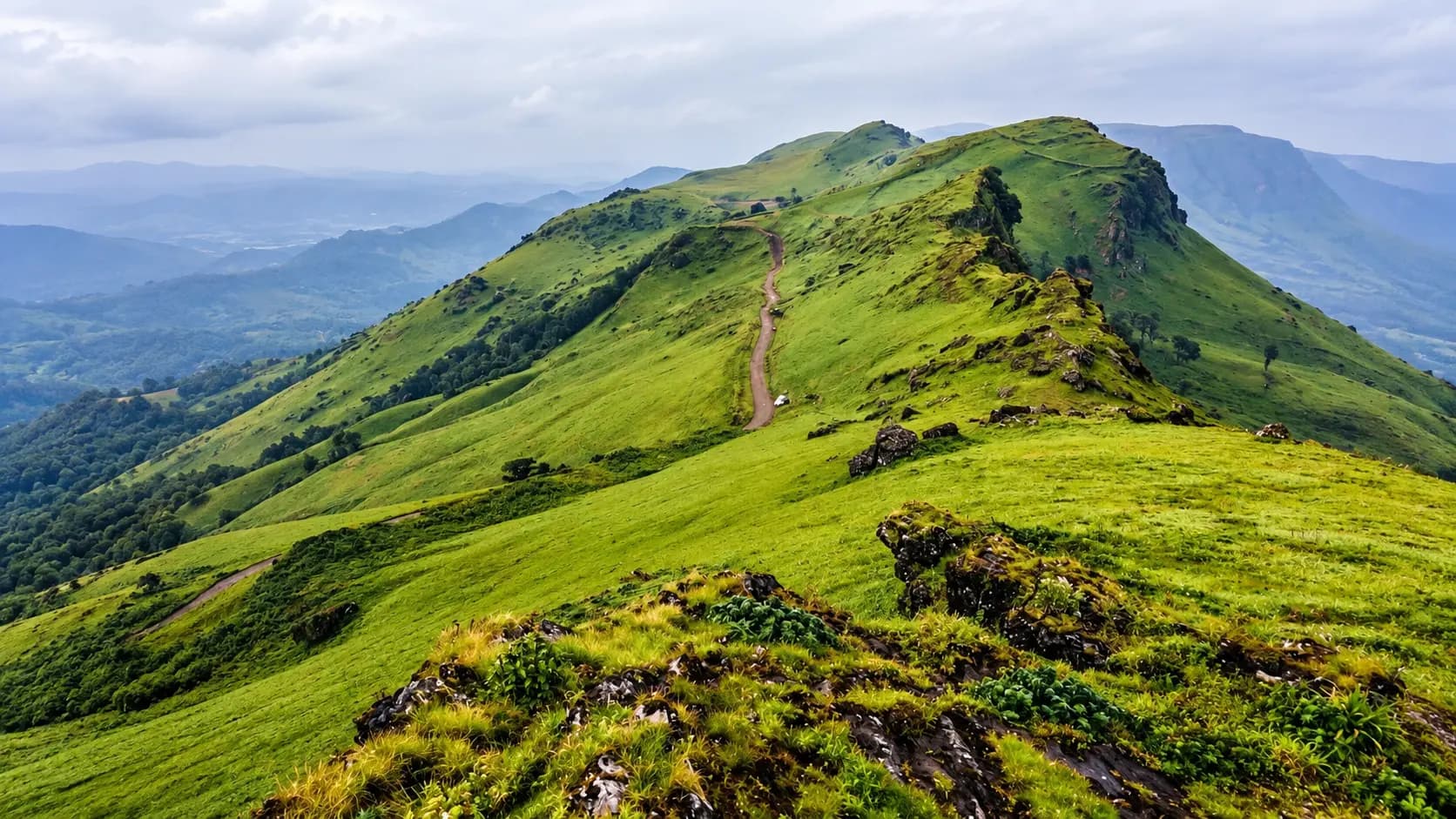
Curving across the highland skyline of Chikkamagaluru District like a colossal crescent blade, Baba Budangiri - known historically in ancient Sanskrit epics as Chandra Drona…
The story of Baba Budangiri
Curving across the highland skyline of Chikkamagaluru District like a colossal crescent blade, Baba Budangiri - known historically in ancient Sanskrit epics as Chandra Drona Parvatha ("Crescent Moon Mountain") - is one of the most prominent, ecologically vital, and spiritually revered mountain massifs in the Western Ghats of Karnataka. Attaining a soaring summit elevation of 1,895 meters (6,217 feet) above mean sea level, this dramatic range forms the northern arm of Karnataka's highest mountain crest. Positioned roughly 30 kilometers north of Chikkamagaluru town, Baba Budangiri stands as a dual icon: celebrated internationally as the birthplace of coffee in India, and revered across faiths as an extraordinary syncretic pilgrimage sanctuary where Sufi mysticism and Hindu philosophy have intertwined for centuries within a natural rock-cut cave.
Start here. Open a tile for the full details.
Why goRead details
For travelers exploring the emerald landscapes of Karnataka's coffee country, a pilgrimage to Baba Budangiri is an unforgettable ascent into high-altitude grandeur, agrarian history, and deep spiritual communion. The mountain range owes its world-renowned fame to an audacious act of agricultural smuggling that forever transformed the economic and cultural fabric of South India. In 1670 CE, the venerated Sufi mystic Hazrat Shah Janab Allah Magatabi - revered colloquially as Baba Budan - was returning from the holy Hajj pilgrimage via the historic Red Sea port of Mocha in Yemen.
When to visitRead details
Entry & permissionsRead details
Fees, visiting hours and entry rules may change. Confirm the latest details with the official operator or local authority before travelling.
Baba Budangiri is administered collaboratively by the District Administration of Chikkamagaluru, the Karnataka Forest Department, and the State Muzrai / Endowments Department.
+----------------------------------------------------------------------------------------------------+
|                                    ADMISSION AND TIMINGS SUMMARY                                   |
|                                                                                                    |
|  [OPERATING HOURS]                                                                                 |
|  - Mountain Road Access: Daily 06:00 AM to 18:00 (6:00 PM).                                         |
|  - Cave Shrine Darshan: Daily 08:00 AM to 18:00 (6:00 PM).                                         |
|  - Manikyadhara Falls: Daily 06:00 AM to 18:00 (6:00 PM).                                          |
|                                                                                                    |
|  [ENTRANCE TARIFFS]                                                                                |
|  - Mountain & Cave Shrine Admission: COMPLETELY FREE.                                              |
|  - Manikyadhara Falls Entry: COMPLETELY FREE.                                                      |
|                                                                                                    |
|  [VEHICULAR PARKING CHARGES]                                                                       |
|  - Four-Wheelers (Cars, Jeeps, SUVs): Approx. ₹50 per vehicle.                                     |
|  - Two-Wheelers (Motorcycles, Scooters): Approx. ₹20 per vehicle.                                  |
|                                                                                                    |
|  [REGULATORY RESTRICTIONS]                                                                         |
|  - Night Driving & Camping: Strictly barred after 18:00 without explicit Forest Dept permits.      |
|  - Attire Protocol: Modest clothing required inside the rock-cut cave shrine; footwear removed.   |
|  - Prohibited Items: Alcohol, firearms, loud sound systems, and single-use plastics.               |
|  - Drone Flights: Strictly prohibited across the shrine precinct and reserve forest.              |
+----------------------------------------------------------------------------------------------------+
Cave Shrine Protocols and Reverence
Because the Sri Guru Dattatreya Bababudan Swamy Cave Shrine is a deeply revered sacred site for multiple religious communities, visitors must observe strict decorum:
- Remove all footwear and leave your shoes at the designated shoe stand outside the cave entrance before stepping into the rock sanctuary.
- Dress modestly with shoulders and knees covered. Avoid beachwear, short shorts, or sleeveless tank tops.
- Maintain silence and respect within the cavern; photography inside the sanctum is strictly prohibited to preserve the solemn atmosphere of prayer and meditation.
Environmental Conservation and Night Curfew
The mountain is an ecologically fragile habitat bordering the Bhadra Tiger Reserve and high-altitude reserve forests:
- No Plastic Littering: Carry all plastic wrappers, empty water bottles, and snack bags back down the mountain. Do not discard trash into the valleys or streams.
- Night Curfew Enforcement: The police checkpost at Kaimara monitors traffic. Vehicles are not permitted to ascend toward Baba Budangiri after 17:00 unless they are local residents or have official guest house bookings. Unregulated camping, setting up tents on the open ridges, and lighting bonfires are strictly prohibited by the Forest Department to prevent forest fires and human-wildlife conflict.
Plan your visitRead details
Baba Budangiri is located 30 kilometers north of Chikkamagaluru town, accessible via a well-engineered mountain road that traverses the heart of the Western Ghats.
Explore the full guide - choose a topic below.
Why visit?
For travelers exploring the emerald landscapes of Karnataka's coffee country, a pilgrimage to Baba Budangiri is…Explore detailsClose details
For travelers exploring the emerald landscapes of Karnataka's coffee country, a pilgrimage to Baba Budangiri is an unforgettable ascent into high-altitude grandeur, agrarian history, and deep spiritual communion. The mountain range owes its world-renowned fame to an audacious act of agricultural smuggling that forever transformed the economic and cultural fabric of South India. In 1670 CE, the venerated Sufi mystic Hazrat Shah Janab Allah Magatabi - revered colloquially as Baba Budan - was returning from the holy Hajj pilgrimage via the historic Red Sea port of Mocha in Yemen.
At that time, the Arab world maintained an ironclad monopoly over global coffee cultivation, strictly prohibiting the export of raw, viable coffee seeds under pain of severe punishment (permitting only boiled or roasted beans to leave the port). Captivated by the stimulating properties of the dark elixir, Baba Budan hid seven raw, fertile green coffee seeds strapped secretly across his chest beneath his robes. Upon arriving back at his mountain hermitage on the Chandra Drona hills, he planted the seven seeds in the fertile, humus-rich volcanic soil. The cool mists, abundant monsoon rains, and high canopy shade of the Western Ghats nurtured the saplings, birthing the very first indigenous coffee plantation in India and spawning the nation's multi-billion-dollar coffee industry.
Beyond its coffee lore, Baba Budangiri is home to one of India’s most profound symbols of communal harmony: the Sri Guru Dattatreya Bababudan Swamy Dargah / Peetha. Tucked inside a deep, natural subterranean rock cavern high on the mountain slope, this sacred shrine is simultaneously venerated by Hindus and Muslims. Hindus revere it as the sanctified meditation hermitage of Lord Dattatreya, the primordial avatar who personifies the unified Trimurti of Brahma, Vishnu, and Shiva. Muslims revere the cavern as the sanctuary and tomb of Baba Budan and his spiritual master, the 11th-century wandering Sufi saint Dada Hayath Mir Qalandar. Within the dimly lit cavern, ancient turbats (graves) and the sacred Nanda Deepa (eternal flame) are honored side by side, transcending sectarian boundaries in a poignant demonstration of composite Indian spiritual heritage.
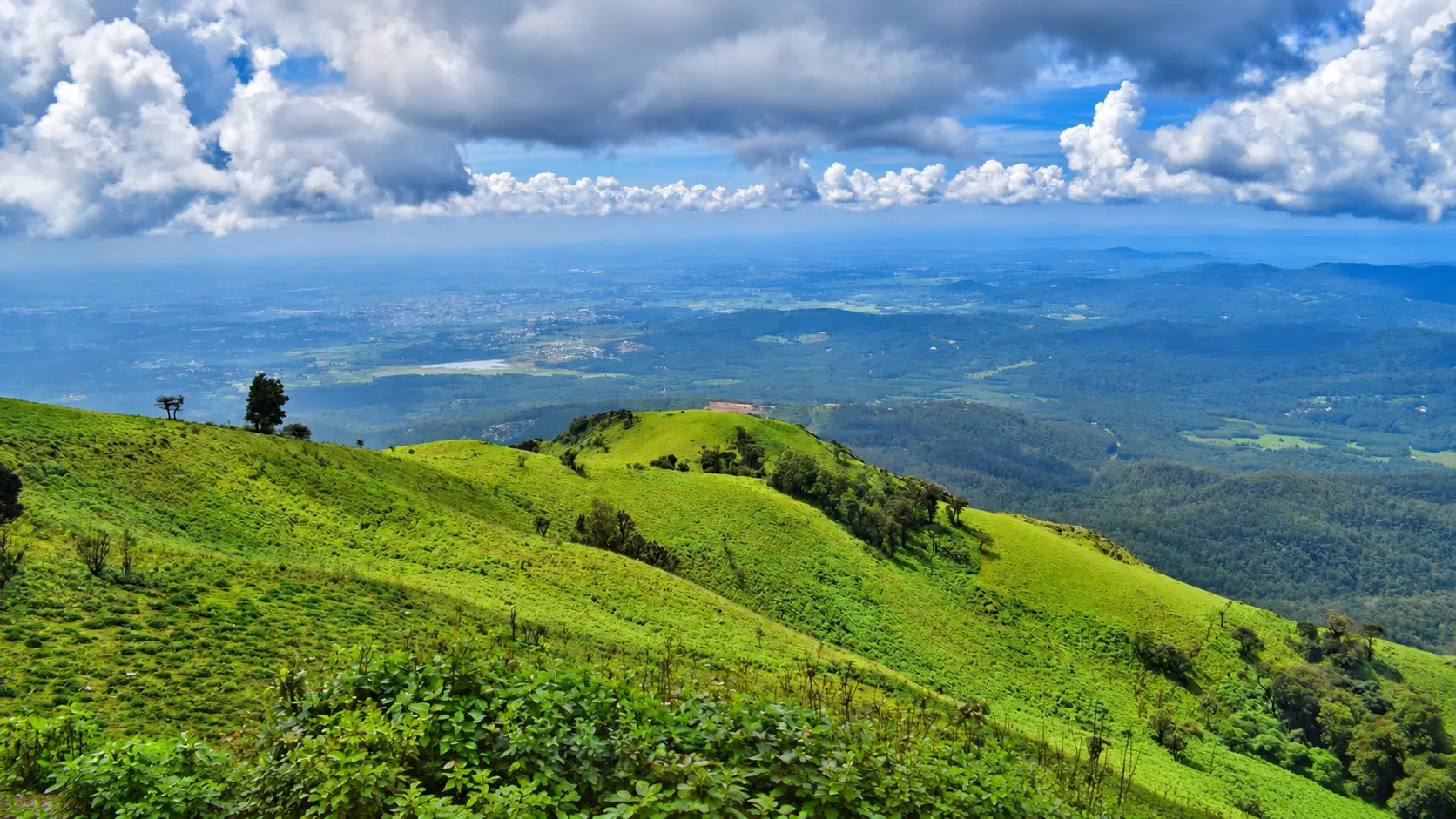
For nature lovers and hikers, Baba Budangiri is an alpine wonderland. The mountain is cloaked in the classic Western Ghats shola-grassland mosaic: undulating, wind-buffeted montane grasslands on the high ridges juxtaposed with dense, stunted evergreen rainforests tucked into sheltered valleys. Here, you can stand beside the sacred, fern-shrouded cascade of Manikyadhara Falls, gaze across the pristine mountain tarn of Galikere (Windy Lake) perched on the ridge at 1,750 meters, or tackle the legendary Mullayanagiri-Bababudangiri Ridge Trek along a knife-edge crest suspended between sweeping valleys. Once every twelve years, the slopes witness the mass flowering of the rare Neelakurinji (Strobilanthes kunthiana), painting the entire crescent range in a breathtaking sea of purplish-blue blossoms.
What to expect
Visiting Baba Budangiri is a dynamic mountain expedition that combines an exhilarating, winding drive through…Explore detailsClose details
Visiting Baba Budangiri is a dynamic mountain expedition that combines an exhilarating, winding drive through thick coffee estates, a walk into a sacred subterranean cave, and dramatic ridge-top explorations of high-altitude waterfalls and glacial tarns.
+----------------------------------------------------------------------------------------------------+
|                                    BABA BUDANGIRI RANGE PRECINCT MAP                               |
|                                                                                                    |
|                                  [North: Galikere (Windy Lake: 1,750 m)]                           |
|                                  (Serene Mountain Tarn on Windswept Ridge)                         |
|                                                  |                                                 |
|                                                  v                                                 |
|  ============================== [BABA BUDANGIRI SUMMIT (1,895 M)] ================================ |
|  - Panoramic 360-degree viewpoints over Bhadra Wildlife Sanctuary and Bababudan Range.             |
|                                                  |                                                 |
|                   +------------------------------+------------------------------+                  |
|                   |                                                             |                  |
|         +---------+---------+                                         +---------+---------+        |
|         | SRI GURU DATTATREYA|                                         | MANIKYADHARA      |        |
|         | BABABUDAN SWAMY   |                                         | WATERFALLS        |        |
|         | CAVE SHRINE       |                                         | (Sacred Cascades &|        |
|         | (Rock Cavern &    |                                         |  Stepped Path)    |        |
|         |  Nanda Deepa)     |                                         +---------+---------+        |
|         +---------+---------+                                                   |                  |
|                   |                                                             |                  |
|                   +------------------------------+------------------------------+                  |
|                                                  |                                                 |
|                                                  v                                                 |
|  ============================== [ATTIGUNDI JUNCTION (COFFEE VILLAGE)] ============================ |
|  - Roadside spice stalls, fresh plantation coffee cafes, local eatery stops.                       |
|                                                  |                                                 |
|                   +------------------------------+------------------------------+                  |
|                   |                                                             |                  |
|         +---------+---------+                                         +---------+---------+        |
|         | MULLAYANAGIRI     |                                         | KAIMARA CHECKPOST |        |
|         | TURN-OFF (12 KM)  |                                         | (Ghat Road Base)  |        |
|         | (Highest Peak:    |                                         +---------+---------+        |
|         |  1,930 m)         |                                                   |                  |
|         +---------+---------+                                                   v                  |
|                                                                       [Chikkamagaluru: 30 km South]|
+----------------------------------------------------------------------------------------------------+
The Scenic Ascent: From Coffee Estates to Montane Grasslands
The road from Chikkamagaluru town to Baba Budangiri covers approximately 30 kilometers of dramatic altitude gain, climbing from the 1,000-meter plateau of the town to nearly 1,900 meters at the mountain summit. Passing through the village of Kaimara, the road ascends through steep, curving switchbacks flanked by some of India's oldest and most prestigious shade-grown coffee estates. Towering silver oaks, wild ficus, and rosewood trees form an unbroken emerald canopy overhead, their trunks wrapped in pepper vines and wild orchids.
Around the intermediate village of Attigundi, the dense rainforest canopy begins to thin. Suddenly, the landscape breaks open into an expansive, cinematic world of rolling emerald-green grasslands and jagged volcanic rock outcrops. Here, the temperature drops noticeably, often by 6°C to 10°C compared to the town below. Dense banks of white mountain fog frequently drift across the tarmac, engulfing the road in swirling highland mist and giving the landscape a surreal, Scottish-highland atmosphere.
Sri Guru Dattatreya Bababudan Swamy Cave Shrine
Located along the southern face of the mountain, the spiritual center of Baba Budangiri is the Sri Guru Dattatreya Bababudan Swamy Dargah / Peetha. Visitors alight at the main roadhead parking apron and walk down a paved stone pathway flanked by small stalls selling fragrant agarbattis, flowers, and holy thread.
The shrine itself is housed entirely within a natural subterranean rock-cut cave. Stepping inside requires removing your shoes and lowering your head beneath the low, dripping stone lintel. The atmosphere inside is intensely serene, lit by flickering brass oil lamps and surrounded by ancient rock walls polished smooth by centuries of reverence. Within the cavern lie the sacred turbats (graves) of Sufi saints and the consecrated padukas (sacred footprints) of Lord Dattatreya, alongside the perpetually burning Nanda Deepa (eternal lamp). Devotees of all faiths - Hindus, Muslims, Sikhs, and Christians - stand side-by-side in quiet prayer, tying sacred protective threads to the iron grilles and receiving holy ash (vibhuti) or blessed water from the custodians.
Manikyadhara Falls (The Stream of Pearls)
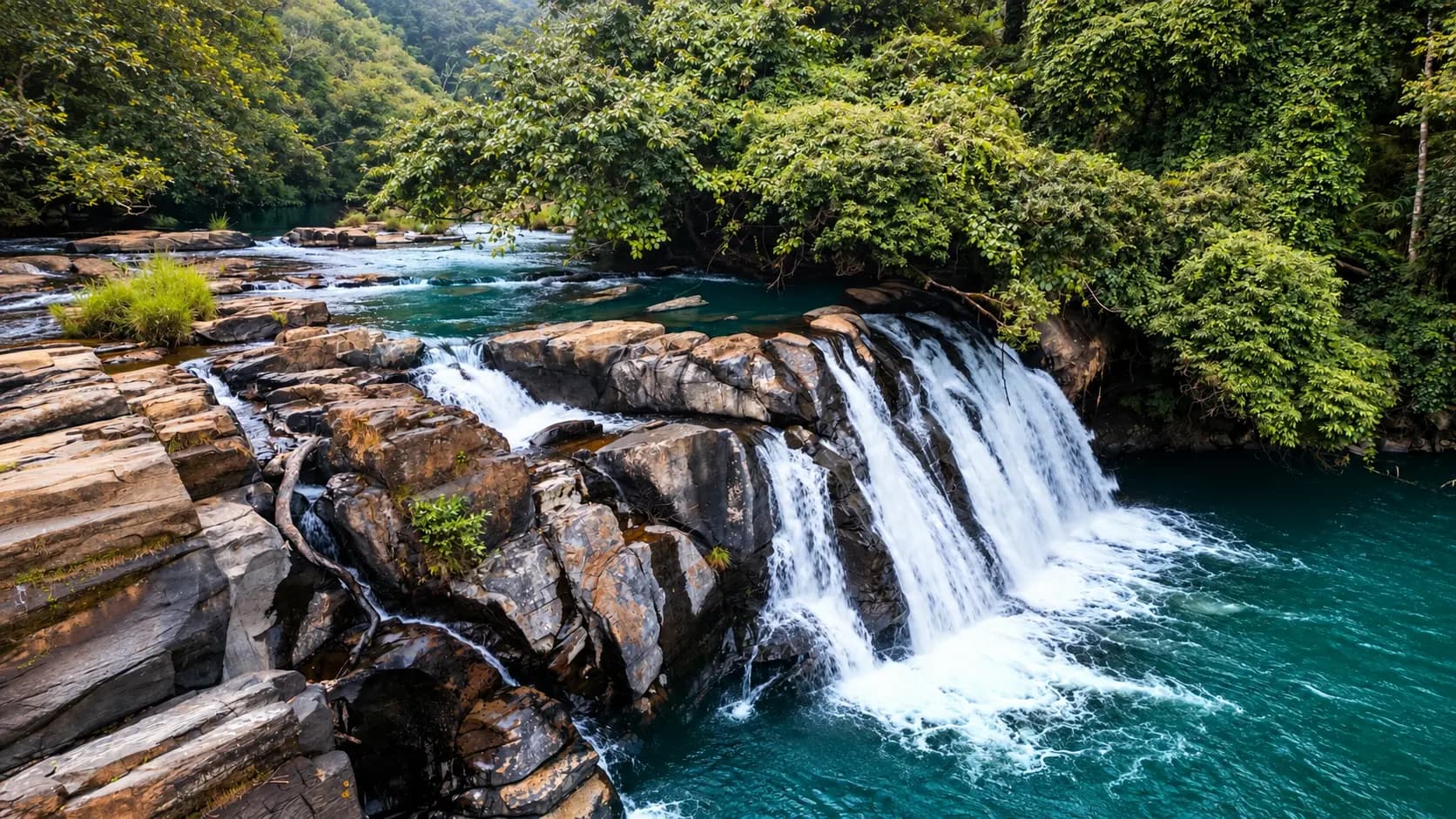
Located approximately 7 kilometers past the main cave shrine along a winding ridge road lies Manikyadhara Falls (meaning "Stream of Pearls"). Perched at an altitude of approximately 1,700 meters, this picturesque waterfall does not plunge in a violent flood, but rather cascades in delicate, crystal-clear droplets down a 10-meter vertical cliff face covered in lush mosses and delicate maidenhair ferns.
Visitors descend approximately 150 concrete steps fitted with railings to reach the bottom of the gorge. The water originates from high-altitude subterranean springs within the shola roots and remains icy cold throughout the year, even during the peak of summer. Local folklore recounts that when Sufi saint Baba Budan and his disciples were traveling through these arid heights without water, the saint prayed for divine relief, striking the mountain with his staff, upon which a spring of pearl-like water burst forth from the rock. Pilgrims bathe beneath the freezing mountain stream, believing the mineral-rich waters cure skin conditions and purify the spirit.
Galikere (Windy Lake)
For travelers seeking raw, untouched wilderness, a side road past the shrine leads toward Galikere ("Windy Lake"). Nestled at an elevation of approximately 1,750 meters on the exposed mountain saddle, Galikere is a natural high-altitude lake framed on one side by towering granite crags and on the other by an abrupt, vertigo-inducing cliff face dropping over a thousand meters into the plains of the Bhadra valley.
Buffeted by perpetual, roaring mountain gales that sweep across the Western Ghats from the Arabian Sea, the surface of Galikere is constantly rippled with silver waves. The grassy shores of the lake are devoid of large trees due to the fierce winds, creating a stark, breathtaking alpine setting. At sunset, the waters reflect the blazing orange and purple colors of the sky, offering one of the most photogenic vantage points anywhere in Karnataka.
The Shola-Grassland Ecosystem and the Neelakurinji Phenomenon
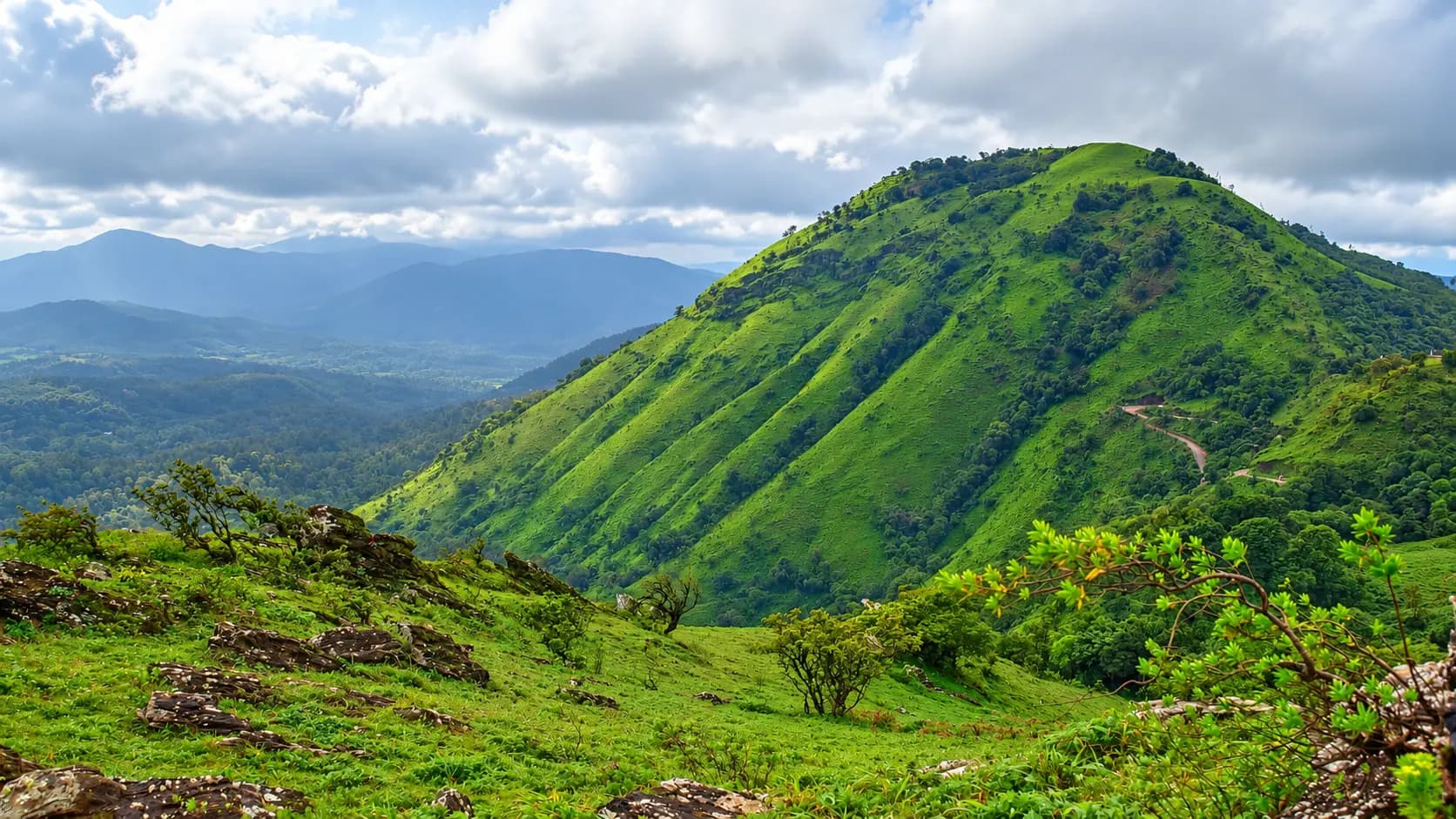
The upper slopes of the Baba Budangiri range represent a fragile and globally significant ecological treasure: the Southern Western Ghats Montane Rain Forests. The vegetation is an ancient natural mosaic of stunted shola forests - dense pockets of dwarf evergreen trees with twisted, moss-draped branches - sheltered within the moist ravines and valleys, bordered by vast undulating sweeps of montane grasslands.
Every twelve years, these grasslands undergo an astonishing transformation during the mass flowering of the Neelakurinji (Strobilanthes kunthiana). When the biological clock of this monocarpic shrub triggers synchronized flowering, millions of tubular blossoms open simultaneously, transforming the entire green mountain range into an ethereal, purplish-blue tapestry that draws botanists and nature lovers from around the globe.
Best time to visit
Because Baba Budangiri sits nearly 1,900 meters above sea level, its climate is cool and temperate throughout the…Explore detailsClose details
Seasonal Weather Patterns
Because Baba Budangiri sits nearly 1,900 meters above sea level, its climate is cool and temperate throughout the year, with distinct seasonal moods:
+----------------------------------------------------------------------------------------------------+
|                                    SEASONAL VISITING CLIMATE & ROAD GUIDE                          |
|                                                                                                    |
|  [SEPTEMBER TO MARCH: THE GOLDEN POST-MONSOON & WINTER WINDOW (RECOMMENDED)]                       |
|  - Temperatures: 12°C to 24°C. Crisp, chilly mornings; brilliant sunny afternoons; clear skies.    |
|  - Experience: Absolute best period for panoramic ridge views, Galikere lake visits, and trekking.|
|  - Tip: Carry a windproof jacket or fleece; mountain winds are strong and biting.                  |
|                                                                                                    |
|  [APRIL TO MAY: PLEASANT SUMMER ESCAPE]                                                            |
|  - Temperatures: 18°C to 28°C. Pleasant mountain breeze; warm mid-day sun; clear roads.            |
|  - Experience: Excellent refuge from the heat of the plains; waterfalls have reduced flow.         |
|  - Tip: Visit the cave shrine and Manikyadhara before 11:30 AM to avoid direct noon sun.           |
|                                                                                                    |
|  [JUNE TO AUGUST: DRAMATIC MONSOON MISTS & ROARING CASCADES]                                       |
|  - Temperatures: 15°C to 20°C. Torrential rains, heavy cloud cover, perpetual mist, high winds.    |
|  - Experience: The mountains turn intensely green; waterfalls thunder; cloud beds swirl everywhere.|
|  - Caution: Road visibility often drops to 5 meters; slippery rocks; monsoon fog driving skills req.|
+----------------------------------------------------------------------------------------------------+
Ideal Time of Day
To maximize your experience, begin your drive from Chikkamagaluru by 07:30 AM. The morning drive through the coffee valleys is crisp and fragrant, allowing you to reach Baba Budangiri by 08:30 AM before the mid-day tour buses arrive. Exploring the cave shrine, walking down to Manikyadhara Falls, and driving up to Galikere takes approximately three to four hours, allowing you to return to Attigundi or Kaimara for a relaxed plantation lunch by 13:00.
How to reach
Baba Budangiri is located 30 kilometers north of Chikkamagaluru town, accessible via a well-engineered mountain…Explore detailsClose details
Baba Budangiri is located 30 kilometers north of Chikkamagaluru town, accessible via a well-engineered mountain road that traverses the heart of the Western Ghats.
+----------------------------------------------------------------------------------------------------+
|                                      REGIONAL TRANSIT CONNECTIONS                                  |
|                                                                                                    |
|  [Mangaluru International Airport (IXE): 180 km SW] <--- Charmadi Ghat & NH-73 (approx. 4.5 hrs)   |
|  [Kempegowda Int'l Airport (BLR): 275 km E]         <--- NH-75 & NH-373 (approx. 5.5 hrs)         |
|                                                                                                    |
|                                                  |                                                 |
|                                                  v                                                 |
|  ============================== [CHIKKAMAGALURU TOWN / CENTRAL BUS STAND] ========================= |
|  - Central Malnad transport hub; hotels, homestays, vehicle rentals, and KSRTC depot.              |
|  - Direct express buses from Bengaluru (Majestic/Satellite), Mysuru, and Mangaluru.                |
|                                                  |                                                 |
|                                                  v                                                 |
|  ============================== [KAIMARA CHECKPOST (10 KM NORTH)] ================================= |
|  - Base junction: Straight to Baba Budangiri; left branch ascends toward Mullayanagiri.            |
|                                                  |                                                 |
|                                                  v                                                 |
|  ============================== [ATTIGUNDI COFFEE VILLAGE (22 KM NORTH)] ========================== |
|  - Mountain junction village; roadside cafes, local homestays, and spice shops.                    |
|                                                  |                                                 |
|                                                  v                                                 |
|  ============================== [BABA BUDANGIRI SHRINE & MANIKYADHARA (30 KM)] ==================== |
|  - Roadhead parking, cave shrine entry, Manikyadhara Falls & Galikere access road.                |
+----------------------------------------------------------------------------------------------------+
By Road: Driving from Chikkamagaluru (30 km)
From central Chikkamagaluru town (MG Road or KSRTC Bus Stand), take the northern highway toward Kaimara (10 km). At the Kaimara junction checkpost, continue straight along the paved mountain road heading toward Attigundi. After 12 kilometers of climbing through coffee estates, you reach Attigundi village; follow the signs branching right toward Baba Budangiri for the final 8 kilometers of ridge driving. Total driving time is approximately 60 to 75 minutes:
- Vehicle Advice: The road is paved throughout, but the upper stretches beyond Attigundi feature narrow sections, steep hairpin curves, and occasional potholes after the monsoon. Hatchbacks, sedans, SUVs, and motorcycles can make the journey comfortably. Drive in low gears, sound your horn around blind curves, and yield right-of-way to ascending vehicles.
- By Hired Taxi / 4x4 Jeep: Confirm the current charge and what it includes with the operator or service provider. Visitor admission, vehicles, parking, activities and accommodation can have separate charges.
By Public Bus (KSRTC)
KSRTC operates regular scheduled mountain buses departing from the Chikkamagaluru Central Bus Stand to Baba Budangiri via Kaimara and Attigundi, running several times daily between 07:00 AM and 16:30. These buses offer an authentic, scenic, and highly affordable travel option for backpackers and solo travelers.
Nearest Railway Stations
- Chikkamagaluru Railway Station (CMGR): Located 32 km south of the mountain, operating daily passenger and express services connecting to Kadur and Shivamogga.
- Kadur Junction (DRU): Located 70 km east along the national highway. Kadur is a major rail junction on the Bengaluru-Hubballi-Goa trunk line, with dozens of daily superfast trains (including the Jan Shatabdi, Rani Chennamma Express, and Siddhaganga Express) connecting directly to Bengaluru (approx. 3.5 hours). Taxis and express buses connect Kadur to Chikkamagaluru around the clock.
- Birur Junction (RRB): Located 75 km northeast, another major rail junction serving express trains from northern Karnataka and Maharashtra.
Nearest Airports
- Mangaluru International Airport (IXE): Located approximately 180 km southwest. The drive traverses the dramatic Charmadi Ghat or Shiradi Ghat, taking roughly 4.5 hours by taxi.
- Kempegowda International Airport Bengaluru (BLR): Located 275 km east. Taxis and KSRTC luxury buses travel via the high-speed NH-75 expressway past Kunigal, Channarayapatna, and Hassan, reaching Chikkamagaluru in roughly 5 to 5.5 hours.
Entry, timings and permissions
Fees, visiting hours and entry rules may change.Explore detailsClose details
Fees, visiting hours and entry rules may change. Confirm the latest details with the official operator or local authority before travelling.
Baba Budangiri is administered collaboratively by the District Administration of Chikkamagaluru, the Karnataka Forest Department, and the State Muzrai / Endowments Department.
+----------------------------------------------------------------------------------------------------+
|                                    ADMISSION AND TIMINGS SUMMARY                                   |
|                                                                                                    |
|  [OPERATING HOURS]                                                                                 |
|  - Mountain Road Access: Daily 06:00 AM to 18:00 (6:00 PM).                                         |
|  - Cave Shrine Darshan: Daily 08:00 AM to 18:00 (6:00 PM).                                         |
|  - Manikyadhara Falls: Daily 06:00 AM to 18:00 (6:00 PM).                                          |
|                                                                                                    |
|  [ENTRANCE TARIFFS]                                                                                |
|  - Mountain & Cave Shrine Admission: COMPLETELY FREE.                                              |
|  - Manikyadhara Falls Entry: COMPLETELY FREE.                                                      |
|                                                                                                    |
|  [VEHICULAR PARKING CHARGES]                                                                       |
|  - Four-Wheelers (Cars, Jeeps, SUVs): Approx. ₹50 per vehicle.                                     |
|  - Two-Wheelers (Motorcycles, Scooters): Approx. ₹20 per vehicle.                                  |
|                                                                                                    |
|  [REGULATORY RESTRICTIONS]                                                                         |
|  - Night Driving & Camping: Strictly barred after 18:00 without explicit Forest Dept permits.      |
|  - Attire Protocol: Modest clothing required inside the rock-cut cave shrine; footwear removed.   |
|  - Prohibited Items: Alcohol, firearms, loud sound systems, and single-use plastics.               |
|  - Drone Flights: Strictly prohibited across the shrine precinct and reserve forest.              |
+----------------------------------------------------------------------------------------------------+
Cave Shrine Protocols and Reverence
Because the Sri Guru Dattatreya Bababudan Swamy Cave Shrine is a deeply revered sacred site for multiple religious communities, visitors must observe strict decorum:
- Remove all footwear and leave your shoes at the designated shoe stand outside the cave entrance before stepping into the rock sanctuary.
- Dress modestly with shoulders and knees covered. Avoid beachwear, short shorts, or sleeveless tank tops.
- Maintain silence and respect within the cavern; photography inside the sanctum is strictly prohibited to preserve the solemn atmosphere of prayer and meditation.
Environmental Conservation and Night Curfew
The mountain is an ecologically fragile habitat bordering the Bhadra Tiger Reserve and high-altitude reserve forests:
- No Plastic Littering: Carry all plastic wrappers, empty water bottles, and snack bags back down the mountain. Do not discard trash into the valleys or streams.
- Night Curfew Enforcement: The police checkpost at Kaimara monitors traffic. Vehicles are not permitted to ascend toward Baba Budangiri after 17:00 unless they are local residents or have official guest house bookings. Unregulated camping, setting up tents on the open ridges, and lighting bonfires are strictly prohibited by the Forest Department to prevent forest fires and human-wildlife conflict.
Nearby places to consider
The Chandra Drona mountain range and the surrounding valleys of Chikkamagaluru are packed with record-setting…Explore detailsClose details
The Chandra Drona mountain range and the surrounding valleys of Chikkamagaluru are packed with record-setting peaks, historic coffee estates, wildlife sanctuaries, and cascading waterfalls.
+----------------------------------------------------------------------------------------------------+
|                                    NEARBY DESTINATIONS NETWORK                                     |
|                                                                                                    |
|  [Bhadra Wildlife Sanctuary: 35 km Northwest]    [Kemmangundi Hill Station: 35 km North]           |
|  (Tiger Reserve, River Safaris, Teak Forests)    (Z Point, Rose Gardens, Hebbe Falls Excursions)   |
|         ^                                              ^                                           |
|          \                                            /                                            |
|           \                                          /                                             |
|  ================== [BABA BUDANGIRI: 1,895 M COFFEE ORIGIN CRESCENT] ============================== |
|           /                                          \                                             |
|          /                                            \                                            |
|         v                                              v                                           |
|  [Mullayanagiri Peak: 15 km Southwest]           [Chikkamagaluru Town: 30 km South]                |
|  (1,930 m Highest Peak in Karnataka)             (Coffee Museum, Historic Temples, Malnad Dining)  |
+----------------------------------------------------------------------------------------------------+
Mullayanagiri Peak (15 km Southwest)
Rising to a magnificent height of 1,930 meters (6,332 feet), Mullayanagiri is the highest mountain summit in the state of Karnataka. Located just a short drive across the ridge via Attigundi and Kaimara, the peak is crowned by an ancient stone temple dedicated to the sage Mullappa Swamy. Visitors ascend approximately 500 stone steps along a narrow, windswept ridge to stand on the roof of Karnataka, enjoying exhilarating 360-degree views extending to the Arabian Sea on clear days.
Kemmangundi Hill Station (35 km North)
Located further north in the Tarikere Taluk, Kemmangundi (elevation 1,434 m) was the favored summer retreat of Maharaja Krishnaraja Wadiyar IV, who donated his royal lodge to the Government of Karnataka. Celebrated for its tranquil rose gardens, pine forests, and the dramatic precipice of Z Point, Kemmangundi is also the staging ground for challenging treks to the spectacular Hebbe Falls (where water plunges 168 meters down two stages) and Kalhatti Falls.
Bhadra Wildlife Sanctuary & Tiger Reserve (35 km Northwest)
Sprawling across the lower western and northern valleys of the Bababudan range, the Bhadra Wildlife Sanctuary is a pristine Project Tiger reserve encompassing over 490 square kilometers of dense moist-deciduous and semi-evergreen forests. The sanctuary is home to healthy populations of Bengal tigers, Indian leopards, wild elephants, gaur (Indian bison), sambar deer, and over 300 bird species. Boat safaris on the vast Bhadra Reservoir offer exceptional wildlife photography opportunities.
Chikkamagaluru Town & The Coffee Museum (30 km South)
The bustling district headquarters at the base of the hills, Chikkamagaluru is the nerve center of India's coffee trade. A key highlight in town is the Coffee Museum, administered by the Coffee Board of India, which takes visitors through interactive exhibitions tracing the botanical science, global history, roasting techniques, and socioeconomic legacy of Indian coffee cultivation.
In pictures
The practical bits
Before you go.
Plan ahead
A well-structured itinerary ensures that you experience the full spectrum of Baba Budangiri's historical…Explore detailsClose details
A well-structured itinerary ensures that you experience the full spectrum of Baba Budangiri's historical mystique, sacred caves, and alpine vistas while avoiding unpredictable mountain weather.
Dress in Warm, Removable Layers
Mountain temperatures at 1,895 meters can change rapidly.Explore detailsClose details
Mountain temperatures at 1,895 meters can change rapidly. Early mornings and late afternoons are chilly and windy (often dropping to 12°C in winter), while mid-day sun on the exposed ridges can be intense. Dress in comfortable layers - a light windproof jacket or sweater over breathable cotton clothing is ideal.
Wear Sturdy Hiking Shoes with Deep Treads
Exploring the full area involves walking down stone steps to the cave shrine, descending the 150 concrete steps…Explore detailsClose details
Exploring the full area involves walking down stone steps to the cave shrine, descending the 150 concrete steps to Manikyadhara Falls, and walking along rocky cliff edges at Galikere. Sturdy trekking shoes or sneakers with reliable rubber grip protect against slippery rocks and loose gravel.
Carry Cash for Parking and Refreshments
Mobile internet connectivity can be intermittent or nonexistent along the higher stretches of the Baba Budangiri…Explore detailsClose details
Mobile internet connectivity can be intermittent or nonexistent along the higher stretches of the Baba Budangiri range. Confirm the current charge and what it includes with the operator or service provider. Visitor admission, vehicles, parking, activities and accommodation can have separate charges.
Sample Freshly Brewed Arabica at Attigundi
Do not miss the opportunity to stop at one of the rustic coffee shacks in Attigundi village on your way up or down.Explore detailsClose details
Do not miss the opportunity to stop at one of the rustic coffee shacks in Attigundi village on your way up or down. Savor a cup of authentic, freshly ground filter coffee made from beans grown right on the surrounding slopes, accompanied by hot steamed corn or piping-hot onion pakodas.
Combine with Mullayanagiri Peak
Since both peaks lie on the same mountain massif, you can easily combine Baba Budangiri with Mullayanagiri (1,930…Explore detailsClose details
Since both peaks lie on the same mountain massif, you can easily combine Baba Budangiri with Mullayanagiri (1,930 m), the highest summit in Karnataka. Start early at Mullayanagiri for sunrise, then drive 40 minutes along the scenic ridge road past Attigundi to explore Baba Budangiri by late morning.
+----------------------------------------------------------------------------------------------------+
|                                  SUGGESTED COMBINED DAY ITINERARY: CHIKMAGALUR HIGHLANDS           |
|                                                                                                    |
|  06:00 AM to 07:30 AM  -  Early Morning Drive & Mullayanagiri Sunrise                                |
|  - Depart Chikkamagaluru; ascend through Kaimara to Mullayanagiri peak (1,930 m).                  |
|  - Climb the 500 stone steps to the summit temple; watch the sunrise illuminate the valleys.       |
|                                                                                                    |
|  08:00 AM to 08:45 AM  -  Ridge Drive to Attigundi & Breakfast                                       |
|  - Descend to Attigundi village; enjoy fresh piping-hot idlis, dosas, and estate-brewed coffee.    |
|                                                                                                    |
|  09:00 AM to 10:30 AM  -  Sri Guru Dattatreya Bababudan Swamy Cave Shrine                           |
|  - Arrive at Baba Budangiri; deposit footwear; enter the cool subterranean rock-cut cavern.        |
|  - Learn about Baba Budan's 1670 CE coffee planting and witness the syncretic shrine.              |
|                                                                                                    |
|  10:45 AM to 12:15 PM  -  Manikyadhara Falls & Galikere Exploration                                 |
|  - Drive 7 km along the ridge to Manikyadhara; descend 150 steps to the sacred pearl cascade.      |
|  - Continue to Galikere (Windy Lake); admire the alpine tarn and sweeping Bhadra valley views.     |
|                                                                                                    |
|  12:45 PM to 02:00 PM  -  Traditional Malnad Plantation Lunch                                        |
|  - Dine at a mountain cafe or homestay: enjoy spiced Malnad thali with bamboo shoot curry or chicken|
|                                                                                                    |
|  02:30 PM to 04:30 PM  -  Coffee Estate Walking Tour                                                 |
|  - Tour a working coffee plantation near Kaimara; learn the nuances of pulping, drying, & roasting.|
|  - Shop for whole-bean Arabica, freshly ground chicory blends, and black pepper before descending. |
+----------------------------------------------------------------------------------------------------+
A few things you might wonder
Common questions about visiting Baba Budangiri. Fees, visiting hours and ceremonies are researched details that may change; confirm current arrangements with the operator before travelling.
Why is Baba Budangiri called the birthplace of coffee in India?
What is the religious significance of the cave shrine?
What is Manikyadhara Falls and how far is it from the shrine?
What are the opening timings and entry fees for Baba Budangiri?
Can visitors drive regular cars all the way to Baba Budangiri?
How far is Baba Budangiri from Mullayanagiri Peak?
What is the Neelakurinji phenomenon at Baba Budangiri?
Is night camping allowed on Baba Budangiri?
Explore more in Coorg Chikmagalur
Discover other destinations around this hub
More Hubs in Karnataka
Continue exploring other travel hubs in this state
Planning a trip to Coorg Chikmagalur?