Mysore Palace
Comprehensive visitor guide to Mysore Palace (Amba Vilas) in Mysuru. Details on Indo-Saracenic architecture, Golden Howdah, Kalyana Mantapa, illumination hours, and tickets.
Location
Bengaluru Mysuru, Karnataka
A closer look
Your visit, at a glance.
Bengaluru Mysuru, Karnataka
GET TO KNOW THE PLACE
Rising majestically at the epicenter of Karnataka's royal heritage city, Mysore Palace (officially designated as Amba Vilas Palace) is one of the most magnificent and…
The story of Mysore Palace
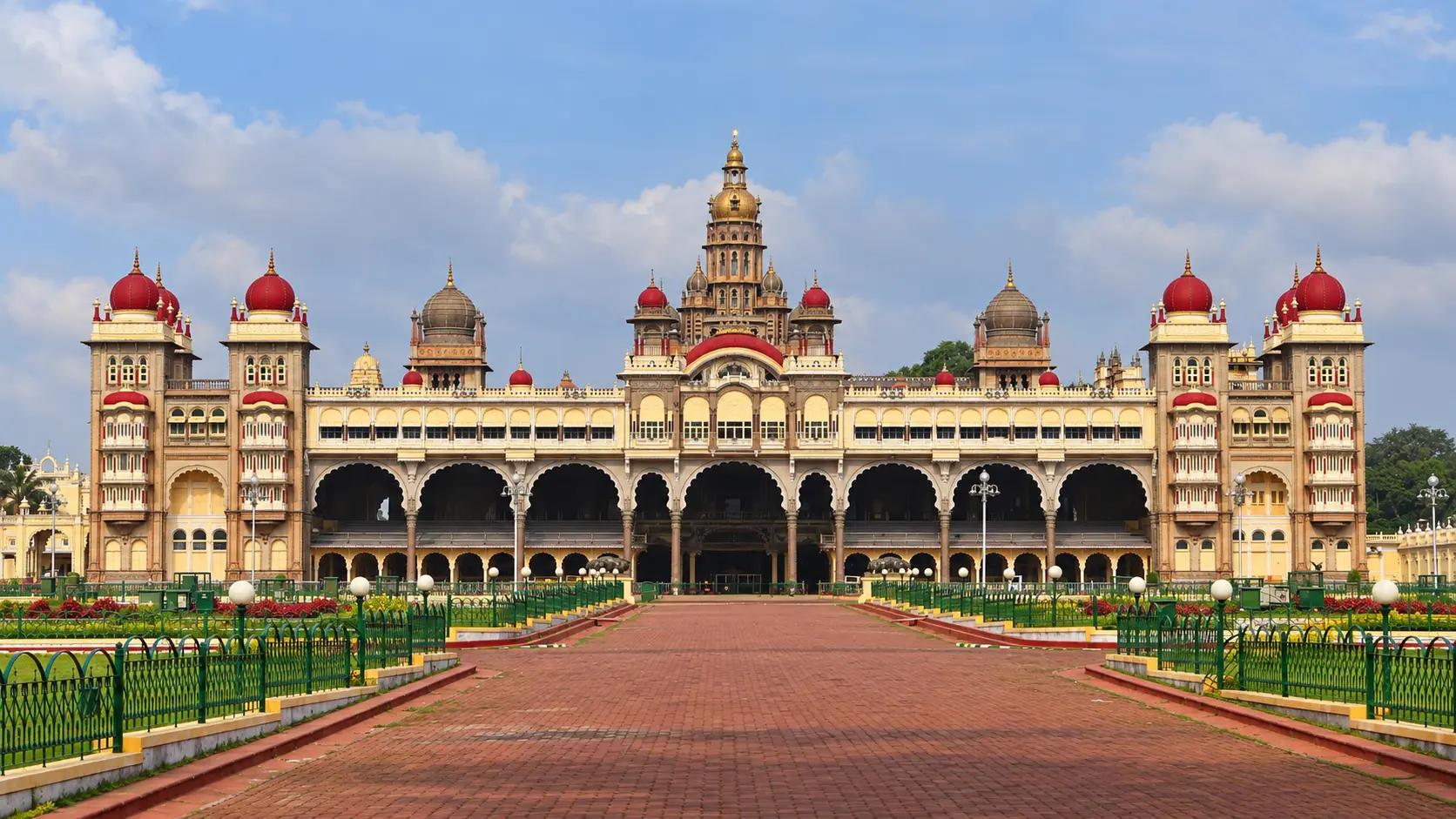
Rising majestically at the epicenter of Karnataka's royal heritage city, Mysore Palace (officially designated as Amba Vilas Palace) is one of the most magnificent and historically significant royal citadels in Asia. Situated within the Mysuru Urban Taluk of Mysuru District at an elevation of 763 meters (2,503 feet) above mean sea level on the Southern Deccan Plateau, the palace served as the official seat and royal residence of the Wadiyar Dynasty from the 14th century until the accession of princely states to the Indian Union. Reconstructed in fine grey granite and pink marble between 1897 and 1912 following a catastrophic fire, this Indo-Saracenic marvel blends Hindu, Rajput, Islamic, and Gothic architectural styles into a palatial sanctuary celebrated worldwide for its stained-glass pavilions, ivory-inlaid rosewood doors, solid gold elephant howdah, and nocturnal illuminations.
Start here. Open a tile for the full details.
Why goRead details
Mysore Palace - officially designated as Amba Vilas Palace - is one of the most celebrated royal residences on the Indian subcontinent, drawing millions of travelers, architectural scholars, and heritage enthusiasts from across the globe each year. Positioned at the geographic and cultural heart of Mysuru city in southern Karnataka, this monumental citadel stands as the timeless seat of the Wadiyar Dynasty, a regal lineage that governed the Kingdom of Mysore for over five and a half centuries (from 1399 to 1950). The palace represents the absolute zenith of the Indo-Saracenic architectural movement, a breathtaking stylistic synthesis that seamlessly melds Hindu sculptural motifs, Rajput ceremonial verve, Mughal/Islamic domes and cusped arches, and Gothic revival iron-and-glass engineering into a harmonious, awe-inspiring stone masterpiece.
When to visitRead details
Every evening of Dasara, the palace is illuminated by its nearly 100,000 light bulbs from 19:00 to 22:00 (rather than the usual 45-minute Sunday schedule), casting a golden reflection visible from miles away atop Chamundi Hill. On the final tenth day (Vijayadashami), the legendary Jamboo Savari procession departs from the palace courtyard, featuring caparisoned elephants, royal cavalry, folk dancers, brass bands, and elaborate cultural floats depicting Karnataka's rich heritage. Travelers planning to visit during Dasara must book accommodations and transportation months in advance, as Mysuru welcomes hundreds of thousands of domestic and international visitors during this period.
Entry & permissionsRead details
Fees, visiting hours and entry rules may change. Confirm the latest details with the official operator or local authority before travelling.
Operating guidelines, ticketing protocols, and behavioral rules at Mysore Palace are strictly managed by the Mysore Palace Board under the oversight of the District Administration of Mysuru. Adhering to these regulations ensures a smooth, respectful, and hassle-free visit.
+----------------------------------------------------------------------------------------------------+
|                                    ADMISSION AND TIMINGS SUMMARY                                   |
|                                                                                                    |
|  [DAYTIME PALACE INTERIOR TOURS]                                                                   |
|  - Operating Hours: Daily 10:00 AM to 17:30 (5:30 PM).                                             |
|  - Ticket Counter Closing: Promptly at 17:00 (5:00 PM).                                            |
|  - Adult Admission (Indian Citizens): ₹100 per person.                                             |
|  - Children Admission (Aged 10 to 18 years): ₹50 per person.                                       |
|  - Children Below 10 Years: Free admission.                                                        |
|  - Foreign Tourist Admission: ₹1,000 per person (includes automated multilingual audio guide).     |
|  - Audio Guide Kit (Domestic Visitors): ₹100 (available in English, Hindi, Kannada, etc.).       |
|                                                                                                    |
|  [WEEKEND & HOLIDAY EXTERIOR ILLUMINATION]                                                         |
|  - Schedule: All Sundays, National Holidays & State Festivals.                                     |
|  - Illumination Timings: 19:00 to 19:45 or 20:00 (Daily 19:00 to 22:00 during 10-day Dasara).      |
|  - Illumination Fee: Free viewing from palace perimeter grounds / outer gardens.                  |
|                                                                                                    |
|  [SOUND AND LIGHT SHOW (SON-ET-LUMIÈRE)]                                                           |
|  - Days: Monday through Saturday evenings (except Sundays and state holidays).                     |
|  - Kannada Program: Mon - Wed (19:00 - 20:00), Sat (20:15 - 21:15).                                      |
|  - English Program: Thu - Sat (19:00 - 20:00).                                                         |
|  - Admission: Approx. ₹100 for adults, ₹40 for children (separate evening ticket required).         |
+----------------------------------------------------------------------------------------------------+
Footwear Custody Protocol
In keeping with traditional royal and spiritual customs, footwear is strictly prohibited inside the main palace interior. Visitors must remove their shoes, sandals, or boots before climbing the entrance stairs to the Gombe Thotti.
- Free Footwear Counters: Official, secure footwear custody counters operated by the Mysore Palace Board are situated immediately outside the entrance near the Varaha Gate. Visitors hand over their footwear, receive a metal token or numbered card, and retrieve their shoes upon exiting.
- Visitor Footwear Advice: While walking barefoot is common, the smooth marble, granite, and tiled floors inside the palace can feel cool in winter mornings and warm in summer afternoons. Wearing clean cotton socks is permitted and highly recommended for comfort and hygiene.
Photography and Videography Regulations
- Strict Interior Prohibition: Photography, video recording, and mobile phone filming are strictly banned inside the main residential palace chambers, durbar halls, and private pavilions. Security guards are stationed in every hall to enforce this rule. Visitors must keep cameras and smartphones tucked inside pockets or bags while touring the interior.
- Exterior Photography: Photography is fully permitted in the outdoor courtyards, landscaped gardens, fort gates, and around the 12 historic fort temples. Capturing photographs of the palace exterior at golden hour or during evening illumination is a cherished visitor highlight.
- Commercial Filming and Drones: Flying drones over Mysore Palace and the fort precinct is strictly banned under national heritage airspace security regulations. Commercial film shoots, professional video production, and tripods require prior written statutory permission and fee clearance from the Mysore Palace Board and the Deputy Commissioner's office.
Luggage, Cloakrooms, and Security Screening
Every visitor must pass through metal detectors and security bag inspection checkpoints at the entrance gates.
- Prohibited Items: Large suitcases, oversized hiking backpacks, sharp objects, scissors, alcohol, tobacco products, cigarettes, lighters, and outside food items are strictly prohibited inside the palace.
- Cloakroom Facilities: A designated luggage cloakroom counter is situated near the Varaha Gate ticket complex where visitors can securely store travel bags and daypacks for a nominal fee before entering the palace interior.
Plan your visitRead details
Mysuru is one of southern India's most accessible heritage cities, situated approximately 140 km southwest of Bengaluru. The palace sits directly in the historical city center on Sayyaji Rao Road, easily reachable via high-speed expressways, electrified rail corridors, and state transit networks.
Explore the full guide - choose a topic below.
Why visit?
Mysore Palace - officially designated as Amba Vilas Palace - is one of the most celebrated royal residences on…Explore detailsClose details
Mysore Palace - officially designated as Amba Vilas Palace - is one of the most celebrated royal residences on the Indian subcontinent, drawing millions of travelers, architectural scholars, and heritage enthusiasts from across the globe each year. Positioned at the geographic and cultural heart of Mysuru city in southern Karnataka, this monumental citadel stands as the timeless seat of the Wadiyar Dynasty, a regal lineage that governed the Kingdom of Mysore for over five and a half centuries (from 1399 to 1950). The palace represents the absolute zenith of the Indo-Saracenic architectural movement, a breathtaking stylistic synthesis that seamlessly melds Hindu sculptural motifs, Rajput ceremonial verve, Mughal/Islamic domes and cusped arches, and Gothic revival iron-and-glass engineering into a harmonious, awe-inspiring stone masterpiece.
Stepping past the monumental stone gates into the expansive palace grounds immediately transports visitors into an era of extraordinary royal patronages, dynastic pageantry, and peerless craftsmanship. Every chamber within the palace reveals a distinctive aesthetic universe. In the world-famous Kalyana Mantapa (Marriage Pavilion), light cascades through a soaring octagonal dome of Glasgow-manufactured stained glass adorned with resplendent peacocks and geometric arabesques, illuminating hand-painted cast-iron pillars cast in Scotland and glazed encaustic ceramic floor tiles imported from England. In the Diwan-i-Khas (Private Durbar Hall), the eyes are treated to an astonishing visual feast of carved teakwood ceilings, doors inlaid with real ivory, Belgian cut-glass chandeliers, and polished Italian marble pillars inlaid with delicate semi-precious stone Pietra Dura flora.
Beyond its interior opulence, Mysore Palace holds immense spiritual and cultural importance as the living epicenter of the grand Mysuru Dasara (Navaratri) festival. For ten days every autumn, the palace courtyard becomes the staging ground for age-old traditions rooted in the victory of Goddess Chamundeshwari over the demon Mahishasura. On the climactic day of Vijayadashami, the world-renowned Jamboo Savari procession commences right from the palace courtyard, where a decorated royal tusker elephant carries the idol of Chamundeshwari mounted upon the legendary 84-kilogram solid gold Golden Howdah (Chinnada Ambari) through the streets of the royal city.
Even outside the festival season, visiting Mysore Palace offers an unforgettable evening spectacle. On every Sunday, national holiday, and special state occasion, dusk brings the magical illumination of the palace facade: precisely 97,000 incandescent electric bulbs flicker to life in unison, outlining every stone dome, chhatri, arch, and balustrade in a blinding golden glow that reflects against the twilight sky. Whether you are mesmerized by the intricate historical armoury, captivated by the original canvas paintings of royal court artist Raja Ravi Varma, or simply marveling at the sheer scale of the three-storied granite palace, Mysore Palace delivers an unforgettable immersion into the living regal soul of Karnataka.
What to expect
Visiting Mysore Palace is an expansive, multi-hour cultural journey across both the palatial royal interior and…Explore detailsClose details
Visiting Mysore Palace is an expansive, multi-hour cultural journey across both the palatial royal interior and the expansive 72-acre fort compound that surrounds it. The entire precinct is enclosed by high stone ramparts and features 12 historic Hindu temples dating from the 14th through the 19th centuries, formal royal courtyards, ornamental lawns, and royal administrative offices. Expect an experience that combines deep historical reverence, meticulous security protocols, and exquisite architectural discovery.
+----------------------------------------------------------------------------------------------------+
|                                  MYSORE PALACE (AMBA VILAS) COMPLEX LAYOUT                         |
|                                                                                                    |
|                                     [North Gate: Balarama Gate]                                    |
|                                                  |                                                 |
|                                        +---------+---------+                                       |
|                                        |  Trineshwara Swamy|                                       |
|                                        |  Temple (1700s)   |                                       |
|                                        +---------+---------+                                       |
|                                                  |                                                 |
|   [West Gate: Amba Vilas] <--- [Expansive Outer Gardens & Parade Grounds] ---> [East: Jayamarthanda|
|                                                  |                               Gate - Royal View]|
|                                        +---------+---------+                                       |
|                                        |    MYSORE PALACE  |                                       |
|                                        |    MAIN EDIFICE   |                                       |
|                                        | (Granite Façade & |                                       |
|                                        | 145-ft Gold Tower)|                                       |
|                                        +---------+---------+                                       |
|                                                  |                                                 |
|                   +------------------------------+------------------------------+                  |
|                   |                              |                              |                  |
|         +---------+---------+          +---------+---------+          +---------+---------+        |
|         |   GOMBE THOTTI    |          |  KALYANA MANTAPA  |          |   DIWAN-I-KHAS    |        |
|         | (Dolls' Pavilion &|          | (Octagonal Stained|          | (Private Durbar & |        |
|         |  Golden Howdah)   |          |    Glass Dome)    |          |  Ivory Inlay)     |        |
|         +---------+---------+          +---------+---------+          +---------+---------+        |
|                   |                              |                              |                  |
|                   +------------------------------+------------------------------+                  |
|                                                  |                                                 |
|                                        +---------+---------+                                       |
|                                        |    DIWAN-I-AAM    |                                       |
|                                        | (Public Durbar &  |                                       |
|                                        | Grand Colonnade)  |                                       |
|                                        +---------+---------+                                       |
|                                                  |                                                 |
|                                        +---------+---------+                                       |
|                                        | Shweta Varahaswamy|                                       |
|                                        | Temple & Cloakroom|                                       |
|                                        +---------+---------+                                       |
|                                                  |                                                 |
|                                     [South Gate: Varaha Gate]                                      |
|                                   (Primary Public Visitor Entry)                                   |
+----------------------------------------------------------------------------------------------------+
The Historical Genesis and the Great 1897 Fire
The story of the current Mysore Palace is one of triumphant resurrection following a devastating catastrophe. For centuries, the royal seat of the Wadiyar kings inside the fort was an intricate, multi-storied wooden palace embellished with carved sandalwood, cedar, and lacquerwork. In February 1897, during the extravagant royal wedding festivities of Princess Jayalakshammanni (the eldest daughter of Maharaja Chamaraja Wadiyar IX), a catastrophic fire broke out inside the wooden structure. Fanned by brisk dry winds, the inferno consumed the ancient wooden palace within hours, reducing priceless heirloom furniture, royal tapestries, and timber pavilions to ashes.
Undeterred by the tragedy, the royal regent, Maharani Kempananjammanni Vani Vilasa Sannidhana (governing on behalf of her young son, Maharaja Krishnaraja Wadiyar IV), resolved to commission a monumental palace that would be entirely fire-resistant, architecturally peerless, and enduringly magnificent. She selected renowned British architect Lord Henry Irwin, who was then serving as consulting architect to the Government of Madras. Irwin had already achieved renown for designing monumental Indo-Saracenic landmarks such as the Madras High Court and the Viceregal Lodge in Shimla.
Construction commenced in October 1897 under the direct on-site supervision of executive royal engineer B.P. Raghavalu Naidu. Masons, stonecutters, ironworkers, and glassmakers were mobilized from across India, Scotland, England, and Italy. Confirm the current charge and what it includes with the operator or service provider. Visitor admission, vehicles, parking, activities and accommodation can have separate charges.
Indo-Saracenic Architectural Marvel
The facade of Mysore Palace is an extraordinary symphony of architectural styles. The building measures 245 feet in length and 156 feet in width, constructed primarily from fine-grained grey granite quarried from local hills around Mysuru. The stone exterior is articulated by rhythmic arcades, pointed Islamic arches, deep projecting eaves (chhajjas), and delicate carved balcony windows (jharokhas) derived from the royal palaces of Rajasthan.
Crowning the structure are dramatic deep pink marble domes quarried from Makrana in Rajasthan, which create a striking visual contrast against the muted grey granite walls. At the center of the eastern facade rises the monumental 145-foot five-story central tower, crowned by a gilded copper dome. Perched atop the summit of this central tower is the majestic sculptured crest of Mysore: the Gandaberunda, a mythical two-headed bird of enormous strength and spiritual vigilance that has served as the royal emblem of the Wadiyar dynasty for centuries and remains the official state seal of Karnataka today.
Gombe Thotti (The Dolls' Pavilion)
Public entry into the palace interior leads visitors first into the Gombe Thotti, or the Dolls' Pavilion. Traditionally used during the annual Dasara festival to display intricate multi-tiered arrangements of handmade clay, wooden, and porcelain figurines depicting Hindu epics and royal court life, this long gallery houses several of the palace’s most treasured artifacts.
Along the pavilion corridors, visitors encounter life-sized European marble statues, ornate brass candelabras, and royal palanquins carved from solid silver and rosewood used by the maharanis during ceremonial processions. At the center of the pavilion rests a magnificent model of the wooden palace as it existed prior to the 1897 fire, offering a haunting glimpse into the lost timber architecture of old Mysore.
Most famously, Gombe Thotti displays the priceless Golden Howdah (Chinnada Ambari). Fabricated from solid wood and encased entirely in 84 kilograms of pure 24-karat gold, this ceremonial elephant saddle is an extraordinary triumph of south Indian metalcraft. Adorned with delicate relief carvings of Goddess Chamundeshwari, celestial nymphs (apsaras), and floral arabesques, the Golden Howdah was originally used by the Maharaja to ride through the city during Dasara. Today, the sacred idol of Chamundeshwari is consecrated upon this very howdah atop the lead elephant during the Jamboo Savari procession.
Kalyana Mantapa (The Octagonal Marriage Pavilion)
Passing beyond the Dolls' Pavilion brings visitors into the most photogenic and awe-inspiring interior space in the entire palace: the Kalyana Mantapa, or Marriage Pavilion. Designed in a dramatic octagonal layout, this soaring ceremonial hall rises through multiple levels to a breathtaking domed ceiling crafted entirely of multi-colored stained glass.
+----------------------------------------------------------------------------------------------------+
|                                    KALYANA MANTAPA CEILING DETAIL                                  |
|                                                                                                    |
|                                      * * * * * * * * * * * *                                       |
|                                  *                             *                                   |
|                              *      GLASGOW STAINED GLASS DOME    *                                |
|                            *       (Brilliant Cobalt Blue, Amber,   *                              |
|                           *         Emerald & Ruby Peacock Glass)    *                             |
|                          *                                            *                            |
|                          *  ||   ||   ||   ||   ||   ||   ||   ||   ||  *                           |
|                          *  ||   ||   ||   ||   ||   ||   ||   ||   ||  *                           |
|                          *   [CAST-IRON STRUCTURAL PILLARS FROM GLASGOW]  *                           |
|                           *                                            *                           |
|                            *      OIL PAINTINGS OF DASARA PROCESSIONS   *                          |
|                              *   (Royal Court Artist K. Venkatappa)   *                            |
|                                  *                             *                                   |
|                                      * * * * * * * * * * * *                                       |
|                                                                                                    |
|                       ======================================================                       |
|                       [GLAZED ENCAUSTIC MINTON FLOOR TILES IMPORTED FROM UK]                       |
|                       ======================================================                       |
+----------------------------------------------------------------------------------------------------+
The stained-glass dome was custom-fabricated by the renowned Walter Macfarlane & Co. Saracen Foundry in Glasgow, Scotland, and shipped to India via maritime freight. The glass panels depict vivid peacock feathers, swirling floral vines, and geometric kaleidoscope stars that refract natural sunlight into dazzling jewel-toned pools of ruby red, emerald green, amber, and cobalt blue across the hall below.
The soaring dome is supported by heavy cast-iron pillars, also cast in Glasgow, embellished with ornate capitals and finished in vibrant turquoise and gold leaf. The floor beneath your bare feet is an intricate mosaic of glazed encaustic ceramic tiles manufactured by the celebrated Minton Pottery in Stoke-on-Trent, England, arranged in geometric peacock and star patterns that have retained their brilliant gloss and color after more than a century of royal footfalls. Around the upper gallery walls of the Kalyana Mantapa hang 26 massive oil canvases painted by renowned royal court artists, depicting the Dasara festivities of the early 20th century with extraordinary photographic realism.
Diwan-i-Khas (Private Durbar Hall / Amba Vilas)
Upstairs on the second level lies the Diwan-i-Khas, the private audience chamber where the Maharaja met with his council of ministers, prime ministers (Diwans), high-ranking nobles, and visiting state dignitaries. Widely considered one of the most opulent royal rooms anywhere in Asia, the Diwan-i-Khas is an overwhelming testament to the lavish artistic vision of Maharaja Krishnaraja Wadiyar IV.
The entrance to the hall features massive rosewood and teakwood double doors richly inlaid with pure ivory in intricate depictions of flora, fauna, and Hindu deities. Inside, the ceiling is a gilded masterpiece of deeply coffered teak panels, accented with gold leaf and suspended Belgian cut-crystal chandeliers that once sparkled under hundreds of candles. The floor is paved with polished white and green Italian marble, while the slender iron and stone colonnades are adorned with delicate Pietra Dura semi-precious stone inlay work executed by master craftsmen brought from Agra - the very descendants of the artisans who decorated the Taj Mahal. Stained-glass clerestory windows along the upper walls filter gentle daylight through the hall, casting an ethereal golden glow over the gilded thrones and silver doors.
Diwan-i-Aam (Public Durbar Hall)
In stark contrast to the intimate, jewel-box atmosphere of the Diwan-i-Khas, the Diwan-i-Aam (Public Durbar Hall) on the eastern wing is a monumental open-air pillared hall measuring approximately 40 meters wide by 100 meters long. Built without interior dividing walls, this expansive hall features an uninterrupted forest of grand cast-iron columns painted in striking shades of turquoise blue, deep red, and shimmering gold.
The eastern colonnade opens completely onto the vast palace courtyard below, providing a commanding panoramic vantage point. It was from this elevated hall that the Maharaja would sit upon the historic jeweled throne to address thousands of gathered subjects, review military parades, observe ceremonial wrestling matches, and preside over traditional music concerts during the grand autumn durbars. The ceilings are painted with vibrant mythological scenes from the Ramayana and Mahabharata, framed by gold-leaf borders and delicate plaster rosettes.
The Royal Portrait Gallery & The Armoury
Continuing through the palace circuit, visitors enter the Portrait Gallery, which houses a priceless collection of original canvas oil paintings. The highlight of this collection is a series of portraits and mythological scenes executed by Raja Ravi Varma, India’s most celebrated classical painter, who was an honored guest and royal court artist of the Mysore royal family. The gallery also displays historic black-and-white and hand-tinted photographs documenting the royal durbars, foreign visits by European royalty, and the construction phases of the palace between 1897 and 1912.
Adjoining the portrait halls is the palace Armoury, a fascinating historical repository holding more than 700 weapons spanning six centuries of warfare on the Deccan Plateau. The collection includes lethal multi-bladed daggers (katar), curved Rajput scimitars (talwar), medieval chainmail armour, ceremonial shields inlaid with mother-of-pearl and gold wire, ivory-hilted pistols, and the famous personal curved sword of Tipu Sultan, engraved with Islamic calligraphy and captured following the Siege of Srirangapatna in 1799.
The 12 Historic Fort Temples
While most visitors focus on the central palace building, the 72-acre fort enclosure itself is an ancient sacred precinct housing 12 historic Hindu temples that predate the current palace by centuries. These temples represent diverse architectural epochs spanning the Vijayanagara, Hoysala, and post-Vijayanagara Wadiyar periods:
- Sri Lakshmiramana Swamy Temple: The oldest consecrated structure inside the fort, dating back to 1499. Dedicated to Lord Vishnu (Lakshmiramana), it was here that Maharaja Krishnaraja Wadiyar III underwent his coronation ceremony in 1799 following the fall of Tipu Sultan.
- Sri Shweta Varahaswamy Temple: Located near the southern Varaha Gate, this temple was constructed in the Hoysala style using ornate soapstone pillars and relief panels salvaged from an ancient temple in Shimoga. It enshrines an idol of Varaha (the boar incarnation of Vishnu) installed by Dewan Purnaiah in the early 19th century.
- Sri Trineshwara Swamy Temple: Situated at the northeastern corner near Balarama Gate, this ancient Dravidian-style Shiva temple dates back to the 16th century, featuring a massive three-tiered gopuram and stone shrines dedicated to Lord Trineshwara.
- Sri Prasanna Krishnaswamy Temple: Built in 1829 by Krishnaraja Wadiyar III, containing 40 exquisite bronze idols of Hindu deities and royal court portraits.
- Sri Someshwara Temple: An ancient 14th-century temple dedicated to Lord Shiva, reflecting early Wadiyar religious patronage.
Best time to visit
Mysuru is situated at an elevation of 763 meters on the southern Deccan plateau, conferring upon the city a…Explore detailsClose details
Seasonal Weather Patterns
Mysuru is situated at an elevation of 763 meters on the southern Deccan plateau, conferring upon the city a moderate, pleasant semi-arid tropical highland climate far cooler and less humid than coastal Karnataka. Understanding seasonal weather patterns is essential for planning an optimal visit:
+----------------------------------------------------------------------------------------------------+
|                                    SEASONAL VISITING CLIMATE & CROWD GUIDE                         |
|                                                                                                    |
|  [OCTOBER TO MARCH: PEAK HERITAGE SEASON]                                                          |
|  - Temperatures: 18°C to 29°C. Cool, crisp mornings; pleasant sun; gentle evening breezes.        |
|  - Experience: Absolute best weather for exploring the stone courtyards and fort temples on foot.  |
|  - Special Highlight: Mysuru Dasara (September/October) - incomparable pageantry and night lighting.|
|                                                                                                    |
|  [APRIL TO MAY: WARM SUMMER]                                                                       |
|  - Temperatures: 22°C to 35°C. Warm mid-day sun; clear skies; pleasant late afternoons.           |
|  - Experience: Stone courtyards become hot by 12:00 PM; palace interior remains cool and breezy.  |
|Check the current visiting hours and permitted access with the site operator before departure; ceremonies, closures and visitor sessions can affect access.|
|                                                                                                    |
|  [JUNE TO SEPTEMBER: MONSOON REFRESHMENT]                                                          |
|  - Temperatures: 20°C to 28°C. Moderate rainfall; lush green palace lawns; dramatic overcast skies.|
|  - Experience: Fewer weekday crowds; cool walking weather; palace gardens at their vibrant best.   |
|  - Tip: Carry an umbrella for walking between the outer gates, shoe counters, and fort temples.    |
+----------------------------------------------------------------------------------------------------+
The Magic of Mysuru Dasara (September / October)
Visiting during the ten days of Mysuru Dasara (occurring between late September and mid-October depending on the Hindu lunar calendar) is an extraordinary, once-in-a-lifetime cultural experience. During this festival, the entire palace is transformed into a vibrant wonderland of live classical music, Carnatic vocal concerts, dance recitals, and wrestling bouts.
Every evening of Dasara, the palace is illuminated by its nearly 100,000 light bulbs from 19:00 to 22:00 (rather than the usual 45-minute Sunday schedule), casting a golden reflection visible from miles away atop Chamundi Hill. On the final tenth day (Vijayadashami), the legendary Jamboo Savari procession departs from the palace courtyard, featuring caparisoned elephants, royal cavalry, folk dancers, brass bands, and elaborate cultural floats depicting Karnataka's rich heritage. Travelers planning to visit during Dasara must book accommodations and transportation months in advance, as Mysuru welcomes hundreds of thousands of domestic and international visitors during this period.
Best Days and Time of Day
- Best Time of Day: Check the current visiting hours and permitted access with the site operator before departure; ceremonies, closures and visitor sessions can affect access.
- Best Days of the Week: Tuesdays through Thursdays offer the most peaceful visiting environment with minimal lines. Sundays and public holidays Check the current visiting hours and permitted access with the site operator before departure; ceremonies, closures and visitor sessions can affect access.
How to reach
Mysuru is one of southern India's most accessible heritage cities, situated approximately 140 km southwest of…Explore detailsClose details
Mysuru is one of southern India's most accessible heritage cities, situated approximately 140 km southwest of Bengaluru. The palace sits directly in the historical city center on Sayyaji Rao Road, easily reachable via high-speed expressways, electrified rail corridors, and state transit networks.
+----------------------------------------------------------------------------------------------------+
|                                      REGIONAL TRANSIT CONNECTIONS                                  |
|                                                                                                    |
|  [Kempegowda International Airport (BLR): 180 km NE]  <-- NH-275 Expressway (approx. 2.5-3 hrs)    |
|  [Mysuru Mandakalli Airport (MYQ): 10 km South]       <-- Ooty Road (approx. 20 mins)              |
|                                                                                                    |
|                                                  |                                                 |
|                                                  v                                                 |
|  ============================== [MYSURU JUNCTION RAILWAY STATION (MYS)] ========================== |
|  - Located 2 km Northwest of Palace (5-10 min auto-rickshaw ride).                                 |
|  - Vande Bharat Express: Bengaluru KSR to Mysuru in 1 hr 45 mins; Chennai to Mysuru in 6.5 hrs.   |
|  - Shatabdi Express: Fast daily executive morning and evening trains from Bengaluru & Chennai.     |
|                                                  |                                                 |
|                                                  v                                                 |
|  ============================== [MYSURU BUS TERMINALS & ROAD NETWORK] ============================= |
|  - Mysuru City Bus Stand: 1 km North (city suburban routes, Chamundi Hill buses).                 |
|  - Mysuru Suburban KSRTC Bus Stand: 1.5 km Northeast (Flybus from BLR Airport, Airavat Club Class).|
|  - Bengaluru-Mysuru Expressway (NH-275): 119 km 10-lane access-controlled highway (90 min drive).  |
|                                                  |                                                 |
|                                                  v                                                 |
|  ============================== [MYSORE PALACE: CENTRAL CITY PRECINCT] ============================ |
|  - Public Visitor Entry: Varaha Gate (South) / Amba Vilas Gate (West).                             |
+----------------------------------------------------------------------------------------------------+
By Road: The Bengaluru-Mysuru Expressway (NH-275)
The opening of the Bengaluru-Mysuru Expressway (NH-275) has revolutionized road travel between the state capital and Mysuru. This 119-kilometer, 10-lane access-controlled expressway bypasses congested historic towns like Bidadi, Ramanagara, Channapatna, Maddur, Mandya, and Srirangapatna, cutting road transit times between central Bengaluru and Mysuru from over three hours to just 75 to 90 minutes.
- By Car / Self-Drive: Depart central Bengaluru via NICE Road onto NH-275. After crossing the final toll plaza near Srirangapatna, follow the four-lane arterial road directly into Mysuru city center, following signs for Sayyaji Rao Road and Mysore Palace. Ample designated pay-and-park vehicular parking is available outside the Varaha Gate and Balarama Gate.
- By KSRTC Express Buses: The Karnataka State Road Transport Corporation (KSRTC) operates frequent Airavat Club Class (Volvo Multi-Axle) and non-stop Express buses departing every 5 to 10 minutes from Bengaluru’s Kempegowda Bus Station (Majestic) and satellite terminals. Transit time is roughly 2 to 2.5 hours, terminating at the Mysuru Suburban KSRTC Bus Stand (1.5 km from the palace).
By Rail: Mysuru Junction Railway Station (MYS)
Mysuru Junction (Station Code: MYS) is a major railway hub situated just 2 kilometers northwest of Mysore Palace. The double-line electrified corridor between Bengaluru and Mysuru is one of the busiest and best-served rail corridors in South India:
- Vande Bharat Express (Train No. 20607 / 20608): High-speed train operating between Chennai, Bengaluru, and Mysuru, covering the Bengaluru-to-Mysuru stretch in approximately 1 hour and 45 minutes with modern amenities, large panoramic windows, and onboard catering.
- Shatabdi Express (Train No. 12007 / 12008): Premier daily executive express connecting Chennai Central, Bengaluru City (SBC), and Mysuru Junction.
- Mysuru-Bengaluru Daily Express Trains: Dozens of daily superfast express trains (including the Chamundi Express, Tipu Express, Rajya Rani Express, and Malgudi Express) run at regular intervals throughout the day, offering affordable and punctual transit.
- Station to Palace Transfer: From Mysuru Junction, metered auto-rickshaws, app-based cabs (Ola / Uber), and local city buses take less than 10 minutes to reach the palace gates.
By Air
- Mysuru Mandakalli Airport (MYQ): Located approximately 10 km south of the city center along the Mysuru-Ooty Highway (NH-766). It operates limited regional flights under the UDAN scheme connecting Mysuru with Chennai, Hyderabad, and Goa.
- Kempegowda International Airport Bengaluru (BLR): The primary international aviation gateway, situated 180 km northeast of Mysuru. The airport operates direct flights to dozens of domestic cities and major international hubs across Europe, the Middle East, and Southeast Asia.
- Direct Airport Transit (KSRTC Flybus): KSRTC operates dedicated luxury Flybus coaches running directly between Kempegowda International Airport (BLR) and Mysuru Suburban Bus Stand around the clock. Equipped with Wi-Fi, onboard entertainment, live flight status displays, and chemical toilets, Flybus provides a seamless, direct transit experience in roughly 3.5 to 4 hours without entering central Bengaluru traffic.
Entry, timings and permissions
Fees, visiting hours and entry rules may change.Explore detailsClose details
Fees, visiting hours and entry rules may change. Confirm the latest details with the official operator or local authority before travelling.
Operating guidelines, ticketing protocols, and behavioral rules at Mysore Palace are strictly managed by the Mysore Palace Board under the oversight of the District Administration of Mysuru. Adhering to these regulations ensures a smooth, respectful, and hassle-free visit.
+----------------------------------------------------------------------------------------------------+
|                                    ADMISSION AND TIMINGS SUMMARY                                   |
|                                                                                                    |
|  [DAYTIME PALACE INTERIOR TOURS]                                                                   |
|  - Operating Hours: Daily 10:00 AM to 17:30 (5:30 PM).                                             |
|  - Ticket Counter Closing: Promptly at 17:00 (5:00 PM).                                            |
|  - Adult Admission (Indian Citizens): ₹100 per person.                                             |
|  - Children Admission (Aged 10 to 18 years): ₹50 per person.                                       |
|  - Children Below 10 Years: Free admission.                                                        |
|  - Foreign Tourist Admission: ₹1,000 per person (includes automated multilingual audio guide).     |
|  - Audio Guide Kit (Domestic Visitors): ₹100 (available in English, Hindi, Kannada, etc.).       |
|                                                                                                    |
|  [WEEKEND & HOLIDAY EXTERIOR ILLUMINATION]                                                         |
|  - Schedule: All Sundays, National Holidays & State Festivals.                                     |
|  - Illumination Timings: 19:00 to 19:45 or 20:00 (Daily 19:00 to 22:00 during 10-day Dasara).      |
|  - Illumination Fee: Free viewing from palace perimeter grounds / outer gardens.                  |
|                                                                                                    |
|  [SOUND AND LIGHT SHOW (SON-ET-LUMIÈRE)]                                                           |
|  - Days: Monday through Saturday evenings (except Sundays and state holidays).                     |
|  - Kannada Program: Mon - Wed (19:00 - 20:00), Sat (20:15 - 21:15).                                      |
|  - English Program: Thu - Sat (19:00 - 20:00).                                                         |
|  - Admission: Approx. ₹100 for adults, ₹40 for children (separate evening ticket required).         |
+----------------------------------------------------------------------------------------------------+
Footwear Custody Protocol
In keeping with traditional royal and spiritual customs, footwear is strictly prohibited inside the main palace interior. Visitors must remove their shoes, sandals, or boots before climbing the entrance stairs to the Gombe Thotti.
- Free Footwear Counters: Official, secure footwear custody counters operated by the Mysore Palace Board are situated immediately outside the entrance near the Varaha Gate. Visitors hand over their footwear, receive a metal token or numbered card, and retrieve their shoes upon exiting.
- Visitor Footwear Advice: While walking barefoot is common, the smooth marble, granite, and tiled floors inside the palace can feel cool in winter mornings and warm in summer afternoons. Wearing clean cotton socks is permitted and highly recommended for comfort and hygiene.
Photography and Videography Regulations
- Strict Interior Prohibition: Photography, video recording, and mobile phone filming are strictly banned inside the main residential palace chambers, durbar halls, and private pavilions. Security guards are stationed in every hall to enforce this rule. Visitors must keep cameras and smartphones tucked inside pockets or bags while touring the interior.
- Exterior Photography: Photography is fully permitted in the outdoor courtyards, landscaped gardens, fort gates, and around the 12 historic fort temples. Capturing photographs of the palace exterior at golden hour or during evening illumination is a cherished visitor highlight.
- Commercial Filming and Drones: Flying drones over Mysore Palace and the fort precinct is strictly banned under national heritage airspace security regulations. Commercial film shoots, professional video production, and tripods require prior written statutory permission and fee clearance from the Mysore Palace Board and the Deputy Commissioner's office.
Luggage, Cloakrooms, and Security Screening
Every visitor must pass through metal detectors and security bag inspection checkpoints at the entrance gates.
- Prohibited Items: Large suitcases, oversized hiking backpacks, sharp objects, scissors, alcohol, tobacco products, cigarettes, lighters, and outside food items are strictly prohibited inside the palace.
- Cloakroom Facilities: A designated luggage cloakroom counter is situated near the Varaha Gate ticket complex where visitors can securely store travel bags and daypacks for a nominal fee before entering the palace interior.
Nearby places to consider
Mysuru’s compact geography and rich royal heritage make it easy to combine a visit to Mysore Palace with…Explore detailsClose details
Mysuru’s compact geography and rich royal heritage make it easy to combine a visit to Mysore Palace with world-class historic monuments, art museums, sacred hill shrines, and lush botanical gardens.
+----------------------------------------------------------------------------------------------------+
|                                    NEARBY DESTINATIONS NETWORK                                     |
|                                                                                                    |
|  [Chamundi Hill: 12 km Southeast]                [Jaganmohan Palace: 1 km West]                    |
|  (1,062 m Sacred Hill, Chamundeshwari Temple)    (1861 Royal Residence, Premier Art Gallery)       |
|         ^                                              ^                                           |
|          \                                            /                                            |
|           \                                          /                                             |
|  ================== [MYSORE PALACE: AMBA VILAS ROYAL CITADEL] ===================================== |
|           /                                          \                                             |
|          /                                            \                                            |
|         v                                              v                                           |
|  [Devaraja Market: 800 m North]                  [St. Philomena's Cathedral: 2.5 km Northeast]     |
|  (130-Year-Old Historic Heritage Market)         (Monumental Twin-Spired Neo-Gothic Landmark)       |
+----------------------------------------------------------------------------------------------------+
Chamundi Hill and Sri Chamundeshwari Temple (12 km Southeast)
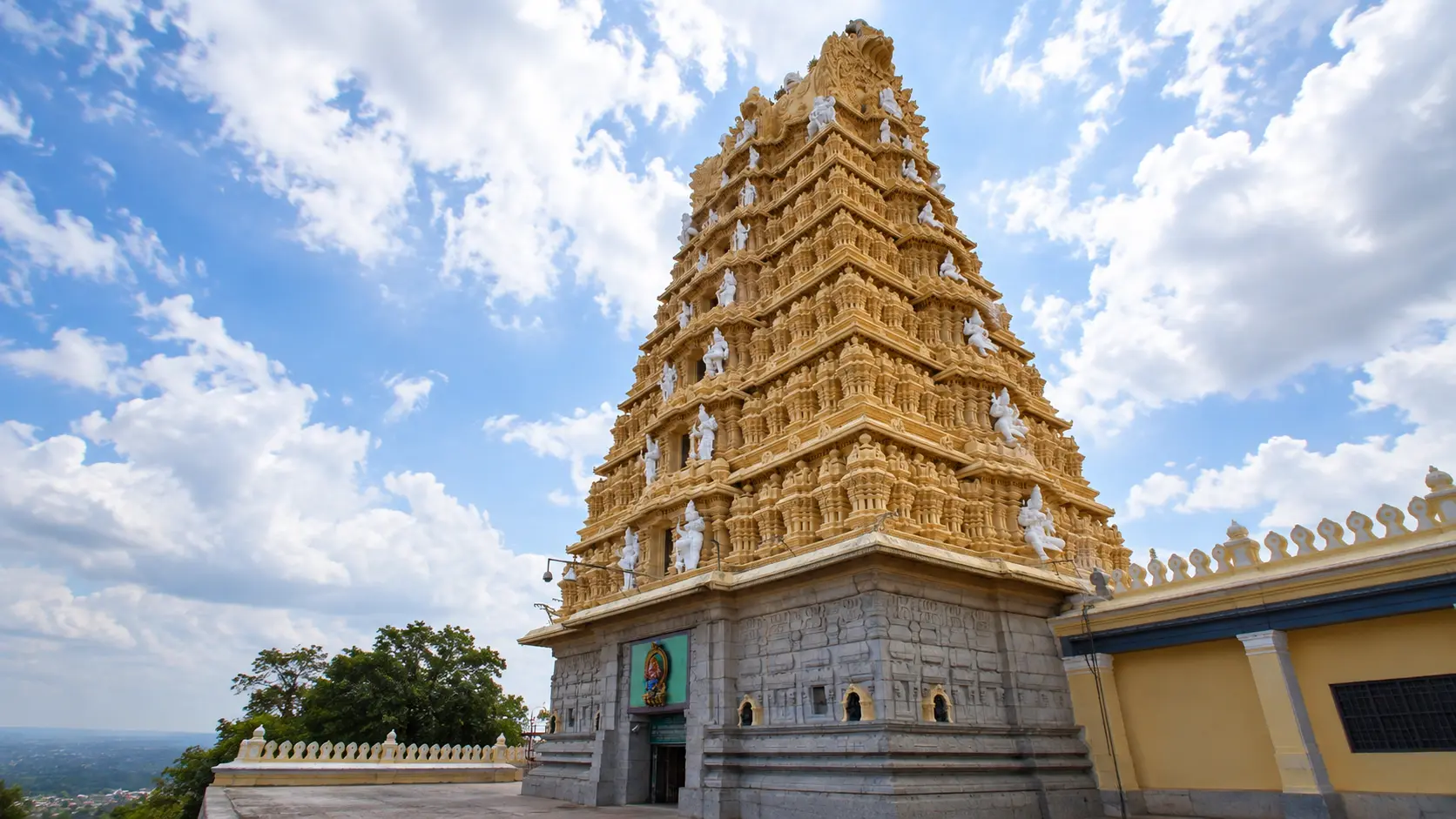
Rising prominently above the southern skyline of Mysuru, Chamundi Hill (elevation 1,062 meters) is the spiritual anchor of the Kingdom of Mysore. Atop its summit stands the historic Sri Chamundeshwari Temple, dedicated to the patron goddess of the Wadiyar dynasty. Dating back to the 12th century with additions by the Vijayanagara kings and an imposing seven-tiered gopuram constructed by Maharaja Krishnaraja Wadiyar III in 1827, the temple attracts pilgrims from across India. Midway along the historic 1,000-step stone pilgrimage trail sits the colossal 1659 monolithic Nandi Bull, carved from a single boulder of black granite measuring 16 feet in height and 24 feet in length.
Jaganmohan Palace Art Gallery (1 km West)
Located just a short walk west of Mysore Palace, Jaganmohan Palace was constructed in 1861 by Maharaja Krishnaraja Wadiyar III as an alternative royal residence and served as the temporary home of the royal family following the tragic 1897 wooden palace fire. Today, this handsome three-story wooden and stucco palace houses the Sri Jayachamarajendra Art Gallery, one of the finest art museums in southern India. Its galleries display original masterpieces by Raja Ravi Varma, exquisite Mysore traditional gold-leaf paintings, antique musical instruments, Japanese ivory carvings, and a remarkable French musical clock that performs miniature mechanical parades on the hour.
Devaraja Market (800 m North)
Dating back to the reign of Chamaraja Wadiyar IX in the late 19th century, Devaraja Market is a vibrant, sensory wonderland running parallel to Sayyaji Rao Road. With over 800 stalls arranged along covered stone arcades, the market is renowned for its vivid, photogenic pyramids of kumkum and turmeric powders, strings of fragrant Mysore jasmine (Mysore Mallige), pure sandalwood soaps and incense, betel leaves, and heaps of seasonal bananas and mangoes.
St. Philomena's Cathedral (2.5 km Northeast)
Constructed in 1936 under the architectural guidance of French architect Reverend Rene Feuge and commissioned by Maharaja Krishnaraja Wadiyar IV, St. Philomena’s Cathedral is one of the largest and most magnificent churches in India. Built in the Neo-Gothic style modeled after the Cologne Cathedral in Germany, the cathedral is dominated by twin soaring spires rising 175 feet into the air. Inside, beautiful stained-glass windows imported from France depict scenes from the life of Christ, while an underground catacomb preserves a sacred relic of Saint Philomena.
Sri Chamarajendra Zoological Gardens / Mysuru Zoo (2 km East)
Established in 1892 by Maharaja Chamaraja Wadiyar X, the Mysuru Zoo is one of the oldest and most scientifically advanced zoological parks in India. Spanning 157 acres adjacent to the scenic Karanji Lake, the zoo is celebrated for its spacious, naturalistic enclosures sheltering white tigers, Asiatic lions, Indian elephants, giraffes, zebras, gorillas, and an extensive aviary.
In pictures
The practical bits
Before you go.
Plan ahead
A well-structured itinerary ensures that you experience the full breadth of Mysore Palace - from its intricate…Explore detailsClose details
A well-structured itinerary ensures that you experience the full breadth of Mysore Palace - from its intricate interior craftsmanship to its tranquil fort temples and spectacular evening lighting - without unnecessary fatigue or queue delays.
Arrive Promptly at Morning Opening or Late Afternoon
Check the current visiting hours and permitted access with the site operator before departure; ceremonies…Explore detailsClose details
Check the current visiting hours and permitted access with the site operator before departure; ceremonies, closures and visitor sessions can affect access. Mid-day hours between 11:30 and 14:30 see the arrival of massive tour bus groups and school excursions, leading to crowded corridors inside the Kalyana Mantapa and Diwan-i-Khas.
Hire an Automated Multilingual Audio Guide
To truly appreciate the historical nuance and architectural symbolism of each royal hall, pick up an official…Explore detailsClose details
To truly appreciate the historical nuance and architectural symbolism of each royal hall, pick up an official audio guide kit at the entrance kiosk. Available in English, Kannada, Hindi, German, French, Italian, and Japanese, the audio guide provides informative, self-paced narrations corresponding to numbered plaques placed in every major hall and gallery.
Wear Comfortable Socks for Interior Walking
Confirm the current charge and what it includes with the operator or service provider.Explore detailsClose details
Confirm the current charge and what it includes with the operator or service provider. Visitor admission, vehicles, parking, activities and accommodation can have separate charges. The interior tour covers several hundred meters of walking across polished stone, ceramic tile, and marble corridors, and socks protect your feet from cold drafts in winter or sun-warmed outdoor walkways.
Time Your Visit for Sunday Evening Illumination
If your travel schedule allows, coordinate your Mysuru stay to include a Sunday evening.Explore detailsClose details
If your travel schedule allows, coordinate your Mysuru stay to include a Sunday evening. Experiencing the daytime interior splendor between 15:30 and 17:30, followed by a tea break in the gardens and witnessing the sudden ignition of nearly 100,000 incandescent light bulbs at 19:00, is the quintessential Mysuru experience.
Combine with Old Fort Temples and Devaraja Market
Allocate at least one hour outside the main palace building to stroll through the fort grounds, visiting ancient…Explore detailsClose details
Allocate at least one hour outside the main palace building to stroll through the fort grounds, visiting ancient shrines like Sri Shweta Varahaswamy and Sri Trineshwara Swamy. Afterward, take a leisurely 10-minute walk north along Sayyaji Rao Road to explore the bustling, 130-year-old Devaraja Market, famous for fragrant heaps of Mysuru jasmine (Mallige), sandalwood oils, and colorful cones of traditional kumkum powder.
+----------------------------------------------------------------------------------------------------+
|                                  SUGGESTED COMBINED DAY ITINERARY: ROYAL MYSURU                    |
|                                                                                                    |
|  08:00 AM to 09:30 AM  -  Chamundi Hill & Sri Chamundeshwari Temple                                  |
|  - Drive or take city bus up Chamundi Hill (1,062 m) for blessings and city panoramic views.       |
|  - Pay respects at the colossal 1659 monolithic Nandi Bull midway down the hill.                   |
|                                                                                                    |
|  10:00 AM to 12:30 PM  -  Mysore Palace (Amba Vilas) Complete Tour                                   |
|  - Enter via Varaha Gate; deposit footwear; explore Gombe Thotti, Kalyana Mantapa & Durbar Halls.  |
|  - Marvel at the 84-kg Golden Howdah, Glasgow stained-glass ceiling, and Raja Ravi Varma canvases.|
|                                                                                                    |
|  12:45 PM to 02:00 PM  -  Traditional Mysuru Royal Lunch                                             |
|  - Enjoy an authentic Karnataka thali served on plantain leaves at a nearby heritage restaurant.   |
|  - Savor genuine *Mysore Pak* sweets from historic sweet stalls near the palace.                   |
|                                                                                                    |
|  02:30 PM to 04:30 PM  -  Jaganmohan Palace Art Gallery & Devaraja Market                            |
|  - Tour Jaganmohan Palace (1861 wooden palace) displaying royal artifacts and Ravi Varma masters.  |
|  - Walk through colorful Devaraja Market for sandalwood, spices, and fresh jasmine garlands.       |
|                                                                                                    |
|  05:00 PM to 06:30 PM  -  St. Philomena's Cathedral or Mysuru Zoo                                    |
|  - Admire the twin 175-foot Neo-Gothic spires of St. Philomena's, one of India's tallest churches. |
|                                                                                                    |
|  07:00 PM to 08:00 PM  -  Mysore Palace Illumination / Sound & Light Show                            |
|  - Return to the palace grounds to watch 97,000 light bulbs illuminate the golden granite facade.  |
+----------------------------------------------------------------------------------------------------+
A few things you might wonder
Common questions about visiting Mysore Palace. Fees, visiting hours and ceremonies are researched details that may change; confirm current arrangements with the operator before travelling.
What is the difference between Mysore Palace and Amba Vilas Palace?
Is photography permitted inside Mysore Palace?
When does the exterior bulb illumination take place at Mysore Palace?
Where do visitors deposit their shoes, and is there a fee?
What is the Golden Howdah (Chinnada Ambari) and where is it kept?
How long does it take to tour Mysore Palace comfortably?
Is Mysore Palace wheelchair accessible for elderly visitors and travelers with disabilities?
What are the timings and languages for the evening Sound and Light show?
Explore more in Bengaluru Mysuru
Discover other destinations around this hub
More Hubs in Karnataka
Continue exploring other travel hubs in this state
Planning a trip to Bengaluru Mysuru?