Five Rathas (Pancha Rathas)
Comprehensive visitor guide to Five Rathas (Pancha Rathas) in Mahabalipuram, Tamil Nadu. Explore 7th-century monolithic rock temples, Dravidian architecture & tickets.
Location
Chennai & Mahabalipuram, Tamil Nadu
A closer look
Your visit, at a glance.
Chennai Mahabalipuram, Tamil Nadu
GET TO KNOW THE PLACE
Standing in peaceful archaeological seclusion near the southern edge of the ancient port town of Mahabalipuram (Mamallapuram) in Chengalpattu District, Tamil Nadu, the Five…
The story of Five Rathas (Pancha Rathas)
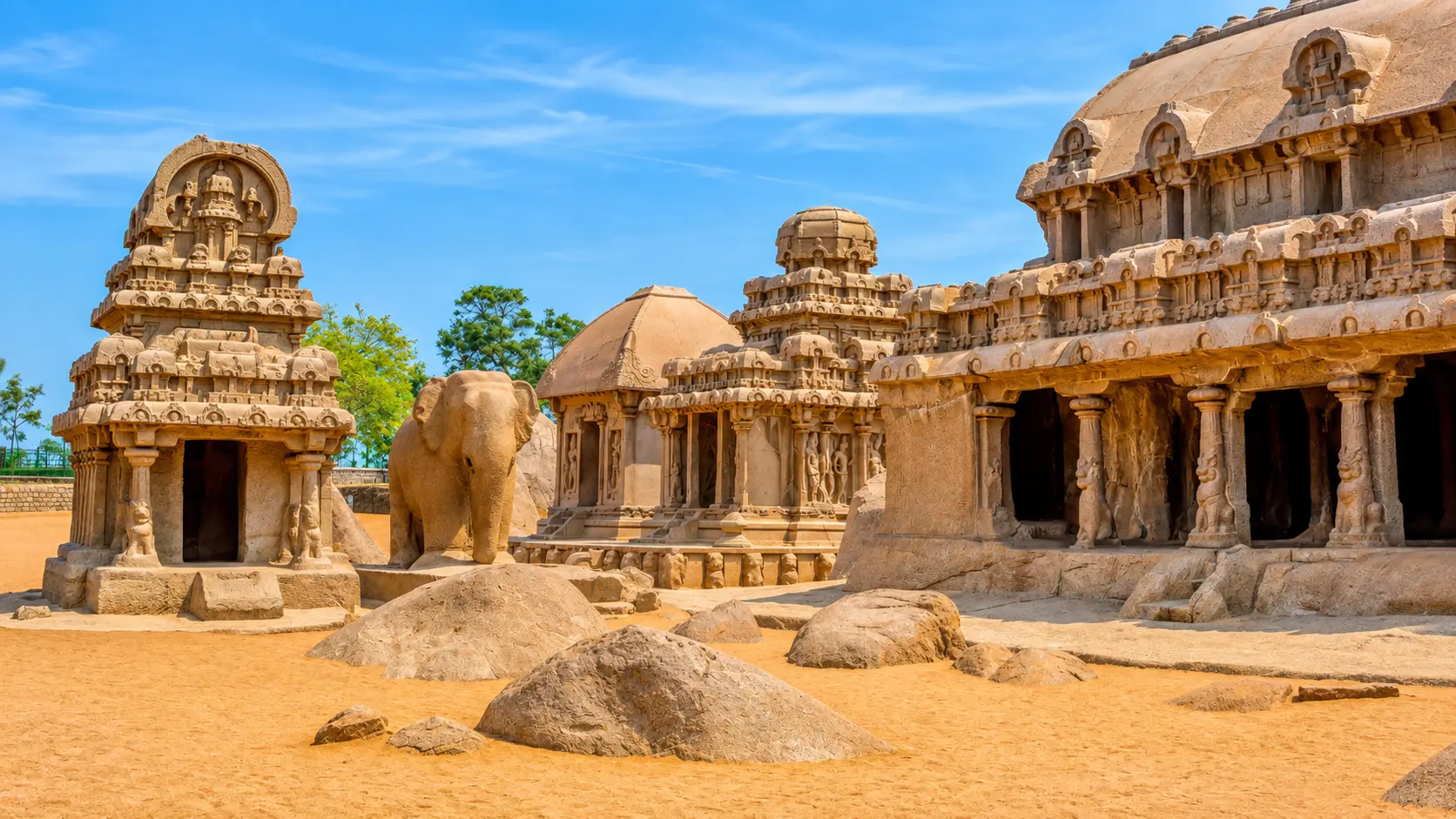
Standing in peaceful archaeological seclusion near the southern edge of the ancient port town of Mahabalipuram (Mamallapuram) in Chengalpattu District, Tamil Nadu, the Five Rathas - universally known as Pancha Rathas - represent one of the most astonishing triumphs of rock-cut stone sculpture in the history of human architecture. Inscribed as a UNESCO World Heritage Site in 1984 as part of the Group of Monuments at Mahabalipuram, this breathtaking group of five monolithic temples was carved during the reign of the legendary Pallava monarch Narasimhavarman I (known as Mamalla, "The Great Wrestler", who reigned 630 - 668 CE).
What makes the Five Rathas a wonder of global archaeology is that all five monumental temples were carved entirely in situ from a single, continuous sloping outcrop of living granite rock.
Instead of quarrying stone blocks, hauling them with draft animals, and assembling them with lime mortar, Pallava master sculptors worked top-down like classical sculptors carving statues from marble blocks. Chiseling away hundreds of tons of living grey granite from summit to base, they freed five complete, free-standing temple structures from the rock, alongside three colossal, lifelike animal companions: a towering elephant, a majestic lion, and a resting Nandi bull.
Although named by local villagers centuries later after the five Pandava brothers and their common consort Draupadi from the Hindu epic Mahabharata - Dharmaraja (Yudhishthira), Bhima, Arjuna, Nakula, Sahadeva, and Draupadi - the monuments have no genuine historical connection to the epic. Instead, they served as an open-air royal architectural laboratory where Pallava kings experimented with diverse styles of temple towers (vimanas), creating the structural prototypes that would inspire all subsequent Dravidian temple architecture across South India and Southeast Asia.
Start here. Open a tile for the full details.
Why goRead details
For travelers, historians, and art lovers, the Five Rathas provide an unmatched encounter with 7th-century artistic genius:
When to visitRead details
Visiting the open-air stone courtyards of the Five Rathas is strongly shaped by seasonal coastal weather.
Entry & permissionsRead details
Fees, visiting hours and entry rules may change. Confirm the latest details with the official operator or local authority before travelling.
The Five Rathas are protected and maintained by the Archaeological Survey of India (ASI):
- Operating Hours:
- Open daily from 06:00 AM to 18:00 PM (sunrise to sunset).
- Open 365 days a year without weekly closures.
- Admission Charges (ASI Composite Ticket):
- Indian Citizens, SAARC & BIMSTEC Nationals: ₹40 per adult.
- Foreign Nationals: ₹600 per adult.
- Children under 15 years: Free entry (upon presenting age proof).
- Composite Pass Benefit: The ticket purchased at Five Rathas is a dual-entry pass that also grants admission to the Shore Temple on the same day. Retain your digital QR code or paper ticket receipt!
- Photography Rules & Regulations:
- Standard handheld mobile phone and digital camera photography is permitted free of charge.
- Video cameras for non-commercial personal use are permitted (nominal ₹25 fee may apply).
- Flying drones over the archaeological enclosure is strictly prohibited under central heritage conservation and national security regulations.
- Visitors are requested not to touch, deface, or climb upon the 1,350-year-old monolithic sculptures or animal figures.
Plan your visitRead details
The Five Rathas are located at the southern edge of Mahabalipuram town, approximately 55 kilometres south of Chennai.
Explore the full guide - choose a topic below.
Why visit?
For travelers, historians, and art lovers, the Five Rathas provide an unmatched encounter with 7th-century…Explore detailsClose details
For travelers, historians, and art lovers, the Five Rathas provide an unmatched encounter with 7th-century artistic genius:
- Monolithic Sculpture on a Superhuman Scale: Unlike structural temples composed of thousands of individual mortar-bound stones, every pillar, roof finial, deity relief, and decorative bracket in the Pancha Rathas is a monolithic extension of the earth's natural granite bedrock.
- The Foundational Blueprints of Dravidian Architecture: The Five Rathas are the literal birthplaces of South Indian temple design. Within a single enclosed garden, Pallava architects demonstrated four distinct structural paradigms: the square hut (kuta), the oblong barrel-vault (sala), the multi-tiered pyramid (tritala vimana), and the apsidal elephant-back (gajaprishta).
- The Sublime Monolithic Animal Triumvirate: Interspersed among the five stone shrines are three world-famous, free-standing animal sculptures carved out of individual boulders:
- An anatomically flawless life-sized Elephant, complete with textured hide, folded ears, and expressive eyes, standing beside Nakula-Sahadeva Ratha.
- A proud six-foot Lion (Simha), the royal emblem of the Pallava kings and the sacred vahana of Goddess Durga.
- A peacefully resting Nandi Bull tucked behind the Arjuna Ratha, sculpted with a garlanded hump and gentle expression.
- The Iconic Dharmaraja Ratha & Royal Epigraphs: The grandest of the five shrines, Dharmaraja Ratha rises three storeys into the sky. It contains 28 masterfully sculpted relief panels, including the world-famous representation of Ardhanarisvara (the half-male Shiva, half-female Parvati form), as well as 16 titles of King Narasimhavarman I carved in ornate 7th-century Pallava Grantha script.
- A Single Composite Ticket with the Shore Temple: Managed by the Archaeological Survey of India (ASI), a single entry ticket allows you to explore both the Five Rathas and the oceanfront Shore Temple on the same day, making for an extraordinary half-day UNESCO world heritage expedition.
What to expect
Visiting the Five Rathas is a serene outdoor walk across manicured green lawns enclosed by flowering…Explore detailsClose details
Visiting the Five Rathas is a serene outdoor walk across manicured green lawns enclosed by flowering bougainvillea and coastal casuarina trees.
Approaching the Monolithic Enclosure
Entering through the ASI ticket turnstiles on Five Rathas Road, visitors are immediately greeted by the sight of five sandstone-colored granite temples rising in a neat north-to-south procession, descending in height according to the natural southern slope of the original granite knoll.
Because the temples sit in a slight natural hollow, you can look down upon the complex from the approach path before walking down onto the white sandy clearing that surrounds the monolithic plinths.
Exploring the Five Individual Rathas
Walking along the sandy court, visitors explore the five shrines one by one:
- Draupadi Ratha (The Thatched Cottage Shrine): The northernmost and smallest ratha, measuring 11 feet square and 18 feet tall. It is sculpted in the kuta style, deliberately mimicking the simple four-sided sloping thatched roofs of traditional village mud cottages. Dedicated to Goddess Durga, the entrance is guarded by two female dvarapalikas leaning gracefully on bows. Inside the small sanctum, a striking relief portrays four-armed Goddess Durga standing on a lotus, flanked by celestial ganas and two kneeling devotees - one of whom is depicted in the act of offering his own head in ritual sacrifice. Outside, the monolithic stone Lion stands vigilant.
- Arjuna Ratha (The Stepped Vimana): Sharing a common elevated rock plinth with Draupadi Ratha, Arjuna Ratha is dedicated to Lord Shiva. It represents a flawless prototype of the two-storeyed (dvitala) Dravidian vimana, featuring a square base, miniature roof pavilions, and an octagonal crowning dome (shikhara). The exterior wall niches are adorned with exquisite relief sculptures of Shiva leaning casually on Nandi, Vishnu with his eagle Garuda, Indra mounted on Airavata, and graceful royal court couples.
- Bhima Ratha (The Wagon-Vaulted Hall): The second-largest shrine, measuring 42 feet in length. Sculpted in the sala style, it features an elongated rectangular hall covered by a massive, curved barrel-vaulted roof reminiscent of an overturned ship's hull. The open pillared entrance is supported by four pillars resting on the backs of crouching horned lions (vyalas). Historians believe it was intended to house a colossal reclining image of Lord Vishnu (Anantasayana), but the sanctum was left unfinished.
- Dharmaraja Ratha (The Multi-Tiered Pyramid): The southernmost, tallest, and most complex monument in the complex. Rising three storeys on a 28-foot square base, it is crowned by a finely fluted octagonal shikhara. The upper storeys - which can be admired from the ground - contain 28 sculpted panels of unparalleled artistry, depicting Brahma, Harihara, Surya, and Ardhanarisvara. High on the corner pilasters are carved 16 royal titles of King Narasimhavarman I in ancient Grantha lettering.
- Nakula-Sahadeva Ratha (The Elephant-Back Shrine): Standing apart from the main north-south axis on a separate rock knoll, this shrine faces south. It features a unique semi-circular apsidal roof known as gajaprishta ("elephant's back"). Directly beside it stands the world-famous life-sized monolithic Elephant, facing opposite the shrine in poetic symmetry.
The Mystery of the Unfinished Shrines
As you examine the temples closely, notice that the lower plinths of Bhima Ratha and the interior sanctums of Dharmaraja Ratha remain rough-hewn and incomplete.
None of the temples have wear marks on their thresholds from worshippers, nor do the sanctums contain consecrated idols. Historical chronicles indicate that when King Narasimhavarman I died in 668 CE, work on the experimental stone workshops abruptly stopped. Subsequent Pallava kings shifted their patronage toward structural masonry temples - such as the Shore Temple - leaving the Five Rathas frozen in time as a 1,350-year-old architectural museum.
Best time to visit
Visiting the open-air stone courtyards of the Five Rathas is strongly shaped by seasonal coastal weather.Explore detailsClose details
Visiting the open-air stone courtyards of the Five Rathas is strongly shaped by seasonal coastal weather.
Seasonal Breakdown
- Winter (November to February) - Prime Touring Season: Winter is by far the finest season to visit Mahabalipuram. Daytime temperatures remain pleasant and sunny, averaging between 22°C and 29°C with refreshing sea breezes blowing off the Bay of Bengal. The granite stones remain cool to walk around, skies are clear blue, and humidity is manageable.
- Monsoon (October to November) - The Northeast Coastal Season: Coastal Chengalpattu receives the brunt of its rainfall during the northeast monsoon. Passing showers leave the granite shrines clean and dark, highlighting the crisp chisel lines of the carvings, though visitors should carry an umbrella and wear non-slip footwear.
- Summer (March to June) - Intense Heat & Glare: Summer along the Coromandel coast is hot and humid, with midday temperatures reaching 36°C to 39°C. Check the current visiting hours and permitted access with the site operator before departure; ceremonies, closures and visitor sessions can affect access. If visiting in summer, enter promptly at 06:00 AM at sunrise or after 16:00 PM.
Optimal Time of Day for Photography
The finest time to photograph the Five Rathas is early morning between 06:30 and 08:30 AM or late afternoon between 16:00 and 17:30 PM. During golden hour, the warm morning or evening sunlight illuminates the golden-grey granite faces of Arjuna and Dharmaraja Rathas, casting dramatic shadows that accentuate the three-dimensional depth of the carved pilasters and animal sculptures.
How to reach
The Five Rathas are located at the southern edge of Mahabalipuram town, approximately 55 kilometres south of…Explore detailsClose details
The Five Rathas are located at the southern edge of Mahabalipuram town, approximately 55 kilometres south of Chennai.
By Road & Public Transit
- From Chennai along the East Coast Road (approx. 55 km / 1.5 hours): Drive south along the scenic four-lane East Coast Road (SH-49) past Kovalam and Muttukadu. The highway offers beautiful coastal views and connects directly to Mahabalipuram town.
- By State Bus (SETC / MTC): Frequent express and regular public buses run between Chennai (CMBT Koyambedu and Tambaram) and the Mahabalipuram bus station. Popular routes include Bus No. 119 (from Guindy), Bus No. 588 (from Thiruvanmiyur), and Bus No. 599 (from T. Nagar). From the Mahabalipuram bus stand, the Five Rathas are a leisurely 10-minute walk or a quick auto-rickshaw ride (approx. 1 km).
- By Taxi / App Cabs (Uber / Ola): Confirm the current charge and what it includes with the operator or service provider. Visitor admission, vehicles, parking, activities and accommodation can have separate charges.
By Train & Air
- Chengalpattu Junction (CGL): The nearest major railway station, located approximately 29 kilometres west. Taxis and local buses run frequently from Chengalpattu to Mahabalipuram (approx. 45 minutes).
- Chennai Central Railway Station (MAS): Situated approximately 58 kilometres north.
- Chennai International Airport (MAA): Located roughly 52 kilometres northwest. Taxis take about 1 hour and 15 minutes via the Pallavaram 200 Feet Radial Road, OMR, and ECR.
Entry, timings and permissions
Fees, visiting hours and entry rules may change.Explore detailsClose details
Fees, visiting hours and entry rules may change. Confirm the latest details with the official operator or local authority before travelling.
The Five Rathas are protected and maintained by the Archaeological Survey of India (ASI):
- Operating Hours:
- Open daily from 06:00 AM to 18:00 PM (sunrise to sunset).
- Open 365 days a year without weekly closures.
- Admission Charges (ASI Composite Ticket):
- Indian Citizens, SAARC & BIMSTEC Nationals: ₹40 per adult.
- Foreign Nationals: ₹600 per adult.
- Children under 15 years: Free entry (upon presenting age proof).
- Composite Pass Benefit: The ticket purchased at Five Rathas is a dual-entry pass that also grants admission to the Shore Temple on the same day. Retain your digital QR code or paper ticket receipt!
- Photography Rules & Regulations:
- Standard handheld mobile phone and digital camera photography is permitted free of charge.
- Video cameras for non-commercial personal use are permitted (nominal ₹25 fee may apply).
- Flying drones over the archaeological enclosure is strictly prohibited under central heritage conservation and national security regulations.
- Visitors are requested not to touch, deface, or climb upon the 1,350-year-old monolithic sculptures or animal figures.
Nearby places to consider
The Five Rathas are located at the center of Mahabalipuram’s UNESCO World Heritage archaeological landscape: -…Explore detailsClose details
The Five Rathas are located at the center of Mahabalipuram’s UNESCO World Heritage archaeological landscape:
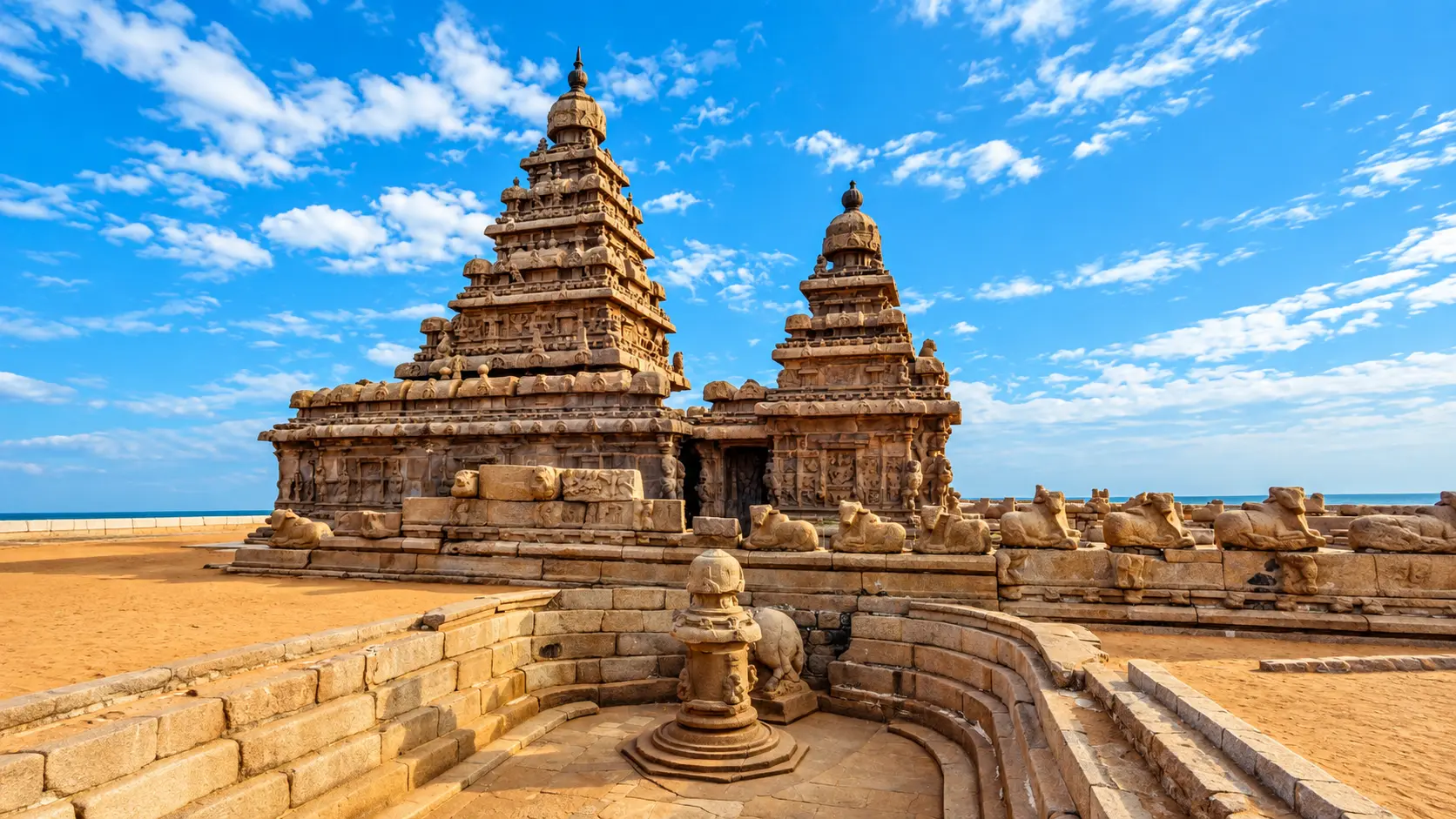
- Shore Temple (approx. 1.8 km northeast on the beach): The magnificent 8th-century structural stone temple built by Rajasimha Pallava, standing on the edge of the Bay of Bengal with its two spires and hundreds of carved Nandi bulls.
- Arjuna’s Penance / Descent of the Ganges (approx. 1.2 km north): The world’s largest open-air rock relief (96 feet long by 43 feet high), featuring over 150 exquisitely carved figures of gods, humans, animals, and flying celestial beings.
- Krishna’s Butter Ball (approx. 1.3 km north): A colossal 250-tonne natural granite boulder balancing precariously on a smooth 45-degree rocky slope, defying gravity for over a millennium.
- Mahishasuramardini Cave Temple (approx. 1 km north on the hill): A spectacular rock-cut cave containing the dramatic masterwork relief of eight-armed Goddess Durga battling the buffalo demon Mahishasura.
- Mahabalipuram Beach & Lighthouse (approx. 1 km east): A lively seaside promenade featuring fresh seafood shacks, traditional fishing catamarans, and a climbable 1904 circular stone lighthouse offering panoramic coastal views.
In pictures
The practical bits
Before you go.
Plan ahead
To make the most of your exploration of the Five Rathas, keep the following structured planning guidelines in mind:Explore detailsClose details
To make the most of your exploration of the Five Rathas, keep the following structured planning guidelines in mind:
Combine with the Shore Temple on a Single Ticket
Confirm the current charge and what it includes with the operator or service provider.Explore detailsClose details
Confirm the current charge and what it includes with the operator or service provider. Visitor admission, vehicles, parking, activities and accommodation can have separate charges. Start early at the Five Rathas at 06:30 AM when the grounds are completely empty of tour buses, spend 90 minutes exploring the monoliths, and then head over to the Shore Temple to enjoy the morning ocean breeze over the Bay of Bengal.
Wear Sun Protection and Light Slip-On Shoes
The sandy courtyard surrounding the Five Rathas has very limited tree shade.Explore detailsClose details
The sandy courtyard surrounding the Five Rathas has very limited tree shade. Carry a sun umbrella, sunglasses, and a wide-brimmed hat, and apply high-SPF sunscreen. While you can wear shoes around the sandy complex, you will want to step inside the elevated sanctum of Draupadi Ratha or onto the rock plinths, making lightweight, comfortable walking sandals ideal.
Hire an Authorized ASI Guide for Deeper Insight
While the visual beauty of the monoliths is obvious, the rich iconographic symbolism, Pallava royal history, and…Explore detailsClose details
While the visual beauty of the monoliths is obvious, the rich iconographic symbolism, Pallava royal history, and architectural terminology (such as kuta, sala, and gajaprishta) are best understood with a guide. Confirm the current charge and what it includes with the operator or service provider. Visitor admission, vehicles, parking, activities and accommodation can have separate charges.
Explore the Stone Carving Workshops on Five Rathas Road
The street leading to the Five Rathas is known across India as the heart of stone sculpture.Explore detailsClose details
The street leading to the Five Rathas is known across India as the heart of stone sculpture. Hundreds of traditional sthapatis and stone carvers work in open-air ateliers, chiseling granite, soapstone, and marble statues using the same ancient hand-tools depicted on the 7th-century Pallava monuments. Browsing these workshops offers an incredible look at living heritage.
A few things you might wonder
Common questions about visiting Five Rathas (Pancha Rathas). Fees, visiting hours and ceremonies are researched details that may change; confirm current arrangements with the operator before travelling.
Where are the Five Rathas located and what does the name mean?
Who built the Five Rathas and when were they carved?
Are the Five Rathas built of assembled stones or carved from one rock?
Why are the shrines named after the Pandavas and Draupadi?
Were the Five Rathas ever used for Hindu worship?
What are the three animal sculptures at the Five Rathas?
What are the opening hours and entry fees for the Five Rathas?
What is the best time of year to visit the Five Rathas?
Explore more in Chennai Mahabalipuram
Discover other destinations around this hub
More Hubs in Tamil Nadu
Continue exploring other travel hubs in this state
Planning a trip to Chennai Mahabalipuram?