Raj Ghat
Comprehensive guide to Raj Ghat in Central Delhi. Explore Mahatma Gandhi's memorial on the Yamuna, the eternal flame, world leader tree plantings, timings, and metro transit.
Location
Old Delhi, Delhi NCR
A closer look
Your visit, at a glance.
Old Delhi, Delhi Ncr
GET TO KNOW THE PLACE
---
The story of Raj Ghat
Start here. Open a tile for the full details.
Why goRead details
In a city defined by towering Mughal battlements, bustling multi-century bazaars, and imperial colonial avenues, Raj Ghat exists as a profoundly moving sanctuary of silence, dignity, and national remembrance. Situated along the green, gently sloping western banks of the Yamuna River on Mahatma Gandhi Marg (Ring Road) in Central Delhi, this world-renowned memorial marks the sacred spot where Mohandas Karamchand Gandhi - universally revered as Mahatma Gandhi, the "Father of the Nation" - was cremated on January 31, 1948. Following his tragic assassination on the evening of January 30 at Birla House (now Gandhi Smriti) by Nathuram Godse, Gandhi's mortal remains were carried across Delhi upon a flower-decked military gun carriage, escorted by an emotional funeral procession of over one million citizens, before being committed to the flames on this ancient riverbank terrace.
When to visitRead details
Entry & permissionsRead details
Fees, visiting hours and entry rules may change. Confirm the latest details with the official operator or local authority before travelling.
Operating Schedule and Hours
- Daily Operating Schedule: Open 365 days a year, Monday through Sunday.
- Visiting Hours: 06:30 AM to 06:00 PM daily (during peak summer, grounds may open at 06:00 AM and close at 06:30 PM).
- Public Holidays: Open on all national holidays, Sundays, and religious festivals.
- VIP Ceremonial Restrictions: On October 2 (Gandhi Jayanti) and January 30 (Martyrs’ Day), general public entry is restricted during early morning state prayer ceremonies until approximately 11:30 AM or 12:00 PM.
Tariff Structure
Category / Service | Tariff Rate (INR) | Remarks / Applicable Terms |
|---|---|---|
Indian Citizens (Adults & Children) | Free (₹0) | Complimentary admission for all |
Foreign National Tourists | Free (₹0) | Complimentary admission for all |
Complimentary Shoe Storage Service | Free (₹0) | Operated by Samadhi Committee |
Handheld Mobile Still Photography | Free (₹0) | Personal non-commercial use only |
Dedicated Surface Car Parking | Free / Nominal (₹20-₹40) | Standard municipal surface parking |
National Gandhi Museum (Opposite) | Free (₹0) | Open Tue-Sun (closed Mondays) |
Regulations, Photography and Memorial Etiquette
- Mandatory Shoe Removal: All footwear - including shoes, sandals, slippers, and boots - must be removed before crossing from the paved pathway into the sunken red sandstone memorial courtyard. Attendants at the complimentary shoe counter provide numbered tokens for secure retrieval.
- Photography Guidelines: Personal, handheld mobile phone photography and casual camera usage are permitted throughout the gardens and courtyard free of charge. Visitors must not climb onto the black marble cenotaph, pose inappropriately, or take disrespectful self-portraits while standing over the cremation spot.
- Commercial Filming and Media Broadcasts: Filming commercial television documentaries, news features, or cinema scenes requires advance formal written approval and security clearances from the Secretary, Rajghat Samadhi Committee (Ministry of Housing and Urban Affairs, Government of India).
- Strict Drone Ban: The operation of unmanned aerial vehicles (drones) is strictly prohibited across Raj Ghat and the surrounding Yamuna riverfront corridor under Delhi Police security orders. Unauthorized drone flights incur immediate arrest and criminal prosecution under Indian defense and aviation acts.
- Prohibited Articles: Consuming food, picnicking on the lawns of the inner quadrangle, chewing tobacco or betel leaves (paan), smoking, and consuming alcohol are strictly banned by law throughout the 44-hectare complex.
Plan your visitRead details
Positioned along Mahatma Gandhi Marg (Ring Road) on the eastern edge of Central Delhi, Raj Ghat is readily accessible via the Delhi Metro, Indian Railways, and arterial road networks.
Explore the full guide - choose a topic below.
Why visit?
In a city defined by towering Mughal battlements, bustling multi-century bazaars, and imperial colonial avenues…Explore detailsClose details
In a city defined by towering Mughal battlements, bustling multi-century bazaars, and imperial colonial avenues, Raj Ghat exists as a profoundly moving sanctuary of silence, dignity, and national remembrance. Situated along the green, gently sloping western banks of the Yamuna River on Mahatma Gandhi Marg (Ring Road) in Central Delhi, this world-renowned memorial marks the sacred spot where Mohandas Karamchand Gandhi - universally revered as Mahatma Gandhi, the "Father of the Nation" - was cremated on January 31, 1948. Following his tragic assassination on the evening of January 30 at Birla House (now Gandhi Smriti) by Nathuram Godse, Gandhi's mortal remains were carried across Delhi upon a flower-decked military gun carriage, escorted by an emotional funeral procession of over one million citizens, before being committed to the flames on this ancient riverbank terrace.
What makes Raj Ghat one of the most powerful and spiritually arresting monuments in modern world history is its radical architectural restraint. While monarchs and conquerors across centuries constructed towering stone mausoleums, marble domes, and gilded minarets to immortalize their worldly power, Gandhi’s memorial was designed by architect Vanu G. Bhuta to embody the core spiritual philosophy that guided his life: absolute simplicity, truth (Satya), and non-violence (Ahimsa). There are no soaring arches, no ornate domes, and no bombastic inscriptions. Instead, the memorial consists of a modest, pristine square cenotaph (samadhi) of polished black marble, left completely open to the expanse of the sky. Inscribed in Devanagari upon the black stone are his poignant final words, "हे राम" (Hē Ram / "Oh God"), whispered as he fell. At the northern end of the black marble plinth, a perpetual eternal flame (Akhand Jyoti) burns steadily within a glass-walled lantern, symbolizing the enduring light of his moral message.
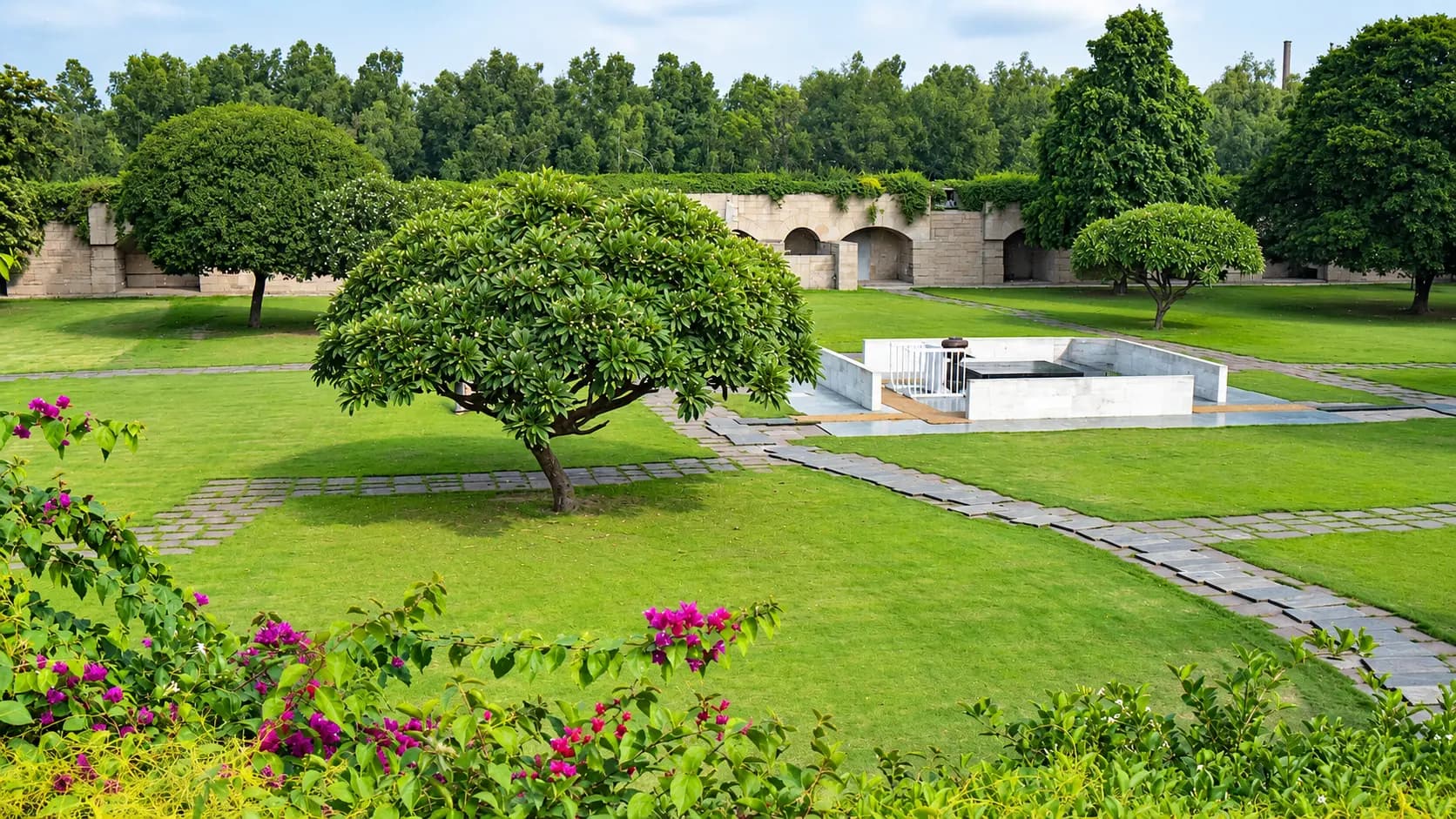
Surrounding the central samadhi is an ingenious landscape design that transforms an urban plot into a cocoon of meditative stillness. The black marble platform rests within a sunken, red sandstone courtyard, shielded from the noise and vehicular traffic of the surrounding city by high, grassy earthen mounds. Beyond these mounds lies an expansive 44-hectare landscaped memorial parkland, framed by weeping willows, broad manicured lawns, peaceful water channels, and an extraordinary arboretum of sacred trees personally planted by visiting world leaders - including Queen Elizabeth II, Dwight D. Eisenhower, Ho Chi Minh, and Nelson Mandela. Located directly across the road is the National Gandhi Museum, which preserves his walking stick, spinning wheels, and personal correspondence. Visiting Raj Ghat is not merely a sightseeing excursion; it is a serene, contemplative pilgrimage that invites every traveler to reflect upon the enduring power of peace, tolerance, and human solidarity.
What to expect
Spanning 44 hectares along the Yamuna riverfront corridor in the Kotwali/Daryaganj sub-division of Central Delhi…Explore detailsClose details
Spanning 44 hectares along the Yamuna riverfront corridor in the Kotwali/Daryaganj sub-division of Central Delhi, Raj Ghat is laid out with deliberate spatial progression. Visitors transition from the urban energy of the Ring Road into a sequence of tranquil outer gardens, security checkpoints, and grassy acoustic berms before descending into the silent central courtyard.
       +-------------------------------------------------------------+
       |             MAHATMA GANDHI MARG (RING ROAD) ENTRANCE        |
       |  (Dedicated Drop-off, Tour Bus Parking & National Museum)   |
       +-------------------------------------------------------------+
                                      |
                                      v
  +------------------------------------------------------------------+
  | SECTION 1: RECEPTION, PERIMETER SECURITY & FOOTWEAR COUNTER      |
  | - Security Bag Screening & Metal Detector Archways               |
  | - Complimentary Shoe Storage Counters (Footwear Removal Zone)    |
  | - Paved, Accessible Tree-Lined Stone Pathways                    |
  +------------------------------------------------------------------+
                                      |
                                      v
  +------------------------------------------------------------------+
  | SECTION 2: THE ACOUSTIC EARTHEN BERMS (SOUND BARRIERS)           |
  | - High, rolling grass-covered earthen mounds encircling the quad |
  | - Designed by Vanu G. Bhuta to baffle urban traffic noise        |
  | - Filtered views of mature neem, peepal, and arjun trees         |
  +------------------------------------------------------------------+
                                      |
                                      v
  +------------------------------------------------------------------+
  | SECTION 3: THE SUNKEN MEMORIAL COURTYARD (THE SAMADHI)           |
  |                                                                  |
  |  +------------------------------------------------------------+  |
  |  | Paved Red Sandstone Terraces & Low Boundary Walls          |  |
  |  |                                                            |  |
  |  |        [The Black Marble Cenotaph (Samadhi)]               |  |
  |  |        - Square raised platform marking cremation spot     |  |
  |  |        - Inscribed with "He Ram" in gold-inlaid Devanagari |  |
  |  |        - Adorned with fresh floral marigold garlands       |  |
  |  |                                                            |  |
  |  |        [The Eternal Flame (Akhand Jyoti)]                  |  |
  |  |        - North end of platform; burns 24/7 in brass urn    |  |
  |  |        - Sheltered by square protective glass lantern      |  |
  |  +------------------------------------------------------------+  |
  +------------------------------------------------------------------+
                                      |
                                      v
  +------------------------------------------------------------------+
  | SECTION 4: THE MEMORIAL ARBORETUM & CONTIGUOUS SITES             |
  | - Ceremonial trees planted by foreign heads of state & monarchs  |
  | - Shanti Vana (Nehru), Vijay Ghat (Shastri), Shakti Sthal (Indira|
  | - National Gandhi Museum & Library across Ring Road              |
  +------------------------------------------------------------------+
The Cenotaph (Samadhi) and the Inscription "Hē Ram"
The focal point of Raj Ghat is the sacred cenotaph, an elevated square platform crafted from solid slabs of mirror-polished black basalt and granite marble. Built upon the exact spot where Gandhi’s funeral pyre was lit on January 31, 1948, the platform is intentionally left open to the sky and surrounded by low stone curbs. In the center of the black stone surface, fresh floral tributes - primarily orange marigolds, white jasmine blossoms, and red rose petals - are arranged daily by official caretakers to form decorative patterns.
Carved into the black marble front face and highlighted in gold lettering are the words: $$\text{हे राम} \quad (\textit{Hē Ram})$$ Translating as "Oh God" or "Hail Rama," these sacred syllables were the final words uttered by Mahatma Gandhi as he collapsed into the arms of his grand-nieces Abha and Manu after being shot three times at point-blank range in the garden of Birla House. For hundreds of millions of people across India and the globe, this inscription serves as the supreme epitaph of a man whose entire existence was dedicated to non-violence and divine truth.
The Eternal Flame (Akhand Jyoti)
At the northern extremity of the black marble platform stands the Akhand Jyoti (Perpetual / Eternal Flame). Fuelled continuously and maintained around the clock by dedicated staff of the Rajghat Samadhi Committee, the flame burns inside a heavy decorative brass urn, sheltered against rain and winds by a square, four-sided glass-and-brass lantern. The steady, golden flickering of the flame across the polished black marble surface provides a poignant visual meditation on the inextinguishable nature of Gandhi's philosophy, which inspired civil rights movements across the world - from Martin Luther King Jr. in the United States to Nelson Mandela in South Africa and the Dalai Lama in Tibet.
+---------------------------------------------------------------------------------------------------+
|                            ARCHITECTURAL & MEMORIAL PROFILE OF RAJ GHAT                           |
+------------------------------+--------------------+---------------------+-------------------------+
| Memorial Feature             | Physical Form      | Material Used       | Symbolic Meaning        |
+------------------------------+--------------------+---------------------+-------------------------+
| The Cenotaph (Samadhi)       | Square Platform    | Black Polished Basalt| Austerity & Simplicity  |
| Final Words Inscription      | "हे राम" (He Ram)  | Inlaid Gold Leaf    | Gandhi's final utterance|
| Eternal Flame (Akhand Jyoti) | Continuous Flame   | Brass & Glass Urn   | Inextinguishable truth  |
| Sunken Memorial Quadrangle   | Recessed Plaza     | Red Sandstone Flags | Humility before nature  |
| Perimeter Earthen Berms      | High Grass Mounds  | Turf & Soil Mounds  | Acoustic soundproofing  |
| Surrounding Memorial Park    | 44 Hectares        | Lawns, Canals, Trees| Life, peace & renewal   |
| World Leader Arboretum       | 100+ Planted Trees | Peepal, Neem, Arjun | Global non-violence bond|
| National Gandhi Museum       | Memorial Archive   | Brick, Glass, Stone | Historical education    |
+------------------------------+--------------------+---------------------+-------------------------+
The Acoustic Landscaping: The Sunken Courtyard and Berms
One of the brilliant architectural innovations introduced by Vanu G. Bhuta is the acoustic isolation of the memorial. Mahatma Gandhi Marg (the Ring Road) is one of Delhi’s most heavily trafficked arterial thoroughfares, carrying tens of thousands of buses, trucks, and automobiles daily. To protect the solemnity of the cremation spot without erecting oppressive concrete security walls, Bhuta created a sunken courtyard surrounded by high, rolling earthen mounds (berms) covered in lush green lawn grass.
As visitors pass through the gap in the earthen mounds and descend the broad red sandstone steps into the sunken quadrangle, the roar of modern traffic disappears, replaced by the soft whistling of wind through tree leaves and the chirping of birds. A low red sandstone perimeter wall demarcates the inner sanctum, where visitors walk barefoot along smooth sandstone flagstones.
The World Leader Tree Arboretum
Strolling through the outer landscaped gardens of Raj Ghat reveals a living diplomatic and historical archive. Beginning in the late 1950s, the Government of India established a tradition whereby visiting foreign heads of state, monarchs, and prime ministers pay their respects at Gandhi's memorial and plant a sapling in the surrounding gardens. Today, over one hundred mature trees stand in peaceful rows, each accompanied by an engraved bilingual stone marker noting the dignitary, country, and date of planting:
- Dwight D. Eisenhower (President of the United States) - 1959
- Queen Elizabeth II (Monarch of the United Kingdom) - 1961
- Charles de Gaulle (President of France)
- Ho Chi Minh (President of the Democratic Republic of Vietnam)
- Nelson Mandela (President of South Africa) - 1993
- Emperor Akihito & Empress Michiko (Japan)
- Josip Broz Tito (President of Yugoslavia)
- Fidel Castro (President of Cuba)
- Kofi Annan (Secretary-General of the United Nations)
The Contiguous Memorial Enclave and National Gandhi Museum
Raj Ghat anchors a broader 250-acre riverfront memorial landscape dedicated to leaders of independent India:
- Shanti Vana (Forest of Peace): Located immediately north of Raj Ghat, this sprawling wooded park surrounds the cremation plinth of Jawaharlal Nehru, India's first Prime Minister (cremated 1964).
- Vijay Ghat (Victory Bank): Located further north, commemorating Lal Bahadur Shastri, India’s second Prime Minister (cremated 1966).
- Shakti Sthal (Place of Power): Commemorating Indira Gandhi (cremated 1984), marked by a massive, monolithic grey-red jasper stone boulder brought from the mountains of Chhattisgarh.
- Vir Bhumi (Land of the Brave): The memorial of Rajiv Gandhi (cremated 1991), featuring a polished stone lotus surrounded by 46 smaller stone petals representing his years of life.
- Sadaiv Atal: The memorial of former Prime Minister Atal Bihari Vajpayee (cremated 2018), built on a raised lotus-petal plinth.
- National Gandhi Museum and Library: Situated directly across the Ring Road from Raj Ghat’s main gate, this essential museum preserves Gandhi's personal possessions. Key exhibits include his pocket watch, round wire-rimmed spectacles, bamboo walking sticks, wooden dining bowls, spinning wheels (charkha), original letters, and the white khadi dhoti and shawl he was wearing when assassinated, bearing faint stains of his blood and powder marks from the fatal bullets.
Best time to visit
October to November (Autumn / Post-Monsoon): An exceptional season to visit Raj Ghat.Explore detailsClose details
Seasonal Guide
- October to November (Autumn / Post-Monsoon): An exceptional season to visit Raj Ghat. The extreme summer heat has dissipated, daytime temperatures average a pleasant 22°C to 28°C, and the sprawling 44 hectares of lawns are vibrant and verdant following the monsoon rains.
- Special Date - October 2 (Gandhi Jayanti): Marks Mahatma Gandhi’s Birth Anniversary, observed across India as a national holiday and globally as the International Day of Non-Violence. The President, Prime Minister, Union Cabinet Ministers, and foreign ambassadors gather at dawn for an interfaith prayer assembly (Sarva Dharma Prarthana), featuring hymns from Hindu, Buddhist, Islamic, Christian, Sikh, and Jain scriptures. While VIP security restricts general public entry during early morning hours, the memorial opens to citizens by midday, illuminated with thousands of floral garlands and oil lamps.
- December to February (Winter - Optimal Visiting Window): Widely considered the finest period for visiting Raj Ghat. Crisp, chilly winter mornings (10°C to 18°C) bring a gentle morning fog that blankets the Yamuna riverfront, creating an ethereal, deeply peaceful atmosphere. Walking barefoot across the stone courtyard flagstones is comfortable, and visitors can spend several hours strolling through the expansive tree-lined pathways.
- Special Date - January 30 (Martyrs’ Day / Shaheed Diwas): Marks the anniversary of Gandhi’s assassination in 1948. At 11:00 AM, a nationwide two-minute silence is observed, accompanied by solemn wreath-laying ceremonies and buglers sounding the Last Post.
- March (Early Spring): A pleasant transitional window with comfortable temperatures (18°C to 28°C) and blooming garden borders before the arrival of summer heat.
- April to June (Summer - Early Morning Visits Only): Scorching summer heat routinely pushes daytime temperatures above 40°C to 44°C. Crucial Visitor Precaution: Because shoes must be removed before entering the inner memorial courtyard, the dark red sandstone and black marble flagstones absorb direct sunlight and become blistering hot by midday. Walking barefoot becomes painful or impossible between 11:30 AM and 04:00 PM. Visitors during summer should visit strictly between 06:30 AM and 09:00 AM or after 05:00 PM in the evening, and consider carrying thick white cotton socks to protect their soles.
- July to September (Monsoon): Heavy monsoon downpours wash the black marble cenotaph clean, while the Yamuna riverbanks become lush and green. Breezy overcast days offer comfortable walking conditions, though visitors should carry an umbrella for sudden showers.
+---------------------------------------------------------------------------------------------------+
|                           SEASONAL CLIMATE & CEREMONIAL DYNAMICS AT RAJ GHAT                      |
+-------------------+--------------------+----------------------------------+-----------------------+
| Season            | Months             | Climate Conditions               | Commemorative Events  |
+-------------------+--------------------+----------------------------------+-----------------------+
| Autumn Season     | October - November | Mild, sunny (18°C - 30°C);       | Gandhi Jayanti (2 Oct)|
|                   |                    | lush lawns, clear skies          | Interfaith prayers    |
+-------------------+--------------------+----------------------------------+-----------------------+
| Peak Winter       | December - January | Crisp, chilly (8°C - 20°C);      | Martyrs' Day (30 Jan) |
|                   |                    | morning mist over Yamuna         | Solemn national homage|
+-------------------+--------------------+----------------------------------+-----------------------+
| Spring Season     | February - March   | Warm, pleasant (16°C - 28°C);    | Beautiful garden blooms|
|                   |                    | comfortable strolling weather    | moderate tourist flow |
+-------------------+--------------------+----------------------------------+-----------------------+
| Summer Heat       | April - June       | Scorching hot (30°C - 44°C);     | Early morning visits; |
|                   |                    | COURTYARD STONE GETS VERY HOT    | carry socks for soles |
+-------------------+--------------------+----------------------------------+-----------------------+
| Monsoon Season    | July - September   | Humid, rain showers (26°C - 35°C)| Fresh green lawns;    |
|                   |                    | clean marble; occasional rain    | peaceful rainy walks  |
+-------------------+--------------------+----------------------------------+-----------------------+
How to reach
Positioned along Mahatma Gandhi Marg (Ring Road) on the eastern edge of Central Delhi, Raj Ghat is readily…Explore detailsClose details
Positioned along Mahatma Gandhi Marg (Ring Road) on the eastern edge of Central Delhi, Raj Ghat is readily accessible via the Delhi Metro, Indian Railways, and arterial road networks.
       +-------------------------------------------------------------+
       |             REGIONAL ACCESS & TRANSPORT MATRIX              |
       +-------------------------------------------------------------+
                                      |
         +----------------------------+---------------------------+
         |                                                        |
         v                                                        v
  [METRO TRANSIT]                                          [RAILWAY TERMINALS]
  - Delhi Gate Station (Violet Line):                      - New Delhi Railway Station (NDLS):
    Gate 4 exit -> 1.2 km east via Asaf Ali Rd               3.5 km west (~12 min auto ride).
    (15 min walk or 4 min auto-rickshaw).                  - Old Delhi Railway Station (DLI):
  - ITO Station (Violet Line):                               3.0 km northwest via Ring Road.
    1.5 km south via Bahadur Shah Zafar Marg.              - Hazrat Nizamuddin Station (NZM):
  - Jama Masjid Station (Violet Line):                       7.0 km south along Ring Road (~15 min).
    1.8 km northwest via Daryaganj.
                                      |
         +----------------------------+---------------------------+
         |                                                        |
         v                                                        v
  [ROADWAY & PARKING ACCESS]                               [AIRPORT CONNECTIONS]
  - Ring Road (Mahatma Gandhi Marg):                       - Indira Gandhi Int'l Airport (DEL):
    Direct arterial multi-lane access.                       18 km southwest (~35 min via Airport
  - Dedicated Surface Parking:                               Express Line from New Delhi Station).
    Large free parking lots for cars & buses.
By Delhi Metro (Recommended Mode)
The Delhi Metro network provides convenient access via the Violet Line:
- Delhi Gate Metro Station (Violet Line / Line 6 - Nearest Station): Located approximately 1.2 kilometers west. Take Exit Gate 4 onto Asaf Ali Road near the historic Delhi Gate of the walled city. Confirm the current charge and what it includes with the operator or service provider. Visitor admission, vehicles, parking, activities and accommodation can have separate charges. The Violet Line connects directly to Kashmere Gate, Central Secretariat, Khan Market, and South Delhi.
- ITO Metro Station (Violet Line / Line 6): Situated approximately 1.5 kilometers south along Bahadur Shah Zafar Marg. Exiting through Gate 3, visitors can hail an auto-rickshaw or take a DTC feeder bus north along the Ring Road to Raj Ghat in less than 5 minutes.
- Chandni Chowk / Chawri Bazaar Metro Stations (Yellow Line): Located roughly 2.5 to 3.0 kilometers northwest. Passengers arriving via the Yellow Line can take an auto-rickshaw from outside the metro stations across Daryaganj to Raj Ghat in approximately 10 to 12 minutes.
By Indian Railways
- New Delhi Railway Station (NDLS): Positioned 3.5 kilometers west at Paharganj/Ajmeri Gate. A pre-paid taxi or auto-rickshaw from New Delhi Station takes approximately 12 to 15 minutes via Bhavbhuti Marg, Asaf Ali Road, and Delhi Gate.
- Old Delhi Railway Station (Delhi Junction - DLI): Situated 3.0 kilometers northwest. Travel via Shyama Prasad Mukherjee Marg past the Red Fort and turn onto Mahatma Gandhi Marg; driving time is approximately 10 to 15 minutes.
- Hazrat Nizamuddin Railway Station (NZM): Located roughly 7.0 kilometers south. Travel straight northward along the signal-free corridor of the Ring Road; driving time is approximately 15 minutes.
By Road, Taxis, and Personal Vehicles
Raj Ghat benefits from direct access onto Mahatma Gandhi Marg (Ring Road), one of Delhi's primary multi-lane bypass highways:
- Vehicular Drop-off: Taxis, ride-hailing cabs (Uber/Ola), and auto-rickshaws can pull up directly to the designated curbside drop-off bays outside the main entrance gates on the service road.
- Dedicated Parking: Unlike the congested bazaars of interior Old Delhi, Raj Ghat features large, dedicated, tree-shaded surface parking lots managed by the Municipal Corporation and the Samadhi Committee, capable of accommodating hundreds of private cars, tourist coaches, and school buses free of charge or for a nominal municipal parking fee.
Entry, timings and permissions
Fees, visiting hours and entry rules may change.Explore detailsClose details
Fees, visiting hours and entry rules may change. Confirm the latest details with the official operator or local authority before travelling.
Operating Schedule and Hours
- Daily Operating Schedule: Open 365 days a year, Monday through Sunday.
- Visiting Hours: 06:30 AM to 06:00 PM daily (during peak summer, grounds may open at 06:00 AM and close at 06:30 PM).
- Public Holidays: Open on all national holidays, Sundays, and religious festivals.
- VIP Ceremonial Restrictions: On October 2 (Gandhi Jayanti) and January 30 (Martyrs’ Day), general public entry is restricted during early morning state prayer ceremonies until approximately 11:30 AM or 12:00 PM.
Tariff Structure
Category / Service | Tariff Rate (INR) | Remarks / Applicable Terms |
|---|---|---|
Indian Citizens (Adults & Children) | Free (₹0) | Complimentary admission for all |
Foreign National Tourists | Free (₹0) | Complimentary admission for all |
Complimentary Shoe Storage Service | Free (₹0) | Operated by Samadhi Committee |
Handheld Mobile Still Photography | Free (₹0) | Personal non-commercial use only |
Dedicated Surface Car Parking | Free / Nominal (₹20-₹40) | Standard municipal surface parking |
National Gandhi Museum (Opposite) | Free (₹0) | Open Tue-Sun (closed Mondays) |
Regulations, Photography and Memorial Etiquette
- Mandatory Shoe Removal: All footwear - including shoes, sandals, slippers, and boots - must be removed before crossing from the paved pathway into the sunken red sandstone memorial courtyard. Attendants at the complimentary shoe counter provide numbered tokens for secure retrieval.
- Photography Guidelines: Personal, handheld mobile phone photography and casual camera usage are permitted throughout the gardens and courtyard free of charge. Visitors must not climb onto the black marble cenotaph, pose inappropriately, or take disrespectful self-portraits while standing over the cremation spot.
- Commercial Filming and Media Broadcasts: Filming commercial television documentaries, news features, or cinema scenes requires advance formal written approval and security clearances from the Secretary, Rajghat Samadhi Committee (Ministry of Housing and Urban Affairs, Government of India).
- Strict Drone Ban: The operation of unmanned aerial vehicles (drones) is strictly prohibited across Raj Ghat and the surrounding Yamuna riverfront corridor under Delhi Police security orders. Unauthorized drone flights incur immediate arrest and criminal prosecution under Indian defense and aviation acts.
- Prohibited Articles: Consuming food, picnicking on the lawns of the inner quadrangle, chewing tobacco or betel leaves (paan), smoking, and consuming alcohol are strictly banned by law throughout the 44-hectare complex.
Nearby places to consider
Located directly opposite Raj Ghat across Mahatma Gandhi Marg (accessible via a safe pedestrian subway), this…Explore detailsClose details
National Gandhi Museum and Library
Located directly opposite Raj Ghat across Mahatma Gandhi Marg (accessible via a safe pedestrian subway), this premier institution houses the world’s most comprehensive collection of Gandhi’s personal relics, original correspondence, audio recordings of his speeches, art galleries, and the blood-stained garments from his assassination.
Feroz Shah Kotla (Kotla Firoz Shah)
Situated approximately 1.5 kilometers southwest on Bahadur Shah Zafar Marg, this ruined 14th-century citadel was built by Sultan Feroz Shah Tughlaq in 1354 CE. Architectural highlights include a magnificent three-tiered pyramidal structure topped by a 3rd-century BCE Ashokan stone pillar with Brahmi inscriptions, an ancient stepwell (baoli), and a historic Friday congregational mosque where local citizens revere resident spirit beings (djanns).
Delhi Gate and Daryaganj
Located roughly 1.2 kilometers west, Delhi Gate is one of the historic surviving stone gateways of Emperor Shah Jahan’s 17th-century walled city. Passing through Delhi Gate leads directly into the historic neighborhood of Daryaganj, famous for its heritage printing presses, historic bookshops, and traditional Mughlai dining establishments.
Red Fort (Lal Quila)
Positioned roughly 2.0 kilometers northwest along the Ring Road and Netaji Subhash Marg, this 17th-century UNESCO World Heritage red sandstone palace-citadel was the seat of the Mughal Empire from 1648 to 1857. It features monumental gateways, the Diwan-i-Aam, the Diwan-i-Khas, and imperial gardens.
In pictures
The practical bits
Before you go.
Footwear Removal Protocol and Socks
All visitors must remove their footwear before crossing the threshold into the inner sunken memorial courtyard…Explore detailsClose details
All visitors must remove their footwear before crossing the threshold into the inner sunken memorial courtyard; deposit your shoes at the complimentary shoe counter near the entrance, where attendants provide brass tokens; during the warm months from April to October, bring a pair of clean, thick white cotton socks to protect your feet from hot stone flagstones.
Solemn Decorum and Acoustic Restraint
Raj Ghat is a national memorial of profound solemnity; visitors must maintain silence or speak in quiet…Explore detailsClose details
Raj Ghat is a national memorial of profound solemnity; visitors must maintain silence or speak in quiet, respectful whispers; running, shouting, playing music on mobile phones, sitting on the black marble cenotaph, or picnicking inside the inner quadrangle is strictly prohibited.
Security Protocols on Commemorative Days
Check the current visiting hours and permitted access with the site operator before departure; ceremonies…Explore detailsClose details
Check the current visiting hours and permitted access with the site operator before departure; ceremonies, closures and visitor sessions can affect access.
Combining with the National Gandhi Museum
Allocate at least 45 minutes to cross the Ring Road via the pedestrian subway or pedestrian signal to visit the…Explore detailsClose details
Allocate at least 45 minutes to cross the Ring Road via the pedestrian subway or pedestrian signal to visit the National Gandhi Museum and Library; the museum is open Tuesday through Sunday (closed Mondays) and provides essential biographical and historical context to the memorial.
A few things you might wonder
Common questions about visiting Raj Ghat. Fees, visiting hours and ceremonies are researched details that may change; confirm current arrangements with the operator before travelling.
What is the historical significance of Raj Ghat, and who is commemorated here?
Is there an entry fee to visit Raj Ghat, and what are the opening hours?
What is the dress code and footwear etiquette at Raj Ghat?
What do the words inscribed on the black marble cenotaph mean?
Who designed the Raj Ghat memorial, and what is the significance of the eternal flame?
Which metro station is closest to Raj Ghat, and how can I get there?
Explore more in Old Delhi
Discover other destinations around this hub
More Hubs in Delhi Ncr
Continue exploring other travel hubs in this state
Planning a trip to Old Delhi?