Red Fort (Lal Qila)
Comprehensive travel guide to Red Fort (Lal Qila) in Old Delhi. Discover Mughal palaces, Diwan-i-Khas, Sound and Light show, tickets, timings, and metro routes.
Location
New Delhi, Delhi NCR
A closer look
Your visit, at a glance.
New Delhi, Delhi Ncr
GET TO KNOW THE PLACE
---
The story of Red Fort (Lal Qila)
Start here. Open a tile for the full details.
Why goRead details
Few monuments on earth embody the zenith of imperial grandeur, tragic historical upheaval, and sovereign national triumph as powerfully as the Red Fort (Lal Qila) of Delhi. Rising like a titanic fortress of crimson sandstone along the historic western bank of the Yamuna River in Old Delhi, this monumental citadel was the palatial epicenter of the Mughal Empire for more than two centuries and is today an inscribed UNESCO World Heritage Site (2007, Ref: 231). Commissioned in 1638 by the fifth Mughal Emperor Shah Jahan when he resolved to shift his imperial capital from Agra back to Delhi - founding the walled royal metropolis of Shahjahanabad - the Red Fort represents the absolute pinnacle of Mughal architectural, decorative, and landscape synthesis.
When to visitRead details
- October to November (Autumn / Post-Monsoon): An ideal window to tour the fort. Clear, pleasant weather with temperatures between 22°C and 30°C allows comfortable walking through the gardens and along the ramparts without oppressive heat.
- December to February (Winter): Widely considered the finest season for sightseeing. Daytime highs hover between 18°C and 23°C, accompanied by crisp winter air and gentle sunshine. Morning mist can shroud the Lahori Gate in an atmospheric haze, while afternoon sunlight illuminates the red sandstone and marble inlays in vivid detail.
- March (Early Spring): A pleasant month featuring blooming flowers across Hayat Bakhsh Bagh and daytime temperatures around 24°C to 28°C before summer heat sets in.
- April to June (Summer): Summer in Old Delhi is punishing, with temperatures soaring between 40°C and 45°C. The vast exposed stone courtyards of the Diwan-i-Aam and gardens radiate intense heat. Midday visits are physically grueling. Check the current visiting hours and permitted access with the site operator before departure; ceremonies, closures and visitor sessions can affect access.
- July to September (Monsoon): Heavy monsoon showers wash the red sandstone into rich, dark burgundy tones. While overcast skies reduce direct sun glare, high relative humidity (75% - 85%) can make prolonged walking sticky.
Entry & permissionsRead details
Fees, visiting hours and entry rules may change. Confirm the latest details with the official operator or local authority before travelling.
Entry Fees and Ticket Categories
The Red Fort is maintained as a Category A Centrally Protected World Heritage Site by the Archaeological Survey of India (ASI):
- Indian Citizens, SAARC, and BIMSTEC Nationals: ₹35 per person for online cashless digital bookings via the ASI portal or QR code; ₹40 per person when purchasing physical paper tokens at the on-site cash counter.
- Foreign Tourists (Non-SAARC / Non-BIMSTEC): ₹550 per person for online/cashless digital bookings; ₹600 per person at the cash counter.
- Children: Free admission for all children below the age of 15 years upon age verification.
- Museums Inside Barracks: Access to the specialized Kranti Mandir museums (Netaji Museum, 1857 Museum) requires an additional museum ticket (approx. ₹30 for Indians, ₹250 for foreigners), which can be purchased bundled with monument entry.
- Sound and Light Show Tickets: Separate evening tickets are sold for Jai Hind at the dedicated ticket counter (approx. ₹80 to ₹100 for standard seating; ₹500 for VIP seating).
Timings and Operating Schedules
- Monument Grounds & Palaces: Open Tuesday through Sunday from sunrise to sunset (officially from approximately 06:00 AM to 06:00 PM).
- Museum Galleries in Barracks: Open from 09:00 AM to 05:00 PM.
- WEEKLY CLOSURE: The Red Fort is STRICTLY CLOSED ON MONDAYS all year round for weekly structural maintenance and garden conservation.
- Annual Security Closures: The fort is closed to the public annually for approximately 7 to 10 days in early to mid-August (usually around August 8 to August 15) for official security sanitization and rehearsals for the National Independence Day celebrations.
Photography and Equipment Regulations
- Handheld Photography: Non-commercial still photography, mobile phone snapshots, and tourist videography are completely free and permitted throughout all open courtyards, gardens, and around palace exteriors.
- Tripods, Gimbals & Commercial Productions: In accordance with statutory ASI regulations across World Heritage Sites, the use of camera tripods, monopods, lighting stands, and professional film production equipment is strictly regulated. Commercial filming, fashion model portfolios, and documentary video recording require prior formal written approval, security clearances, and licensing fee payments to the Superintending Archaeologist, ASI Delhi Circle.
- Drone Regulations: Flying uncrewed aerial vehicles (drones/UAVs) of any class over or near the Red Fort is strictly prohibited. The site is a high-security national defense and civil aviation Red Zone; unauthorized drone operations will result in immediate equipment confiscation and criminal prosecution under Indian national security laws.
Security and Entry Protocols
- Because the Red Fort is India’s foremost national ceremonial landmark, visitors must pass through multi-tiered security screening, baggage scanners, and door-frame metal detectors operated by the Central Industrial Security Force (CISF) and Delhi Police.
- Prohibited items include sharp objects, pocket knives, lighters, matches, cigarettes, chewing tobacco, alcohol, and large luggage suitcases.
- A free visitor cloakroom is available near the main ticketing pavilion outside Lahori Gate for depositing daypacks and unauthorized items.
Plan your visitRead details
The Red Fort is situated along Netaji Subhash Marg at the eastern end of Chandni Chowk in Central Delhi (PIN: 110006), directly opposite the historic Mughal market and Digambar Jain Lal Mandir.
Explore the full guide - choose a topic below.
Why visit?
Few monuments on earth embody the zenith of imperial grandeur, tragic historical upheaval, and sovereign national…Explore detailsClose details
Few monuments on earth embody the zenith of imperial grandeur, tragic historical upheaval, and sovereign national triumph as powerfully as the Red Fort (Lal Qila) of Delhi. Rising like a titanic fortress of crimson sandstone along the historic western bank of the Yamuna River in Old Delhi, this monumental citadel was the palatial epicenter of the Mughal Empire for more than two centuries and is today an inscribed UNESCO World Heritage Site (2007, Ref: 231). Commissioned in 1638 by the fifth Mughal Emperor Shah Jahan when he resolved to shift his imperial capital from Agra back to Delhi - founding the walled royal metropolis of Shahjahanabad - the Red Fort represents the absolute pinnacle of Mughal architectural, decorative, and landscape synthesis.
Designed by the master royal architects Ustad Ahmad Lahori (the mastermind behind the Taj Mahal) and Ustad Hamid, the fort was named Qila-i-Mubarak ("The Blessed Fort"). It was conceived not merely as a military fortress, but as an earthly paradise. Behind its 2.41 kilometers of imposing battlements, Shah Jahan created a glittering city of white marble palaces, cascading waterways, and fragrant quadripartite gardens. Here, the waters of the sacred Yamuna were diverted into the Nahr-i-Bihisht ("Stream of Paradise"), a continuous marble canal that flowed through the center of every royal pavilion, cooling the private bedchambers and splashing over scalloped marble fountain basins. Within the pristine white marble hall of the Diwan-i-Khas, the emperor presided from the legendary jewel-studded Peacock Throne (Takht-i-Taus), flanked by the Koh-i-Noor diamond beneath the famous golden inscription: "If there be a paradise on earth, it is this, it is this, it is this!"
Yet the Red Fort is equally a living monument to the dramatic crucible of modern Indian nationhood. It witnessed the harrowing plunder by Persian conqueror Nadir Shah in 1739, the traumatic fall of Delhi during the 1857 Indian Uprising, the trial and exile of the last Mughal poet-emperor Bahadur Shah Zafar, the transformation of royal palaces into British military barracks, and the historic 1945 - 1946 Indian National Army (INA) Trials that shook the British Empire to its core. On August 16, 1947, Prime Minister Jawaharlal Nehru unfurled the flag of free India from the ramparts of Lahori Gate, establishing a revered tradition continued by every Indian Prime Minister each Independence Day. Housing newly curated museums dedicated to India's freedom struggle, dazzling evening sound-and-light projections, and vibrant cultural markets, the Red Fort stands as the monumental heart and sovereign soul of the nation.
What to expect
Covering over 250 acres within the historic walled city of Shahjahanabad, the Red Fort is an expansive royal city…Explore detailsClose details
Covering over 250 acres within the historic walled city of Shahjahanabad, the Red Fort is an expansive royal city surrounded by an octagonal circuit of defensive walls rising between 18 meters on the eastern riverfront to 33 meters on the western city side. Visitors should prepare for extensive walking across outdoor red-stone causeways, colonnaded pavilions, and formal garden courtyards.
Lahori Gate and Chhatta Chowk (Meena Bazaar)
Visitors enter through the monumental Lahori Gate, the primary ceremonial gatehouse named for its orientation toward the historic Mughal city of Lahore. Rising on the western facade directly opposite the bustling boulevard of Chandni Chowk, the gate is flanked by massive octagonal bastion towers crowned by domed marble chhatris. Its battlements form the historic backdrop for the Prime Minister’s annual Independence Day address.
Passing through the massive wooden gates brings visitors into Chhatta Chowk ("Covered Bazaar"), an extraordinary 17th-century vaulted arcade measuring 70 meters in length. Inspired by covered Persian shopping arcades that Shah Jahan observed in Isfahan and Istanbul, this two-storeyed brick bazaar contains 32 arched shops on either side. Historically known as the Meena Bazaar, it was an exclusive royal shopping mall where court merchants displayed fine silks, brocades, velvets, precious gems, and perfumes for the royal women of the imperial zenana. Today, the arcade is lined with traditional artisan shops offering Indian textiles, brassware, miniature paintings, and heritage souvenirs.
Naubat Khana (Drum House) and the Royal Approach
At the eastern end of the covered bazaar rises the Naubat Khana (also called Hathiyan Pol or Elephant Gate), a grand two-storey red sandstone gatehouse. In imperial times, musicians played ceremonial instruments - including kettle drums (naqqara), horns, and shehnai - at appointed hours of the day to announce the arrival of the Emperor and state dignitaries. It marked the boundary where all visiting nobles, ministers, and foreign ambassadors were required to dismount from their horses or elephants and proceed on foot into the royal presence. Today, the upper storeys house the Indian War Memorial Museum, displaying historic Mughal and colonial armaments, swords, uniforms, and battlefield memorabilia.
Diwan-i-Aam (Hall of Public Audience)
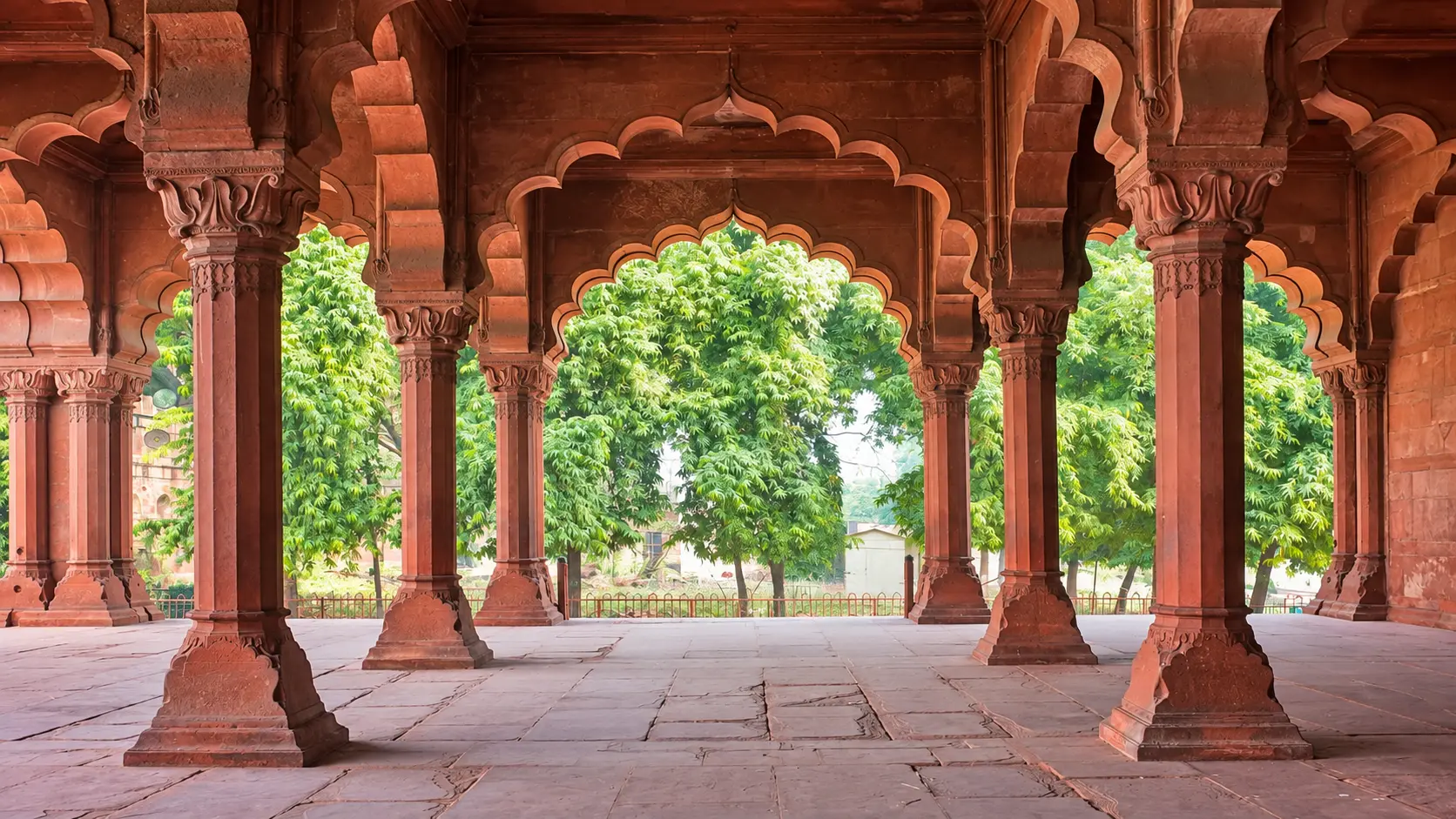
Beyond the Naubat Khana lies a vast open courtyard leading to the Diwan-i-Aam, the monumental hall where the Emperor held daily public court to dispense justice, inspect imperial horses and troops, and receive petitions from his subjects. The hall is a grand open pavilion of red sandstone measuring 24 by 20 meters, supported by three rows of delicate multi-foliated sandstone pillars dividing the interior into 27 graceful arched bays.
At the center of the eastern wall stands the Emperor’s elevated white marble throne canopy (Jharokha), standing upon an ornate marble dais known as the Nashiman-i-Zill-i-Ilahi ("Seat of the Shadow of God"). The back wall of the marble niche is covered with exquisite pietra dura (parchin kari) panels crafted by master Florentine stone carvers, led by Austin of Bordeaux. These semi-precious stone inlays depict birds, flowering fruit trees, and the mythical Greek musician Orpheus seated under a tree playing his lute, with wild beasts (lions, leopards, and hares) resting peacefully around him - a visual allegory chosen by Shah Jahan to symbolize the peace, harmony, and divine justice of his reign.
Nahr-i-Bihisht and the Imperial Palaces
Along the eastern rampart, overlooking what was once the flowing Yamuna River, stands a continuous terrace of pristine royal pavilions constructed of white marble and red sandstone. Through the center of all these pavilions flowed the Nahr-i-Bihisht ("Stream of Paradise"), an artificial channel fed by Yamuna waters lifted by Persian waterwheels (rahats) at the northeastern Shah Burj tower. The stream cascaded through marble sluices, cooled the living quarters, and fed intricate indoor fountains:
- Diwan-i-Khas (Hall of Private Audience): The supreme jewel of the imperial apartments. Built entirely of pure white marble, this columned rectangular hall features 32 multi-faceted pillars decorated with exquisite pietra dura floral inlays of carnelian, lapis lazuli, jasper, and jade. The ceiling was originally lined with solid silver sheets inlaid with gold leaf (later melted down by the Marathas in 1760). Inscribed in elegant gilded Naskh script on the arches is the immortal Persian couplet by Amir Khusrau:
"Agar firdaus bar ru-ye zamin ast, Hamin ast-o hamin ast-o hamin ast"
(If there be a paradise on earth, it is this, it is this, it is this!)
At the center of the hall stood the world-famous Peacock Throne (Takht-i-Taus), constructed of solid gold, encrusted with rubies, emeralds, and pearls, and crowned by two jeweled peacocks flanking the celebrated Koh-i-Noor diamond. The throne was seized by the Persian ruler Nadir Shah during his sack of Delhi in 1739. - Khas Mahal (The Emperor’s Private Palace): Situated south of the Diwan-i-Khas, this intimate palace comprises three suites: the Tasbih Khana (chamber for private prayer and telling beads), the Khwabgah ("Dream House" or imperial bedchamber), and the Toshakhana (royal robe chamber). Connected to the eastern wall is the Muthamman Burj, an octagonal projecting balcony tower from which the Emperor appeared every morning at sunrise for Jharokha Darshan to acknowledge the thousands of subjects waiting on the riverbanks below.
- Rang Mahal (Palace of Colors): Housed the chief queens, consorts, and royal mistresses. The palace is renowned for its central white marble lotus fountain basin, intricately carved into the floor, over which the waters of the Stream of Paradise swirled. Its mirrors and gilded ceilings gave it the name "Palace of Colors."
- Mumtaz Mahal: Located at the southern end of the terrace, once the residence of imperial princesses, now housing the Red Fort Archaeological Museum, exhibiting Mughal jade vessels, manuscripts, celadon porcelain, and calligraphy.
- Moti Masjid (Pearl Mosque): Located beside the royal baths (Hammam), this exquisite small three-domed mosque of pure white Makrana marble was built in 1659 - 1660 by Emperor Aurangzeb as his private sanctuary, featuring scalloped arches and ornate floral parapets.
Hayat Bakhsh Bagh and Zafar Mahal
In the northern section of the fort lies the Hayat Bakhsh Bagh ("Life-Bestowing Garden"), a 200-square-meter formal quadrilateral Persian water garden divided into four quadrants by stone causeways and deep water channels. At the northern and southern ends of the central reservoir stand two matching white marble pavilions named Sawan and Bhadon (named after the two Hindu monsoon months). Water cascaded from niches behind which candles were placed at night, creating a shimmering curtain of illuminated water. In the center of the water tank sits the Zafar Mahal, a red sandstone pavilion constructed in 1842 by Bahadur Shah Zafar, the last Mughal Emperor of India.
British Colonial Barracks and Kranti Mandir Museums
Following the suppression of the 1857 Uprising, the British military expelled the royal family, demolished nearly four-fifths of the delicate Mughal inner pavilions and zenana courts, and erected two-storey red-brick Victorian army barracks to garrison troops. Today, these conserved barracks house the Kranti Mandir museum complex, curated to celebrate India's freedom fighters:
- Netaji Subhas Chandra Bose and INA Museum: Commemorates the Azad Hind Fauj and details the historic 1945 - 1946 INA trials held right inside the Red Fort.
- Yaad-e-Jallian Museum: A moving multimedia memorial marking the centenary of the 1919 Jallianwala Bagh massacre.
- Museum of 1857 (Azadi ke Deewane): Chronicles the brave rebellion of soldiers, peasants, and rulers against the East India Company.
- Drishyakala Art Gallery: Showcases over 400 Indian masterworks from colonial to contemporary times.
Best time to visit
The vast, predominantly open-air grounds of the Red Fort make seasonal climate a major consideration: - October…Explore detailsClose details
Seasonal Guide
The vast, predominantly open-air grounds of the Red Fort make seasonal climate a major consideration:
- October to November (Autumn / Post-Monsoon): An ideal window to tour the fort. Clear, pleasant weather with temperatures between 22°C and 30°C allows comfortable walking through the gardens and along the ramparts without oppressive heat.
- December to February (Winter): Widely considered the finest season for sightseeing. Daytime highs hover between 18°C and 23°C, accompanied by crisp winter air and gentle sunshine. Morning mist can shroud the Lahori Gate in an atmospheric haze, while afternoon sunlight illuminates the red sandstone and marble inlays in vivid detail.
- March (Early Spring): A pleasant month featuring blooming flowers across Hayat Bakhsh Bagh and daytime temperatures around 24°C to 28°C before summer heat sets in.
- April to June (Summer): Summer in Old Delhi is punishing, with temperatures soaring between 40°C and 45°C. The vast exposed stone courtyards of the Diwan-i-Aam and gardens radiate intense heat. Midday visits are physically grueling. Check the current visiting hours and permitted access with the site operator before departure; ceremonies, closures and visitor sessions can affect access.
- July to September (Monsoon): Heavy monsoon showers wash the red sandstone into rich, dark burgundy tones. While overcast skies reduce direct sun glare, high relative humidity (75% - 85%) can make prolonged walking sticky.
Optimal Time of Day
- Early Morning (06:00 AM - 08:30 AM): The best strategy to experience the fort in majestic solitude. The rising sun illuminates the red sandstone walls of the Lahori Gate, and you can explore the Diwan-i-Aam and imperial palaces before thousands of visitors arrive.
- Late Afternoon to Sunset (03:30 PM - 06:00 PM): Golden hour brings warm honey and crimson reflections across the marble pavilions, followed by the evening call to prayer echoing from the minarets of nearby Jama Masjid.
- Evening Sound and Light Show (07:00 PM - 09:00 PM): After dark, the fort hosts Jai Hind, an advanced sound-and-light projection mapping show that illuminates the ramparts, bringing the epic history of the Mughal court and the freedom struggle to life.
How to reach
The Red Fort is situated along Netaji Subhash Marg at the eastern end of Chandni Chowk in Central Delhi (PIN…Explore detailsClose details
The Red Fort is situated along Netaji Subhash Marg at the eastern end of Chandni Chowk in Central Delhi (PIN: 110006), directly opposite the historic Mughal market and Digambar Jain Lal Mandir.
By Delhi Metro
The Delhi Metro network provides the fastest, most reliable way to avoid Old Delhi's notorious vehicular traffic:
- Lal Quila Metro Station (Violet Line [Line 6]): The closest and most convenient station, located just 200 meters west of the fort entrance. Taking Gate 1 or Gate 2, visitors can walk to the main visitor reception pavilion in less than 3 minutes.
- Chandni Chowk Metro Station (Yellow Line [Line 2]): Situated approximately 1.2 kilometers west along the pedestrianized Chandni Chowk avenue. Taking the exit toward Town Hall, visitors can enjoy a 15-minute walk down the historic market promenade, or take a 3-minute ride by electric battery rickshaw (e-rickshaw).
- Jama Masjid Metro Station (Violet Line [Line 6]): Located roughly 800 meters southwest (Gate 3 exit), offering a pleasant 10-minute walk through Old Delhi's heritage bazaars.
By Road, Taxis, and Autos
- Key Approaching Arteries: The fort is accessible via Netaji Subhash Marg from the south (Daryaganj / Delhi Gate), Mahatma Gandhi Marg (Ring Road) from the east and north, and Shyama Prasad Mukherjee Marg from Old Delhi Railway Station.
- App-Based Taxis & Auto-Rickshaws: Ride-hailing services (Uber, Ola, BluSmart) and three-wheeled autorickshaws have designated pick-up and drop-off zones at the 15 August Park visitor concourse, located directly across Netaji Subhash Marg opposite Lahori Gate.
- Self-Driving & Parking: Due to dense Old Delhi traffic, self-driving is discouraged. However, a multi-level automated underground parking facility is available directly opposite the fort at Gandhi Maidan near Chandni Chowk, and at the Asaf Ali Road parking plaza near Delhi Gate.
From Major Transit Hubs
- From Old Delhi Railway Station (DLI): Located just 1.5 kilometers west. A direct 5-to-8-minute autorickshaw or e-rickshaw ride down SPM Marg, or a 15-minute walk through the market.
- From New Delhi Railway Station (NDLS): Approximately 4 kilometers south. Take the Yellow Line from New Delhi Station two stops to Chandni Chowk, or take a pre-paid taxi via Asaf Ali Road (approx. 15 to 20 minutes).
- From Hazrat Nizamuddin Railway Station (NZM): Approximately 9 kilometers south. A 25-minute taxi ride down Mathura Road and Netaji Subhash Marg, or board the Pink Line to Lajpat Nagar and transfer to the Violet Line to Lal Quila.
- From Indira Gandhi International Airport (DEL): Positioned roughly 18 kilometers southwest. The most efficient route is boarding the Airport Express Orange Line from Terminal 3 to New Delhi Station, then transferring to the Yellow Line to Chandni Chowk (total transit time ~40 minutes). Alternatively, a pre-paid taxi via the Ring Road takes 40 to 60 minutes depending on peak traffic.
Entry, timings and permissions
Fees, visiting hours and entry rules may change.Explore detailsClose details
Fees, visiting hours and entry rules may change. Confirm the latest details with the official operator or local authority before travelling.
Entry Fees and Ticket Categories
The Red Fort is maintained as a Category A Centrally Protected World Heritage Site by the Archaeological Survey of India (ASI):
- Indian Citizens, SAARC, and BIMSTEC Nationals: ₹35 per person for online cashless digital bookings via the ASI portal or QR code; ₹40 per person when purchasing physical paper tokens at the on-site cash counter.
- Foreign Tourists (Non-SAARC / Non-BIMSTEC): ₹550 per person for online/cashless digital bookings; ₹600 per person at the cash counter.
- Children: Free admission for all children below the age of 15 years upon age verification.
- Museums Inside Barracks: Access to the specialized Kranti Mandir museums (Netaji Museum, 1857 Museum) requires an additional museum ticket (approx. ₹30 for Indians, ₹250 for foreigners), which can be purchased bundled with monument entry.
- Sound and Light Show Tickets: Separate evening tickets are sold for Jai Hind at the dedicated ticket counter (approx. ₹80 to ₹100 for standard seating; ₹500 for VIP seating).
Timings and Operating Schedules
- Monument Grounds & Palaces: Open Tuesday through Sunday from sunrise to sunset (officially from approximately 06:00 AM to 06:00 PM).
- Museum Galleries in Barracks: Open from 09:00 AM to 05:00 PM.
- WEEKLY CLOSURE: The Red Fort is STRICTLY CLOSED ON MONDAYS all year round for weekly structural maintenance and garden conservation.
- Annual Security Closures: The fort is closed to the public annually for approximately 7 to 10 days in early to mid-August (usually around August 8 to August 15) for official security sanitization and rehearsals for the National Independence Day celebrations.
Photography and Equipment Regulations
- Handheld Photography: Non-commercial still photography, mobile phone snapshots, and tourist videography are completely free and permitted throughout all open courtyards, gardens, and around palace exteriors.
- Tripods, Gimbals & Commercial Productions: In accordance with statutory ASI regulations across World Heritage Sites, the use of camera tripods, monopods, lighting stands, and professional film production equipment is strictly regulated. Commercial filming, fashion model portfolios, and documentary video recording require prior formal written approval, security clearances, and licensing fee payments to the Superintending Archaeologist, ASI Delhi Circle.
- Drone Regulations: Flying uncrewed aerial vehicles (drones/UAVs) of any class over or near the Red Fort is strictly prohibited. The site is a high-security national defense and civil aviation Red Zone; unauthorized drone operations will result in immediate equipment confiscation and criminal prosecution under Indian national security laws.
Security and Entry Protocols
- Because the Red Fort is India’s foremost national ceremonial landmark, visitors must pass through multi-tiered security screening, baggage scanners, and door-frame metal detectors operated by the Central Industrial Security Force (CISF) and Delhi Police.
- Prohibited items include sharp objects, pocket knives, lighters, matches, cigarettes, chewing tobacco, alcohol, and large luggage suitcases.
- A free visitor cloakroom is available near the main ticketing pavilion outside Lahori Gate for depositing daypacks and unauthorized items.
Nearby places to consider
Because the Red Fort anchors the historic heart of Shahjahanabad, it is surrounded by Delhi's most celebrated…Explore detailsClose details
Because the Red Fort anchors the historic heart of Shahjahanabad, it is surrounded by Delhi's most celebrated medieval mosques, historic bazaars, and cultural monuments:
Jama Masjid
Located just 800 meters southwest of the Red Fort (a 10-minute walk down Netaji Subhash Marg or brief e-rickshaw ride), Jama Masjid is one of India's largest and most majestic mosques. Commissioned by Emperor Shah Jahan in 1650 and completed in 1656, this grand red sandstone and white marble congregational sanctuary features a vast courtyard capable of accommodating 25,000 worshippers, two 40-meter-tall minarets offering panoramic views across Old Delhi, and three bulbous marble domes.
Chandni Chowk (Moonlit Square)
Stretching directly westward from the Lahori Gate of the Red Fort to Fatehpuri Masjid, Chandni Chowk was designed in 1650 by Shah Jahan’s favorite daughter, Princess Jahanara. Once featuring a central canal that reflected the moonlight, this vibrant heritage avenue was recently pedestrianized with red sandstone paving. It is home to historic wholesale specialty markets including Dariba Kalan (silver jewellery and attar perfumes), Kinari Bazaar (wedding lace and zardozi embroidery), and Khari Baoli (Asia's largest wholesale spice market).
Gurudwara Sis Ganj Sahib
Situated roughly 600 meters west along Chandni Chowk, this revered historic Sikh shrine marks the site of the martyrdom of Guru Tegh Bahadur, the ninth Sikh Guru, who was beheaded in 1675 on the orders of Mughal Emperor Aurangzeb for defending the religious freedom of Kashmiri Hindus. The gurudwara features a gold-domed sanctum, an inspiring museum of Sikh history, and a round-the-clock free community kitchen (langar).
Digambar Jain Lal Mandir and Charity Birds Hospital
Located directly opposite the Red Fort's Lahori Gate at the entrance to Chandni Chowk, this is Delhi's oldest Jain temple, founded in 1656 during the reign of Shah Jahan. Built of red sandstone, the temple complex houses the unique Charity Birds Hospital, a veterinary sanctuary founded in 1956 where wounded and rescued birds are treated and nursed back to health in accordance with the Jain principle of non-violence (ahimsa).
Kashmiri Gate and St. James' Church
Positioned roughly 2.0 kilometers north along Lothian Road, Kashmiri Gate was the northern bastion of Shahjahanabad, heavily damaged during the British assault in the 1857 Uprising. Nearby stands St. James’ Church (Church of the Skinner's Horse), consecrated in 1836 as the oldest surviving church in Delhi, designed in the neoclassical Greek cruciform style.
In pictures
The practical bits
Before you go.
Plan ahead
To experience the vast grandeur of the Red Fort with ease, observe these proven visitor recommendations:Explore detailsClose details
To experience the vast grandeur of the Red Fort with ease, observe these proven visitor recommendations:
Pacing Your Route and Duration
Budget at least three to three-and-a-half hours for your visit.Explore detailsClose details
Budget at least three to three-and-a-half hours for your visit. Enter through Lahori Gate, browse Chhatta Chowk, admire the Naubat Khana, and step into the vast courtyard of Diwan-i-Aam. Follow the Stream of Paradise along the eastern marble pavilions (Rang Mahal, Khas Mahal, Diwan-i-Khas, Moti Masjid), explore Hayat Bakhsh Bagh, and conclude your visit by touring the Netaji INA Museum inside the British colonial barracks.
Timing to Avoid Peak Crowds
Visit on a weekday morning between 07:00 AM and 09:30 AM (Tuesday through Thursday).Explore detailsClose details
Visit on a weekday morning between 07:00 AM and 09:30 AM (Tuesday through Thursday). The Red Fort attracts tens of thousands of school groups, domestic tourists, and international travelers on weekends, resulting in long security queues. An early morning weekday arrival guarantees direct entry, mild temperatures, and unhurried photography.
Comfort, Hydration, and Footwear
The fort complex spans over 250 acres with extensive walking over stone pathways, gravel tracks, and open lawns.Explore detailsClose details
The fort complex spans over 250 acres with extensive walking over stone pathways, gravel tracks, and open lawns. Wear supportive walking shoes or trainers. In summer, carry an umbrella, sun hat, UV sunglasses, and an insulated water bottle. Filtered RO drinking water kiosks and modern, sanitized restrooms are located near the Diwan-i-Aam courtyard and behind the colonial barracks.
Combining with Old Delhi's Street Food
After completing your tour of the fort, walk across Netaji Subhash Marg into the vibrant labyrinth of Chandni…Explore detailsClose details
After completing your tour of the fort, walk across Netaji Subhash Marg into the vibrant labyrinth of Chandni Chowk. Savor legendary Old Delhi culinary delights: crisp stuffed paranthas at the 150-year-old Gali Paranthe Wali, piping-hot jalebis fried in pure desi ghee at the Old Famous Jalebi Wala, rabri falooda at Giani's, and rich Mughlai kebabs and butter chicken at Karim’s and Al Jawahar near Jama Masjid.
A few things you might wonder
Common questions about visiting Red Fort (Lal Qila). Fees, visiting hours and ceremonies are researched details that may change; confirm current arrangements with the operator before travelling.
Who built the Red Fort, and why was it constructed?
Why is the fort called the Red Fort or Lal Qila?
What was the Peacock Throne, and where was it kept?
What is the famous Persian inscription carved inside the Diwan-i-Khas?
What are the opening hours and ticket prices for the Red Fort?
Why is the Red Fort significant on India’s Independence Day?
Which metro station is closest to the Red Fort?
What are the Kranti Mandir museums inside the Red Fort?
Explore more in New Delhi
Discover other destinations around this hub
More Hubs in Delhi Ncr
Continue exploring other travel hubs in this state
Planning a trip to New Delhi?