Qutub Minar
Comprehensive guide to Qutub Minar in New Delhi. Discover the world's tallest brick minaret, the rustless 1,600-year-old Iron Pillar, Alai Darwaza, tickets, and timings.
Location
New Delhi, Delhi NCR
A closer look
Your visit, at a glance.
New Delhi, Delhi Ncr
GET TO KNOW THE PLACE
---
The story of Qutub Minar
Start here. Open a tile for the full details.
Why goRead details
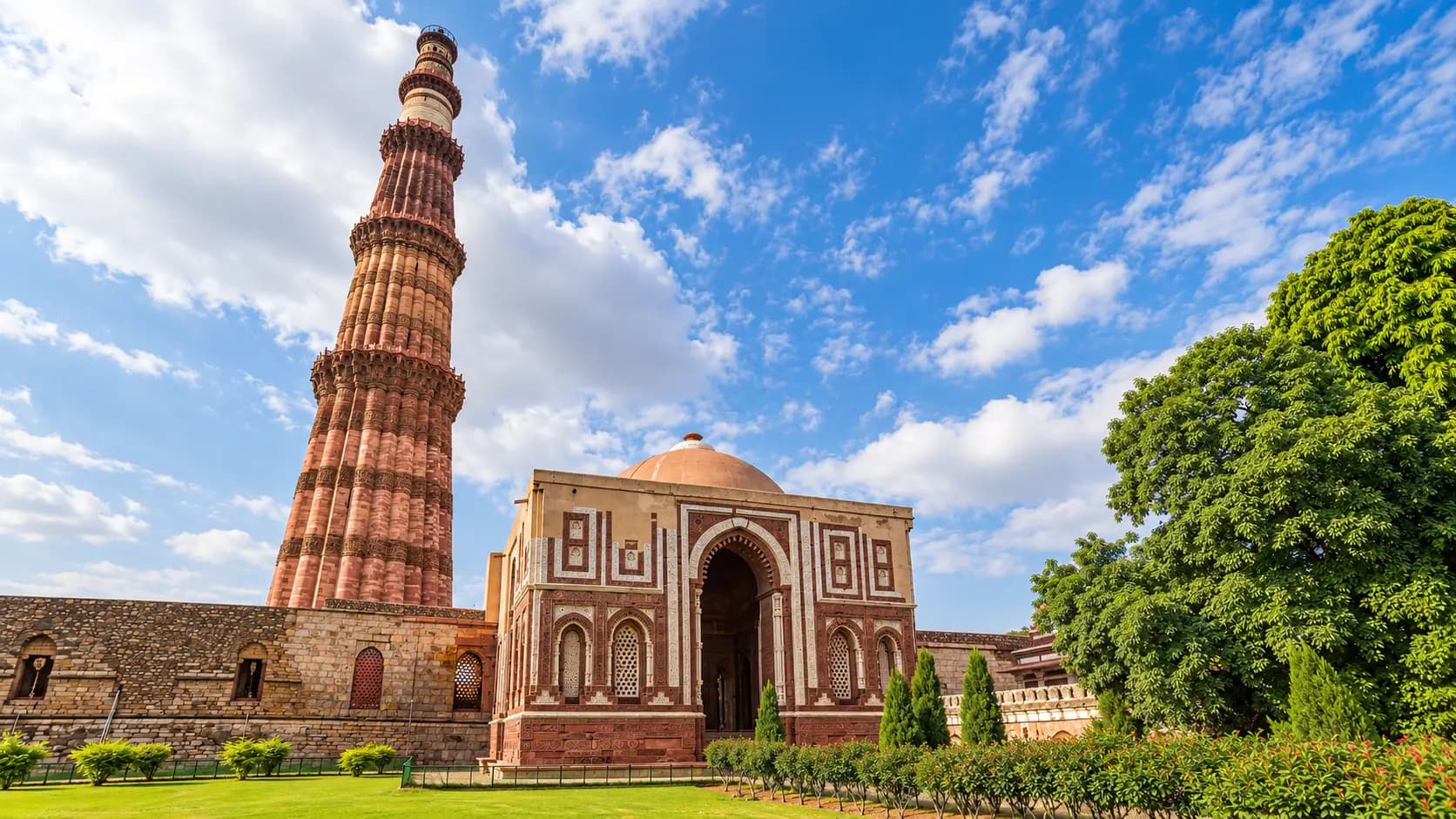
Dominating the southern horizon of Delhi like an exclamation mark of imperial ambition, the Qutub Minar is one of the world's supreme monuments of medieval masonry engineering and the centerpiece of an inscribed UNESCO World Heritage Site (1993, Ref: 233). Rising to a dizzying height of 72.5 meters (237.8 feet) above the ancient quartzite rocky ridge of Mehrauli, this soaring tower of red sandstone, buff stone, and white marble is the tallest individual brick minaret on earth. Commenced in 1199 CE by Qutb-ud-din Aibak, the founder of the Delhi Sultanate, the minaret was erected as both a minar (a tower from which the faithful are called to prayer) and a monumental Qutb (pivot, pole, or victory tower) to celebrate the establishment of Muslim rule across the Gangetic plains.
When to visitRead details
- October to November (Autumn / Post-Monsoon): Widely considered the finest season to visit. The skies are brilliant blue, the monsoon rains leave the surrounding lawns vibrant, and temperatures hover between 22°C and 30°C. Walking between the sandstone monuments in dry, mild weather is thoroughly enjoyable.
- December to February (Winter): The peak tourism season. Temperatures are cool and pleasant, ranging from 10°C in the morning to 22°C in the afternoon. Winter sunlight casts warm golden tones across the fluted red sandstone, while morning mist occasionally swirls around the upper marble storeys. Expect larger crowd volumes on weekend afternoons.
- March (Early Spring): A lovely month with temperatures around 22°C to 28°C and colorful seasonal flowerbeds in full bloom across the gardens before summer heat arrives.
- April to June (Summer): Extreme summer weather brings temperatures of 40°C to 44°C. Because the stone courtyards, ruins, and lawns have limited overhead shade, visiting during midday can be physically taxing. Check the current visiting hours and permitted access with the site operator before departure; ceremonies, closures and visitor sessions can affect access.
- July to September (Monsoon): Frequent showers wash the sandstone facades into deep terracotta and crimson shades. While humidity is high (70% - 85%), overcast skies provide diffused lighting that architectural photographers prize.
Entry & permissionsRead details
Fees, visiting hours and entry rules may change. Confirm the latest details with the official operator or local authority before travelling.
Entry Fees and Ticket Categories
Qutub Minar is maintained as a Category A Centrally Protected World Heritage Site by the Archaeological Survey of India (ASI). Admission fees follow the statutory World Heritage tariff:
- Indian Citizens, SAARC, and BIMSTEC Nationals: ₹35 per person when purchasing digital cashless tickets online via the ASI portal or QR code; ₹40 per person when purchasing physical paper tokens at the on-site cash counter.
- Foreign Tourists (Non-SAARC / Non-BIMSTEC): ₹550 per person for online/cashless digital bookings; ₹600 per person at the cash counter.
- Children: Free admission for all children below the age of 15 years upon age verification.
- Video Camera Permit: ₹25 for personal, non-commercial video cameras (still cameras are free).
- Cashless Digital Booking: Visitors can scan the official ASI QR code boards prominently displayed outside the ticketing pavilion to book tickets instantly on their smartphones via UPI, credit/debit cards, or net banking, bypassing the cash counter lines.
Timings and Operating Schedules
- General Monument Hours: Open daily from sunrise to sunset (officially from approximately 06:00 AM to 06:00 PM), all 365 days of the year, including all Sundays and national public holidays.
- Night Illumination: Architectural floodlighting is illuminated daily from sunset until 10:00 PM. Visitors can admire the illuminated minaret from the exterior plazas and surrounding cafes.
- Ticket Counter Timings: Physical ticket windows close 45 minutes before sunset.
Photography and Equipment Regulations
- Handheld Photography: Non-commercial still photography and mobile phone snapshots are completely free and permitted throughout all monument courtyards, viewing terraces, and garden lawns.
- Tripods, Gimbals & Commercial Productions: In accordance with statutory ASI regulations across World Heritage Sites, the use of camera tripods, monopods, lighting stands, and professional video production equipment is strictly regulated. Commercial filming, fashion model shoots, and documentary video recording require prior formal written approval, security clearances, and licensing fee payments to the Superintending Archaeologist, ASI Delhi Circle.
- Drone Regulations: Flying uncrewed aerial vehicles (drones/UAVs) of any class over or near the Qutb Complex is strictly prohibited. The site is subject to strict DGCA/Delhi Police No-Fly regulations; unauthorized drone operations will result in immediate equipment seizure and criminal prosecution.
Conservation and Monument Etiquette
- No Minaret Climbing: The internal spiral staircase of the Qutub Minar is permanently sealed to all visitors. Attempting to enter or climb the tower is strictly prohibited.
- Iron Pillar Protection: Visitors must respect the protective metal railing installed around the 1,600-year-old Iron Pillar. Touching, climbing, or leaning over the barrier is strictly disallowed to preserve the delicate metal surface from human skin oils.
- Preserving Ancient Spolia: Carving graffiti into ancient stone carvings, climbing onto fragile lintels, or touching delicate calligraphic plasterwork is strictly prohibited and punishable under the Ancient Monuments and Archaeological Sites and Remains Act.
Plan your visitRead details
The Qutb Complex is located on Mehrauli-Badarpur Road (MB Road) at the Sri Aurobindo Marg crossing in Mehrauli, South Delhi (PIN: 110030).
Explore the full guide - choose a topic below.
Why visit?
Dominating the southern horizon of Delhi like an exclamation mark of imperial ambition, the Qutub Minar is one of…Explore detailsClose details
Dominating the southern horizon of Delhi like an exclamation mark of imperial ambition, the Qutub Minar is one of the world's supreme monuments of medieval masonry engineering and the centerpiece of an inscribed UNESCO World Heritage Site (1993, Ref: 233). Rising to a dizzying height of 72.5 meters (237.8 feet) above the ancient quartzite rocky ridge of Mehrauli, this soaring tower of red sandstone, buff stone, and white marble is the tallest individual brick minaret on earth. Commenced in 1199 CE by Qutb-ud-din Aibak, the founder of the Delhi Sultanate, the minaret was erected as both a minar (a tower from which the faithful are called to prayer) and a monumental Qutb (pivot, pole, or victory tower) to celebrate the establishment of Muslim rule across the Gangetic plains.
Yet Qutub Minar is far more than a single solitary tower. It forms the nucleus of the Qutb Complex, an extraordinary archaeological palimpsest that preserves the physical transition from classical Hindu and Jain civilization into the vibrant architectural traditions of the Indo-Islamic Sultanate. Here stands the venerable Quwwat-ul-Islam Mosque ("Might of Islam"), begun in 1192 CE as the earliest surviving congregational mosque in Northern India, constructed from the elaborately carved stone pillars, capitals, and ceiling brackets of 27 demolished pre-existing temples. Rising within its central open courtyard stands one of human metallurgy's greatest enigmas: the Iron Pillar of Delhi, a 7.2-meter column of 98% pure wrought iron forged during the golden age of the Gupta Empire (circa 4th - 5th century CE) that has stood completely exposed to rain, sun, and seasonal monsoon moisture for more than 1,600 years without rusting or deteriorating.
Around the central courtyard, successive Sultanate rulers left an astonishing architectural dialogue of rivalry and ambition. Sultan Shams-ud-din Iltutmish added his own richly carved red sandstone mausoleum in 1235 - an open-roofed marvel whose interior walls are chiseled with staggering geometric and calligraphic complexity. A century later, the ambitious Sultan Ala-ud-din Khalji commissioned the Alai Darwaza (1311 CE), celebrated by architectural historians as the finest single gem of Indo-Islamic architecture, introducing true structural horseshoe arches, marble lattice jalis, and the first true hemispherical dome on the subcontinent. Beside it stands the colossal, brooding stump of the Alai Minar, intended by Khalji to soar twice the height of Qutub Minar before being abandoned upon his death. Set amidst lush, green lawns framed by ancient neem trees and bathed in dramatic golden architectural floodlighting after nightfall, the Qutb Complex offers an unforgettable encounter with the monumental dawn of Delhi's imperial history.
What to expect
Visiting the Qutb Complex is an expansive open-air journey across several acres of conserved ruins, paved stone…Explore detailsClose details
Visiting the Qutb Complex is an expansive open-air journey across several acres of conserved ruins, paved stone pathways, and manicured archaeological lawns. Visitors should prepare for extensive walking across stone courtyards, raised plinths, and garden causeways.
The Great Minaret: Architecture, Inscriptions, and Storeys
The Qutub Minar rises in five distinct, tapering storeys from a base diameter of 14.3 meters (47 feet) to a slender diameter of just 2.75 meters (9 feet) at its apex. Each storey is separated by an ornate, cantilevered balcony supported by clusters of delicate stalactite-like stone corbels (muqarnas) that transfer the structural load outward with breathtaking elegance. The tower’s exterior surfaces are carved into dramatic alternating vertical flutings - semicircular and angular ribs on the first storey, purely semicircular rounded flutings on the second, and purely sharp angular flutings on the third.
The construction of the tower represents a collaborative architectural dialogue spanning three centuries:
- First Storey (1199 CE): Built under Qutb-ud-din Aibak using rich red sandstone, the basement and first storey are encircled by six horizontal bands of magnificent Arabic calligraphy carved in the ornate Naskh and foliated Thuluth scripts. The inscriptions weave verses from the Holy Quran, praise the 99 names of Allah, and record royal dedications to Sultan Mu'izz-ud-din Muhammad Ghori and Aibak himself.
- Second, Third, and Fourth Storeys (1220 CE): Completed by Aibak’s son-in-law and successor, Sultan Shams-ud-din Iltutmish, who added three successive storeys of red and buff sandstone, completing the minaret to its original height.
- The Top Storeys and Marble Reconstruction (1368 CE): In 1368, lightning struck the upper storey, causing severe structural fracturing. Sultan Firoz Shah Tughlaq undertook a radical repair, dismantling the damaged fourth storey and rebuilding it into two distinct upper storeys faced with pure white Makrana marble and bands of red sandstone, crowning the tower at its modern height of 72.5 meters.
- Smith’s Folly (1828): Following an earthquake in 1803, British military engineer Major Robert Smith repaired the tower and added an elaborate red sandstone cupola (chhatri) atop the fifth storey in 1828. Recognizing that this colonial-Gothic-cum-Mughal pavilion clashed terribly with the Afghan architecture below, Governor-General Lord Hardinge ordered it dismantled in 1848. The cupola was lowered to ground level and now rests peacefully on the outer garden lawns as an architectural curiosity known to history as "Smith’s Folly."
(Note on Internal Access: The interior of the minaret contains a narrow spiral staircase of 379 stone steps. Following a tragic power failure and stampede on December 4, 1981, that claimed 45 lives, internal access to the minaret has been permanently barred to the public by the Archaeological Survey of India).
Quwwat-ul-Islam Mosque (1192 - 1198 CE)
Directly adjacent to the northeast of the minaret lies the Quwwat-ul-Islam Mosque ("The Might of Islam"), the earliest surviving congregational mosque built in Northern India following the capture of Delhi by the Ghurid forces. Commissioned by Qutb-ud-din Aibak, the mosque was constructed upon the elevated plinth of an earlier fort temple.
The mosque’s open rectangular courtyard (measuring 43 by 32 meters) is framed by covered cloisters (riwaqs) supported by hundreds of elaborately carved stone pillars, capitals, and corbelled ceiling slabs taken as spolia from 27 pre-existing Hindu and Jain temples located in the vicinity. The foundation inscription in Arabic chiseled over the eastern gate explicitly records: "The materials of 27 temples, on each of which two million Deliwals had been spent, were used in this mosque." Intricately carved stone shafts depicting bell-and-chain motifs, floral urns (kalashas), kirtimukhas (faces of glory), and geometric bands were reassembled by local Indian stonemasons into Islamic colonnades.
In 1199, Aibak erected a colossal stone screen across the western prayer sanctuary, consisting of five soaring corbelled pointed arches. The central arch rises 16 meters (53 feet) high. Because the local Hindu masons employed by Aibak did not know the engineering principle of the true radiating voussoir arch, they constructed the screen using indigenous horizontal corbelling techniques, subsequently carving the stone surface into an exquisite tapestry of sinuous vines, naturalistic acanthus leaves, and intertwined Arabic calligraphy. The mosque was later expanded westward by Iltutmish in 1230 and southward by Ala-ud-din Khalji in 1315.
The 1,600-Year-Old Rustless Iron Pillar
Standing proudly in the center of the Quwwat-ul-Islam courtyard is the world-renowned Iron Pillar of Delhi, one of the most astonishing metallurgical enigmas of human antiquity. Standing 7.21 meters (23 feet 8 inches) tall with a diameter of 42 centimeters at the base, and weighing more than six tonnes (approx. 6,511 kg), this massive pillar was forged during the golden age of the Gupta Empire (circa 375 - 415 CE).
A deeply cut six-line, three-stanza Sanskrit inscription in ancient Gupta Brahmi script on its western face records that the pillar was set up as a standard (dhvaja) of Lord Vishnu on the hill known as Vishnupada by a powerful monarch named Chandra, identified by historians as Emperor Chandragupta II Vikramaditya. The pillar was brought to Delhi centuries later, likely by the Tomar Rajput king Anangpal in the 11th century.
What has fascinated scientists, metallurgists, and travelers for centuries is that despite standing completely exposed to the elements - enduring scorching summer heat, driving monsoon downpours, and winter dew for over sixteen centuries - the iron pillar has not rusted. Scientific analysis by the Indian Institute of Technology (IIT) Kanpur confirmed that ancient Indian metalsmiths utilized a forge-welding technique with unrefined, high-phosphorus iron and no sulfur. The interaction of high phosphorus with atmospheric moisture formed a microscopic, protective passive film of crystalline iron hydrogen phosphate hydrate (misawite), just 0.05 millimeters thick, that seals the iron surface and renders it virtually corrosion-proof. (Note: To protect the historical inscription from the corrosive oils of human hands, the ASI has erected a protective metal barrier around the pillar).
Alai Darwaza (1311 CE)
Located at the southern entrance to the extended mosque enclosure, the Alai Darwaza ("Gate of Ala-ud-din") was erected in 1311 by Sultan Ala-ud-din Khalji. Architectural historians, including Percy Brown and Sir John Marshall, widely acclaim this square gatehouse as one of the most aesthetically perfect buildings in India.
The Alai Darwaza holds paramount structural importance as the first building in India constructed using true Islamic architectural engineering:
- It features true radiating voussoir arches - most notably the graceful, pointed horseshoe arch - rather than indigenous corbelled arches.
- It is capped by the earliest surviving true hemispherical structural dome in India, supported by sophisticated squinch arches across the square room's upper corners.
- The exterior facade is a masterwork of polychrome masonry, adorned with geometric inlays of red sandstone and white marble. The windows are fitted with delicate perforated marble lattice screens (jalis), while the outer arch frames are carved with calligraphic bands and fringed with spearhead cusps.
Alai Minar and Other Monuments
- The Alai Minar: Standing in the northern gardens, this colossal, brooding mass of rough quartzite rubble was begun in 1311 by Ala-ud-din Khalji, who intended to build an astronomical victory tower twice the height of Qutub Minar (over 145 meters tall). When Khalji died in 1316, his successors abandoned the megalomaniacal project. Today, the unfinished first storey stands 24.5 meters (80 feet) high, offering a dramatic contrast between raw ambition and finished mastery.
- Tomb of Iltutmish (1235 CE): Situated northwest of the mosque, this square red sandstone tomb was built by Sultan Iltutmish himself. While its original stone dome collapsed long ago, leaving the central cenotaph open to the sky, the interior walls are breathtaking. Every square centimeter is etched with delicate Quranic calligraphy, geometric knotwork, squinches, and Hindu-inspired bell-and-tassel motifs.
- Madrasa and Tomb of Ala-ud-din Khalji (1316 CE): An L-shaped complex comprising collegiate classrooms and the ruined tomb of the Khalji sultan.
- Imam Zamin’s Tomb (1538 - 1539 CE): Located near the Alai Darwaza, this delicate square tomb with pierced marble jalis was built for a Turkestani Sufi saint who lived in Delhi during the reigns of Sikandar Lodi and Humayun.
Best time to visit
The sprawling outdoor nature of the Qutb archaeological park makes seasonal timing an important factor: - October…Explore detailsClose details
Seasonal Guide
The sprawling outdoor nature of the Qutb archaeological park makes seasonal timing an important factor:
- October to November (Autumn / Post-Monsoon): Widely considered the finest season to visit. The skies are brilliant blue, the monsoon rains leave the surrounding lawns vibrant, and temperatures hover between 22°C and 30°C. Walking between the sandstone monuments in dry, mild weather is thoroughly enjoyable.
- December to February (Winter): The peak tourism season. Temperatures are cool and pleasant, ranging from 10°C in the morning to 22°C in the afternoon. Winter sunlight casts warm golden tones across the fluted red sandstone, while morning mist occasionally swirls around the upper marble storeys. Expect larger crowd volumes on weekend afternoons.
- March (Early Spring): A lovely month with temperatures around 22°C to 28°C and colorful seasonal flowerbeds in full bloom across the gardens before summer heat arrives.
- April to June (Summer): Extreme summer weather brings temperatures of 40°C to 44°C. Because the stone courtyards, ruins, and lawns have limited overhead shade, visiting during midday can be physically taxing. Check the current visiting hours and permitted access with the site operator before departure; ceremonies, closures and visitor sessions can affect access.
- July to September (Monsoon): Frequent showers wash the sandstone facades into deep terracotta and crimson shades. While humidity is high (70% - 85%), overcast skies provide diffused lighting that architectural photographers prize.
Optimal Time of Day
- Sunrise to Early Morning (06:00 AM - 08:30 AM): Highly recommended for photographers, architectural historians, and travelers who appreciate peaceful exploration. The rising sun bathes the eastern face of Qutub Minar in soft golden light, birds sing in the neem trees, and the grounds are blissfully quiet before tour buses arrive.
- Late Afternoon to Sunset (04:00 PM - 06:30 PM): The golden hour casts warm honey tones across the red sandstone flutings and marble inlays of Alai Darwaza.
- Evening Floodlighting (07:00 PM - 10:00 PM): After sunset, high-intensity warm architectural LED floodlights illuminate the entire 72.5-meter tower, the Iron Pillar, and the arches of the Quwwat-ul-Islam Mosque, creating an awe-inspiring spectacle visible for miles across South Delhi.
How to reach
The Qutb Complex is located on Mehrauli-Badarpur Road (MB Road) at the Sri Aurobindo Marg crossing in Mehrauli…Explore detailsClose details
The Qutb Complex is located on Mehrauli-Badarpur Road (MB Road) at the Sri Aurobindo Marg crossing in Mehrauli, South Delhi (PIN: 110030).
By Delhi Metro
The Delhi Metro Yellow Line provides fast, traffic-free connectivity to the site:
- Qutab Minar Metro Station (Yellow Line [Line 2]): The dedicated and closest metro station, situated approximately 1.2 kilometers south of the complex. Taking Gate 1 or Gate 2, visitors can reach the ticket gates via an easy 12-to-15-minute walk along the pedestrian walkway of Anuvrat Marg, or take a 3-minute ride by metered autorickshaw, electric rickshaw, or DTC feeder bus.
- Saket Metro Station (Yellow Line [Line 2]): Located roughly 2.0 kilometers east along Mehrauli-Badarpur Road. A quick 6-minute autorickshaw ride brings you straight to the main visitor plaza.
- Hauz Khas Metro Station (Yellow Line [Line 2] & Magenta Line [Line 8] Interchange): Positioned 3.5 kilometers north, offering convenient interchange access for travelers arriving directly from Indira Gandhi International Airport (Terminal 1) or Noida via the Magenta Line corridor.
By Road, Taxis, and Autos
- Approaching Roads: The complex sits at the nexus of Sri Aurobindo Marg (connecting Central Delhi and AIIMS to Mehrauli), Mehrauli-Badarpur Road, and Anuvrat Marg. It is easily reachable by car from Connaught Place (approx. 30 minutes), Saket (8 minutes), or Gurgaon/Gurugram (25 minutes via Mehrauli-Gurgaon Road).
- App-Based Taxis & Auto-Rickshaws: Ride-hailing cabs (Uber, Ola, BluSmart) and three-wheeled autorickshaws have designated drop-off points directly inside the paved vehicle concourse of the Qutb Complex parking plaza.
- Self-Driving & Parking: A large, modern multi-level and surface parking plaza managed by municipal authorities is located directly adjacent to the main ticketing gate, accommodating cars and tourist coaches for a nominal parking fee.
From Major Transit Hubs
- From New Delhi Railway Station (NDLS): Approximately 15 kilometers north. Direct 25-minute metro ride on the Yellow Line from New Delhi Station straight to Qutab Minar Station without any line changes. Total journey time is roughly 35 minutes.
- From Hazrat Nizamuddin Railway Station (NZM): Approximately 12 kilometers northeast. A 25-to-30-minute taxi ride down Lala Lajpat Rai Marg and Sri Aurobindo Marg, or take the Pink Line from Nizamuddin to Dilli Haat-INA and transfer to the Yellow Line to Qutab Minar.
- From Old Delhi Railway Station (DLI): Approximately 18 kilometers north. Direct Yellow Line ride from Chandni Chowk to Qutab Minar Station (approx. 32 minutes).
- From Indira Gandhi International Airport (DEL): Positioned roughly 13 kilometers west. The fastest route is boarding the Magenta Line (Line 8) from Terminal 1 directly to Hauz Khas, then transferring to the Yellow Line down to Qutab Minar (total travel time ~35 minutes). Alternatively, a pre-paid taxi or app-cab via Mahipalpur and Vasant Kunj takes 25 to 40 minutes depending on traffic.
Entry, timings and permissions
Fees, visiting hours and entry rules may change.Explore detailsClose details
Fees, visiting hours and entry rules may change. Confirm the latest details with the official operator or local authority before travelling.
Entry Fees and Ticket Categories
Qutub Minar is maintained as a Category A Centrally Protected World Heritage Site by the Archaeological Survey of India (ASI). Admission fees follow the statutory World Heritage tariff:
- Indian Citizens, SAARC, and BIMSTEC Nationals: ₹35 per person when purchasing digital cashless tickets online via the ASI portal or QR code; ₹40 per person when purchasing physical paper tokens at the on-site cash counter.
- Foreign Tourists (Non-SAARC / Non-BIMSTEC): ₹550 per person for online/cashless digital bookings; ₹600 per person at the cash counter.
- Children: Free admission for all children below the age of 15 years upon age verification.
- Video Camera Permit: ₹25 for personal, non-commercial video cameras (still cameras are free).
- Cashless Digital Booking: Visitors can scan the official ASI QR code boards prominently displayed outside the ticketing pavilion to book tickets instantly on their smartphones via UPI, credit/debit cards, or net banking, bypassing the cash counter lines.
Timings and Operating Schedules
- General Monument Hours: Open daily from sunrise to sunset (officially from approximately 06:00 AM to 06:00 PM), all 365 days of the year, including all Sundays and national public holidays.
- Night Illumination: Architectural floodlighting is illuminated daily from sunset until 10:00 PM. Visitors can admire the illuminated minaret from the exterior plazas and surrounding cafes.
- Ticket Counter Timings: Physical ticket windows close 45 minutes before sunset.
Photography and Equipment Regulations
- Handheld Photography: Non-commercial still photography and mobile phone snapshots are completely free and permitted throughout all monument courtyards, viewing terraces, and garden lawns.
- Tripods, Gimbals & Commercial Productions: In accordance with statutory ASI regulations across World Heritage Sites, the use of camera tripods, monopods, lighting stands, and professional video production equipment is strictly regulated. Commercial filming, fashion model shoots, and documentary video recording require prior formal written approval, security clearances, and licensing fee payments to the Superintending Archaeologist, ASI Delhi Circle.
- Drone Regulations: Flying uncrewed aerial vehicles (drones/UAVs) of any class over or near the Qutb Complex is strictly prohibited. The site is subject to strict DGCA/Delhi Police No-Fly regulations; unauthorized drone operations will result in immediate equipment seizure and criminal prosecution.
Conservation and Monument Etiquette
- No Minaret Climbing: The internal spiral staircase of the Qutub Minar is permanently sealed to all visitors. Attempting to enter or climb the tower is strictly prohibited.
- Iron Pillar Protection: Visitors must respect the protective metal railing installed around the 1,600-year-old Iron Pillar. Touching, climbing, or leaning over the barrier is strictly disallowed to preserve the delicate metal surface from human skin oils.
- Preserving Ancient Spolia: Carving graffiti into ancient stone carvings, climbing onto fragile lintels, or touching delicate calligraphic plasterwork is strictly prohibited and punishable under the Ancient Monuments and Archaeological Sites and Remains Act.
Nearby places to consider
Because Mehrauli is Delhi's oldest continuously inhabited urban center, the Qutb Complex is surrounded by an…Explore detailsClose details
Because Mehrauli is Delhi's oldest continuously inhabited urban center, the Qutb Complex is surrounded by an extraordinary concentration of historical and natural attractions:
Mehrauli Archaeological Park
Located directly across the road just 400 meters south of Qutub Minar, this sprawling 200-acre heritage park contains over 100 historically significant monuments spanning 1,000 years. Key highlights include the 1528 Jamali Kamali Mosque and Tomb (famed for its early Mughal architecture and exquisite painted ceiling tiles), the stepwell of Rajon ki Baoli (a stunning three-tiered 1506 subterranean stepwell), Balban’s Tomb (containing India’s earliest surviving true structural arch), and Metcalfe's colonial Dilkusha retreat. Confirm the current charge and what it includes with the operator or service provider. Visitor admission, vehicles, parking, activities and accommodation can have separate charges.
The Garden of Five Senses
Situated roughly 2.5 kilometers southeast in Said-ul-Ajaib near Saket (an 8-minute auto ride), the Garden of Five Senses is a 20-acre public park developed by Delhi Tourism. Designed around the five senses, it features theme gardens, stone sculptures, cascading water fountains, bamboo groves, an herb garden, and a solar energy park, offering a peaceful botanical retreat.
Hauz Khas Complex and Village
Located approximately 4.5 kilometers north along Sri Aurobindo Marg (a 12-minute taxi ride or 2 stops on the Yellow Line to Hauz Khas), the Hauz Khas Complex was established by Sultan Ala-ud-din Khalji in 1296 as a royal water reservoir. It features the picturesque lakeside ruins of Sultan Firoz Shah Tughlaq’s 14th-century madrasa and tomb, bordered by the trendy boutiques, art galleries, and lively cafes of Hauz Khas Village.
Chhatarpur Temple (Shri Adhya Katyayani Shaktipith Mandir)
Positioned roughly 4.0 kilometers south along Anuvrat Marg (a 10-minute auto ride or 2 metro stops to Chhatarpur), this colossal 70-acre temple complex built in 1974 is dedicated to Goddess Katyayani. Constructed entirely of pure white Makrana marble, it is one of the largest Hindu temple complexes in India, featuring towering shikharas, intricate marble carvings, and grand prayer halls.
Sanjay Van Forest Reserve
Located immediately adjacent to the west of the Qutb Complex, Sanjay Van is a sprawling 783-acre protected reserve forest along the southern Delhi ridge. Featuring ancient quartzite rocky outcrops, dense vilayati kikar and dhau woodlands, and historic watchtowers from the 12th-century Rajput citadel of Lal Kot, it is a premier sanctuary for birdwatchers and nature trail walkers.
In pictures
The practical bits
Before you go.
Plan ahead
To make the most of your journey through the architectural wonders of the Qutb Complex, observe these essential…Explore detailsClose details
To make the most of your journey through the architectural wonders of the Qutb Complex, observe these essential recommendations:
Optimal Pacing and Time Allocation
Allow at least two to two-and-a-half hours to thoroughly explore the site.Explore detailsClose details
Allow at least two to two-and-a-half hours to thoroughly explore the site. Begin by entering through the security pavilion and walking past the eastern colonnades of the Quwwat-ul-Islam Mosque. Admire the reused temple pillars in the cloisters, inspect the mysterious Iron Pillar in the courtyard, examine the towering calligraphy on the base of Qutub Minar, and continue southward to the Alai Darwaza, the Tomb of Iltutmish, and the unfinished Alai Minar.
Timing to Avoid Peak Crowds
Visit on a weekday morning between 07:00 AM and 09:30 AM (Tuesday through Thursday).Explore detailsClose details
Visit on a weekday morning between 07:00 AM and 09:30 AM (Tuesday through Thursday). The Qutb Complex is one of India's most popular tourist destinations, attracting heavy student groups and tour buses between 11:00 AM and 03:30 PM. Arriving early ensures peaceful contemplation, unobstructed architectural photography, and direct entry without ticket queues.
Sun Protection and Walking Comfort
Because the archaeological park is an expansive outdoor site paved with stone flags and gravel, wear supportive…Explore detailsClose details
Because the archaeological park is an expansive outdoor site paved with stone flags and gravel, wear supportive walking shoes. From March through October, sunny midday conditions can be intense; carry an umbrella or sun hat, UV sunglasses, and a refillable water bottle. Filtered RO cold drinking water fountains and clean restrooms are located near the visitor reception pavilion.
Exploring Mehrauli's Dining Scene
After completing your tour of the monuments, walk across the road into the charming historic enclave of Mehrauli…Explore detailsClose details
After completing your tour of the monuments, walk across the road into the charming historic enclave of Mehrauli and Kalka Das Marg. Overlooking the illuminated minaret are several of Delhi’s most fashionable designer boutiques and rooftop restaurants, including Olive Bar & Kitchen (celebrated for Mediterranean fine dining in a rustic courtyard), Rooh (modern progressive Indian dining), and Dramz (a luxury whiskey and tapas lounge offering breathtaking direct views of the illuminated Qutub Minar at night).
A few things you might wonder
Common questions about visiting Qutub Minar. Fees, visiting hours and ceremonies are researched details that may change; confirm current arrangements with the operator before travelling.
Who built Qutub Minar, and why was it constructed?
How tall is Qutub Minar, and how many storeys does it have?
Can visitors climb the stairs inside Qutub Minar?
What is the mystery behind the 1,600-year-old Iron Pillar of Delhi?
Was the Quwwat-ul-Islam Mosque built using material from older temples?
What is the Alai Darwaza, and why is it architecturally famous?
What are the opening hours and ticket costs for Qutub Minar?
Which metro station is closest to Qutub Minar, and how do I get there?
Explore more in New Delhi
Discover other destinations around this hub
More Hubs in Delhi Ncr
Continue exploring other travel hubs in this state
Planning a trip to New Delhi?