Lotus Temple
Discover the Lotus Temple in New Delhi, the iconic Bahá'í House of Worship with 27 Greek marble petals. Explore architecture, silent meditation, timings, and metro routes.
Location
New Delhi, Delhi NCR
A closer look
Your visit, at a glance.
New Delhi, Delhi Ncr
GET TO KNOW THE PLACE
---
The story of Lotus Temple
Start here. Open a tile for the full details.
Why goRead details
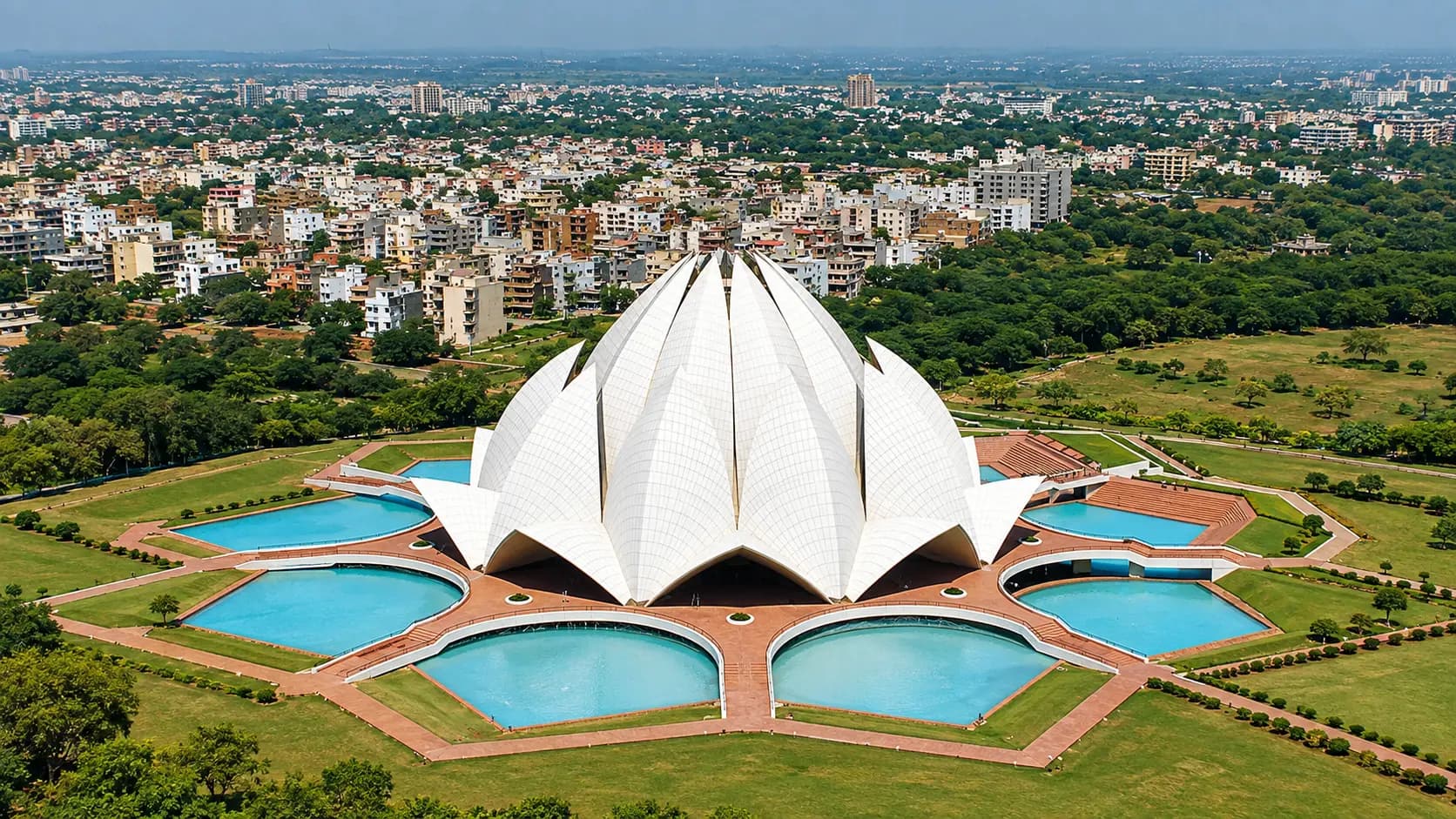
Shining like a pristine white lotus floating above nine turquoise pools, the Lotus Temple - officially known as the Bahá'í House of Worship - is one of the most instantly recognizable and universally admired architectural masterpieces of the modern era. Situated across 26 landscaped acres in South East Delhi, this extraordinary sanctuary bridges religious harmony, structural virtuosity, and quiet contemplation. Since its dedication in December 1986, this soaring expression of thin-shell concrete and Greek Pentelikon marble has welcomed more than 100 million visitors from every corner of the globe, making it one of the most visited buildings on earth, surpassing the annual visitor tallies of both the Eiffel Tower and the Taj Mahal.
When to visitRead details
- October to November (Autumn / Post-Monsoon): The premier season to visit. The air is clear and crisp, humidity is low, and daytime temperatures hover comfortably between 22°C and 30°C. The nine reflection ponds sparkle under bright sunshine, and the 26 acres of gardens are at their lush green peak following the monsoons.
- December to February (Winter): A magical time to experience the temple. The weather is cool and bracing, with daytime highs around 18°C to 24°C. On clear winter afternoons, the pure white Pentelikon marble contrasts brilliantly against deep blue skies. In the early morning, ethereal winter fog occasionally envelops the upper petals, giving the monument an otherworldly, floating appearance. Because this is peak tourism season, expect longer queue times on weekend afternoons.
- March (Early Spring): A delightful transitional month with pleasant temperatures (22°C to 28°C) and blooming garden borders before the severe summer heat arrives.
- April to June (Summer): Summer in Delhi is intense, with temperatures frequently reaching 40°C to 44°C. The open, unshaded stone plazas and ramps leading to the temple can become extremely hot underfoot, even though protective coir mats are laid out. Check the current visiting hours and permitted access with the site operator before departure; ceremonies, closures and visitor sessions can affect access.
- July to September (Monsoon): Heavy tropical rains wash the marble petals clean, restoring their brilliant white luster. Overcast skies produce diffused, shadowless lighting that architectural photographers prize, while water droplets cascade dramatically off the petal tips into the reflection ponds. However, high humidity and sudden downpours can make walking through the open gardens challenging.
Entry & permissionsRead details
Fees, visiting hours and entry rules may change. Confirm the latest details with the official operator or local authority before travelling.
Entry Fees and Admission
- General Admission: Completely Free (₹0) for all visitors, domestic and international. There are no entrance fees, digital booking tariffs, or ticket counters.
- Information Centre & Services: Access to the Information Centre galleries, documentary film screenings, and interfaith prayer sessions is entirely complimentary.
- Warning on Touts: Visitors should strictly disregard unauthorized street vendors or touts near metro exits who claim that "skip-the-line passes" or paid entry tickets are required for the Lotus Temple.
Timings and Operating Schedules
- Summer Timings (April 1 to September 30): Open from 08:30 AM to 06:00 PM (Last entry admitted at 05:30 PM).
- Winter Timings (October 1 to March 31): Open from 08:30 AM to 05:00 PM (Last entry admitted at 04:30 PM).
- MONDAY CLOSURE: The Lotus Temple complex is STRICTLY CLOSED ON MONDAYS all year round for comprehensive deep-cleaning, marble conservation, and horticultural maintenance.
- Special Timings on National Holidays: The temple remains open on Tuesdays following Monday holidays, but will be closed if a national holiday falls on a Monday.
Shoe Removal Protocol
In accordance with sacred Indian spiritual customs, no shoes or footwear of any kind are permitted on the elevated temple terrace or inside the central prayer hall:
- Visitors are directed to large, sheltered, complimentary shoe-keeping counters located near the base of the podium.
- Shoes are handed over to volunteer attendants, who place them in individual cubbies and issue a numbered brass or plastic token. Keep this token safe, as it must be presented to retrieve your footwear upon exiting.
- Socks are permitted and strongly recommended, especially during sunny summer days when the marble terrace can retain solar heat.
Photography and Equipment Restrictions
- Outdoor Photography: Handheld non-commercial still photography and personal mobile phone snapshots are permitted throughout the 26-acre landscaped gardens, walkways, and around the nine reflection ponds.
- Interior Photography Ban: Photography, video recording, FaceTime/livestreaming, and selfie sticks are STRICTLY PROHIBITED inside the central prayer hall. Visitors must keep mobile phones silenced or turned off and stowed inside bags or pockets while in the sanctuary. Security volunteers strictly enforce this rule to preserve the sanctuary’s atmosphere of sacred silence.
- Tripods and Commercial Shoots: Professional tripods, monopods, lighting equipment, and commercial video productions are not permitted on the premises without formal, advance written authorization from the National Spiritual Assembly of the Bahá'ís of India.
- Drone Regulations: Flying uncrewed aerial vehicles (drones/UAVs) over or near the Lotus Temple is strictly prohibited. The site is a high-security zone subject to Delhi Police surveillance; unauthorized drone operations will result in immediate confiscation of equipment and criminal prosecution.
Plan your visitRead details
The Lotus Temple is situated on Lotus Temple Road in Bahapur near Kalkaji, within the South East Delhi revenue district (PIN: 110019), adjacent to the Nehru Place commercial district.
Explore the full guide - choose a topic below.
Why visit?
Shining like a pristine white lotus floating above nine turquoise pools, the Lotus Temple - officially known as…Explore detailsClose details
Shining like a pristine white lotus floating above nine turquoise pools, the Lotus Temple - officially known as the Bahá'í House of Worship - is one of the most instantly recognizable and universally admired architectural masterpieces of the modern era. Situated across 26 landscaped acres in South East Delhi, this extraordinary sanctuary bridges religious harmony, structural virtuosity, and quiet contemplation. Since its dedication in December 1986, this soaring expression of thin-shell concrete and Greek Pentelikon marble has welcomed more than 100 million visitors from every corner of the globe, making it one of the most visited buildings on earth, surpassing the annual visitor tallies of both the Eiffel Tower and the Taj Mahal.
What makes the Lotus Temple unique in India’s spiritual landscape is its radical openness and universal non-denominational ethos. As the Mother Temple of the Bahá'í faith on the Indian subcontinent, it was conceived by its architect, Iranian-Canadian master builder Fariborz Sahba, around the sacred lotus flower (Nelumbo nucifera). The lotus is a timeless spiritual emblem shared across Hinduism, Buddhism, Jainism, and Islam, symbolizing spiritual transcendence, beauty, and detachment - an exquisite bloom that emerges untainted from murky pond waters to open pristine toward the sky. Translating this organic metaphor into sacred geometry, Sahba designed a nonagonal (nine-sided) structure composed of 27 delicate, free-standing marble petals rising 34.27 meters (112 feet) into the heavens.
Stepping inside the Lotus Temple offers an experience unlike any traditional religious site in Delhi. There are no idols, statues, painted murals, ritual bells, burning incense, or priestly altars. In keeping with Bahá'í teachings on the oneness of God, the oneness of religion, and the oneness of humanity, the colossal hall is open to people of all faiths - or no faith at all. Within the cool, echoing expanse of the 2,500-capacity sanctuary, visitors from diverse backgrounds sit side-by-side on curved marble benches in total, pin-drop silence. Here, one can meditate, pray privately in one's own tradition, or listen during special prayer services to the pure, unaccompanied human voice chanting sacred verses from the Bhagavad Gita, the Holy Bible, the Quran, the Guru Granth Sahib, or the Bahá'í scriptures. Surrounded by manicured lawns, whispering fountains, and shaded pergolas, the Lotus Temple offers an indelible sanctuary of stillness and universal fraternity amidst the kinetic roar of Delhi.
What to expect
A visit to the Lotus Temple encompasses a peaceful sequence of experiences across the 26-acre compound, moving…Explore detailsClose details
A visit to the Lotus Temple encompasses a peaceful sequence of experiences across the 26-acre compound, moving from open public gardens to the meditative stillness of the central marble dome. Visitors should expect a serene, well-regulated visit that involves a modest amount of walking along paved stone causeways and a mandatory shoe-removal process before ascending to the temple terrace.
The Architectural Form: 27 Petals and Nine Ponds
Approaching the temple from the main pedestrian avenue reveals its breathtaking geometric complexity. The temple is constructed entirely of cast-in-place white concrete and clad on its outer and inner surfaces with pure white Pentelikon marble quarried from Mount Pentelikon in Greece - the very same historic quarry that supplied the stone for the Parthenon in ancient Athens. Over 10,000 square meters of marble slabs were cut, precision-curved, numbered, and transported to Delhi, where Indian artisans hand-fitted them across the curvilinear concrete shells over a decade of painstaking construction (1976 - 1986).
The structure consists of 27 free-standing thin-shell concrete petals arranged in nine triads (sets of three petals each) around a central axis, creating a symmetrical nine-sided building:
- The Nine Entrance Petals (Outer Gateways): The lowest tier of petals flares outward, forming nine grand entrance portals that welcome pilgrims and visitors arriving from nine radiating causeways.
- The Nine Outer Petals: Rising behind the entrance portals, these petals curve upward and inward, shielding the inner sanctuary from direct sun while framing the sweeping entrance arches.
- The Nine Inner Petals: Soaring vertically to a height of 34.27 meters (112.4 feet) and spanning 34 meters across the central floor, the inner petals curve inward to enclose the main prayer hall, partially overlapping at the apex to form a ribbed, blossom-like crown.
Surrounding the base of the nine entrance portals are nine large, curved reflection ponds shaped like the green leaves of the lotus plant. Lined with light blue ceramic tiles, these ponds not only create dazzling reflections of the white petals under shifting Delhi sunlight, but also play a critical environmental role. The structure utilizes a sophisticated passive natural ventilation system: warm air inside the towering central hall naturally rises and vents through the glazed skylights at the dome’s apex, drawing cool air upward from the water surfaces through subterranean ducts beneath the podium, keeping the sanctuary comfortable without air conditioning.
The Central Sanctuary: The Quiet Hall of Oneness
Passing through one of the nine grand arched doorways brings visitors into the main prayer hall, an expansive, column-free circular auditorium capable of seating 1,300 people on polished white marble benches, with additional standing capacity for up to 1,200 more. The interior surfaces of the inner petals are exposed in ribbed, board-marked concrete, drawing the eye upward toward an exquisite glass-and-steel central skylight shaped like a nine-pointed star.
In accordance with Bahá'í scriptural law, the interior is devoid of any human-made images, statues, relics, or sectarian symbols. There is no pulpit for sermons, no altar for offerings, and no musical instruments. The only decorative inscription is the golden calligraphy of the Greatest Name - the Arabic phrase Yá Bahá'u'l-Abhá ("O Glory of the All-Glorious") - inscribed at the zenith of the skylight. Visitors are ushered into the hall in quiet groups by attentive temple volunteers. Inside, the prevailing atmosphere is one of profound, hushed reverence. Visitors are invited to sit quietly, close their eyes, and immerse themselves in silent meditation or personal prayer. Several times daily, brief 15-minute interfaith devotional services are held, where volunteer readers chant or read aloud verses from the sacred texts of Hinduism, Buddhism, Christianity, Islam, Judaism, Zoroastrianism, and the Bahá'í faith in their original languages without sermonizing or commentary.
The Visitor Information Centre and Grounds
To the southeast of the main temple stands the Information Centre, a modern educational complex that serves as an essential companion visit. Inside, visitors can explore multimedia photographic galleries, scale architectural models, and continuous video screenings that document:
- The history and core theological tenets of the Bahá'í faith, founded in 19th-century Persia by Bahá'u'lláh, emphasizing the oneness of God, religion, and humanity, gender equality, and world peace.
- The engineering history of the Lotus Temple, detailing how structural engineers from Flint & Neill in London and builders from Larsen & Toubro utilized sophisticated computer modeling and indigenous craftsmanship to achieve the complex curves of the precast petals.
- Community development, educational, and social empowerment programs spearheaded by Bahá'í communities across rural and urban India.
The surrounding 26 acres of grounds are maintained with botanical excellence by the temple's horticultural staff. Broad red-stone causeways are bordered by velvety lawns, shaded pergolas draped in flowering bougainvillea, fragrant frangipani (champa) trees, royal palms, and decorative perennial beds. Benches are set along the pathways, providing restful vantage points to admire the architecture against the sky.
Best time to visit
The outdoor gardens, stone walkways, and serene atmosphere of the Lotus Temple are deeply influenced by Delhi's…Explore detailsClose details
Seasonal Guide
The outdoor gardens, stone walkways, and serene atmosphere of the Lotus Temple are deeply influenced by Delhi's seasonal rhythm:
- October to November (Autumn / Post-Monsoon): The premier season to visit. The air is clear and crisp, humidity is low, and daytime temperatures hover comfortably between 22°C and 30°C. The nine reflection ponds sparkle under bright sunshine, and the 26 acres of gardens are at their lush green peak following the monsoons.
- December to February (Winter): A magical time to experience the temple. The weather is cool and bracing, with daytime highs around 18°C to 24°C. On clear winter afternoons, the pure white Pentelikon marble contrasts brilliantly against deep blue skies. In the early morning, ethereal winter fog occasionally envelops the upper petals, giving the monument an otherworldly, floating appearance. Because this is peak tourism season, expect longer queue times on weekend afternoons.
- March (Early Spring): A delightful transitional month with pleasant temperatures (22°C to 28°C) and blooming garden borders before the severe summer heat arrives.
- April to June (Summer): Summer in Delhi is intense, with temperatures frequently reaching 40°C to 44°C. The open, unshaded stone plazas and ramps leading to the temple can become extremely hot underfoot, even though protective coir mats are laid out. Check the current visiting hours and permitted access with the site operator before departure; ceremonies, closures and visitor sessions can affect access.
- July to September (Monsoon): Heavy tropical rains wash the marble petals clean, restoring their brilliant white luster. Overcast skies produce diffused, shadowless lighting that architectural photographers prize, while water droplets cascade dramatically off the petal tips into the reflection ponds. However, high humidity and sudden downpours can make walking through the open gardens challenging.
Optimal Time of Day
- Early Morning (08:30 AM - 10:00 AM): Check the current visiting hours and permitted access with the site operator before departure; ceremonies, closures and visitor sessions can affect access. Queue times are minimal, ambient noise from surrounding city traffic is low, and the interior sanctuary has an exceptionally tranquil, undisturbed atmosphere.
- Late Afternoon to Sunset (04:00 PM - 05:30 PM): The golden hour casts warm honey and rose-colored hues across the western marble petals.
How to reach
The Lotus Temple is situated on Lotus Temple Road in Bahapur near Kalkaji, within the South East Delhi revenue…Explore detailsClose details
The Lotus Temple is situated on Lotus Temple Road in Bahapur near Kalkaji, within the South East Delhi revenue district (PIN: 110019), adjacent to the Nehru Place commercial district.
By Delhi Metro
Confirm the current charge and what it includes with the operator or service provider. Visitor admission, vehicles, parking, activities and accommodation can have separate charges.
- Kalkaji Mandir Metro Station (Magenta Line [Line 8] & Violet Line [Line 6] Interchange): The closest and most convenient metro station, situated approximately 500 meters southwest of the temple gates. Exiting through Gate 1 or Gate 2, visitors can easily walk to the main visitor entry gate in just 6 to 8 minutes along a paved, dedicated pedestrian walkway. Electric rickshaws and autorickshaws are also available right outside the station.
- Nehru Place Metro Station (Violet Line [Line 6]): Located roughly 1.0 kilometer northwest of the temple. Exiting from Gate 1, visitors can walk southeast along Lotus Temple Road in about 10 to 12 minutes, or take a quick 3-minute autorickshaw ride.
- Okhla NSIC Metro Station (Magenta Line [Line 8]): Positioned approximately 800 meters southeast, offering another straightforward access route for visitors arriving from Noida, South Delhi, or the airport via the Magenta Line corridor.
By Road, Taxis, and Autos
- Key Approaching Arteries: The temple is directly connected via Lotus Temple Road, Maa Anandmayee Marg, and the Outer Ring Road (Nehru Place flyover). It is easily accessible from all parts of South Delhi, Noida, and Central Delhi.
- App-Based Taxis & Auto-Rickshaws: Ride-hailing services (Uber, Ola, BluSmart) and metered three-wheeled autorickshaws have designated drop-off and pick-up zones on the service road immediately outside the main pedestrian entrance gate.
- Self-Driving & Parking: Ample designated surface parking managed by municipal authorities is available directly opposite the main entrance gate on Lotus Temple Road. However, on weekend afternoons and national holidays, parking fills rapidly; taking the Delhi Metro to Kalkaji Mandir is strongly recommended.
From Major Transit Hubs
- From New Delhi Railway Station (NDLS): Situated approximately 15 kilometers north. Take the Yellow Line from New Delhi Station to Central Secretariat, then transfer to the Violet Line down to Kalkaji Mandir (total journey time approx. 35 minutes). Alternatively, a pre-paid taxi or app-cab takes 40 to 60 minutes depending on peak traffic.
- From Hazrat Nizamuddin Railway Station (NZM): Located roughly 7 kilometers north. A direct 15-minute taxi or auto ride down Mathura Road and Maa Anandmayee Marg, or take the Pink Line from Sarai Kale Khan to Lajpat Nagar and interchange to the Violet Line to Kalkaji Mandir.
- From Old Delhi Railway Station (DLI): Approximately 18 kilometers north. Direct metro ride on the Yellow Line to Kashmere Gate, transferring to the Violet Line down to Kalkaji Mandir (approx. 45 minutes).
- From Indira Gandhi International Airport (DEL): Positioned roughly 16 kilometers west. The fastest route is boarding the Magenta Line (Line 8) directly from Terminal 1-IGI Airport Metro Station straight to Kalkaji Mandir Metro Station without any line transfers (direct travel time approx. 30 minutes). If arriving at Terminal 3, take the Airport Express Line to Dhaula Kuan, transfer to the Pink Line at Durgabai Deshmukh South Campus to Hauz Khas, and take the Magenta Line to Kalkaji Mandir.
Entry, timings and permissions
Fees, visiting hours and entry rules may change.Explore detailsClose details
Fees, visiting hours and entry rules may change. Confirm the latest details with the official operator or local authority before travelling.
Entry Fees and Admission
- General Admission: Completely Free (₹0) for all visitors, domestic and international. There are no entrance fees, digital booking tariffs, or ticket counters.
- Information Centre & Services: Access to the Information Centre galleries, documentary film screenings, and interfaith prayer sessions is entirely complimentary.
- Warning on Touts: Visitors should strictly disregard unauthorized street vendors or touts near metro exits who claim that "skip-the-line passes" or paid entry tickets are required for the Lotus Temple.
Timings and Operating Schedules
- Summer Timings (April 1 to September 30): Open from 08:30 AM to 06:00 PM (Last entry admitted at 05:30 PM).
- Winter Timings (October 1 to March 31): Open from 08:30 AM to 05:00 PM (Last entry admitted at 04:30 PM).
- MONDAY CLOSURE: The Lotus Temple complex is STRICTLY CLOSED ON MONDAYS all year round for comprehensive deep-cleaning, marble conservation, and horticultural maintenance.
- Special Timings on National Holidays: The temple remains open on Tuesdays following Monday holidays, but will be closed if a national holiday falls on a Monday.
Shoe Removal Protocol
In accordance with sacred Indian spiritual customs, no shoes or footwear of any kind are permitted on the elevated temple terrace or inside the central prayer hall:
- Visitors are directed to large, sheltered, complimentary shoe-keeping counters located near the base of the podium.
- Shoes are handed over to volunteer attendants, who place them in individual cubbies and issue a numbered brass or plastic token. Keep this token safe, as it must be presented to retrieve your footwear upon exiting.
- Socks are permitted and strongly recommended, especially during sunny summer days when the marble terrace can retain solar heat.
Photography and Equipment Restrictions
- Outdoor Photography: Handheld non-commercial still photography and personal mobile phone snapshots are permitted throughout the 26-acre landscaped gardens, walkways, and around the nine reflection ponds.
- Interior Photography Ban: Photography, video recording, FaceTime/livestreaming, and selfie sticks are STRICTLY PROHIBITED inside the central prayer hall. Visitors must keep mobile phones silenced or turned off and stowed inside bags or pockets while in the sanctuary. Security volunteers strictly enforce this rule to preserve the sanctuary’s atmosphere of sacred silence.
- Tripods and Commercial Shoots: Professional tripods, monopods, lighting equipment, and commercial video productions are not permitted on the premises without formal, advance written authorization from the National Spiritual Assembly of the Bahá'ís of India.
- Drone Regulations: Flying uncrewed aerial vehicles (drones/UAVs) over or near the Lotus Temple is strictly prohibited. The site is a high-security zone subject to Delhi Police surveillance; unauthorized drone operations will result in immediate confiscation of equipment and criminal prosecution.
Nearby places to consider
Its strategic location in South East Delhi positions the Lotus Temple close to several significant spiritual…Explore detailsClose details
Its strategic location in South East Delhi positions the Lotus Temple close to several significant spiritual, historic, and commercial landmarks:
Kalkaji Mandir (Kalka Devi Temple)
Located just 500 meters southwest of the Lotus Temple across Lotus Temple Road, Kalkaji Mandir is one of Delhi's oldest and most revered Hindu temple complexes. Dedicated to Goddess Kali (an avatar of Durga), the temple is traditionally believed to date back to the Mahabharata era, with the current octagonal red-brick sanctum constructed in 1764 and expanded in the 19th century. During the Navratri festivals, hundreds of thousands of pilgrims gather for rituals, bell-ringing, and devotional songs, providing a vivid, colorful contrast to the silent, icon-free worship of the Lotus Temple.
ISKCON Temple Delhi (Sri Sri Radha Parthasarathi Mandir)
Situated approximately 1.5 kilometers northwest atop the Hare Krishna Hills in East of Kailash (a 5-minute auto ride or 18-minute walk), the ISKCON Temple is a monumental spiritual complex built in 1998. Designed by architect Achyut Kanvinde, its soaring 90-foot shikharas house resplendent marble deities of Radha and Krishna. The complex features an interactive animatronics museum illustrating the Bhagavad Gita, the world's largest printed sacred book (the Astounding Bhagavad Gita weighing 800 kg), and Govinda's pure-vegetarian restaurant.
Nehru Place Commercial Hub
Located roughly 1.0 kilometer northwest, Nehru Place is widely recognized as Asia’s largest information technology and computer hardware market. Alongside hundreds of electronics outlets, the precinct has evolved into a vibrant culinary and commercial enclave, boasting modern pedestrian plazas, cinema multiplexes, and the Epicuria Food Mall, offering diverse international cuisine from Japanese sushi and Italian pizza to authentic North and South Indian delicacies.
Tughlaqabad Fort
Positioned roughly 5 kilometers south along Mehrauli-Badarpur Road (a 12-minute auto ride), Tughlaqabad Fort is a colossal 14th-century ruined stone citadel built by Sultan Ghiyas-ud-din Tughlaq in 1321. Spanning over six kilometers of rugged quartzite ramparts, cyclopean stone battlements, underground granaries, and the fortified red sandstone tomb of Ghiyas-ud-din Tughlaq, it offers a dramatic journey into medieval Sultanate defense engineering.
Humayun's Tomb and Nizamuddin
Located approximately 6.5 kilometers north along Mathura Road (a 15-minute drive or direct ride on the Delhi Metro Violet Line to JLN Stadium/Nizamuddin), Humayun's Tomb is an inscribed UNESCO World Heritage Site. Combine your southern Delhi itinerary with an afternoon visit to this sublime 16th-century Mughal garden-tomb and the vibrant spiritual quarter of Hazrat Nizamuddin Dargah.
In pictures
The practical bits
Before you go.
Plan ahead
To make your journey to the Lotus Temple seamless, meditative, and memorable, observe these essential…Explore detailsClose details
To make your journey to the Lotus Temple seamless, meditative, and memorable, observe these essential recommendations:
Timing to Avoid Peak Crowds
Visit on a weekday morning between 08:30 AM and 10:30 AM (Tuesday through Thursday).Explore detailsClose details
Visit on a weekday morning between 08:30 AM and 10:30 AM (Tuesday through Thursday). The Lotus Temple can receive upwards of 20,000 to 40,000 visitors on weekends and public holidays, resulting in queue waiting times of 30 to 45 minutes at the security gate and shoe-deposit counters. Arriving early on a weekday guarantees direct, unhurried entry and a deeply peaceful sanctuary experience.
Dress Code and Decorum
While there is no rigid religious dress code, the Lotus Temple is a sacred house of worship.Explore detailsClose details
While there is no rigid religious dress code, the Lotus Temple is a sacred house of worship. Modest, respectful attire covering shoulders and knees is recommended. Avoid noisy footwear or items that rattle, and ensure your mobile phone is set to silent or airplane mode before joining the queue to the main terrace.
Footwear and Terrace Navigation
Because shoes must be deposited before climbing to the temple terrace, wear socks for comfort.Explore detailsClose details
Because shoes must be deposited before climbing to the temple terrace, wear socks for comfort. During peak summer months (May and June), the white Greek marble can absorb significant heat despite green coir runner mats, while in peak winter (January), the stone floor can feel brisk under bare feet. Thick cotton socks provide ideal protection year-round.
Pairing with Local Dining and Markets
After completing your tour of the temple and the Information Centre, walk 500 meters southwest to explore the…Explore detailsClose details
After completing your tour of the temple and the Information Centre, walk 500 meters southwest to explore the historic Kalkaji Mandir Hindu temple complex, or take a 3-minute auto ride northwest to the Nehru Place commercial center, home to popular casual dining spots, cafes (such as Starbucks, Chaayos, and Cafe Coffee Day), and legendary South Indian eateries like Sagar Ratna, celebrated for authentic dosas, idlis, and filter coffee.
A few things you might wonder
Common questions about visiting Lotus Temple. Fees, visiting hours and ceremonies are researched details that may change; confirm current arrangements with the operator before travelling.
Is there an entry fee or online ticket required to visit the Lotus Temple?
What religion does the Lotus Temple belong to, and can people of other faiths visit?
Why is the temple shaped like a lotus flower, and who was the architect?
What are the opening hours, and which day of the week is the temple closed?
Are visitors allowed to take photographs or videos inside the Lotus Temple?
Where do visitors leave their shoes before entering the temple?
How many people can the central prayer hall accommodate, and are there idols inside?
Which metro station is closest to the Lotus Temple?
Explore more in New Delhi
Discover other destinations around this hub
More Hubs in Delhi Ncr
Continue exploring other travel hubs in this state
Planning a trip to New Delhi?