India Gate
Comprehensive travel guide to India Gate in New Delhi. Discover its Lutyens architecture, National War Memorial, Kartavya Path, timings, metro routes, and visitor tips.
Location
New Delhi, Delhi NCR
A closer look
Your visit, at a glance.
New Delhi, Delhi Ncr
GET TO KNOW THE PLACE
---
The story of India Gate
Start here. Open a tile for the full details.
Why goRead details
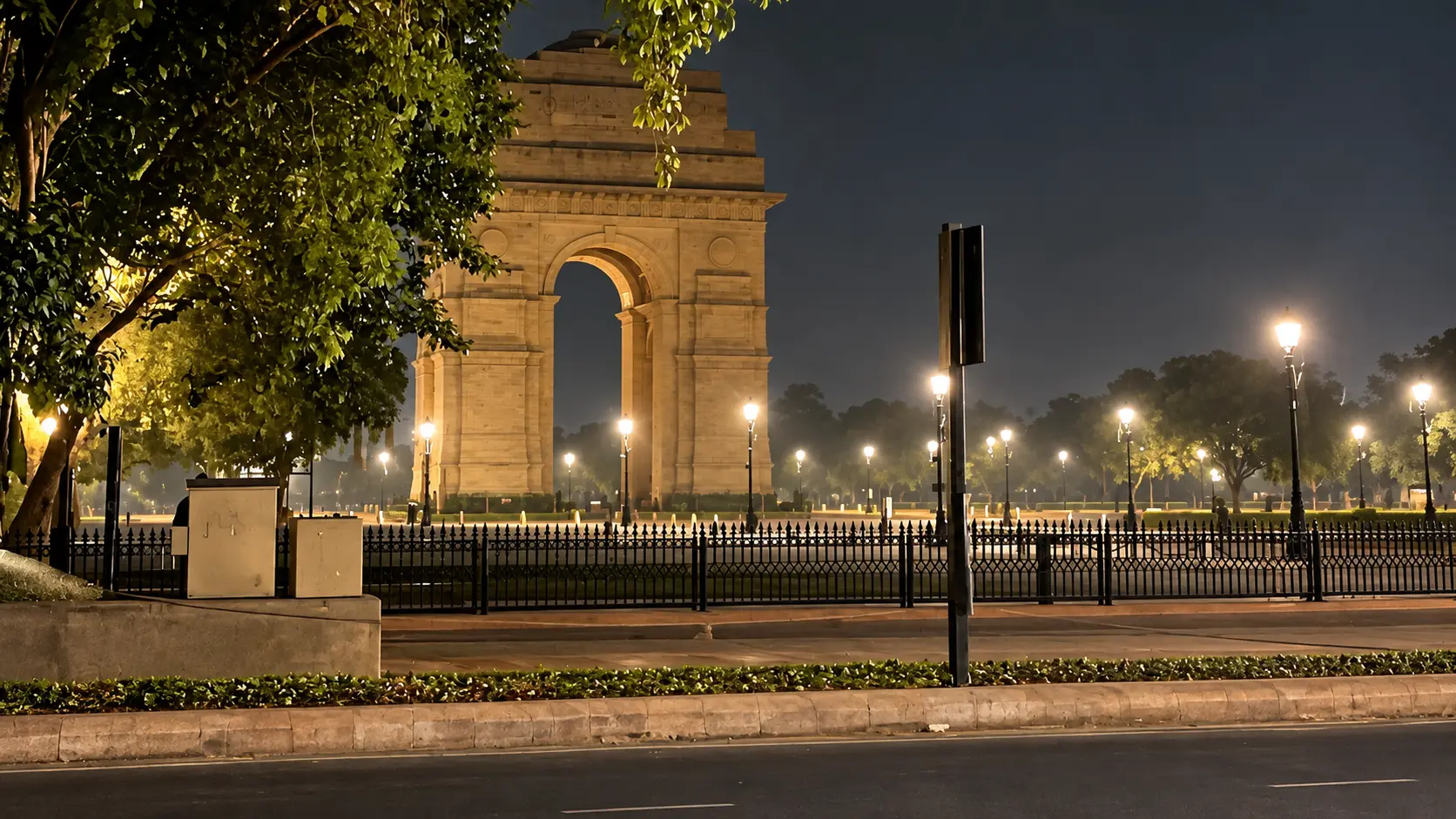
Few monuments on the Indian subcontinent possess the immediate emotional resonance, civic gravitas, and architectural authority of India Gate. Positioned as the majestic anchor at the eastern terminus of Kartavya Path (formerly Rajpath), this 42-meter-tall triumphal arch commands New Delhi's central ceremonial axis, gazing westward past the green expanses of the Central Vista directly toward Rashtrapati Bhavan atop Raisina Hill. Conceived in the aftermath of the First World War as the All India War Memorial, India Gate is at once a solemn sanctuary of military sacrifice, an architectural triumph of the classical revival style, and the beating social heart of the Indian capital.
When to visitRead details
- October to November (Autumn / Post-Monsoon): Widely considered the finest season to explore India Gate. Daytime temperatures range comfortably between 22°C and 30°C with clear blue skies, dry air, and minimal humidity. The surrounding lawns are lush and vibrant following the monsoon rains, making this period ideal for morning photography, open-air strolls, and extended evening walks.
- December to February (Winter): Winter brings crisp, chilly weather, with temperatures ranging from a brisk 7°C at dawn to 22°C in the afternoon. Delhi's notorious morning fog can shroud the upper reaches of the 42-meter arch in atmospheric mist, while the afternoons are sunny and perfect for leisurely picnics on the grass. The precinct is heavily decorated and illuminated around Republic Day (January 26), making late January an especially patriotic and visually arresting time to visit, although security restrictions are enforced around the parade rehearsals.
- March (Early Spring): A delightful transitional month characterized by pleasant days (20°C to 28°C), flowering annuals across the Central Vista gardens, and comfortable evening breezes before summer heat settles in.
- April to June (Summer): Severe summer conditions prevail, with midday temperatures soaring between 38°C and 45°C under an intense sun. Visiting during daytime hours is physically punishing due to the lack of overhead shade across the open stone plazas. However, India Gate becomes a massive social retreat after dark: from 07:30 PM until midnight, thousands of local residents congregate on the lawns to escape indoor heat, enjoy cool evening breezes, and savor ice cream from local vendors.
- July to September (Monsoon): Frequent downpours bring intermittent relief from the heat, lowering temperatures to 30°C - 35°C but pushing relative humidity above 75%. While the rain washes the sandstone facade into vivid terracotta hues and fills the canals, sudden heavy showers and muddy turf can disrupt prolonged outdoor walking.
Entry & permissionsRead details
Fees, visiting hours and entry rules may change. Confirm the latest details with the official operator or local authority before travelling.
Entry Fees
- General Public Entry: Free of cost (₹0) for all visitors, including Indian citizens, foreign tourists, and children of all ages.
- National War Memorial Entry: Free of cost (₹0). No ticketing, online reservation, or token issuance is required.
- Payment & Tickets: Because admission is entirely free, visitors do not need to book tickets in advance. Beware of unauthorized touts around metro exits offering "fast-track passes" or tickets for India Gate.
Timings and Operating Hours
- India Gate Plaza, Promenades & Lawns: Daylight visits recommended; confirm any after-dark access a day, 7 days a week, 365 days a year. Public pedestrian access along Kartavya Path and around the outer lawns remains open continuously, except during official state closures for the Republic Day parade preparations (typically between January 18 and January 26).
- Architectural Illumination: High-intensity decorative floodlighting is activated daily from dusk (approx. 06:30 PM in winter, 07:15 PM in summer) until 11:00 PM (frequently extended until midnight on weekends and national holidays).
- National War Memorial Hours: Open daily from 09:00 AM to 06:30 PM during winter months (November to March) and 09:00 AM to 07:30 PM during summer months (April to October). Entry into the inner sanctum ceases 30 minutes prior to closing.
- Ceremonial Retreat: The formal military retreat ceremony, featuring the solemn sounding of the bugle and the change of guard, takes place daily at sunset at the National War Memorial's Amar Chakra.
Photography and Equipment Permissions
- Handheld Photography: Non-commercial still photography, tourist snapshots, and personal smartphone video recording are completely free and permitted throughout the lawns, Kartavya Path, and the India Gate plaza.
- National War Memorial Guidelines: Handheld photography is allowed within the memorial, but visitors are expected to maintain utmost solemnity and decorum. Posing inappropriately, climbing on memorial walls, sitting on granite plinths, or loud videography is strictly prohibited by military marshals.
- Tripods, Gimbals & Professional Equipment: The use of heavy professional camera gear, tripods, monopods, lighting rigs, and professional video cameras is restricted across the high-security Central Vista zone. Anyone wishing to shoot documentary films, commercial advertisements, or professional music videos must obtain prior written permission and security clearances from the Ministry of Housing and Urban Affairs (CPWD), the New Delhi Municipal Council (NDMC), and the Delhi Police.
- Drone Regulations: Flying remotely piloted aircraft (drones/UAVs) of any weight class is strictly prohibited. The entire Central Vista, Rashtrapati Bhavan, and India Gate precinct is designated as a strict No-Fly Red Zone under the Directorate General of Civil Aviation (DGCA) and Delhi Police security protocols. Unauthorized drone operations are treated as criminal national security violations, resulting in immediate equipment confiscation and legal prosecution.
Security Protocol
Because India Gate sits at the heart of the national government district, robust multi-tiered security is maintained around the clock by Delhi Police and paramilitary forces:
- All visitors entering the inner pedestrian perimeter around India Gate and the National War Memorial must pass through security gates equipped with door-frame metal detectors and submit handbags or backpacks to physical inspection.
- Prohibited items include firearms, sharp objects, knives, flammable substances, alcohol, chewing tobacco, firecrackers, large luggage bags, and drones.
- Cloakroom facilities are available at the visitor reception center of the National War Memorial for small bags, but visitors are strongly encouraged to travel light.
Plan your visitRead details
India Gate is located at the center of the C-Hexagon roundabout in the heart of New Delhi (PIN: 110001), making it one of the most accessible geographic points in the National Capital Region.
Explore the full guide - choose a topic below.
Why visit?
Few monuments on the Indian subcontinent possess the immediate emotional resonance, civic gravitas, and…Explore detailsClose details
Few monuments on the Indian subcontinent possess the immediate emotional resonance, civic gravitas, and architectural authority of India Gate. Positioned as the majestic anchor at the eastern terminus of Kartavya Path (formerly Rajpath), this 42-meter-tall triumphal arch commands New Delhi's central ceremonial axis, gazing westward past the green expanses of the Central Vista directly toward Rashtrapati Bhavan atop Raisina Hill. Conceived in the aftermath of the First World War as the All India War Memorial, India Gate is at once a solemn sanctuary of military sacrifice, an architectural triumph of the classical revival style, and the beating social heart of the Indian capital.
Designed by the master architect Sir Edwin Landseer Lutyens, India Gate pays tribute to approximately 84,000 soldiers of the British Indian Army who lost their lives between 1914 and 1921 during the harrowing battlefields of the First World War across France, Belgium, Mesopotamia, Persia, East Africa, Gallipoli, Egypt, and the Third Anglo-Afghan War. Unlike many triumphal arches of Europe that celebrate conquering emperors or territorial subjugation, India Gate is dedicated fundamentally to the individual human sacrifice of combatants from diverse communities across the subcontinent. Meticulously chiseled across its pale red and buff Bharatpur sandstone walls are the names of 13,218 soldiers and non-combatants who died on active service and have no known graves. Standing beneath the towering barrel vault and scanning the thousands of engraved names - including Punjabi infantrymen, Gurkha riflemen, Maratha sappers, and even a British female nurse who perished during the Afghan frontier campaign - is an experience of profound quietude and solemn reflection.
In recent years, the India Gate precinct has undergone a monumental transformation that weaves historical memory with 21st-century civic infrastructure. Directly east of the triumphal arch stands the 73-foot sandstone canopy, an exquisite architectural pavilion inspired by 6th-century rock-cut shrines of Mahabalipuram, which now shelters a commanding 28-foot monolithic black granite statue of Netaji Subhas Chandra Bose, unveiled in September 2022 to commemorate the visionary leader of the Indian National Army (Azad Hind Fauj). Beyond the canopy unfolds the 40-acre National War Memorial (Rashtriya Samar Smarak), dedicated in 2019 to honor all Indian armed forces personnel who made the supreme sacrifice in post-independence wars and conflicts. Here, the four concentric circular sanctums - the Amar Chakra with its eternal flame, the Veerta Chakra illustrating iconic military campaigns, the Tyag Chakra bearing more than 26,000 fallen heroes' names in gleaming gold letters, and the forested Raksha Chakra - create India's most comprehensive national shrine.
Beyond its military solemnity, India Gate embodies the vibrant, democratic spirit of public life in Delhi. Following the sweeping redevelopment of Kartavya Path, the precinct features 15.5 kilometers of red Lakha granite promenades, refurbished stepped water canals, modern pedestrian underpasses, landscaped lawns shaded by stately Jamun trees, and curated vendor plazas. On warm summer evenings and crisp winter afternoons, families, students, elderly morning walkers, and international travelers gather across the illuminated lawns. Whether you come at dawn to witness the mist rise over the tranquil reflection pools, visit at dusk to observe the poignant retreat ceremony at the National War Memorial, or walk beneath the illuminated archway glowing against the night sky, India Gate offers an indelible encounter with the soul, history, and civic pulse of modern India.
What to expect
Visiting the India Gate precinct is an expansive multi-layered journey that integrates monumental imperial…Explore detailsClose details
Visiting the India Gate precinct is an expansive multi-layered journey that integrates monumental imperial architecture, contemporary military memorials, and lively urban parkland across more than 100 acres of the Central Vista. Visitors should prepare for significant walking on wide paved pathways, open-air lawns, and dedicated pedestrian subways.
The Triumphal Arch and Sandstone Inscriptions
Rising from a low foundation of deep red Bharatpur stone to an imposing height of 42 meters (138 feet), India Gate is modeled in the classical Roman triumphal tradition, echoing the proportions of Paris's Arc de Triomphe while integrating subtle indigenous motifs. The archway itself spans 9.1 meters (30 feet) in width, framing panoramic vistas down the full length of Kartavya Path. The structure is built primarily from pale red and buff-colored sandstone sourced from Bharatpur and Dholpur in Rajasthan, which absorbs and reflects changing daylight - shifting from warm ochre at midday to rich terracotta and rose gold during the late afternoon golden hour.
Above the central arch on both the east and west facades, the word INDIA is boldly chiseled in Roman lettering, flanked by the Roman numerals MCMXIV (1914) on the left and MCMXIX (1919) on the right. Directly below the moulding, an inscription carved into the frieze reads:
"TO THE DEAD OF THE INDIAN ARMIES WHO FELL AND ARE HONOURED IN FRANCE AND FLANDERS MESOPOTAMIA AND PERSIA EAST AFRICA GALLIPOLI AND ELSEWHERE IN THE NEAR AND THE FAR-EAST AND IN SACRED MEMORY ALSO OF THOSE WHOSE NAMES ARE HERE RECORDED AND WHO FELL IN INDIA OR THE NORTH-WEST FRONTIER AND DURING THE THIRD AFGHAN WAR."
At the summit of the structure rests a shallow circular bowl mounted atop stepped stone discs. Lutyens originally conceived this bowl to be filled with burning oil on significant imperial anniversaries, sending a plume of flame and smoke into the night sky, though this feature was rarely ignited. The exterior surfaces of the four massive sandstone piers and side walls are etched with 13,218 names of soldiers arranged alphabetically by regiment and rank, providing an astonishing physical testament to the human cost borne by Indian soldiers across three continents.
The Canopy and the Netaji Subhas Chandra Bose Statue
Situated roughly 150 meters east of India Gate on the central axis stands a magnificent 73-foot sandstone canopy designed by Sir Edwin Lutyens in 1936. Drawing inspiration from 6th-century rock-cut pavilions at Mahabalipuram in Tamil Nadu, this ornate structure features four fluted sandstone pillars supporting a ribbed dome, chhatri-style parapets, and delicate Rajasthani brackets. The canopy originally sheltered a 70-foot white marble statue of King George V sculpted by Charles Sargeant Jagger, which was erected in 1936 following the monarch's death and later relocated to Coronation Park in North Delhi in 1968.
For over five decades, the empty canopy stood as a prominent architectural curiosity on Delhi's skyline. On September 8, 2022, during the inauguration of the revamped Kartavya Path, Prime Minister Narendra Modi unveiled a monumental 28-foot-tall monolithic statue of Netaji Subhas Chandra Bose beneath the historic dome. Sculpted by renowned master sculptor Arun Yogiraj of Mysuru from a single 280-tonne block of jet-black granite sourced from Telangana, the 65-tonne statue depicts Netaji in his signature Indian National Army uniform, military cap, and resolute forward-striding posture. The deep black polished granite provides a striking aesthetic contrast against the warm terracotta sandstone of the surrounding 1930s canopy, embodying India's anti-colonial resistance and honoring the INA's pivotal role in achieving national independence.
The National War Memorial (Rashtriya Samar Smarak)
Spanning 40 acres immediately east of the Netaji canopy within the C-Hexagon complex, the National War Memorial is India's principal sanctuary dedicated to the armed forces personnel who made the supreme sacrifice in wars, counter-insurgency operations, and UN peacekeeping missions since India's independence in 1947. Formally dedicated on February 25, 2019, the memorial is masterfully laid out in four concentric circular zones inspired by ancient Indian defensive military formations (Chakravyuha):
- Amar Chakra (Circle of Immortality): The innermost sanctum, featuring a 15.5-meter-tall granite obelisk rising from an elevated circular plinth. At the base of the obelisk burns the eternal flame (Amar Jawan Jyoti), symbolizing the immortal soul of the fallen warrior. On January 21, 2022, the eternal flame that had burned under India Gate since 1972 was formally merged with this flame in a solemn military ceremony, establishing this courtyard as the unified central flame of the Indian Republic.
- Veerta Chakra (Circle of Bravery): A semi-subterranean circular ambulatory gallery enclosing the inner courtyard. It features six monumental bronze bas-relief murals crafted by prominent Indian sculptors, vividly depicting joint operations across the Army, Navy, and Air Force - including the 1947 - 48 Kashmir operations, the 1962 Sino-Indian War, the 1965 and 1971 Indo-Pakistani Wars, the 1999 Battle of Tiger Hill during Operation Vijay in Kargil, and maritime rescue missions.
- Tyag Chakra (Circle of Sacrifice): Formed by concentric circular granite retaining walls arranged like the petals of a lotus or military formations. The walls are clad in sixteen rows of rectangular granite tablets engraved in gleaming gold letters with the names, ranks, and regiments of more than 26,000 fallen personnel. Interactive digital kiosks allow visitors to search for specific soldiers by name, unit, or conflict to locate the exact granite tablet where their sacrifice is memorialized.
- Raksha Chakra (Circle of Protection): The outermost protective perimeter, densely planted with more than 600 evergreen trees (including neem, peepal, and arjun) that form a symbolic green shield safeguarding the sanctum, echoing the armed forces' duty to protect the sovereignty and citizens of the nation.
To the southeast of the memorial lies the Param Yodha Sthal, a landscaped promenade featuring 21 bronze portrait busts of all recipients of the Param Vir Chakra - India's highest wartime gallantry decoration - accompanied by detailed biographical citations describing their extraordinary valor in the face of the enemy.
Kartavya Path Promenades, Canals, and Lawns
Stretching 3.2 kilometers from the forecourt of Rashtrapati Bhavan on Raisina Hill to the India Gate C-Hexagon, the ceremonial boulevard underwent a comprehensive renewal under the Central Vista Redevelopment Project and was reopened in September 2022. The avenue features 15.5 kilometers of dedicated pedestrian walkways paved with durable red Lakha granite, replacing deteriorating asphalt and mud tracks.
Along both flanks of the avenue run historic stepped water canals spanning 19 acres, now equipped with modern water filtration systems, circulating aeration pumps, and 16 beautifully designed stone bridges that allow seamless passage between lawn sectors. Over 987 heritage-style cast-iron lampposts have been retrofitted with energy-efficient LED luminaires, casting a warm golden glow over the gardens after twilight. Dedicated vendor kiosks, stone seating amphitheaters, modern subterranean restrooms, drinking water fountains, and four automated pedestrian underpasses ensure that navigating the precinct is clean, safe, and universally accessible for elderly visitors and wheelchair users.
Best time to visit
Delhi's weather swings through dramatic extremes over the course of the year, significantly shaping the outdoor…Explore detailsClose details
Seasonal Guide
Delhi's weather swings through dramatic extremes over the course of the year, significantly shaping the outdoor visiting experience at India Gate:
- October to November (Autumn / Post-Monsoon): Widely considered the finest season to explore India Gate. Daytime temperatures range comfortably between 22°C and 30°C with clear blue skies, dry air, and minimal humidity. The surrounding lawns are lush and vibrant following the monsoon rains, making this period ideal for morning photography, open-air strolls, and extended evening walks.
- December to February (Winter): Winter brings crisp, chilly weather, with temperatures ranging from a brisk 7°C at dawn to 22°C in the afternoon. Delhi's notorious morning fog can shroud the upper reaches of the 42-meter arch in atmospheric mist, while the afternoons are sunny and perfect for leisurely picnics on the grass. The precinct is heavily decorated and illuminated around Republic Day (January 26), making late January an especially patriotic and visually arresting time to visit, although security restrictions are enforced around the parade rehearsals.
- March (Early Spring): A delightful transitional month characterized by pleasant days (20°C to 28°C), flowering annuals across the Central Vista gardens, and comfortable evening breezes before summer heat settles in.
- April to June (Summer): Severe summer conditions prevail, with midday temperatures soaring between 38°C and 45°C under an intense sun. Visiting during daytime hours is physically punishing due to the lack of overhead shade across the open stone plazas. However, India Gate becomes a massive social retreat after dark: from 07:30 PM until midnight, thousands of local residents congregate on the lawns to escape indoor heat, enjoy cool evening breezes, and savor ice cream from local vendors.
- July to September (Monsoon): Frequent downpours bring intermittent relief from the heat, lowering temperatures to 30°C - 35°C but pushing relative humidity above 75%. While the rain washes the sandstone facade into vivid terracotta hues and fills the canals, sudden heavy showers and muddy turf can disrupt prolonged outdoor walking.
Optimal Time of Day
- Early Morning (06:00 AM - 08:30 AM): Ideal for photographers, joggers, and architecture enthusiasts who wish to experience the monument in profound quietude. The rising sun illuminates the eastern face of India Gate and the Netaji statue in soft golden rays, with virtually no crowds and clean ambient light.
- Late Afternoon to Sunset (04:30 PM - 06:30 PM): The premier window for a complete cultural visit. Arrive around 04:30 PM to tour the inscriptions on India Gate, stroll past the canopy, and enter the National War Memorial before dusk to witness the ceremonial retreat (bugle sounding and guard change) at sunset.
- Evening & Night (07:00 PM - 10:30 PM): After twilight, high-powered architectural floodlights illuminate the facade of India Gate in the vibrant tricolor of the Indian flag (saffron, white, and green) on special occasions, or warm golden light on standard nights. The vibrant atmosphere, illuminated canals, and cool evening breeze make this Delhi's most popular nocturnal gathering spot.
How to reach
India Gate is located at the center of the C-Hexagon roundabout in the heart of New Delhi (PIN: 110001), making…Explore detailsClose details
India Gate is located at the center of the C-Hexagon roundabout in the heart of New Delhi (PIN: 110001), making it one of the most accessible geographic points in the National Capital Region.
By Delhi Metro
Confirm the current charge and what it includes with the operator or service provider. Visitor admission, vehicles, parking, activities and accommodation can have separate charges.
- Central Secretariat Metro Station (Yellow Line [Line 2] & Violet Line [Line 6]): Situated roughly 1.2 kilometers west of India Gate along Kartavya Path. Exiting through Gate 3 or Gate 4 places you directly onto the pedestrian promenade. It is a pleasant 15-minute tree-lined walk eastward toward the arch, or a brief 3-minute ride by shared battery-operated e-rickshaw or autorickshaw.
- Udyog Bhawan Metro Station (Yellow Line [Line 2]): Located approximately 1.2 kilometers southwest of India Gate, near the National Museum. A brisk 15-minute walk down Rajpath/Kartavya Path brings you directly to the C-Hexagon.
- Khan Market Metro Station (Violet Line [Line 6]): Positioned 1.8 kilometers south of India Gate. An excellent choice if you plan to combine your sightseeing with dining or shopping in Khan Market; autorickshaws take approximately 5 minutes to reach the monument.
- Mandi House Metro Station (Blue Line [Line 3] & Violet Line [Line 6]): Located 1.8 kilometers north along Tilak Marg, offering convenient access for travelers arriving from East Delhi, Noida, or West Delhi.
- Supreme Court Metro Station (Blue Line [Line 3]): Located roughly 2.0 kilometers northeast, providing another direct access point from the Blue Line corridor.
By Road, Taxis, and Autos
The C-Hexagon acts as a grand traffic rotary where eight major arterial avenues converge:
- Key Approaching Roads: Tilak Marg (from ITO and Old Delhi), Kasturba Gandhi Marg and Janpath (from Connaught Place), Ashoka Road (from Parliament Street), Akbar Road (from South Delhi/Chanakyapuri), Shahjahan Road (from Lodhi Road), Pandara Road, and Zakir Hussain Marg.
- App-Based Taxis & Auto-Rickshaws: Ride-hailing services (Uber, Ola, BluSmart) and metered three-wheeled autorickshaws have designated pick-up and drop-off zones along the feeder roads adjacent to the C-Hexagon and along the service lanes of Kartavya Path. During weekends and festival evenings, vehicular entry into the immediate C-Hexagon may be restricted by Delhi Traffic Police, requiring drop-offs at nearby outer junctions.
- Self-Driving & Parking: While driving is possible, parking around India Gate during weekend evenings can be challenging. Dedicated multi-level and surface parking facilities have been developed near Man Singh Road, C-Hexagon feeder lanes, and the National Gallery of Modern Art (NGMA). Visitors are strongly advised to utilize the Delhi Metro during peak evening hours.
From Major Transit Hubs
- From New Delhi Railway Station (NDLS): Approximately 4.5 kilometers north. A direct 15-minute ride on the Delhi Metro Yellow Line from New Delhi Metro Station to Central Secretariat, followed by a walk down Kartavya Path. By taxi or auto, travel time is 15 to 25 minutes depending on traffic.
- From Hazrat Nizamuddin Railway Station (NZM): Roughly 5.5 kilometers southeast. Take an autorickshaw or taxi down Mathura Road and Shershah Road (15 to 20 minutes), or board the Pink Line to Lajpat Nagar and interchange to the Violet Line to Khan Market or Central Secretariat.
- From Old Delhi Railway Station (DLI): Approximately 8 kilometers north. Board the Yellow Line at Chandni Chowk Metro Station directly to Central Secretariat (approx. 18 minutes).
- From Indira Gandhi International Airport (DEL): Located roughly 17 kilometers southwest. The most efficient transit route is boarding the Airport Express Orange Line from Terminal 3 to New Delhi Station, then transferring to the Yellow Line down to Central Secretariat (total transit time ~40 minutes). Alternatively, a pre-paid taxi or app-cab via Dhaula Kuan and Sardar Patel Marg takes 35 to 55 minutes depending on city traffic.
Entry, timings and permissions
Fees, visiting hours and entry rules may change.Explore detailsClose details
Fees, visiting hours and entry rules may change. Confirm the latest details with the official operator or local authority before travelling.
Entry Fees
- General Public Entry: Free of cost (₹0) for all visitors, including Indian citizens, foreign tourists, and children of all ages.
- National War Memorial Entry: Free of cost (₹0). No ticketing, online reservation, or token issuance is required.
- Payment & Tickets: Because admission is entirely free, visitors do not need to book tickets in advance. Beware of unauthorized touts around metro exits offering "fast-track passes" or tickets for India Gate.
Timings and Operating Hours
- India Gate Plaza, Promenades & Lawns: Daylight visits recommended; confirm any after-dark access a day, 7 days a week, 365 days a year. Public pedestrian access along Kartavya Path and around the outer lawns remains open continuously, except during official state closures for the Republic Day parade preparations (typically between January 18 and January 26).
- Architectural Illumination: High-intensity decorative floodlighting is activated daily from dusk (approx. 06:30 PM in winter, 07:15 PM in summer) until 11:00 PM (frequently extended until midnight on weekends and national holidays).
- National War Memorial Hours: Open daily from 09:00 AM to 06:30 PM during winter months (November to March) and 09:00 AM to 07:30 PM during summer months (April to October). Entry into the inner sanctum ceases 30 minutes prior to closing.
- Ceremonial Retreat: The formal military retreat ceremony, featuring the solemn sounding of the bugle and the change of guard, takes place daily at sunset at the National War Memorial's Amar Chakra.
Photography and Equipment Permissions
- Handheld Photography: Non-commercial still photography, tourist snapshots, and personal smartphone video recording are completely free and permitted throughout the lawns, Kartavya Path, and the India Gate plaza.
- National War Memorial Guidelines: Handheld photography is allowed within the memorial, but visitors are expected to maintain utmost solemnity and decorum. Posing inappropriately, climbing on memorial walls, sitting on granite plinths, or loud videography is strictly prohibited by military marshals.
- Tripods, Gimbals & Professional Equipment: The use of heavy professional camera gear, tripods, monopods, lighting rigs, and professional video cameras is restricted across the high-security Central Vista zone. Anyone wishing to shoot documentary films, commercial advertisements, or professional music videos must obtain prior written permission and security clearances from the Ministry of Housing and Urban Affairs (CPWD), the New Delhi Municipal Council (NDMC), and the Delhi Police.
- Drone Regulations: Flying remotely piloted aircraft (drones/UAVs) of any weight class is strictly prohibited. The entire Central Vista, Rashtrapati Bhavan, and India Gate precinct is designated as a strict No-Fly Red Zone under the Directorate General of Civil Aviation (DGCA) and Delhi Police security protocols. Unauthorized drone operations are treated as criminal national security violations, resulting in immediate equipment confiscation and legal prosecution.
Security Protocol
Because India Gate sits at the heart of the national government district, robust multi-tiered security is maintained around the clock by Delhi Police and paramilitary forces:
- All visitors entering the inner pedestrian perimeter around India Gate and the National War Memorial must pass through security gates equipped with door-frame metal detectors and submit handbags or backpacks to physical inspection.
- Prohibited items include firearms, sharp objects, knives, flammable substances, alcohol, chewing tobacco, firecrackers, large luggage bags, and drones.
- Cloakroom facilities are available at the visitor reception center of the National War Memorial for small bags, but visitors are strongly encouraged to travel light.
Nearby places to consider
Because India Gate occupies the focal center of New Delhi's cultural and administrative district, several of the…Explore detailsClose details
Because India Gate occupies the focal center of New Delhi's cultural and administrative district, several of the city's finest museums, historic monuments, and civic landmarks are situated within walking distance or a short metro ride:
National War Memorial (Rashtriya Samar Smarak)
Located immediately adjacent to India Gate within the inner eastern perimeter of the C-Hexagon, this 40-acre memorial is a mandatory companion visit. Dedicated in February 2019, its concentric design (Amar Chakra, Veerta Chakra, Tyag Chakra, and Raksha Chakra) honors over 26,000 post-independence military martyrs. Don't miss the 21 Param Vir Chakra bronze busts at the Param Yodha Sthal, each accompanied by inspiring battlefield citations. Confirm the current charge and what it includes with the operator or service provider. Visitor admission, vehicles, parking, activities and accommodation can have separate charges.
National Gallery of Modern Art (NGMA)
Housed within the splendid historic palace of the former Maharaja of Jaipur (Jaipur House), the NGMA is situated directly across the southeastern arc of the C-Hexagon (approx. 400 meters from India Gate). It hosts one of the world's most prestigious collections of modern and contemporary Indian art, showcasing seminal masterpieces by Raja Ravi Varma, Amrita Sher-Gil, Rabindranath Tagore, Jamini Roy, Nandalal Bose, and the Progressive Artists' Group (M.F. Husain, F.N. Souza, S.H. Raza). The gallery features shaded sculpture gardens, a specialist art bookshop, and revolving international exhibitions.
National Museum
Located approximately 1.2 kilometers west along Janpath and Maulana Azad Road (a pleasant walk down Kartavya Path or 5 minutes by auto), the National Museum is India's premier multidisciplinary repository of cultural heritage. Its world-renowned collections span more than 5,000 years of civilization, featuring extraordinary treasures such as the bronze Dancing Girl and stone seals from the Indus Valley Civilization (Harappa and Mohenjo-daro), holy Buddhist relics from Kapilavastu, Gupta-era master sculptures, Mughal and Rajasthani miniature paintings, and an unmatched decorative arts gallery.
Kartavya Path and Rashtrapati Bhavan
Walking westward from India Gate along the ceremonial axis of Kartavya Path leads past the grand North and South Blocks of the Central Secretariat toward Raisina Hill. Crowned at the western summit is Rashtrapati Bhavan, the colossal 340-room presidential palace designed by Sir Edwin Lutyens. During the spring months of February and March, the magnificent Mughal Gardens (now Amrit Udyan) within the presidential estate open to the public, showcasing thousands of blooming roses, tulips, and tiered fountains. Guided tours of the state rooms and the Rashtrapati Bhavan Museum can be reserved online via the official presidential portal.
Purana Qila (Old Fort) and Delhi Zoo
Situated roughly 2 kilometers east of India Gate along Mathura Road, Purana Qila stands as one of Delhi's oldest surviving fortifications, traditionally linked to the ancient city of Indraprastha from the Mahabharata epic. Within its massive 16th-century stone ramparts built by Sher Shah Suri and Emperor Humayun lie the Qila-i-Kuhna Mosque, the Sher Mandal octagonal pavilion (where Humayun suffered his fatal fall), and a picturesque moat offering pedal boating. Immediately adjacent lies the National Zoological Park, a verdant 176-acre sanctuary housing white tigers, Asian elephants, rhinoceroses, and migratory waterbirds.
In pictures
The practical bits
Before you go.
Plan ahead
To make the most of your excursion to India Gate and its surrounding national landmarks, careful attention to…Explore detailsClose details
To make the most of your excursion to India Gate and its surrounding national landmarks, careful attention to logistics, security protocols, and pacing will elevate your experience:
Timing Your Arrival
Schedule your visit for the late afternoon around 04:00 PM to 04:30 PM during the winter months (October to March).Explore detailsClose details
Schedule your visit for the late afternoon around 04:00 PM to 04:30 PM during the winter months (October to March). This window allows you to inspect the intricate sandstone inscriptions of India Gate in soft daylight, photograph the commanding Netaji statue under the Lutyens canopy, explore the four concentric rings of the National War Memorial, and witness the moving military retreat ceremony at sunset, before lingering to watch the monument illuminate against the twilight sky.
Navigating the Central Vista Axis
Wear supportive, broken-in walking shoes, as a comprehensive tour of the India Gate plaza, the 40-acre National…Explore detailsClose details
Wear supportive, broken-in walking shoes, as a comprehensive tour of the India Gate plaza, the 40-acre National War Memorial, and a stroll along Kartavya Path easily entails 3 to 5 kilometers of walking. Utilize the newly constructed pedestrian underpasses (subways) featuring ramps and escalators to cross between the lawns and monument plazas safely without contending with busy surface vehicular traffic around the C-Hexagon.
Observing Memorial Decorum
While the outer lawns of Kartavya Path have a festive picnic atmosphere, the National War Memorial is a sacred…Explore detailsClose details
While the outer lawns of Kartavya Path have a festive picnic atmosphere, the National War Memorial is a sacred national military sanctuary. Dress respectfully (modest casual attire is appropriate), silence mobile ringtones, refrain from walking on manicured grass verges inside the circular memorial, avoid eating or drinking inside the Amar Chakra, and treat the inscribed names of the fallen with solemn reverence.
Dining and Refreshment Strategy
While designated vending zones along the flanks of Kartavya Path offer filtered drinking water, packaged snacks…Explore detailsClose details
While designated vending zones along the flanks of Kartavya Path offer filtered drinking water, packaged snacks, ice creams, and Indian street food (such as chaat and chole bhature), visitors seeking a substantial sit-down meal should walk or take a 3-minute auto ride south to the famous Pandara Road Market (located roughly 800 meters from India Gate). Renowned as one of Delhi's premier culinary hubs, Pandara Road is home to legendary North Indian dining institutions including Gulati, Havemore, and Pindi, celebrated for rich butter chicken, dal makhani, kebabs, and kulfi.
A few things you might wonder
Common questions about visiting India Gate. Fees, visiting hours and ceremonies are researched details that may change; confirm current arrangements with the operator before travelling.
Is India Gate open at night, and what are the best hours for an evening visit?
Do I need to buy an entry ticket or book online to visit India Gate or the National War Memorial?
Where was the Amar Jawan Jyoti eternal flame moved, and why was it shifted?
Which metro station is closest to India Gate, and how do I walk from there?
Can I carry bags, tripods, or fly drones around India Gate and Kartavya Path?
Whose statue stands under the sandstone canopy near India Gate?
Are there clean restrooms, drinking water facilities, and food options available at India Gate?
Is India Gate accessible for wheelchair users and visitors with limited mobility?
Explore more in New Delhi
Discover other destinations around this hub
More Hubs in Delhi Ncr
Continue exploring other travel hubs in this state
Planning a trip to New Delhi?