Purana Qila
Explore Purana Qila in New Delhi. Discover 2,500 years of history, Indraprastha excavations, Qila-i-Kuhna Mosque, Sher Mandal, boating on the lake, tickets & timings.
Location
New Delhi, Delhi NCR
A closer look
Your visit, at a glance.
New Delhi, Delhi Ncr
GET TO KNOW THE PLACE
---
The story of Purana Qila
Start here. Open a tile for the full details.
Why goRead details
Perched upon an ancient, elevated ridge overlooking the historic floodplains of the Yamuna River along Mathura Road, Purana Qila (literally "Old Fort") is one of the most historically evocative and archaeologically significant citadels in South Asia. While Delhi boasts grand imperial monuments from many epochs, Purana Qila is the very crucible of the capital’s antiquity. Here, embedded within an imposing circuit of nearly two kilometers of 16th-century stone ramparts, lies the continuous physical record of Delhi's civilizational journey, spanning over 2,500 years of unbroken human habitation - from the Iron Age settlements of the Painted Grey Ware culture to the turbulent confrontations between the Mughal Empire and the Afghan Suri dynasty.
When to visitRead details
Entry & permissionsRead details
Fees, visiting hours and entry rules may change. Confirm the latest details with the official operator or local authority before travelling.
Entry Fees and Ticketing
Purana Qila is maintained as a Centrally Protected Monument by the Archaeological Survey of India (ASI). Admission tariffs follow the standard Category B ASI fee structure:
- Indian Citizens, SAARC, and BIMSTEC Nationals: ₹20 per person when purchasing digital cashless tickets online via the ASI portal or QR code; ₹25 per person when purchasing physical paper tokens at the on-site cash counter.
- Foreign Tourists (Non-SAARC / Non-BIMSTEC): ₹250 per person for online/cashless digital bookings; ₹300 per person at the cash counter.
- Children: Free admission for all children below the age of 15 years upon verification.
- Site Museum Entry: Included with the monument entry ticket (no extra fee).
- Boating Charges: Pedal boats and motor boats operated by DTTDC on the moat lake are charged separately (approx. ₹100 to ₹150 for 20 to 30 minutes of boating).
- Sound and Light Show Tickets: Separate evening tickets are sold at the dedicated show counter (approx. ₹100 for adults, ₹50 for children).
Timings and Operating Schedules
- Monument Grounds & Fort: Open daily from sunrise to sunset (officially from approximately 06:00 AM to 06:00 PM), all 365 days of the year, including Sundays and national holidays.
- ASI Archaeological Site Museum: Open from 09:00 AM to 05:00 PM (Closed on Fridays and national public holidays).
- Boating Operations: Daily from 10:00 AM to 06:00 PM (subject to seasonal daylight and lake water maintenance).
- Sound and Light Show (Ishq-e-Dilli): Two shows daily after sunset (Hindi show: 07:00 PM to 07:50 PM; English show: 08:00 PM to 08:50 PM; winter timings shift one hour earlier).
Photography and Equipment Regulations
- Handheld Photography: Handheld non-commercial still photography and mobile phone snapshots are completely free and permitted throughout all fort grounds, ramparts, and monument exteriors.
- Tripods, Gimbals & Commercial Productions: In accordance with statutory ASI regulations, the use of camera tripods, monopods, lighting equipment, and professional video cameras is strictly regulated. Commercial filming, fashion portfolio shoots, and documentary video recording require prior formal application, security clearance, and permit fee payments to the Superintending Archaeologist, ASI Delhi Circle.
- Drone Regulations: Flying uncrewed aerial vehicles (drones/UAVs) of any weight class is strictly prohibited. Purana Qila is located within the high-security diplomatic and governmental perimeter of Central/South East Delhi, falling within a strict DGCA/Delhi Police No-Fly Red Zone. Unauthorized drone operations are treated as security offenses resulting in equipment seizure and legal prosecution.
Conservation and Visitor Safety
- Rampart Safety: Portions of the high perimeter ramparts have sheer drops of up to 18 meters without safety railings. Visitors must exercise extreme caution, supervise children closely, and refrain from sitting or walking along the edge of unbarricaded walls.
- Preserving Ancient Masonry: Climbing on the dome of the Qila-i-Kuhna Mosque, entering barricaded excavation pits, or scratching graffiti on historical stone surfaces is strictly prohibited and punishable under the Ancient Monuments and Archaeological Sites and Remains Act.
Plan your visitRead details
Purana Qila is situated on Mathura Road in South East Delhi (PIN: 110003), directly opposite Pragati Maidan and the National Crafts Museum, bounded by the National Zoological Park to the south.
Explore the full guide - choose a topic below.
Why visit?
Perched upon an ancient, elevated ridge overlooking the historic floodplains of the Yamuna River along Mathura…Explore detailsClose details
Perched upon an ancient, elevated ridge overlooking the historic floodplains of the Yamuna River along Mathura Road, Purana Qila (literally "Old Fort") is one of the most historically evocative and archaeologically significant citadels in South Asia. While Delhi boasts grand imperial monuments from many epochs, Purana Qila is the very crucible of the capital’s antiquity. Here, embedded within an imposing circuit of nearly two kilometers of 16th-century stone ramparts, lies the continuous physical record of Delhi's civilizational journey, spanning over 2,500 years of unbroken human habitation - from the Iron Age settlements of the Painted Grey Ware culture to the turbulent confrontations between the Mughal Empire and the Afghan Suri dynasty.
For centuries, popular folklore and oral tradition held that Purana Qila stood upon the exact legendary site of Indraprastha, the fabulous capital city founded by the Pandava brothers in the ancient Sanskrit epic, the Mahabharata. That legend was transformed into verifiable archaeological history through pioneering scientific excavations conducted by the Archaeological Survey of India (ASI), beginning under Prof. B.B. Lal in the 1950s and continuing through major digs in 2014, 2018, and 2023. These excavations uncovered nine distinct cultural strata layered one atop the other - revealing 3,000-year-old Painted Grey Ware pottery, Mauryan terracotta seals, punch-marked coins, Kushana-era structural remains, Gupta dynasty terracotta figurines, medieval Rajput artifacts, Sultanate pottery, and Mughal imperial coins. Nowhere else in Delhi can a traveler stand on ground that so tangibly compresses ancient mythology, classical Indian archaeology, and medieval palace drama into a single panoramic vista.
Beyond its ancient subterranean strata, the standing architecture of Purana Qila represents the supreme zenith of pre-Mughal and early Mughal military engineering. Begun in 1533 by the second Mughal Emperor Humayun as the inner citadel of his new city Dinpanah ("Refuge of Faith"), the fortress was captured, heavily fortified, and completed by his brilliant Afghan rival, Sher Shah Suri, who ruled it as Shergarh between 1540 and 1545. Within the walls stand extraordinary masterworks: the Qila-i-Kuhna Mosque (1541), celebrated as the finest architectural link between Sultanate and classical Mughal styles, adorned with contrasting red sandstone, white marble intarsia, and intricate calligraphic plasterwork; the enigmatic octagonal Sher Mandal, where Emperor Humayun fell fatally down the library stairs in 1556; a massive 89-step stone stepwell; and an on-site archaeological museum. Complete with a surrounding moat offering pedal boating and a nightly sound-and-light show, Purana Qila provides an unmissable, tranquil escape into the heroic foundations of Delhi.
What to expect
Purana Qila spans an elevated, walled plateau covering roughly 40 acres.Explore detailsClose details
Purana Qila spans an elevated, walled plateau covering roughly 40 acres. Visitors enter through the colossal western gatehouse (Bada Darwaza) and encounter an expansive open-air park filled with manicured lawns, mature shade trees, active and conserved archaeological excavation trenches, and freestanding medieval stone structures. Exploring the fort involves moderate walking over paved stone pathways, grassy slopes, and historic rampart steps.
The Colossal Ramparts and Three Gateways
The perimeter of Purana Qila is enclosed by monumental defensive stone ramparts rising up to 18 meters (60 feet) in height, extending for nearly two kilometers. Constructed of rugged Delhi quartzite rubble with dressed sandstone trims and semi-circular bastions, the fortification was engineered to withstand cannon artillery and Yamuna floods. The fort is pierced by three grand, double-storeyed gatehouses:
- Bada Darwaza (The Great Gate): Positioned on the western rampart facing Mathura Road, this massive structure serves as the main modern public entrance. Flanked by two colossal semi-circular stone bastions, the gateway features pointed arched openings, recessed balconies (jharokhas) supported by heavy stone brackets, and two domed pavilions (chhatris) crowning the battlements. Over the gateway arches are decorative red sandstone panels inlaid with white and black marble bands.
- Humayun Darwaza (The Southern Gate): Facing southward toward the National Zoological Park, this gate is constructed of dressed red sandstone and grey quartzite. An inscription found here credits its construction to Emperor Humayun. The upper storey features arched niches, decorative tilework rosettes in vivid blue and turquoise, and two graceful chhatris overlooking the moat.
- Talaqi Darwaza (The Forbidden Gate): Located on the northern wall, this magnificent gate is one of the most enigmatic structures in the fort. Legend holds that an emperor departed through this gate with a vow never to reopen it until he returned victorious - or that it was cursed and sealed after an imperial tragedy, giving it the name Talaqi ("Forbidden" or "Divorced"). The exterior facade is celebrated for its exquisite marble relief carving depicting a pair of fierce lions battling elephants, displaying rare figural art in Islamic military architecture.
Qila-i-Kuhna Mosque (1541)
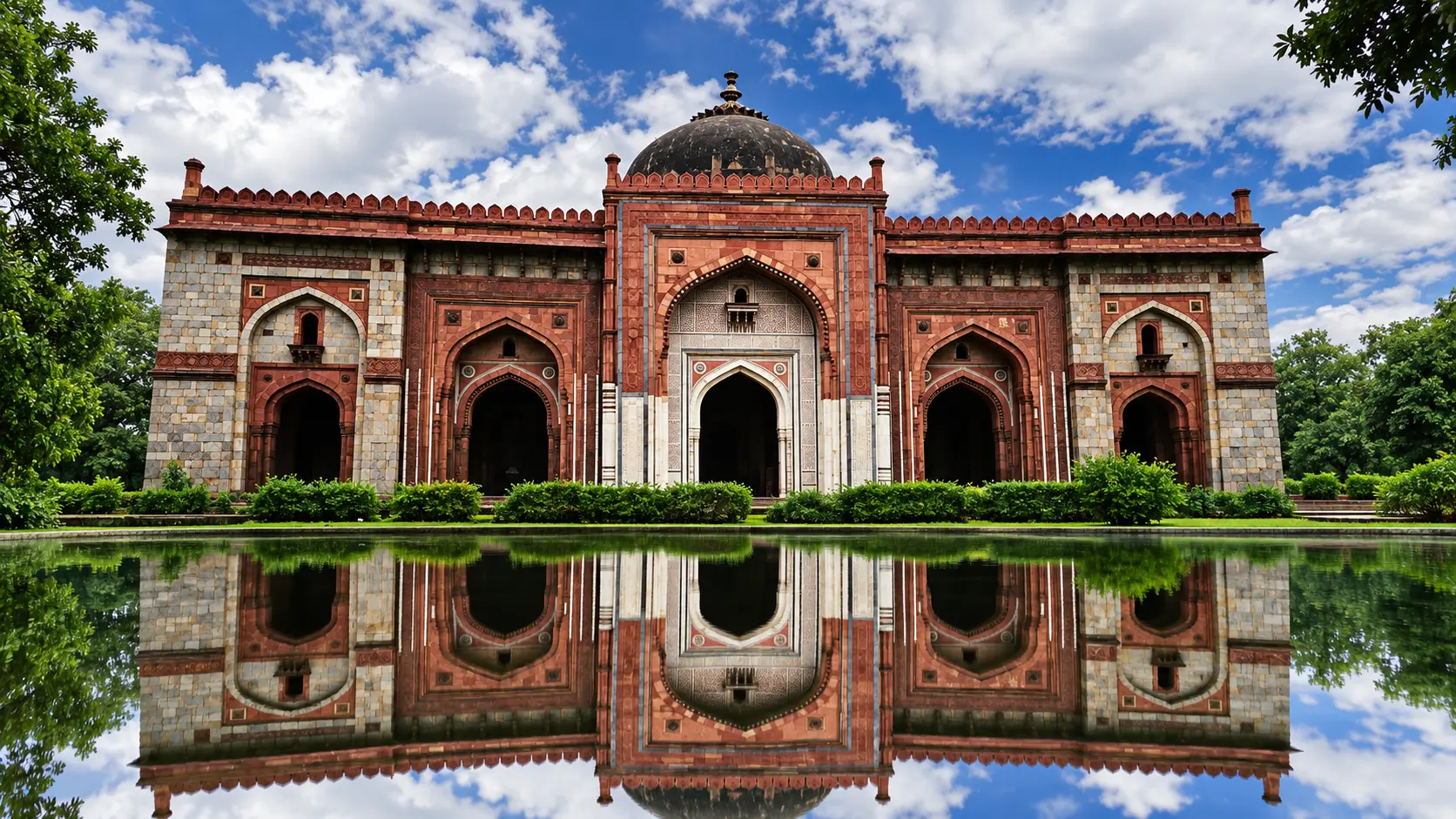
Situated near the center of the fort stands the Qila-i-Kuhna Mosque ("Mosque of the Old Fort"), built in 1541 by Sher Shah Suri. Universally acknowledged by architectural historians as a pivotal masterpiece of South Asian Islamic architecture, this royal Friday mosque represents the critical evolutionary bridge between the heavy, austere forms of the Lodi Sultanate and the refined, polychromatic elegance of classical Mughal monuments.
The facade of the mosque is a visual triumph, featuring five pointed horseshoe arches of varying proportions. The central arched bay rises dramatically above the flanking bays, framed by a broad rectangular archway embellished with bold bands of rich red sandstone, white marble, and black slate inlays. Above the central arch, stylized marble lotus rosettes and geometric frets catch shifting daylight, while two slender decorative minarets (guldastas) rise from the roofline.
Stepping into the single-aisled prayer hall reveals five interconnected vaulted bays. The central bay is crowned by a high hemispherical dome set on a squinch arch system. The western wall contains five deeply recessed mihrabs (prayer niches) decorated with breathtaking craftsmanship: incised plaster arabesques, Quranic verses written in elegant Naskh and Kufic scripts, intricate marble strapwork, and delicate geometric rosettes. The contrast of light streaming through stone jali screens onto the polished sandstone floor creates an atmosphere of profound serenity.
Sher Mandal: Humayun’s Library and Observatory
Positioned approximately 100 meters south of the mosque atop the highest point of the fort ridge is the Sher Mandal, a distinctive two-storey octagonal pavilion constructed of red sandstone with white marble band inlays. Commissioned by Sher Shah Suri as a royal pleasure retreat, it was adapted by Emperor Humayun following his reconquest of Delhi in 1555 as his private astrological observatory and personal library. The lower storey is solid with eight arched recesses, while the upper storey features deep open balconies, painted plaster interiors, and a crowning octagonal domed chhatri.
The Sher Mandal is world-famous in Mughal history as the tragic setting of Emperor Humayun’s fatal accident in January 1556. A passionate astronomer, Humayun was on the flat roof observing the transit of Venus. Upon hearing the evening Adhan (call to prayer) echoing from the nearby Qila-i-Kuhna Mosque, he knelt in piety. In descending the steep, polished stone staircase with an armful of manuscripts, the hem of his long royal robe caught beneath his shoe. The Emperor slipped, tumbled violently down the flight of stairs, and sustained severe head trauma, succumbing to his injuries three days later on January 27, 1556. His sudden demise led to the hasty coronation of his 13-year-old son, Jalal-ud-din Muhammad Akbar, at Kalanaur, inaugurating the golden age of the Mughal Empire.
Baoli, Hammam, and Underground Engineering
- The Baoli (Stepwell): Located between the mosque and the Sher Mandal lies a massive 16th-century stone stepwell. A straight flight of 89 stone steps, interrupted by landings, descends deep into the rocky subsoil. Constructed of quartzite rubble masonry, this subterranean reservoir weather-dependent an independent and secure water supply during protracted military sieges.
- The Royal Hammam (Bathhouse): Situated northwest of the mosque are the conserved ruins of a royal bathhouse. Excavations uncovered terracotta water pipes, sunken bathing basins, dressing alcoves, and a subterranean hypocaust heating chamber that circulated steam and warm air beneath the tiled floors, illustrating the sophisticated hydro-engineering imported from Persia and Central Asia.
The ASI Archaeological Site Museum & Excavation Trenches
Located inside the vaulted chambers beside the Bada Darwaza, the ASI Archaeological Site Museum is an essential visit for understanding the multi-millennial antiquity of Delhi. The museum exhibits artifacts recovered directly from excavations inside Purana Qila, chronologically displayed across its galleries:
- Painted Grey Ware (PGW): Fine grey earthenware bowls and dishes decorated with black geometric motifs dating from 1000 to 600 BCE, associated with the Mahabharata cultural horizon.
- Mauryan & Shunga Art: Stamped terracotta seals, human and animal figurines, and punch-marked silver coins from the 3rd to 1st centuries BCE.
- Kushana & Gupta Terracottas: Intricately molded terracotta plaques, female figurines with elaborate coiffures, gold and copper coins of King Kanishka, and carved stone seals from the 1st to 6th centuries CE.
- Medieval & Mughal Antiquities: Glazed Sultanate pottery, Chinese blue-and-white porcelain shards, Mughal copper coins, and weaponry.
- A stratigraphic soil model illustrates the nine cultural layers of Indraprastha, showing how successive generations built cities atop the ruins of their predecessors. Conserved open excavation trenches can also be viewed across the fort grounds.
Purana Qila Lake, Moat, and Boating
The western perimeter of the fort is bordered by the historic defensive moat, which was originally fed by the waters of the Yamuna River. Today, the moat has been beautifully restored by Delhi Tourism into a 2.5-acre landscaped lake surrounded by weeping willows and stone promenades. Visitors can hire pedal boats and motorized boats to cruise along the water, enjoying magnificent views of the towering quartzite bastions reflecting across the surface. At dusk, the fort grounds host Ishq-e-Dilli ("The Story of Delhi"), a captivating 50-minute laser, sound, and light projection show that brings to life the rise and fall of Delhi's historic cities against the backdrop of the medieval ramparts.
Best time to visit
October to November (Autumn / Post-Monsoon): Widely considered the most enjoyable season.Explore detailsClose details
Seasonal Guide
- October to November (Autumn / Post-Monsoon): Widely considered the most enjoyable season. The monsoon rains leave the 40-acre fort grounds lush and vibrant, the moat lake is full, and the air is crisp with temperatures between 22°C and 30°C. Walking the stone ramparts and viewing the excavation pits in mild sunshine is exceptionally pleasant.
- December to February (Winter): The peak visiting season. The weather is cool and bracing (8°C to 22°C), with sunny winter afternoons ideal for picnicking on the lawns, exploring the open-air monuments, and leisurely boating. In the early morning, atmospheric fog cloaks the bastions, creating an evocative medieval aura.
- March (Early Spring): A lovely transitional month featuring comfortable temperatures (20°C to 28°C) and blooming garden annuals before the severe summer heat sets in.
- April to June (Summer): Summer in Delhi is scorching, with temperatures frequently reaching 40°C to 44°C. Because the fort comprises vast open stone terraces, unshaded earthen mounds, and exposed ramparts, visiting during midday can be physically exhausting. If visiting during summer, arrive early in the morning (06:30 AM to 09:30 AM) or in the late afternoon (04:30 PM to 06:30 PM).
- July to September (Monsoon): Tropical downpours wash the ancient quartzite and red sandstone into rich, vibrant colors. While overcast skies provide welcome relief from direct solar heat, rain-slicked stone staircases at the Sher Mandal and Baoli require cautious footing.
Optimal Time of Day
- Morning (07:30 AM - 10:30 AM): The ideal window for photographers, archaeology enthusiasts, and birdwatchers. The low morning sun illuminates the western facades of the Qila-i-Kuhna Mosque and Bada Darwaza, the site museum is uncrowded, and peacocks can often be spotted strutting across the ruins.
- Late Afternoon to Twilight (03:30 PM - 06:30 PM): Arrive around 03:30 PM to explore the monuments, walk along the ramparts, take a 30-minute boat ride on the moat lake during golden hour, and linger for the evening Sound & Light show.
How to reach
Purana Qila is situated on Mathura Road in South East Delhi (PIN: 110003), directly opposite Pragati Maidan and…Explore detailsClose details
Purana Qila is situated on Mathura Road in South East Delhi (PIN: 110003), directly opposite Pragati Maidan and the National Crafts Museum, bounded by the National Zoological Park to the south.
By Delhi Metro
The Delhi Metro network provides efficient access within a short auto-rickshaw or walking distance:
- Supreme Court Metro Station (Blue Line [Line 3]): The closest metro station, located approximately 1.8 kilometers north along Mathura Road. Exiting from the station, it is a 5-minute ride by metered autorickshaw or battery e-rickshaw straight down Mathura Road to the fort gate.
- Indraprastha Metro Station (Blue Line [Line 3]): Located roughly 2.0 kilometers northeast near the Ring Road, providing convenient access for travelers arriving from East Delhi and Noida.
- Mandi House Metro Station (Blue Line [Line 3] & Violet Line [Line 6] Interchange): Positioned 2.2 kilometers northwest, offering convenient transfers from North, West, and South Delhi.
- Khan Market Metro Station (Violet Line [Line 6]): Situated approximately 2.5 kilometers southwest via Subramaniam Bharti Marg and Mathura Road (an 8-minute auto ride).
By Road, Taxis, and Autos
- Key Approaching Roads: Purana Qila sits directly on Mathura Road (National Highway 44 corridor), connected to Bhairon Marg to the north and Subramaniam Bharti Marg to the west. It is a 5-minute drive from India Gate, 7 minutes from Connaught Place, and 8 minutes from Nizamuddin.
- App-Based Taxis & Auto-Rickshaws: Ride-hailing services (Uber, Ola, BluSmart) and three-wheeled autorickshaws have designated drop-off points along the Mathura Road service lane directly outside the Bada Darwaza main entrance.
- Self-Driving & Parking: Ample paid surface parking managed by municipal authorities is available directly opposite the main entrance gate on the service road between Purana Qila and the Delhi Zoo entry plaza.
From Major Transit Hubs
- From New Delhi Railway Station (NDLS): Situated roughly 5.5 kilometers north. Take the Yellow Line to Rajiv Chowk, interchange to the Blue Line to Supreme Court Metro Station, or take a direct 15-minute taxi ride down Barakhamba Road and Mathura Road.
- From Hazrat Nizamuddin Railway Station (NZM): Located just 3.5 kilometers south along Mathura Road. A direct 8-to-10-minute taxi or autorickshaw ride straight past the Sundar Nagar market brings you directly to the fort gate.
- From Old Delhi Railway Station (DLI): Approximately 8 kilometers north. Board the Yellow Line to Chandni Chowk, transfer to the Blue Line at Rajiv Chowk to Supreme Court (approx. 25 minutes).
- From Indira Gandhi International Airport (DEL): Located roughly 16 kilometers southwest. Take the Airport Express Orange Line from Terminal 3 to New Delhi Station and transfer to the Blue Line, or take a pre-paid taxi via Dhaula Kuan and Mathura Road (approx. 35 to 50 minutes depending on traffic).
Entry, timings and permissions
Fees, visiting hours and entry rules may change.Explore detailsClose details
Fees, visiting hours and entry rules may change. Confirm the latest details with the official operator or local authority before travelling.
Entry Fees and Ticketing
Purana Qila is maintained as a Centrally Protected Monument by the Archaeological Survey of India (ASI). Admission tariffs follow the standard Category B ASI fee structure:
- Indian Citizens, SAARC, and BIMSTEC Nationals: ₹20 per person when purchasing digital cashless tickets online via the ASI portal or QR code; ₹25 per person when purchasing physical paper tokens at the on-site cash counter.
- Foreign Tourists (Non-SAARC / Non-BIMSTEC): ₹250 per person for online/cashless digital bookings; ₹300 per person at the cash counter.
- Children: Free admission for all children below the age of 15 years upon verification.
- Site Museum Entry: Included with the monument entry ticket (no extra fee).
- Boating Charges: Pedal boats and motor boats operated by DTTDC on the moat lake are charged separately (approx. ₹100 to ₹150 for 20 to 30 minutes of boating).
- Sound and Light Show Tickets: Separate evening tickets are sold at the dedicated show counter (approx. ₹100 for adults, ₹50 for children).
Timings and Operating Schedules
- Monument Grounds & Fort: Open daily from sunrise to sunset (officially from approximately 06:00 AM to 06:00 PM), all 365 days of the year, including Sundays and national holidays.
- ASI Archaeological Site Museum: Open from 09:00 AM to 05:00 PM (Closed on Fridays and national public holidays).
- Boating Operations: Daily from 10:00 AM to 06:00 PM (subject to seasonal daylight and lake water maintenance).
- Sound and Light Show (Ishq-e-Dilli): Two shows daily after sunset (Hindi show: 07:00 PM to 07:50 PM; English show: 08:00 PM to 08:50 PM; winter timings shift one hour earlier).
Photography and Equipment Regulations
- Handheld Photography: Handheld non-commercial still photography and mobile phone snapshots are completely free and permitted throughout all fort grounds, ramparts, and monument exteriors.
- Tripods, Gimbals & Commercial Productions: In accordance with statutory ASI regulations, the use of camera tripods, monopods, lighting equipment, and professional video cameras is strictly regulated. Commercial filming, fashion portfolio shoots, and documentary video recording require prior formal application, security clearance, and permit fee payments to the Superintending Archaeologist, ASI Delhi Circle.
- Drone Regulations: Flying uncrewed aerial vehicles (drones/UAVs) of any weight class is strictly prohibited. Purana Qila is located within the high-security diplomatic and governmental perimeter of Central/South East Delhi, falling within a strict DGCA/Delhi Police No-Fly Red Zone. Unauthorized drone operations are treated as security offenses resulting in equipment seizure and legal prosecution.
Conservation and Visitor Safety
- Rampart Safety: Portions of the high perimeter ramparts have sheer drops of up to 18 meters without safety railings. Visitors must exercise extreme caution, supervise children closely, and refrain from sitting or walking along the edge of unbarricaded walls.
- Preserving Ancient Masonry: Climbing on the dome of the Qila-i-Kuhna Mosque, entering barricaded excavation pits, or scratching graffiti on historical stone surfaces is strictly prohibited and punishable under the Ancient Monuments and Archaeological Sites and Remains Act.
Nearby places to consider
Its central location on Mathura Road makes Purana Qila an exceptional anchor for exploring Delhi's historic…Explore detailsClose details
Its central location on Mathura Road makes Purana Qila an exceptional anchor for exploring Delhi's historic, cultural, and artistic treasures:
National Zoological Park (Delhi Zoo)
Bordering Purana Qila immediately to the south, the Delhi Zoo spans 176 acres of verdant woodland along the historic Yamuna bank. Established in 1959, the zoo provides naturalistic island enclosures for over 1,300 animals representing 130 species, including the Royal Bengal tiger, rare white tigers, Asian elephants, swamp deer (barasingha), and chimpanzees, along with an expansive winter bird sanctuary for migratory painted storks and pelicans.
National Crafts Museum & Hastkala Academy
Located directly opposite Purana Qila along Bhairon Marg and Mathura Road, the National Crafts Museum is one of India's most enchanting cultural destinations. Set within a rustic village-style complex with courtyards from Gujarat, Rajasthan, and Himachal Pradesh, it showcases over 35,000 rare tribal and folk artifacts, live artisan demonstrations, an official handloom boutique, and the acclaimed contemporary Indian restaurant, Cafe Lota.
National Gallery of Modern Art (NGMA)
Situated roughly 1.5 kilometers west at the India Gate C-Hexagon (Jaipur House), the NGMA houses India’s premier collection of modern visual art. Its sunlit galleries display iconic masterworks by Raja Ravi Varma, Amrita Sher-Gil, Rabindranath Tagore, Jamini Roy, and the progressive modernist masters, complemented by lush outdoor sculpture lawns and an art cafe.
Humayun's Tomb
Positioned approximately 2.5 kilometers south along Mathura Road in Nizamuddin East (a 5-minute auto ride), Humayun's Tomb is an inscribed UNESCO World Heritage Site. Visiting Humayun's Tomb after Purana Qila provides an extraordinary narrative closure: after witnessing the Sher Mandal where the Emperor met his untimely death in 1556, you can stand before the sublime Persian garden-tomb erected a decade later by his senior consort Bega Begum to house his final mortal remains.
India Gate and Kartavya Path
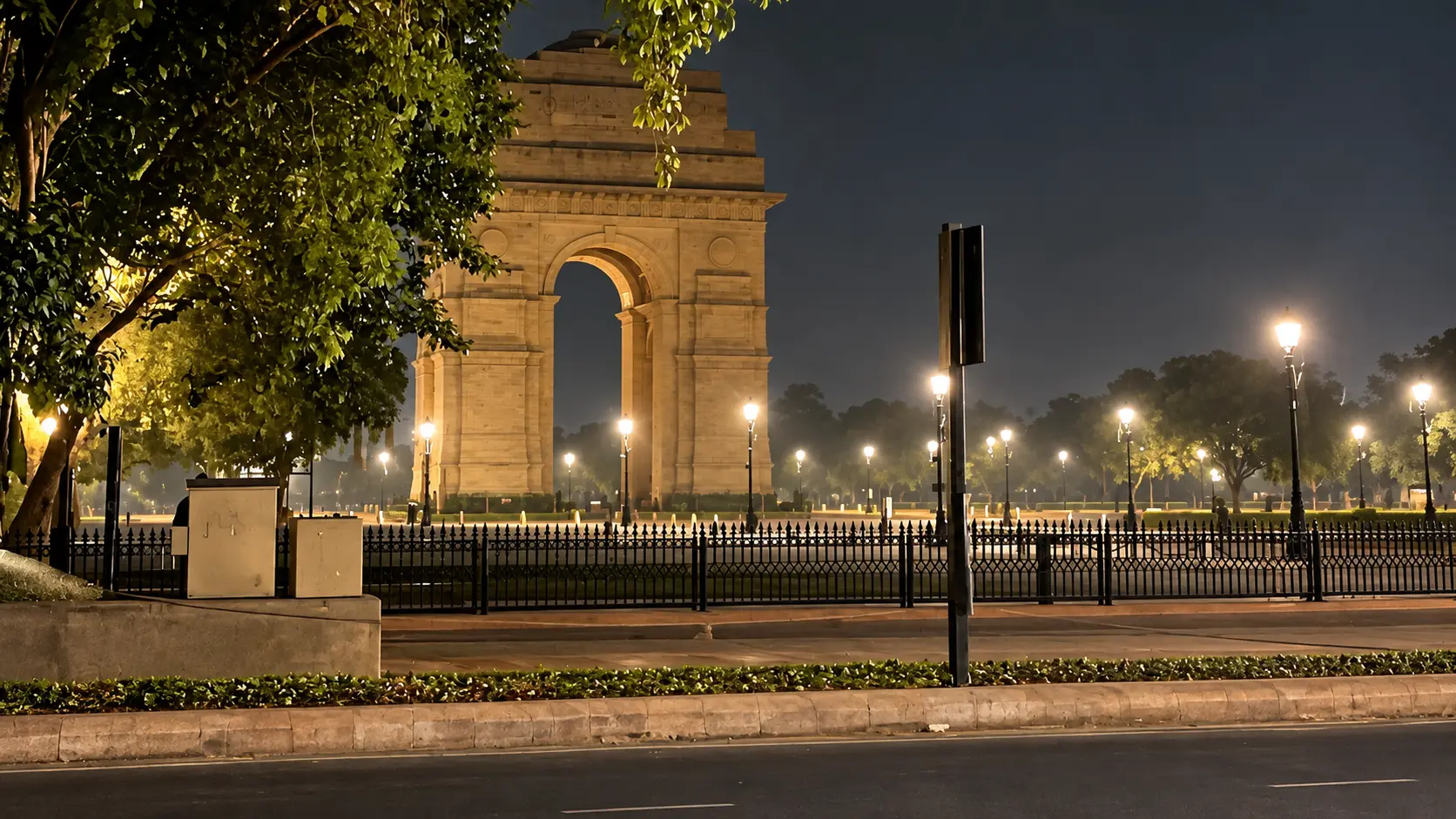
Located just 2.0 kilometers west via Shershah Road and the C-Hexagon, India Gate is the monumental 42-meter triumphal war arch honoring 84,000 fallen soldiers. Stroll the newly revitalized pedestrian avenues of Kartavya Path and visit the 40-acre National War Memorial as the sun sets over Delhi.
In pictures
The practical bits
Before you go.
Plan ahead
To maximize your experience of Purana Qila's layered heritage and peaceful ambiance, keep these practical tips in…Explore detailsClose details
To maximize your experience of Purana Qila's layered heritage and peaceful ambiance, keep these practical tips in mind:
Curating Your Walking Circuit
Enter through the Bada Darwaza and begin by turning right to tour the ASI Archaeological Site Museum to…Explore detailsClose details
Enter through the Bada Darwaza and begin by turning right to tour the ASI Archaeological Site Museum to familiarize yourself with the 2,500-year timeline of Indraprastha. Next, walk east across the central lawn to the Qila-i-Kuhna Mosque, allowing 30 minutes to inspect its intricate marble inlays and carved stucco mihrabs. Continue south to the octagonal Sher Mandal to learn about Humayun’s tragic fall, peer into the 89-step Baoli, and stroll past the royal Hammam ruins before ascending the conserved rampart paths for sweeping views across the Yamuna plains.
Comfort, Footwear, and Sun Protection
Because Purana Qila is an expansive 40-acre outdoor archaeological site with minimal shade over the open lawns…Explore detailsClose details
Because Purana Qila is an expansive 40-acre outdoor archaeological site with minimal shade over the open lawns and stone paths, wear comfortable walking shoes with good tread. From March through October, carry a broad-brimmed sun hat, sunglasses, and an insulated water bottle. Filtered RO drinking water stations and clean public restrooms are located near the Bada Darwaza reception area.
Combining with the National Zoological Park
Purana Qila shares its southern boundary with the National Zoological Park (Delhi Zoo), a 176-acre lush green…Explore detailsClose details
Purana Qila shares its southern boundary with the National Zoological Park (Delhi Zoo), a 176-acre lush green habitat housing white tigers, Asiatic lions, Indian rhinoceroses, and thousands of migratory waterbirds. Nature lovers and families traveling with children can easily combine a morning visit to the zoo with an afternoon tour and boating at Purana Qila.
Exploring the National Crafts Museum
Directly across Mathura Road from Purana Qila's main gate lies the National Crafts Museum & Hastkala Academy.Explore detailsClose details
Directly across Mathura Road from Purana Qila's main gate lies the National Crafts Museum & Hastkala Academy. After exploring the fort, walk across the pedestrian crossing to enjoy authentic Indian regional cuisine at the celebrated Cafe Lota (famous for palak patta chaat, apple jalebi, and filter coffee) and browse the museum’s open-air artisan courtyards displaying traditional handloom textiles, terracotta art, and tribal handicrafts.
A few things you might wonder
Common questions about visiting Purana Qila. Fees, visiting hours and ceremonies are researched details that may change; confirm current arrangements with the operator before travelling.
Is Purana Qila the site of ancient Indraprastha from the Mahabharata?
Who built Purana Qila, and why is it called the Old Fort?
How did Mughal Emperor Humayun die at Purana Qila?
What are the opening hours and ticket prices for Purana Qila?
Is boating available at Purana Qila, and how does it work?
Which metro station is closest to Purana Qila, and how do I reach it?
What is the evening Sound and Light Show at Purana Qila?
What can visitors see inside the on-site Archaeological Site Museum?
Explore more in New Delhi
Discover other destinations around this hub
More Hubs in Delhi Ncr
Continue exploring other travel hubs in this state
Planning a trip to New Delhi?