Lodhi Gardens
Comprehensive guide to Lodhi Gardens in New Delhi. Explore 15th-century Sayyid and Lodi tombs, Bara Gumbad, Sikandar Lodi tomb, jogging tracks, timings, and metro routes.
Location
New Delhi, Delhi NCR
A closer look
Your visit, at a glance.
New Delhi, Delhi Ncr
GET TO KNOW THE PLACE
---
The story of Lodhi Gardens
Start here. Open a tile for the full details.
Why goRead details
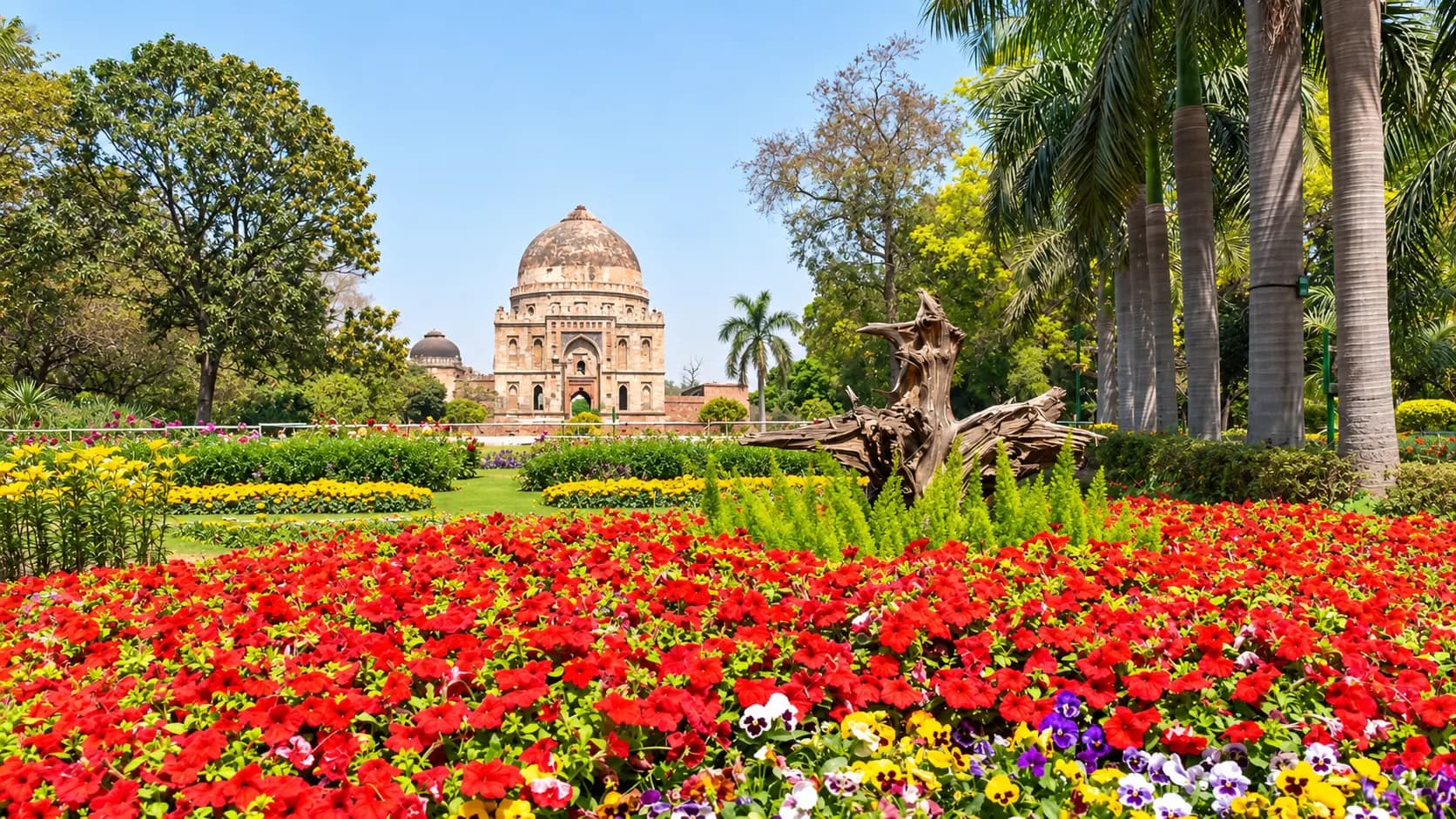
Few public spaces in the world achieve the sublime harmony of monumental medieval history, botanical richness, and democratic civic life found within Lodhi Gardens. Situated along Lodhi Road in South-Central New Delhi, this 90-acre landscape is at once an open-air architectural museum of the Delhi Sultanate, a premier botanical sanctuary housing centenarian trees and hundreds of avian species, and the beloved green lung of the Indian capital. While modern Delhi buzzes with fast-paced commerce, stepping through any of the sandstone gates of Lodhi Gardens transports visitors into a serene realm where 15th-century sandstone domes and arched arcades rise gracefully above undulating lawns, tranquil lotus ponds, and ancient flowering trees.
When to visitRead details
Entry & permissionsRead details
Fees, visiting hours and entry rules may change. Confirm the latest details with the official operator or local authority before travelling.
Entry Fees and Ticketing
- General Admission: Completely Free (₹0) for all visitors, including Indian citizens, foreign tourists, students, and children of all ages.
- Ticketing & Reservations: There are no entrance tickets, digital entry fees, advance registrations, or queue tokens required. Visitors can simply walk into the park through any of the active entry gates during operating hours.
Timings and Operating Schedules
- Summer Timings (April 1 to September 30): Open daily from 05:00 AM to 08:00 PM.
- Winter Timings (October 1 to March 31): Open daily from 06:00 AM to 07:30 PM.
- Year-Round Operation: The gardens remain open 365 days a year, including all Sundays, gazetted national holidays (Republic Day, Independence Day, Gandhi Jayanti), and religious festivals.
- Park Gate Closures: Gatekeepers ring warning bells approximately 15 minutes before closing time to signal visitors to move toward the exits.
Photography and Equipment Regulations
- Handheld Photography: Handheld non-commercial still photography, mobile phone video recording, and tourist snapshots are completely free and permitted throughout all lawns, walking paths, and around the medieval monuments.
- Tripods, Gimbals & Commercial Productions: The use of tripods, monopods, portable lighting rigs, and professional filming equipment is strictly regulated. Commercial video shoots, fashion model portfolios, music videos, and film productions require prior written approval and payment of commercial licensing fees from both the New Delhi Municipal Council (NDMC) and the Archaeological Survey of India (ASI) Delhi Circle.
- Drone Regulations: Flying uncrewed aerial vehicles (drones/UAVs) of any weight class is strictly prohibited. Lodhi Gardens is located in the high-security diplomatic and ministerial core of New Delhi, within 2 kilometers of the Prime Minister's residence, central ministry secretariats, and Safdarjung Airport airspace, placing it squarely within a strict DGCA/Delhi Police No-Fly Red Zone. Unauthorized drone operations result in immediate equipment seizure and criminal prosecution.
Park Etiquette and Conservation Guidelines
- Protecting Historical Masonry: Visitors must not climb on the domes, carve graffiti into historic plasterwork, or scale the decorative parapets of the monuments.
- Litter and Plastic Ban: Lodhi Gardens is an environmentally sensitive zero-litter zone. Single-use plastic bags, disposable cutlery, and littering are strictly banned. Visitors must deposit all waste in designated color-coded municipal dustbins.
- Sports and Activities: Gentle leisure activities like yoga, meditation, jogging, and walking on grass are encouraged. However, organized competitive sports such as cricket, football, or flying kites are prohibited to maintain visitor safety and preserve manicured lawns.
Plan your visitRead details
Lodhi Gardens is situated on Lodhi Road in South-Central New Delhi (PIN: 110003), framed by Amrita Shergill Marg, Max Mueller Marg, and Archbishop Makarios Marg, making it exceptionally accessible from all parts of the National Capital Region.
Explore the full guide - choose a topic below.
Why visit?
Few public spaces in the world achieve the sublime harmony of monumental medieval history, botanical richness…Explore detailsClose details
Few public spaces in the world achieve the sublime harmony of monumental medieval history, botanical richness, and democratic civic life found within Lodhi Gardens. Situated along Lodhi Road in South-Central New Delhi, this 90-acre landscape is at once an open-air architectural museum of the Delhi Sultanate, a premier botanical sanctuary housing centenarian trees and hundreds of avian species, and the beloved green lung of the Indian capital. While modern Delhi buzzes with fast-paced commerce, stepping through any of the sandstone gates of Lodhi Gardens transports visitors into a serene realm where 15th-century sandstone domes and arched arcades rise gracefully above undulating lawns, tranquil lotus ponds, and ancient flowering trees.
The historical significance of Lodhi Gardens is immense, capturing a pivotal transitional moment in Indian architectural evolution between the crumbling authority of the Delhi Sultanate and the dawn of the Mughal Empire. Here, within walking distance of one another, stand the masterworks of the Sayyid Dynasty (1414 - 1451) and the Lodi Dynasty (1451 - 1526) - the last Afghan rulers of Delhi before Babur’s victory at Panipat in 1526. The park preserves the breathtaking Tomb of Muhammad Shah (1444), an octagonal marvel that served as the architectural prototype for later Mughal garden-tombs like Isa Khan's tomb and Sher Shah Suri's mausoleum; the colossal Bara Gumbad (1494) and its attached Friday mosque adorned with some of the most intricate stucco calligraphy in Islamic India; the jewel-like Sheesh Gumbad, once clad in glistening Persian blue tiles; and the fortified Tomb of Sikandar Lodi (1517 - 1518), recognized as the subcontinent's earliest walled garden-tomb featuring an early double-dome structure.
What elevates Lodhi Gardens beyond an ordinary archaeological site is its vibrant, living integration into the daily fabric of New Delhi. Landscaped originally in 1936 under British Viceroy Lord Willingdon and later masterfully reimagined in 1968 by the celebrated American modernist architect Joseph Allen Stein and landscape architect Garrett Eckbo, the grounds marry historical conservation with organic landscape design. In the early morning mist, diplomats, senior judges, cabinet ministers, university students, and local residents share the 2.2-kilometer jogging track beneath the canopy of towering Arjun, Jamun, and Peepal trees. Throughout the sunny winter afternoons, the lawns become an idyllic gathering place for families, sketch artists, birdwatchers, and literature enthusiasts soaking in the gentle Delhi sun. Completely free of charge and open seven days a week, Lodhi Gardens offers a quintessential Delhi experience where centuries of imperial drama dissolve into birdsong and emerald tranquility.
What to expect
Covering 90 expansive acres, Lodhi Gardens is organized around paved footpaths, rolling turf berms, wooded…Explore detailsClose details
Covering 90 expansive acres, Lodhi Gardens is organized around paved footpaths, rolling turf berms, wooded groves, and water canals that weave among five primary centrally protected historical monuments. Visitors can expect an immersive outdoor walking experience that requires moderate physical movement over gentle grassy slopes and paved stone walkways.
Tomb of Muhammad Shah (1444)
Located in the southwestern quadrant of the gardens near the main Lodhi Road entrance, the Tomb of Muhammad Shah is the oldest monument in the complex and one of the finest surviving examples of Sayyid dynasty architecture. Built in 1444 by Ala-ud-din Alam Shah as a royal tribute to his father Muhammad Shah (the third Sultan of the Sayyid dynasty), the structure is celebrated for its elegant octagonal plan.
The central tomb chamber is encircled by an open-arched verandah featuring three gracefully proportioned pointed arches on each of its eight sides. Heavy, sloping stone buttresses anchor the eight corners of the structure, imparting both structural stability and architectural weight characteristic of late Sultanate engineering. Above the wide eaves (chhajjas), an arcade of eight delicate domed kiosks (chhatris) encircles the soaring central dome, with each chhatri resting on a cluster of slender stone pillars. The summit of the dome is crowned by an ornate lotus-bud finial. Within the central chamber lie eight stone cenotaphs, with the Sultan’s grave occupying the elevated central plinth. The harmonious geometry of this building directly inspired later octagonal masterworks, including the 1547 tomb of Isa Khan Niyazi at Humayun's Tomb and the magnificent imperial tomb of Sher Shah Suri in Sasaram, Bihar.
Bara Gumbad (Big Dome) and the Friday Mosque (1494)
Positioned near the center of the gardens atop an elevated rectangular stone terrace, the Bara Gumbad complex forms the monumental core of the park. Erected in 1494 during the reign of Sultan Sikandar Lodi, the complex comprises three distinct facing buildings: the colossal square Bara Gumbad gateway, an attached three-domed Friday mosque to the west, and a matching guest house or assembly hall (Mehmon Khana) directly opposite to the east.
- The Bara Gumbad: Rising as a massive square cubic structure topped by an enormous hemispherical dome, the Bara Gumbad ("Big Dome") is an imposing architectural statement. Intriguingly, the interior contains no grave cenotaph; architectural historians believe it was designed as a monumental entrance gateway to the mosque or as a grand commemorative pavilion. The exterior walls are cleverly articulated into two vertical tiers of blind arches and oriel balconies, creating the optical illusion of a two-storey building from the outside while sheltering a soaring single-storey hall within.
- The Friday Mosque (Jama Masjid): Attached directly to the western flank of the Bara Gumbad, this three-domed mosque is universally acknowledged as one of the artistic pinnacles of pre-Mughal Islamic architecture in India. The prayer hall features five arched bays leading into three domed bays. The interior walls, squinches, mihrabs, and ceiling vaults are covered in an astonishing tapestry of incised and painted stucco plasterwork. Intricate Quranic verses written in elegant Naskh and foliated Kufic calligraphy intertwine with geometric knotwork, stylized rosettes, and arabesque foliage, displaying a level of calligraphic craftsmanship rarely matched even in later Mughal palaces.
Sheesh Gumbad (Glazed Dome)
Standing roughly 50 meters north of the Bara Gumbad on the same historic axis, the Sheesh Gumbad ("Glazed Dome" or "Glass Dome") is an exquisite square mausoleum dating from the late 15th-century Lodi period. Constructed of grey Delhi quartzite and dressed sandstone, it shares the two-tiered external facade of the Bara Gumbad, with recessed arched niches and bracketed balconies.
The monument earned its name from the brilliant cobalt-blue and turquoise glazed Persian ceramic tiles that once covered the decorative frieze running above the main western entrance portal. While centuries of weathering have stripped away much of the glaze, significant patches of vibrant blue and turquoise tiles still cling to the plasterwork, offering a glimpse of the building's medieval luminescence. The spacious interior houses several plastered grave cenotaphs belonging to an unidentified Lodi aristocratic or royal family, sheltered beneath an expansive vaulted ceiling with painted plaster rosettes.
Tomb of Sikandar Lodi (1517 - 1518)
Situated in the northern sector of the gardens, the Tomb of Sikandar Lodi was commissioned in 1517 - 1518 by his son Ibrahim Lodi (the last Sultan of Delhi, who was defeated by Babur at the First Battle of Panipat in 1526). This monument holds seminal importance in South Asian architectural history as the direct evolutionary ancestor of the Mughal Charbagh (four-quadrant garden-tomb) typology.
Unlike the open tombs of Muhammad Shah and Sheesh Gumbad, Sikandar Lodi’s mausoleum is set within a spacious, square fortified walled enclosure (char-diwari) entered through an imposing western gatehouse flanked by corner turrets. The central mausoleum is octagonal, surrounded by an arched verandah, but its defining technical innovation is its double dome. Engineered with an inner hemispherical ceiling that preserves balanced proportions inside the chamber and a taller, bulbous outer dome that commands the external landscape, this was one of the earliest successful applications of double-dome construction on the subcontinent, a technique perfected decades later at Humayun's Tomb and the Taj Mahal.
Athpula (Eight-Piered Bridge)
Spanning a serene water canal in the northeastern quadrant of the park, the Athpula ("Eight-Piered Bridge") is the only major monument in Lodhi Gardens dating from the Mughal era. Commissioned during the reign of the third Mughal Emperor Akbar the Great in the late 16th century, the bridge was built by Nawab Bahadur, an imperial courtier.
Constructed of solid dressed stone, the bridge features seven arched spans resting upon eight sturdy masonry piers (ath meaning eight, and pula meaning piers/bridge). The central arches are broader and taller than the tapering side spans, giving the bridge a graceful, undulating profile that reflects beautifully across the water. Shaded by weeping willows and jamun trees, the Athpula is a favorite gathering spot for visitors watching ducks swim across the canal and enjoying the peaceful waterside atmosphere.
Flora, Fauna, and Botanical Collections
Lodhi Gardens is an exceptional ecological treasure in the heart of urban Delhi, supporting over 7,000 trees across more than 100 native and exotic species. Stately centenarian specimens of Arjun (Terminalia arjuna), Jamun, Peepal, Banyan, Neem, and Semal (Silk Cotton) provide deep shade throughout the hotter months. In spring (February and March), the park erupts in a blaze of color as Semal trees bloom with scarlet petals, Amaltas (Golden Shower) trees drip with yellow cascading blossoms, and manicured flowerbeds display petunias, pansies, and marigolds.
The park is also celebrated as one of Delhi's premier urban bird sanctuaries. Birdwatchers regularly spot over 50 resident and winter migratory bird species, including rose-ringed parakeets, yellow-footed green pigeons, brown-headed barbets, spotted owlets nesting in tree hollows, white-throated kingfishers hunting near the waterways, and flocks of jungle babblers hopping across the lawns. The garden also houses the National Bonsai Park, showcasing over 300 meticulously pruned miniature trees, as well as an active butterfly conservatory, a glasshouse nursery, and a dedicated herbal medicine garden.
Best time to visit
October to November (Autumn / Post-Monsoon): One of the most enchanting times to explore Lodhi Gardens.Explore detailsClose details
Seasonal Guide
- October to November (Autumn / Post-Monsoon): One of the most enchanting times to explore Lodhi Gardens. The monsoon rains leave the 90-acre park exceptionally green, water bodies full, and air crisp and clear. Daytime temperatures range from 22°C to 30°C, providing perfect conditions for long walks and relaxed picnics.
- December to February (Winter): Widely regarded as the golden season for Lodhi Gardens. Mornings are brisk and cool (7°C to 12°C), frequently blanketed in soft morning mist that creates an ethereal atmosphere around the medieval domes. Sunny afternoons (18°C to 24°C) are spectacular, drawing hundreds of Delhiites to sprawl across the sun-drenched lawns with books and picnic baskets. In February, winter flowerbeds reach peak bloom.
- March (Early Spring): A vibrant month when temperatures remain pleasant (20°C to 28°C), flowering trees burst into color, and bird activity is at its height before the onset of summer.
- April to June (Summer): Extreme summer conditions bring midday temperatures soaring between 38°C and 44°C. Midday visits are strongly discouraged due to intense heat and strong sun. However, the park is deeply rewarding during the early mornings (05:30 AM to 08:00 AM) and late evenings (06:00 PM to 07:45 PM), when cool breezes circulate under the dense tree canopy.
- July to September (Monsoon): Frequent tropical rains transform the gardens into a lush, vibrant jungle. Overcast skies and rain-washed terracotta stone create dramatic photographic opportunities, though high humidity (75% - 85%) and occasional waterlogged turf require careful footing along paved paths.
Optimal Time of Day
- Dawn to Early Morning (05:30 AM - 08:30 AM): The ideal window to witness Delhi's unique civic culture. The park is alive with morning walkers, yoga practitioners, and birdwatchers, while golden sunrise rays stream through ancient trees and illuminate the arches of Muhammad Shah's tomb.
- Late Afternoon to Dusk (03:30 PM - 06:30 PM): The best time for heritage lovers and casual sightseers. The low-angled golden afternoon light illuminates the textured sandstone of Bara Gumbad and Sheesh Gumbad, followed by peaceful twilight across the lotus ponds.
How to reach
Lodhi Gardens is situated on Lodhi Road in South-Central New Delhi (PIN: 110003), framed by Amrita Shergill Marg…Explore detailsClose details
Lodhi Gardens is situated on Lodhi Road in South-Central New Delhi (PIN: 110003), framed by Amrita Shergill Marg, Max Mueller Marg, and Archbishop Makarios Marg, making it exceptionally accessible from all parts of the National Capital Region.
By Delhi Metro
The Delhi Metro system offers multiple convenient access points within 1.0 to 1.5 kilometers of the gardens:
- Jor Bagh Metro Station (Yellow Line [Line 2]): The most convenient and closest metro station, located approximately 1.0 kilometer southwest. Taking Gate 2, visitors can enjoy a pleasant 10-to-12-minute walk northeast along the tree-lined avenues of Jor Bagh, or take a 3-minute ride by battery-operated e-rickshaw or autorickshaw directly to the main gate on Lodhi Road.
- JLN Stadium Metro Station (Violet Line [Line 6]): Located roughly 1.2 kilometers east along Lodhi Road. Exiting from Gate 2, it is an easy 12-minute stroll west past the India Habitat Centre, or a 3-minute auto ride to the eastern gates on Max Mueller Marg.
- Khan Market Metro Station (Violet Line [Line 6]): Positioned approximately 1.2 kilometers northeast. Taking the exit toward Amrita Shergill Marg, visitors can walk down through Delhi's premier diplomatic residential avenues to reach the northeastern park gate in about 12 minutes.
- Lok Kalyan Marg Metro Station (Yellow Line [Line 2]): Situated 1.5 kilometers west along Safdarjung Road and Lodhi Road, providing convenient access for travelers coming from South Delhi.
By Road, Taxis, and Autos
- Approaching Roads: Lodhi Gardens is accessed directly via Lodhi Road from the south, Amrita Shergill Marg from the west and north, and Max Mueller Marg from the east. It is a 5-minute drive from Khan Market, 7 minutes from India Gate, and 10 minutes from Connaught Place.
- App-Based Taxis & Auto-Rickshaws: Ride-hailing services (Uber, Ola, BluSmart) and metered autorickshaws have designated drop-off points outside Gate 1 (Lodhi Road main gate), Gate 4 (Max Mueller Marg), and Gate 7 (Amrita Shergill Marg).
- Self-Driving & Parking: Dedicated public parking areas maintained by NDMC are located along the service lanes of Lodhi Road (near Gate 1) and on Max Mueller Marg outside the India International Centre. Parking can fill up during pleasant winter weekend afternoons, so arriving early or taking the metro is recommended.
From Major Transit Hubs
- From New Delhi Railway Station (NDLS): Approximately 6 kilometers north. Direct 12-minute ride on the Yellow Line from New Delhi Metro Station to Jor Bagh, followed by a short walk or auto ride. Total transit time is roughly 20 to 25 minutes.
- From Hazrat Nizamuddin Railway Station (NZM): Located roughly 4.5 kilometers east. A 12-to-15-minute taxi or autorickshaw ride straight down Lodhi Road, or a quick metro hop from Sarai Kale Khan-Nizamuddin to JLN Stadium via the Pink and Violet lines.
- From Old Delhi Railway Station (DLI): Approximately 9 kilometers north. Take the Yellow Line from Chandni Chowk directly to Jor Bagh (approx. 20 minutes).
- From Indira Gandhi International Airport (DEL): Located 15 kilometers west. Board the Airport Express Orange Line from Terminal 3 to Dhaula Kuan or New Delhi Station, or take a direct pre-paid taxi or app-cab via Sardar Patel Marg and Lodhi Road (approx. 30 to 45 minutes depending on traffic).
Entry, timings and permissions
Fees, visiting hours and entry rules may change.Explore detailsClose details
Fees, visiting hours and entry rules may change. Confirm the latest details with the official operator or local authority before travelling.
Entry Fees and Ticketing
- General Admission: Completely Free (₹0) for all visitors, including Indian citizens, foreign tourists, students, and children of all ages.
- Ticketing & Reservations: There are no entrance tickets, digital entry fees, advance registrations, or queue tokens required. Visitors can simply walk into the park through any of the active entry gates during operating hours.
Timings and Operating Schedules
- Summer Timings (April 1 to September 30): Open daily from 05:00 AM to 08:00 PM.
- Winter Timings (October 1 to March 31): Open daily from 06:00 AM to 07:30 PM.
- Year-Round Operation: The gardens remain open 365 days a year, including all Sundays, gazetted national holidays (Republic Day, Independence Day, Gandhi Jayanti), and religious festivals.
- Park Gate Closures: Gatekeepers ring warning bells approximately 15 minutes before closing time to signal visitors to move toward the exits.
Photography and Equipment Regulations
- Handheld Photography: Handheld non-commercial still photography, mobile phone video recording, and tourist snapshots are completely free and permitted throughout all lawns, walking paths, and around the medieval monuments.
- Tripods, Gimbals & Commercial Productions: The use of tripods, monopods, portable lighting rigs, and professional filming equipment is strictly regulated. Commercial video shoots, fashion model portfolios, music videos, and film productions require prior written approval and payment of commercial licensing fees from both the New Delhi Municipal Council (NDMC) and the Archaeological Survey of India (ASI) Delhi Circle.
- Drone Regulations: Flying uncrewed aerial vehicles (drones/UAVs) of any weight class is strictly prohibited. Lodhi Gardens is located in the high-security diplomatic and ministerial core of New Delhi, within 2 kilometers of the Prime Minister's residence, central ministry secretariats, and Safdarjung Airport airspace, placing it squarely within a strict DGCA/Delhi Police No-Fly Red Zone. Unauthorized drone operations result in immediate equipment seizure and criminal prosecution.
Park Etiquette and Conservation Guidelines
- Protecting Historical Masonry: Visitors must not climb on the domes, carve graffiti into historic plasterwork, or scale the decorative parapets of the monuments.
- Litter and Plastic Ban: Lodhi Gardens is an environmentally sensitive zero-litter zone. Single-use plastic bags, disposable cutlery, and littering are strictly banned. Visitors must deposit all waste in designated color-coded municipal dustbins.
- Sports and Activities: Gentle leisure activities like yoga, meditation, jogging, and walking on grass are encouraged. However, organized competitive sports such as cricket, football, or flying kites are prohibited to maintain visitor safety and preserve manicured lawns.
Nearby places to consider
Lodhi Gardens is situated at the epicenter of South-Central Delhi's most prestigious cultural, architectural, and…Explore detailsClose details
Lodhi Gardens is situated at the epicenter of South-Central Delhi's most prestigious cultural, architectural, and diplomatic district:
Safdarjung Tomb
Located just 1.0 kilometer west along Lodhi Road (a 12-minute walk or 3-minute auto ride), Safdarjung Tomb is the grand marble-and-sandstone garden mausoleum of Mirza Muqim Abul Mansur Khan (Safdarjung), the Prime Minister of Mughal Emperor Ahmad Shah Bahadur. Built in 1754, this enclosed Charbagh monument is widely celebrated as the "last flicker of the Mughal architectural lamp," offering a fascinating visual and stylistic comparison to the earlier 15th-century Lodi tombs.
Khan Market
Situated roughly 1.2 kilometers northeast, Khan Market is India's most upscale and celebrated lifestyle and dining enclave. Developed in 1951 to rehabilitate partition refugees, it is today packed with high-end boutiques, artisanal jewelers, renowned independent bookstores (such as Bahrisons Booksellers and Faqir Chand & Sons), and acclaimed international eateries, making it the perfect destination for an afternoon lunch or evening dinner after exploring the gardens.
India Habitat Centre (IHC) and Stein Studios
Located directly across Max Mueller Marg on the eastern edge of the gardens, the India Habitat Centre is Delhi's premier multidisciplinary cultural hub. Designed by legendary architect Joseph Allen Stein, the complex features stunning open-air brick-and-steel courtyards, visual art galleries, auditoriums hosting classical concerts and plays, and iconic dining spots such as The All American Diner (HabitArt) and Delhi O' Delhi.
Humayun's Tomb
Positioned approximately 2.5 kilometers east along Lodhi Road and Mathura Road (a 7-minute auto ride), Humayun's Tomb is an inscribed UNESCO World Heritage Site (1993, Ref: 232). Commissioned in 1565, this monumental red sandstone and white marble mausoleum represents the triumphant zenith of Mughal garden architecture, directly evolving from the foundational double-dome and garden-enclosure prototypes pioneered at Sikandar Lodi's tomb in Lodhi Gardens.
National Crafts Museum & Hastkala Academy
Located roughly 3.0 kilometers northeast near Pragati Maidan and Bhairon Marg, the National Crafts Museum is a captivating open-air village complex celebrating India's rich artisanal traditions. Its mud-walled courtyards, tribal wooden carvings, textile galleries, live folk artisan demonstrations, and the acclaimed Cafe Lota restaurant offer an enriching cultural complement to your heritage day.
In pictures
The practical bits
Before you go.
Plan ahead
To experience the magic of Lodhi Gardens at its best, keep these practical recommendations in mind:Explore detailsClose details
To experience the magic of Lodhi Gardens at its best, keep these practical recommendations in mind:
Curating Your Walking Route
Enter through the main Lodhi Road Gate (Gate 1) to begin with the octagonal Tomb of Muhammad Shah.Explore detailsClose details
Enter through the main Lodhi Road Gate (Gate 1) to begin with the octagonal Tomb of Muhammad Shah. Follow the central winding paved path northward to the towering Bara Gumbad and its exquisitely carved mosque. From there, inspect the tile fragments on Sheesh Gumbad, walk northeast past the rose garden to admire the Mughal Athpula bridge over the water canal, and conclude at the fortified garden-tomb of Sikandar Lodi. This natural progression allows you to experience the full chronological evolution of Sultanate and Mughal architecture over two hours.
Dressing for Walking and Weather
The 90-acre park requires substantial walking across stone pathways, gravel tracks, and rolling grass berms.Explore detailsClose details
The 90-acre park requires substantial walking across stone pathways, gravel tracks, and rolling grass berms. Wear supportive walking shoes or trainers. In winter, dress in comfortable layers, as mornings and late afternoons turn brisk quickly once the sun dips. During summer, carry a sun hat, sunglasses, and an insulated water bottle to stay refreshed between shaded resting spots.
Birdwatching and Botanical Exploration
If you are interested in urban ecology and birdwatching, carry a pair of compact binoculars and visit between…Explore detailsClose details
If you are interested in urban ecology and birdwatching, carry a pair of compact binoculars and visit between 06:30 AM and 09:00 AM. Walk near the water bodies around Athpula and the bamboo groves on the eastern perimeter, where kingfishers, barbets, owls, and migratory ducks congregate in relative quietude away from larger crowds.
Pairing with Iconic Nearby Dining
After touring the gardens, exit through the eastern gates onto Max Mueller Marg to enjoy coffee, artisanal…Explore detailsClose details
After touring the gardens, exit through the eastern gates onto Max Mueller Marg to enjoy coffee, artisanal pastries, or cultural exhibitions at the India International Centre (IIC) or India Habitat Centre (IHC). Alternatively, take a 10-minute walk northeast to the legendary Khan Market, home to Delhi's finest cafes, bookstores, and bistros, including Cafe Turtle, Big Chill, Town Hall, and Khan Chacha for classic seekh kebabs and kathi rolls.
A few things you might wonder
Common questions about visiting Lodhi Gardens. Fees, visiting hours and ceremonies are researched details that may change; confirm current arrangements with the operator before travelling.
Is there an entry fee to visit Lodhi Gardens?
What was Lodhi Gardens originally called, and when was it built?
Who redesigned Lodhi Gardens into its current landscape layout?
Which historical monuments are located inside Lodhi Gardens?
Can visitors jog, exercise, or have picnics in Lodhi Gardens?
What is the closest metro station to Lodhi Gardens?
Are drones or professional commercial shoots permitted in Lodhi Gardens?
What bird and tree species can be seen in Lodhi Gardens?
Explore more in New Delhi
Discover other destinations around this hub
More Hubs in Delhi Ncr
Continue exploring other travel hubs in this state
Planning a trip to New Delhi?