Jantar Mantar
Explore Jantar Mantar in New Delhi, the 1724 astronomical observatory built by Maharaja Sawai Jai Singh II.
Location
New Delhi, Delhi NCR
A closer look
Your visit, at a glance.
New Delhi, Delhi Ncr
GET TO KNOW THE PLACE
---
The story of Jantar Mantar
Start here. Open a tile for the full details.
Why goRead details
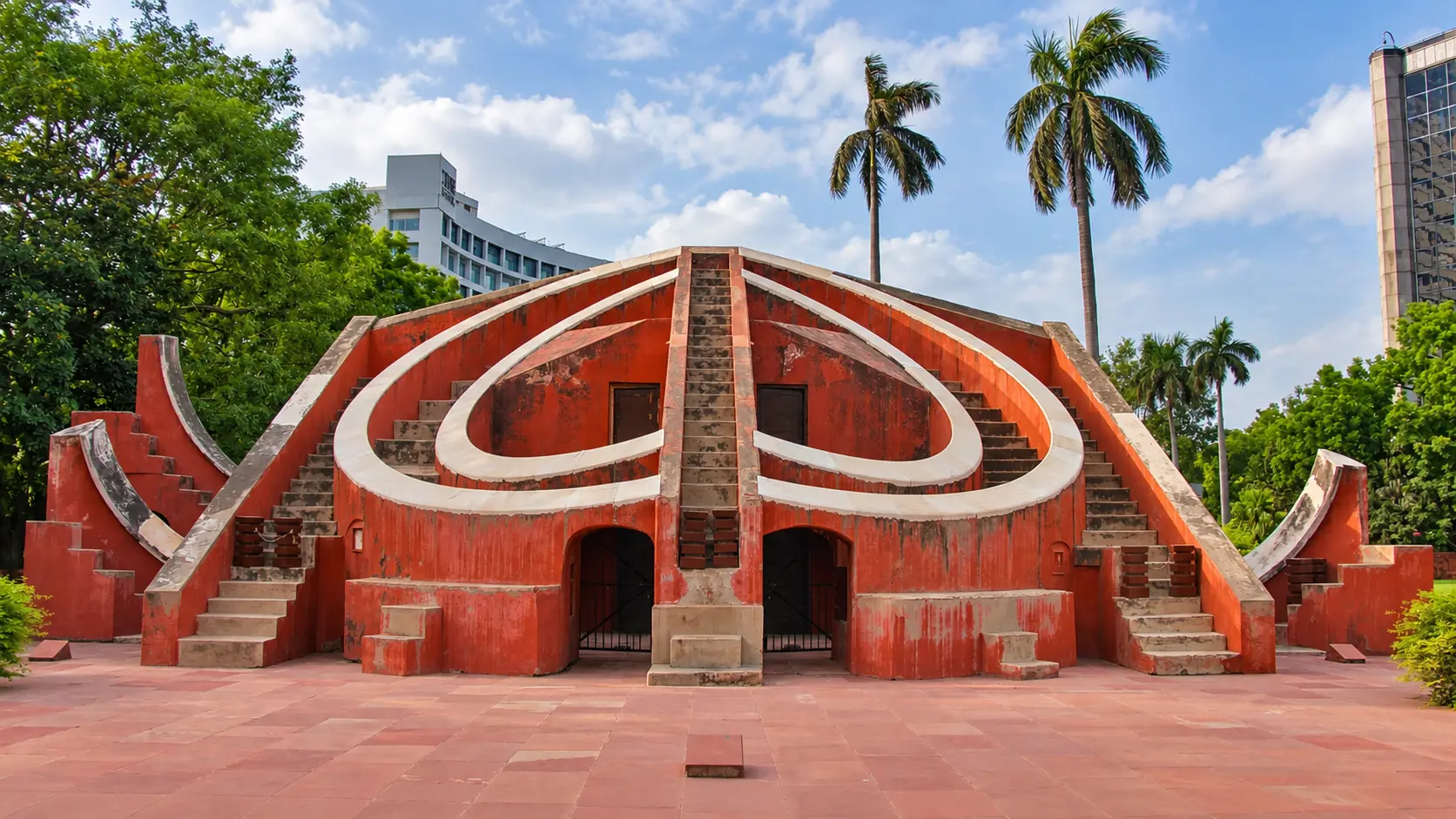
Surrounded by the modern glass-and-concrete high-rises and busy avenues of Sansad Marg in the heart of New Delhi, Jantar Mantar appears at first glance like a surreal, monumental sculpture garden from an avant-garde artistic movement. With its sweeping curvilinear ramps, soaring triangular gnomons, hollowed subterranean stone spheres, and vibrant terracotta-red masonry, this complex is not modern abstract art, but rather one of the 18th century's most extraordinary scientific achievements. Built in 1724 by the visionary mathematician and astronomer-king Maharaja Sawai Jai Singh II of Amber and Jaipur, Jantar Mantar is a masterwork of naked-eye observational astronomy, where pure geometry was translated into colossal architecture to decipher the mechanics of the cosmos.
When to visitRead details
- October to November (Autumn / Post-Monsoon): Exceptional weather conditions with clear blue skies, pleasant dry breezes, and daytime temperatures ranging between 22°C and 30°C. Sunlight is bright and unobstructed, allowing the shadows on the sundials and concave bowls to register with maximum sharpness.
- December to February (Winter): The most popular visiting season, featuring crisp mornings (8°C to 14°C) and comfortable sunny afternoons (20°C to 24°C). The soft winter sunlight produces dramatic, elongated shadows across the red masonry surfaces, making midday strolls thoroughly enjoyable. Keep in mind that early morning dense winter fog (common in late December and January) can obscure the sun until around 10:00 AM.
- March (Early Spring): A wonderful time to visit, with temperatures hovering around 22°C to 28°C and colorful seasonal flowers blooming in the landscaped gardens before the onset of summer heat.
- April to June (Summer): Summer in Delhi is scorching, with temperatures frequently exceeding 40°C to 45°C. Because the observatory consists of exposed stone plazas and open lawns with very limited overhead canopy, visiting during midday can be physically exhausting. Check the current visiting hours and permitted access with the site operator before departure; ceremonies, closures and visitor sessions can affect access.
- July to September (Monsoon): Characterized by periodic downpours, overcast skies, and high humidity (70% - 85%). While the rain enriches the lushness of the lawns and washes the terracotta plaster clean, overcast skies prevent the sundials from casting shadows, eliminating the opportunity to observe the instruments functioning in real time.
Entry & permissionsRead details
Fees, visiting hours and entry rules may change. Confirm the latest details with the official operator or local authority before travelling.
Entry Fees and Ticketing
Jantar Mantar is maintained as a Ticketed Centrally Protected Monument by the Archaeological Survey of India (ASI). Admission tariffs follow the standard Category B ASI fee structure:
- Indian Citizens, SAARC, and BIMSTEC Nationals: ₹20 per person when purchasing digital cashless tickets online via the ASI portal or QR code; ₹25 per person when purchasing physical paper tokens at the on-site cash counter.
- Foreign Tourists (Non-SAARC / Non-BIMSTEC): ₹250 per person for online/cashless digital bookings; ₹300 per person at the cash counter.
- Children: Free admission for all children below the age of 15 years (proof of age may be requested by ASI security staff).
- Digital Ticketing Process: Visitors can scan the official ASI QR code boards displayed at the main gate using any smartphone browser or UPI app to purchase tickets instantly, avoiding counter queues.
Timings and Operating Hours
- General Operating Hours: Open daily from sunrise to sunset (officially from approximately 06:00 AM to 06:00 PM), all 365 days of the year, including Sundays and national public holidays.
- Last Entry: Visitors are admitted until 30 minutes before sunset (approx. 05:30 PM). Security staff begin ushering visitors toward the exits at sundown.
Photography and Equipment Regulations
- Handheld Photography: Handheld non-commercial still photography and personal mobile phone video recording are completely free and permitted throughout the lawns and around all instrument viewing barriers.
- Tripods, Gimbals & Commercial Gear: In accordance with statutory ASI regulations across centrally protected heritage sites, the use of tripods, monopods, lighting stands, and professional video production equipment is strictly regulated. Commercial filming, fashion portfolio shoots, and documentary video recording require prior formal application, security clearance, and permit fee payments to the Superintending Archaeologist, ASI Delhi Circle (located at Safdarjung Tomb).
- Drone Regulations: Flying uncrewed aerial vehicles (drones/UAVs) is strictly prohibited. Jantar Mantar is situated within the high-security diplomatic and governmental perimeter of New Delhi, just one kilometer from the Parliament of India and Rashtrapati Bhavan, falling entirely within a designated Red Zone under Delhi Police and Directorate General of Civil Aviation (DGCA) no-fly regulations. Violators face immediate equipment seizure and criminal prosecution.
Visitor Rules and Monument Conservation
- Safety Barriers: To protect the delicate marble gradations, astronomical scales, and lime plaster from physical erosion, visitors are strictly prohibited from climbing, sitting, or leaning on the historical instruments or crossing the protective metal railings.
- Security Check: All visitors must pass through a security bag-check and metal-detector frame at the main entrance gate. Prohibited items include knives, scissors, sharp objects, alcohol, tobacco products, and spray cans.
Plan your visitRead details
Jantar Mantar is situated on Sansad Marg (Parliament Street) in the New Delhi revenue district (PIN: 110001), just south of Connaught Place and directly opposite Palika Kendra (the NDMC headquarters tower).
Explore the full guide - choose a topic below.
Why visit?
Surrounded by the modern glass-and-concrete high-rises and busy avenues of Sansad Marg in the heart of New Delhi…Explore detailsClose details
Surrounded by the modern glass-and-concrete high-rises and busy avenues of Sansad Marg in the heart of New Delhi, Jantar Mantar appears at first glance like a surreal, monumental sculpture garden from an avant-garde artistic movement. With its sweeping curvilinear ramps, soaring triangular gnomons, hollowed subterranean stone spheres, and vibrant terracotta-red masonry, this complex is not modern abstract art, but rather one of the 18th century's most extraordinary scientific achievements. Built in 1724 by the visionary mathematician and astronomer-king Maharaja Sawai Jai Singh II of Amber and Jaipur, Jantar Mantar is a masterwork of naked-eye observational astronomy, where pure geometry was translated into colossal architecture to decipher the mechanics of the cosmos.
The Delhi observatory holds special historical preeminence as the very first and foundational site among the five astronomical complexes erected by Jai Singh II across Northern India - predating the larger, UNESCO-inscribed observatory at Jaipur by four years, as well as sister installations in Ujjain, Varanasi, and Mathura. Commissioned by the Mughal Emperor Muhammad Shah ("Rangila") to eliminate errors in outdated astronomical tables and create accurate ephemerides for religious calendars and court astrology, Jai Singh realized that conventional brass astrolabes and armillary spheres were too small, subject to mechanical wear, and prone to optical errors. His revolutionary solution was to cast off brass instruments in favor of gargantuan, immobile masonry structures (yantras) constructed of local brick, stone, and lime mortar. By scaling the instruments to immense proportions - where a single second of time is represented by measurable centimeters of stone - he achieved a level of observational precision that rivaled the finest contemporary European observatories of Paris and Greenwich, all without optical lenses or glass telescopes.
Today, walking through the verdant gardens of Jantar Mantar offers a captivating journey into the golden age of Indo-Persian and Rajput scientific inquiry. Visitors can stand in the shadow of the colossal Samrat Yantra, an equinoctial sundial rising 21.3 meters (70 feet) into the sky, watch the sun cast real-time shadows moving at a visible pace across curved marble quadrants, peer into the sunken celestial bowls of the Jai Prakash Yantra, and marvel at the enigmatic Misra Yantra, a composite instrument found nowhere else on earth that tracks solar noon simultaneously across Delhi, Greenwich, Zurich, Japan, and France. Protected as a Monument of National Importance by the Archaeological Survey of India (ASI), Jantar Mantar is an unmissable destination for architecture lovers, science enthusiasts, history buffs, and curious travelers seeking an oasis of intellectual wonder right beside Connaught Place.
What to expect
Jantar Mantar occupies a tranquil, walled parkland spanning several acres along Sansad Marg.Explore detailsClose details
Jantar Mantar occupies a tranquil, walled parkland spanning several acres along Sansad Marg. Within this quiet green sanctuary, four primary surviving masonry astronomical instruments (yantras), along with specialized auxiliary observing structures, are arranged across open lawns. The structures are finished in a distinctive warm reddish-orange and ochre lime plaster, punctuated by white marble facing along calibrated scales and reading quadrants.
The Samrat Yantra (Supreme Instrument)
The undisputed centerpiece of the observatory is the Samrat Yantra, an enormous equinoctial sundial and the largest instrument in the Delhi complex. Dominated by a massive central triangular gnomon (ramp) standing 21.3 meters (70 feet) high, 34.6 meters (114 feet) long at the base, and 3.2 meters (10.5 feet) wide, the structure is an awe-inspiring feat of masonry precision.
The gnomon's hypotenuse (the sloping top edge) extends for 39 meters and is inclined at an exact angle of 28°37'42", precisely matching the geographic latitude of Delhi. Consequently, the edge of the gnomon points directly toward the celestial North Pole, remaining parallel to the rotational axis of the Earth. Flanked symmetrically on both sides of the central gnomon are two massive curved stone quadrants, each constructed parallel to the Earth's equator. The inner surfaces of these quadrants are surfaced in polished marble and finely engraved with divisions marking hours, minutes, and two-second increments.
As the sun arcs across the sky, the central gnomon casts a sharp shadow across the curved quadrants. Because of the sheer physical scale of the instrument, the edge of the shadow moves noticeably across the marble markings - traveling roughly four millimeters every minute - allowing an observer to read the local solar apparent time with remarkable accuracy. In addition to measuring local solar time, the Samrat Yantra was used to calculate the sun's declination, the exact moment of the equinoxes and solstices, and the coordinates of stars passing the meridian during nighttime observations.
The Jai Prakash Yantra
Positioned just south of the Samrat Yantra lie two sunken hemispherical structures known collectively as the Jai Prakash Yantra ("Light of Jai"). Widely celebrated by modern historians of science as Maharaja Jai Singh's most original and ingenious contribution to observational astronomy, the instrument consists of two complementary concave hemispherical bowls hollowed into the ground, each measuring approximately 8.3 meters (27.2 feet) in diameter.
The interior surface of each bowl represents an inverted hemisphere of the celestial vault (the sky above). Crosshairs formed of taut metal wires were stretched across the top rim of each bowl, intersecting at a central sighting ring directly above the center of the sphere. During the day, the shadow of this central ring projects onto the curved concave marble surface below, which is meticulously inscribed with coordinates representing the celestial meridian, zenith, horizon, celestial equator, tropics of Cancer and Capricorn, and the twelve zodiacal constellations. By noting the position of the shadow ring, astronomers could instantly read the altitude, azimuth, hour angle, and celestial latitude and longitude of the sun without performing complex mathematical calculations.
What makes the Jai Prakash truly brilliant is its complementary dual design. Because an observer walking inside a solid concave bowl would obstruct sunlight and step on the graduated scale, Jai Singh divided the hemisphere into alternating marble-lined graduated sections and recessed walkways with stone staircases. One bowl contains the graduated surfaces where the other has pathways, and vice versa. By walking through the sunken passages of both bowls, astronomers could access every single point of the celestial coordinate map without casting interfering shadows or damaging the delicate calibrated markings.
The Rama Yantra
Situated to the south of the Jai Prakash are the twin cylindrical masonry towers of the Rama Yantra, an instrument designed specifically to measure the altitude (zenith distance) and azimuth of celestial bodies directly in horizontal coordinates.
The instrument comprises two identical, open-topped circular masonry enclosures, each featuring a solid vertical pillar (gnomon) at its center. The height of the central pillar and the height of the circular exterior wall are both exactly equal to the inner radius of the structure. The floor of each enclosure consists of thirty radiating stone sectors elevated three feet above the ground, separated by equal open spaces. The circular walls are similarly divided into thirty vertical stone pillars separated by thirty open window spaces.
Like the Jai Prakash, the Rama Yantra operates as a complementary pair: the solid sectors of one cylinder correspond precisely to the open spaces of the other. An astronomer standing within the recessed walkways can sight a star or planet past the tip of the central pillar, aligning it with the calibrated radial markings on the floor or the vertical scales on the outer wall, thereby determining its exact angular altitude above the horizon and its azimuth direction.
The Misra Yantra (Mixed / Composite Instrument)
Located in the northwestern quadrant of the complex, the Misra Yantra (literally "Mixed" or "Composite" Instrument) is one of the most visually distinctive structures in Delhi. Recognizable by its stepped, winged architectural profile resembling a stylized crown or abstract bird in flight, this instrument is entirely unique to the Delhi observatory and does not exist in Jai Singh's subsequent observatories at Jaipur, Ujjain, or Varanasi. Built by Jai Singh II and later completed or refined by his son, Maharaja Madho Singh, the Misra Yantra consolidates five separate observational devices into a single monolithic structure:
- Niyat Chakra: The central arched feature, consisting of four inclined semicircular gnomon planes radiating at specific angles. These planes are calibrated to indicate the exact moment of solar noon at four significant international locations around the globe: Greenwich (England), Zurich (Switzerland), Notkey (Fukushima, Japan), and Serichew (Pic du Midi observatory in France). Long before electronic communication or standard global time zones, this device allowed Indian astronomers to compute international longitudinal time differences and global celestial events simultaneously.
- Samrat Yantra Half-Dials: Two scaled-down equinoctial sundial quadrants positioned on the western and eastern flanks, used for quick verification of local solar noon.
- Dakshinottara Bhitti (Meridian Wall): A vertical north-south wall equipped with graduated arcs, designed to determine the precise meridian altitude and zenith distance of celestial bodies at the moment they transit the local meridian.
- Karka Rasi Valaya: Two circular arcs engraved on the northern face of the structure, engineered to measure the precise instant when the sun enters the zodiac sign of Cancer (the summer solstice).
The Shasthamsa Yantra and Observatory Grounds
Near the central axis of the complex sits the Shasthamsa Yantra, a specialized 60-degree meridian arc constructed inside a darkened rectangular masonry chamber. A narrow pinhole aperture at the top of the chamber acts as a camera obscura, projecting an image of the sun onto a calibrated marble scale along the meridian arc precisely at solar noon. This setup allowed astronomers to measure the sun's angular diameter, declination, and zenith distance with high precision without staring directly into the blinding solar disk.
The entire observatory is embedded within well-manicured green lawns dotted with mature neem, jamun, and bougainvillea trees. Neatly paved pathways curve between the massive red sandstone structures, accompanied by bilingual English and Hindi interpretive signboards installed by the Archaeological Survey of India that outline the historical context and mathematical functions of each instrument.
Best time to visit
The outdoor nature of Jantar Mantar makes weather a crucial factor in planning your excursion: - October to…Explore detailsClose details
Seasonal Guide
The outdoor nature of Jantar Mantar makes weather a crucial factor in planning your excursion:
- October to November (Autumn / Post-Monsoon): Exceptional weather conditions with clear blue skies, pleasant dry breezes, and daytime temperatures ranging between 22°C and 30°C. Sunlight is bright and unobstructed, allowing the shadows on the sundials and concave bowls to register with maximum sharpness.
- December to February (Winter): The most popular visiting season, featuring crisp mornings (8°C to 14°C) and comfortable sunny afternoons (20°C to 24°C). The soft winter sunlight produces dramatic, elongated shadows across the red masonry surfaces, making midday strolls thoroughly enjoyable. Keep in mind that early morning dense winter fog (common in late December and January) can obscure the sun until around 10:00 AM.
- March (Early Spring): A wonderful time to visit, with temperatures hovering around 22°C to 28°C and colorful seasonal flowers blooming in the landscaped gardens before the onset of summer heat.
- April to June (Summer): Summer in Delhi is scorching, with temperatures frequently exceeding 40°C to 45°C. Because the observatory consists of exposed stone plazas and open lawns with very limited overhead canopy, visiting during midday can be physically exhausting. Check the current visiting hours and permitted access with the site operator before departure; ceremonies, closures and visitor sessions can affect access.
- July to September (Monsoon): Characterized by periodic downpours, overcast skies, and high humidity (70% - 85%). While the rain enriches the lushness of the lawns and washes the terracotta plaster clean, overcast skies prevent the sundials from casting shadows, eliminating the opportunity to observe the instruments functioning in real time.
Optimal Time of Day
- Mid-Morning (09:30 AM to 11:30 AM): The ideal window to observe the astronomical instruments in action. The sun is sufficiently elevated to cast crisp, well-defined shadows across the quadrants of the Samrat Yantra and into the bowls of the Jai Prakash Yantra, while ambient temperatures remain comfortable.
- Solar Noon (Approx. 12:15 PM - 12:30 PM IST): The most scientifically compelling moment to visit. At local solar transit, the sun aligns exactly with the central meridian of the Samrat Yantra and the Misra Yantra, allowing visitors to witness the instruments indicate true solar midday.
- Late Afternoon Golden Hour (04:00 PM to 05:30 PM): Photographers will find this time most rewarding. The warm, low-angled sunlight illuminates the terracotta and ochre walls, creating striking contrasts against the green lawns and deep blue Delhi sky.
How to reach
Jantar Mantar is situated on Sansad Marg (Parliament Street) in the New Delhi revenue district (PIN: 110001)…Explore detailsClose details
Jantar Mantar is situated on Sansad Marg (Parliament Street) in the New Delhi revenue district (PIN: 110001), just south of Connaught Place and directly opposite Palika Kendra (the NDMC headquarters tower).
By Delhi Metro
The Delhi Metro network provides quick, economical, and seamless connectivity to the monument:
- Patel Chowk Metro Station (Yellow Line [Line 2]): The absolute closest metro station, located approximately 400 meters south along Sansad Marg. Exiting from Gate 2, it is an easy 5-minute walk along a broad, tree-shaded pavement directly to the entrance gate of Jantar Mantar.
- Janpath Metro Station (Violet Line [Line 6]): Located roughly 600 meters east along Tolstoy Road. Exiting from Gate 1, visitors can walk straight down Tolstoy Road to Sansad Marg in about 7 minutes.
- Rajiv Chowk Metro Station (Yellow Line [Line 2] & Blue Line [Line 3/4] Interchange): Positioned 800 meters north at the center of Connaught Place. Taking Gate 6 (Sansad Marg exit), visitors can stroll down Parliament Street past the historic banks and heritage buildings to reach the observatory in 10 minutes.
- Shivaji Stadium Metro Station (Airport Express Orange Line): Situated approximately 800 meters northwest on Baba Kharak Singh Marg, offering high-speed transit directly from Terminal 3 of Indira Gandhi International Airport in just 20 minutes, followed by an 8-minute walk or brief autorickshaw ride.
By Road, Taxis, and Autos
- Road Network: Jantar Mantar sits on Sansad Marg, which connects Connaught Place Outer Circle to the Parliament House complex. It is flanked by Tolstoy Road to the north and Ashoka Road to the south, making it directly accessible from any part of Delhi.
- Auto-Rickshaws & App Cabs: App-based taxi aggregators (Uber, Ola, BluSmart) and metered three-wheeled autorickshaws have designated drop-off points right outside the main ticketing gate on Sansad Marg.
- City Buses: Numerous Delhi Transport Corporation (DTC) bus routes ply Sansad Marg, Ashoka Road, and Connaught Circus. The closest bus stops are Palika Kendra (directly opposite) and Patel Chowk Bus Stop, serviced by regular low-floor AC and non-AC buses.
- Self-Driving & Parking: On-street parking directly on Sansad Marg is strictly regulated. Visitors arriving by private vehicle can utilize the multi-level underground parking facility at Shivaji Stadium or the NDMC surface parking lots located on Tolstoy Road and around Janpath, both within 5 to 7 minutes' walk.
From Major Transit Hubs
- From New Delhi Railway Station (NDLS): Situated only 1.5 kilometers north. A direct 2-minute ride on the Yellow Line from New Delhi Metro Station to Rajiv Chowk or Patel Chowk, or a 10-minute auto-rickshaw ride down Bhavbhuti Marg and Connaught Place.
- From Hazrat Nizamuddin Railway Station (NZM): Located roughly 7 kilometers southeast. Take an auto-rickshaw or taxi via Mathura Road and Barakhamba Road (approx. 20 minutes), or take the Pink Line from Sarai Kale Khan-Nizamuddin to Lajpat Nagar and transfer to the Violet Line up to Janpath.
- From Old Delhi Railway Station (DLI): Approximately 5 kilometers north. Direct metro ride on the Yellow Line from Chandni Chowk to Patel Chowk (approx. 12 minutes).
- From Indira Gandhi International Airport (DEL): Located 14 kilometers southwest. Board the Airport Express Orange Line from Terminal 3 directly to Shivaji Stadium Station (approx. 20 minutes transit), followed by an easy 800-meter walk to Jantar Mantar. Total journey time is under 35 minutes.
Entry, timings and permissions
Fees, visiting hours and entry rules may change.Explore detailsClose details
Fees, visiting hours and entry rules may change. Confirm the latest details with the official operator or local authority before travelling.
Entry Fees and Ticketing
Jantar Mantar is maintained as a Ticketed Centrally Protected Monument by the Archaeological Survey of India (ASI). Admission tariffs follow the standard Category B ASI fee structure:
- Indian Citizens, SAARC, and BIMSTEC Nationals: ₹20 per person when purchasing digital cashless tickets online via the ASI portal or QR code; ₹25 per person when purchasing physical paper tokens at the on-site cash counter.
- Foreign Tourists (Non-SAARC / Non-BIMSTEC): ₹250 per person for online/cashless digital bookings; ₹300 per person at the cash counter.
- Children: Free admission for all children below the age of 15 years (proof of age may be requested by ASI security staff).
- Digital Ticketing Process: Visitors can scan the official ASI QR code boards displayed at the main gate using any smartphone browser or UPI app to purchase tickets instantly, avoiding counter queues.
Timings and Operating Hours
- General Operating Hours: Open daily from sunrise to sunset (officially from approximately 06:00 AM to 06:00 PM), all 365 days of the year, including Sundays and national public holidays.
- Last Entry: Visitors are admitted until 30 minutes before sunset (approx. 05:30 PM). Security staff begin ushering visitors toward the exits at sundown.
Photography and Equipment Regulations
- Handheld Photography: Handheld non-commercial still photography and personal mobile phone video recording are completely free and permitted throughout the lawns and around all instrument viewing barriers.
- Tripods, Gimbals & Commercial Gear: In accordance with statutory ASI regulations across centrally protected heritage sites, the use of tripods, monopods, lighting stands, and professional video production equipment is strictly regulated. Commercial filming, fashion portfolio shoots, and documentary video recording require prior formal application, security clearance, and permit fee payments to the Superintending Archaeologist, ASI Delhi Circle (located at Safdarjung Tomb).
- Drone Regulations: Flying uncrewed aerial vehicles (drones/UAVs) is strictly prohibited. Jantar Mantar is situated within the high-security diplomatic and governmental perimeter of New Delhi, just one kilometer from the Parliament of India and Rashtrapati Bhavan, falling entirely within a designated Red Zone under Delhi Police and Directorate General of Civil Aviation (DGCA) no-fly regulations. Violators face immediate equipment seizure and criminal prosecution.
Visitor Rules and Monument Conservation
- Safety Barriers: To protect the delicate marble gradations, astronomical scales, and lime plaster from physical erosion, visitors are strictly prohibited from climbing, sitting, or leaning on the historical instruments or crossing the protective metal railings.
- Security Check: All visitors must pass through a security bag-check and metal-detector frame at the main entrance gate. Prohibited items include knives, scissors, sharp objects, alcohol, tobacco products, and spray cans.
Nearby places to consider
Its central location on Sansad Marg makes Jantar Mantar an ideal launchpad for exploring New Delhi's premier…Explore detailsClose details
Its central location on Sansad Marg makes Jantar Mantar an ideal launchpad for exploring New Delhi's premier heritage, cultural, and spiritual landmarks:
Gurudwara Bangla Sahib
Located approximately 1.0 kilometer west along Ashoka Road and Baba Kharak Singh Marg (a 12-minute walk or 3-minute auto ride), Gurudwara Bangla Sahib is Delhi's most prominent Sikh shrine. Renowned for its shimmering golden dome, sacred Sarovar (holy water pool), and round-the-clock langar (free community kitchen) that feeds tens of thousands of visitors daily, it offers a deeply peaceful, soul-stirring spiritual contrast to the scientific geometry of Jantar Mantar.
Agrasen ki Baoli
Situated roughly 1.4 kilometers east along Hailey Road (near Kasturba Gandhi Marg), Agrasen ki Baoli is an exquisite 14th-century stepped water reservoir. Featuring 108 stone steps descending through four tiered arcade levels of ancient Delhi quartzite masonry, this subterranean stepwell provides a striking architectural parallel to the sunken hemispherical bowls of Jantar Mantar. Confirm the current charge and what it includes with the operator or service provider. Visitor admission, vehicles, parking, activities and accommodation can have separate charges.
Connaught Place and Janpath Market
Just 600 to 800 meters north of Jantar Mantar lies Connaught Place, Delhi's grand colonial shopping and commercial circle designed by Robert Tor Russell. Featuring white Georgian-style colonnades, luxury boutiques, historic bookshops, and rooftop cafes, it is the city's premier social crossroads. Immediately adjacent along Janpath lies the lively Janpath Flea Market and the Tibetan Market, celebrated for handloom textiles, Kashmiri shawls, silver jewelry, brass handicrafts, and antique curios.
National Museum
Located approximately 1.5 kilometers south down Janpath (a 5-minute auto ride or 20-minute stroll past the cultural centers), the National Museum is India's foremost cultural storehouse. Its expansive galleries house over 200,000 antiquities spanning five millennia, including the famous Indus Valley bronze Dancing Girl, sacred relics of Lord Buddha, miniature Mughal paintings, and exquisite decorative arts.
India Gate and Kartavya Path
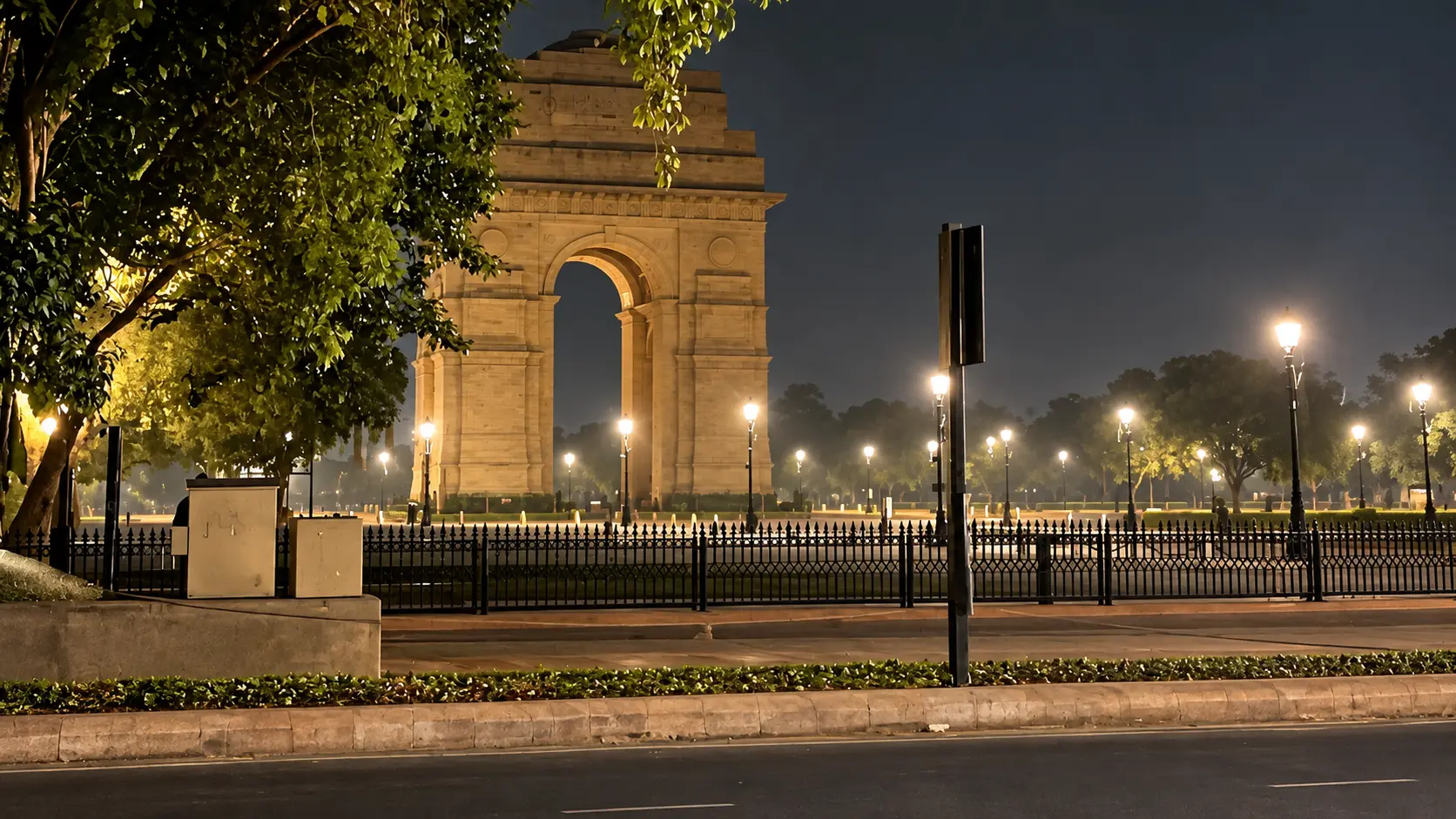
Positioned roughly 2.2 kilometers southeast via Ashoka Road, India Gate and the newly revitalized Kartavya Path form the ceremonial heart of the capital. Combine an afternoon visit to Jantar Mantar with a late afternoon walk down Kartavya Path to view the 42-meter triumphal war arch, the Netaji Subhas Chandra Bose granite statue, and the moving 40-acre National War Memorial as twilight descends.
In pictures
The practical bits
Before you go.
Plan ahead
A well-prepared visit to Jantar Mantar ensures you fully appreciate the scientific genius embedded within its…Explore detailsClose details
A well-prepared visit to Jantar Mantar ensures you fully appreciate the scientific genius embedded within its geometric forms:
Optimal Solar Timing
Plan your arrival between 10:00 AM and 12:30 PM on a clear, sunny day.Explore detailsClose details
Plan your arrival between 10:00 AM and 12:30 PM on a clear, sunny day. Because Jantar Mantar is fundamentally an open-air solar laboratory, clear sunshine is essential to observe the shadow mechanics of the Samrat Yantra sundials and the complementary bowls of the Jai Prakash Yantra, allowing you to witness the instruments tell time and map coordinates in real time.
Comfort and Sun Protection
Because the observatory grounds are largely open with limited shade directly around the stone instruments, wear…Explore detailsClose details
Because the observatory grounds are largely open with limited shade directly around the stone instruments, wear comfortable walking shoes, a broad-brimmed sun hat, UV-protective sunglasses, and applied sunscreen, particularly from March through October. Carry a refillable water bottle to stay hydrated; clean, chilled RO drinking water dispensers are available near the entrance amenity block.
Engaging with the Astronomy
Before visiting, familiarize yourself briefly with the basic concepts of equinoctial sundials and celestial…Explore detailsClose details
Before visiting, familiarize yourself briefly with the basic concepts of equinoctial sundials and celestial coordinates, or take time to read the detailed ASI interpretive plaques mounted beside each structure. Without understanding how the shadow of the central gnomon translates to hours and minutes, the structures can easily be mistaken for abstract sculptures rather than functioning computational engines.
Combining with Connaught Place Dining
Jantar Mantar is located just a five-minute walk from the outer circle of Connaught Place (CP) and Janpath…Explore detailsClose details
Jantar Mantar is located just a five-minute walk from the outer circle of Connaught Place (CP) and Janpath, offering unmatched dining choices after your tour. Stroll north into CP to visit iconic culinary landmarks such as Saravana Bhavan (famous for South Indian dosas and filter coffee), United Coffee House (heritage Continental and North Indian dining established in 1942), or Wenger's (Delhi's premier 1926 bakery for patties, pastries, and artisanal breads).
A few things you might wonder
Common questions about visiting Jantar Mantar. Fees, visiting hours and ceremonies are researched details that may change; confirm current arrangements with the operator before travelling.
What does the name "Jantar Mantar" mean, and who constructed it?
How does the giant Samrat Yantra sundial measure time, and how accurate is it?
Why did Jai Singh build astronomical instruments out of stone rather than brass?
Are there other Jantar Mantar observatories in India?
Can visitors walk onto or touch the instruments at Jantar Mantar?
What is the unique feature of the Misra Yantra at the Delhi observatory?
What are the opening hours and ticket prices for Jantar Mantar?
Which metro station is closest to Jantar Mantar?
Explore more in New Delhi
Discover other destinations around this hub
More Hubs in Delhi Ncr
Continue exploring other travel hubs in this state
Planning a trip to New Delhi?