Hawa Mahal
Comprehensive visitor guide to Hawa Mahal (Palace of Winds) in Jaipur, Rajasthan. Explore the 953 carved jharokhas, Krishna-crown facade, history & entry fees.
Location
Jaipur, Rajasthan
A closer look
Your visit, at a glance.
Jaipur, Rajasthan
GET TO KNOW THE PLACE
Rising in flamboyant pink and terracotta sandstone above the lively bazaar street of Badi Chaupar in the heart of Jaipur's UNESCO-inscribed Walled City, Hawa Mahal - the "Palace…
The story of Hawa Mahal
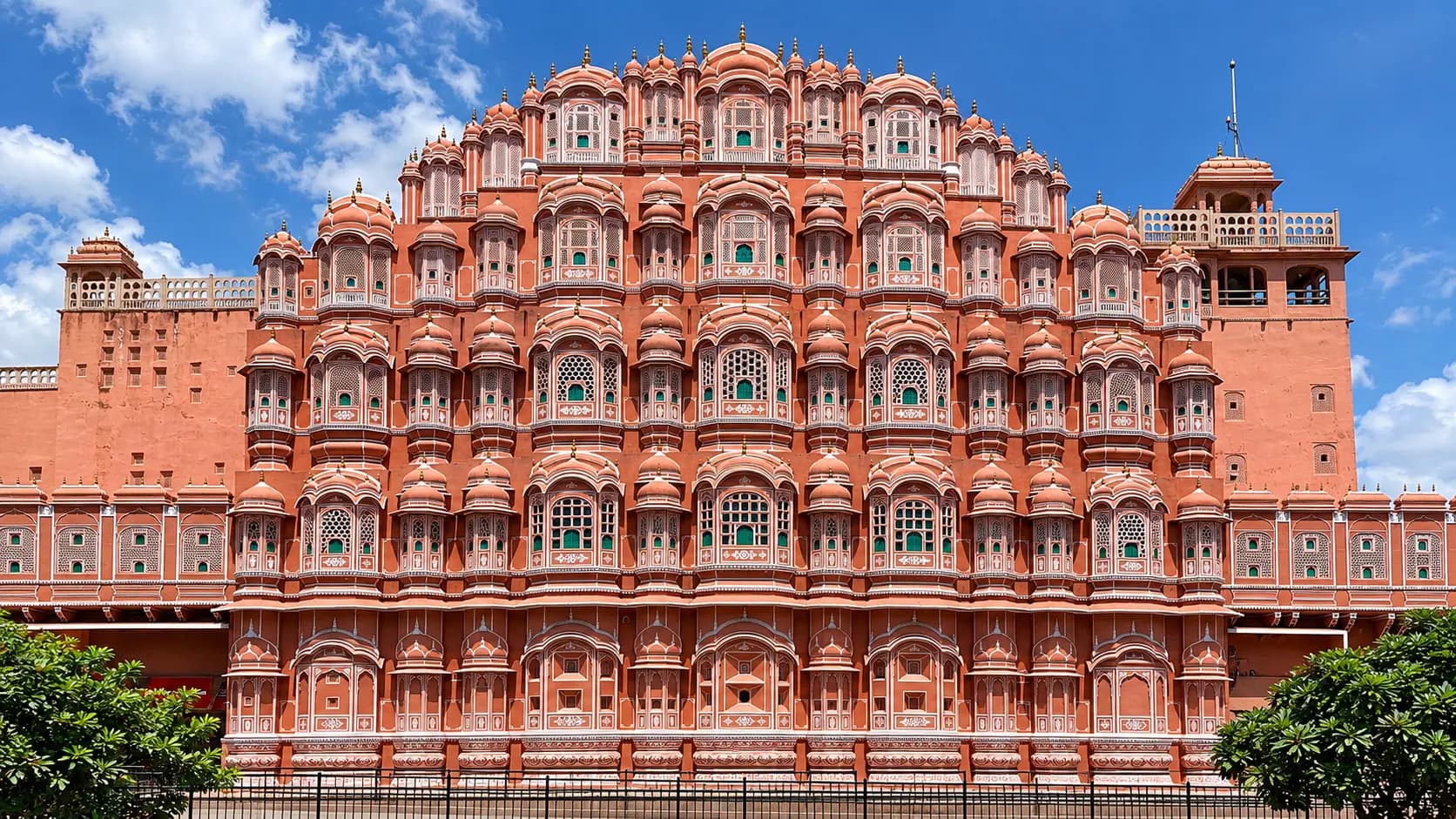
Rising in flamboyant pink and terracotta sandstone above the lively bazaar street of Badi Chaupar in the heart of Jaipur's UNESCO-inscribed Walled City, Hawa Mahal - the "Palace of Winds" - is one of the most recognizable and photographed architectural landmarks in the world. Built in 1799 CE by Maharaja Sawai Pratap Singh, the poet-king grandson of Jaipur’s founder Sawai Jai Singh II, this extraordinary five-storey pyramidal facade stands as an enduring tribute to Rajput architectural audacity, thermodynamic engineering, and artistic devotion.
Designed by the brilliant royal master-builder Lal Chand Ustad, Hawa Mahal was conceived in the graceful, soaring silhouette of the mukut (peacock-feathered crown) of Lord Krishna, to whom Sawai Pratap Singh was passionately dedicated. Rising roughly 50 feet (15 metres) from its elevated plinth, the monument’s street facade is an intricate stone honeycomb pierced by an astonishing 953 miniature casements and bay windows (jharokhas).
Each jharokha is adorned with delicate stone fretwork screens (jaalis), miniature fluted domes, and carved finials. Beyond its aesthetic wonder, Hawa Mahal was designed as a sophisticated royal observation screen: built as an eastern wing of the City Palace’s Zenana (Women's Quarters), it allowed royal Rajput ladies living under the strict social customs of purdah (seclusion) to watch the lively street dramas, royal processions, camel caravans, and religious festivals of the bazaar below without ever being observed by the public.
Start here. Open a tile for the full details.
Why goRead details
Hawa Mahal is far more than a celebrated backdrop for travel photographs; it is a fascinating window into the daily life, engineering genius, and courtly aesthetics of 18th-century Rajasthan:
When to visitRead details
Visiting Hawa Mahal is deeply influenced by the time of day, lighting angles, and seasonal climate in Jaipur.
Entry & permissionsRead details
Fees, visiting hours and entry rules may change. Confirm the latest details with the official operator or local authority before travelling.
Visiting Hawa Mahal is managed by the Department of Archaeology & Museums with straightforward, affordable ticketing:
- Operating Hours:
- Monument Interiors & Museum: Open daily from 09:00 AM to 17:00 PM.
- Facade Night Illumination: Illuminated daily from 19:00 PM to 22:00 PM.
- Street Facade Photography: The public exterior on Hawa Mahal Bazaar can be viewed and photographed freely at all hours.
- Entry Tariffs:
- Indian Nationals: ₹50 per adult; ₹20 for students (valid student identification card required).
- Foreign Nationals: ₹200 per adult; ₹100 for foreign students.
- Jaipur Composite Ticket: Highly recommended if visiting multiple landmarks. Valid for 2 consecutive days, it covers Hawa Mahal, Amer Fort, Jantar Mantar, Nahargarh Fort, and Albert Hall Museum for ₹300 (Indians) or ₹1,000 (Foreigners).
- Photography & Equipment Rules:
- Standard handheld mobile phone and digital camera photography is permitted inside the monument free of charge.
- Using heavy tripods, commercial video rigs, or filming without prior written permission from the Department of Archaeology & Museums is prohibited.
- Flying drones over the Walled City or Hawa Mahal is strictly illegal under city police regulations.
Plan your visitRead details
Hawa Mahal is situated right at Badi Chaupar in the historic center of Jaipur, making it exceptionally accessible via Jaipur's modern transit network.
Explore the full guide - choose a topic below.
Why visit?
Hawa Mahal is far more than a celebrated backdrop for travel photographs; it is a fascinating window into the…Explore detailsClose details
Hawa Mahal is far more than a celebrated backdrop for travel photographs; it is a fascinating window into the daily life, engineering genius, and courtly aesthetics of 18th-century Rajasthan:
- The World-Famous 953 Jharokhas: Nowhere else on Earth does a single facade feature 953 exquisitely sculpted bay windows and stone lattices. Walking through the narrow upper chambers and peering through the miniature stone screens onto the bustling bazaar below offers an authentic, first-person experience of royal seclusion.
- Mastery of Natural Thermodynamic Cooling: Named the "Palace of Winds", Hawa Mahal is a marvel of passive climate design. Utilizing the Venturi Effect, hot desert winds funnel through the hundreds of miniature stone perforations, compressing and accelerating the air so that it undergoes natural adiabatic cooling before circulating through the interior chambers.
- The Kaleidoscopic Ratan Mandir: On the second floor, the royal chamber of Ratan Mandir is fitted with vibrant imported Belgian stained glass in deep ruby, emerald, cobalt, and amber hues. When the morning sun shines through these ornate arched windows, kaleidoscopic pools of colored light dance across the polished white marble floors.
- Climbing via Royal Ramps to the Hawa Mandir: Unlike conventional multi-storey palaces that feature exhausting staircases, the upper levels of Hawa Mahal are accessed via broad, gently sloping brick ramps. This architectural feature allowed the royal queens to ascend comfortably or be carried by attendants in palanquins. Reaching the narrow crowning crest at Hawa Mandir rewards you with stunning aerial panoramas of Jantar Mantar, the City Palace, and Nahargarh Fort crowning the northern Aravalli ridge.
- The On-Site Archaeological Museum: Tucked into the quiet colonnaded rear courtyard, this state-run museum displays precious 9th-to-12th-century stone sculptures, ancient terracotta vessels, ceremonial Rajput daggers, and historic miniature paintings excavated across Jaipur District.
What to expect
Visiting Hawa Mahal involves both an external appreciation of its iconic street-facing facade and an intriguing…Explore detailsClose details
Visiting Hawa Mahal involves both an external appreciation of its iconic street-facing facade and an intriguing exploration of its narrow interior chambers and serene rear courtyard.
The Front Facade vs. The Rear Entrance
A near-universal surprise for first-time visitors is that there is no entrance door on the front street facade. The magnificent 5-storey pink screen rising over Hawa Mahal Bazaar is entirely sealed from the roadside.
To enter the monument, visitors must walk around the corner along Sireh Deori Bazaar and enter through an arched imperial gateway into a tranquil rear courtyard. Here, the deafening noise of market auto-rickshaws, honking scooters, and street vendors abruptly ceases, replaced by the tranquil splashing of courtyard water fountains, shaded stone colonnades, and the chatter of green parakeets nesting in the high eaves.
Touring the Five Poetic Storeys
Inside, the structure unfolds as an extraordinarily slender building - barely a foot or two in depth along its upper levels. Visitors ascend through five distinct levels, each holding historic and seasonal significance:
- Sharad Mandir (First Floor): The "Autumn Temple", adjoining the main open courtyard. This level was historically dedicated to grand autumnal celebrations, including the full-moon festival of Sharad Purnima, accompanied by classical music recitals and royal court gatherings.
- Ratan Mandir (Second Floor): The "Jewel Temple", celebrated for its dazzling arched windows inset with Belgian stained glass that create breathtaking visual displays as morning sunlight filters into the room.
- Vichitra Mandir (Third Floor): The "Unique Temple", an intimate, quiet chamber where Maharaja Sawai Pratap Singh retreated to meditate, compose devotional Braj Bhasha poetry, and offer prayers to his beloved deity, Lord Krishna.
- Prakash Mandir (Fourth Floor): The "Temple of Light", featuring open, sun-drenched marble roof terraces flanking both sides, offering expansive views looking east toward the sunrise and west toward the City Palace complex.
- Hawa Mandir (Fifth Floor): The narrow, airy crowning pinnacle. At this highest level, the building is only a single room wide. Windows open on all sides to catch the continuous mountain breezes sweeping down from the Aravalli hills, providing breathtaking vistas of the Jantar Mantar observatory, the sprawling City Palace courtyards, and the distant watchtowers of Nahargarh Fort.
Experiencing the Viewpoints Across the Street
After touring the interior, cross the bustling bazaar street to experience the classic postcard view of Hawa Mahal. Several multi-storey heritage buildings directly opposite the monument house popular rooftop cafes - such as Wind View Cafe and Tattoo Cafe. Sitting on their open rooftop terraces with a cold drink or hot masala chai gives you an unobstructed, eye-level panorama of all 953 jharokhas bathed in warm light.
Best time to visit
Visiting Hawa Mahal is deeply influenced by the time of day, lighting angles, and seasonal climate in Jaipur.Explore detailsClose details
Visiting Hawa Mahal is deeply influenced by the time of day, lighting angles, and seasonal climate in Jaipur.
Seasonal Breakdown
- Winter (October to March) - Prime Sightseeing Season: Winter is the most delightful period to visit Jaipur. Days are sunny, dry, and mild, with temperatures hovering between 13°C and 26°C. Exploring the open courtyards and climbing the ramps is comfortable and effortless, and walking through the surrounding bazaars is a pleasure.
- Monsoon (July to September) - Refreshing Air & Washed Sandstone: Monsoon showers wash away desert dust, giving the red and pink sandstone of Hawa Mahal a vibrant, saturated glow. The air is humid but considerably cooler than summer, making early morning visits highly rewarding.
- Summer (April to June) - Scorching Midday Temperatures: Summer temperatures in Jaipur frequently exceed 40°C to 44°C. While the internal Venturi air currents still cool the chambers, walking through the sun-baked Walled City streets between 11:00 AM and 16:00 PM can be exhausting. Check the current visiting hours and permitted access with the site operator before departure; ceremonies, closures and visitor sessions can affect access.
Optimal Time of Day for Photography
The optimal window to view and photograph Hawa Mahal’s exterior facade is early morning between 07:30 and 09:30 AM. Because the monument faces directly east, the rising sun illuminates the entire pink sandstone facade in warm, golden light, highlighting every carved jharokha, bracket, and lattice screen against a vivid morning sky. At night, the monument is illuminated between 19:00 and 22:00 with soft amber floodlights.
How to reach
Hawa Mahal is situated right at Badi Chaupar in the historic center of Jaipur, making it exceptionally accessible…Explore detailsClose details
Hawa Mahal is situated right at Badi Chaupar in the historic center of Jaipur, making it exceptionally accessible via Jaipur's modern transit network.
By Metro
- Badi Chaupar Metro Station: The most convenient, traffic-free way to reach Hawa Mahal. The underground Badi Chaupar station on the Jaipur Metro Pink Line is located just 200 metres southeast of Hawa Mahal (a 2-minute walk). Confirm the current charge and what it includes with the operator or service provider. Visitor admission, vehicles, parking, activities and accommodation can have separate charges.
By Train
- Jaipur Junction (JP): The main railway station, located approximately 5 kilometres west. It connects by direct superfast and express trains to all major Indian cities. Confirm the current charge and what it includes with the operator or service provider. Visitor admission, vehicles, parking, activities and accommodation can have separate charges.
By Air
- Jaipur International Airport (JAI): Located approximately 12 kilometres south in Sanganer. Pre-paid taxis and app cabs (Uber/Ola) take roughly 30 to 45 minutes to reach Badi Chaupar via JLN Marg and Ajmeri Gate.
By Bus & Auto-Rickshaw
- City Buses: JCTSL low-floor buses on Route 29 and various other city routes connect directly to Badi Chaupar from Ajmeri Gate, Ramgarh Mod, and Amer.
- Auto-Rickshaws & E-Rickshaws: Confirm the current charge and what it includes with the operator or service provider. Visitor admission, vehicles, parking, activities and accommodation can have separate charges.
- Driving & Parking Caveat: Driving private cars directly to Hawa Mahal is strongly discouraged due to heavy market traffic and severe parking scarcity. If driving, park at the authorized multi-level parking facility at Ramniwas Bagh (near Albert Hall) and take an e-rickshaw up to Badi Chaupar.
Entry, timings and permissions
Fees, visiting hours and entry rules may change.Explore detailsClose details
Fees, visiting hours and entry rules may change. Confirm the latest details with the official operator or local authority before travelling.
Visiting Hawa Mahal is managed by the Department of Archaeology & Museums with straightforward, affordable ticketing:
- Operating Hours:
- Monument Interiors & Museum: Open daily from 09:00 AM to 17:00 PM.
- Facade Night Illumination: Illuminated daily from 19:00 PM to 22:00 PM.
- Street Facade Photography: The public exterior on Hawa Mahal Bazaar can be viewed and photographed freely at all hours.
- Entry Tariffs:
- Indian Nationals: ₹50 per adult; ₹20 for students (valid student identification card required).
- Foreign Nationals: ₹200 per adult; ₹100 for foreign students.
- Jaipur Composite Ticket: Highly recommended if visiting multiple landmarks. Valid for 2 consecutive days, it covers Hawa Mahal, Amer Fort, Jantar Mantar, Nahargarh Fort, and Albert Hall Museum for ₹300 (Indians) or ₹1,000 (Foreigners).
- Photography & Equipment Rules:
- Standard handheld mobile phone and digital camera photography is permitted inside the monument free of charge.
- Using heavy tripods, commercial video rigs, or filming without prior written permission from the Department of Archaeology & Museums is prohibited.
- Flying drones over the Walled City or Hawa Mahal is strictly illegal under city police regulations.
Nearby places to consider
Hawa Mahal sits at the epicentre of Jaipur's historical, artistic, and astronomical heritage: - Jantar Mantar…Explore detailsClose details
Hawa Mahal sits at the epicentre of Jaipur's historical, artistic, and astronomical heritage:
- Jantar Mantar (approx. 300 metres west): The UNESCO World Heritage astronomical observatory built by Sawai Jai Singh II in 1734, housing nineteen colossal architectural instruments, including the world’s largest stone sundial (Vrihat Samrat Yantra).
- The City Palace, Jaipur (approx. 400 metres west): The magnificent royal residence of the Jaipur royal family, featuring the Mubarak Mahal museum, the Diwan-e-Khas with its colossal sterling silver water vessels, and the vibrant peacock-themed courtyards of Pritam Niwas Chowk.
- Albert Hall Museum (approx. 1.8 km south): The state's oldest museum, housed in a stunning 1887 Indo-Saracenic palace in Ramniwas Bagh, displaying royal portraits, Persian carpets, Egyptian mummies, and metalwork.
- Nahargarh Fort (approx. 6 km north on the Aravalli ridge): The formidable hill citadel guarding Jaipur from the north, renowned for its panoramic sunset views over the entire Walled City and the Madhavendra Bhawan royal apartments.
- Amer Fort (approx. 10 km north): The grand 16th-century Kachhwaha citadel overlooking Maota Lake, famous for its opulent Sheesh Mahal and Ganesh Pol gateway.
In pictures
The practical bits
Before you go.
Plan ahead
To maximize your experience of Hawa Mahal and avoid common tourist mistakes, keep the following practical tips in…Explore detailsClose details
To maximize your experience of Hawa Mahal and avoid common tourist mistakes, keep the following practical tips in mind:
Visit the Rooftop Cafes for Classic Photographs
The street directly in front of Hawa Mahal is a busy, narrow road filled with passing traffic, making it…Explore detailsClose details
The street directly in front of Hawa Mahal is a busy, narrow road filled with passing traffic, making it difficult to photograph the entire 50-foot facade from sidewalk level. Walk across the street to the second or third-floor open terraces of Wind View Cafe or Tattoo Cafe. Ordering a tea or breakfast gives you unobstructed, eye-level photography angles of the complete 953-jharokha facade in the golden morning light.
Pair with the City Palace and Jantar Mantar
Hawa Mahal is situated within 300 metres of two other world-famous heritage sites: the royal residence of the…Explore detailsClose details
Hawa Mahal is situated within 300 metres of two other world-famous heritage sites: the royal residence of the City Palace and the UNESCO-listed astronomical observatory of Jantar Mantar. Plan your itinerary to explore all three monuments together in a single half-day walking tour of the central heritage quarter.
Watch Your Step on the Upper Ramps
The ramps connecting the upper levels of Hawa Mahal are paved with polished brick and stone that can be slippery…Explore detailsClose details
The ramps connecting the upper levels of Hawa Mahal are paved with polished brick and stone that can be slippery, especially in smooth-soled leather shoes. The passages and doorways leading to the topmost Hawa Mandir are narrow and low-ceilinged, designed for 18th-century royal seclusion rather than large modern crowds. Take your time, watch your head at doorways, and hold handrails where provided.
Explore the Historic Walled City Bazaars
Directly outside Hawa Mahal lie some of Jaipur's most vibrant traditional markets.Explore detailsClose details
Directly outside Hawa Mahal lie some of Jaipur's most vibrant traditional markets. Stroll along Johari Bazaar for authentic Kundan-Meena jewelry and tie-dye bandhani textiles, explore Sireh Deori Bazaar for Rajasthani leather juttis and handmade quilts (jaipuri razai), or sample piping-hot pyaz kachoris and lassi from legendary local shops near Badi Chaupar.
A few things you might wonder
Common questions about visiting Hawa Mahal. Fees, visiting hours and ceremonies are researched details that may change; confirm current arrangements with the operator before travelling.
Where is Hawa Mahal located and who built it?
Why is Hawa Mahal called the "Palace of Winds"?
What was the historical purpose of Hawa Mahal?
How many windows (jharokhas) are there in Hawa Mahal?
How do visitors enter Hawa Mahal?
What are the five storeys of Hawa Mahal called?
What are the opening hours and ticket prices for Hawa Mahal?
Where is the best place to photograph Hawa Mahal?
Explore more in Jaipur
Discover other destinations around this hub
Planning a trip to Jaipur?