Amer Fort (Amber Fort)
Comprehensive visitor guide to Amer Fort in Jaipur, Rajasthan. Explore the Sheesh Mahal, Ganesh Pol, four courtyards, night tourism, entry fees & history.
Location
Jaipur, Rajasthan
A closer look
Your visit, at a glance.
Jaipur, Rajasthan
GET TO KNOW THE PLACE
Perched majestically atop a jagged ridge of the ancient Aravalli Hills in Jaipur District, Rajasthan, Amer Fort (often written as Amber Fort or Amber Palace) is one of the…
The story of Amer Fort (Amber Fort)
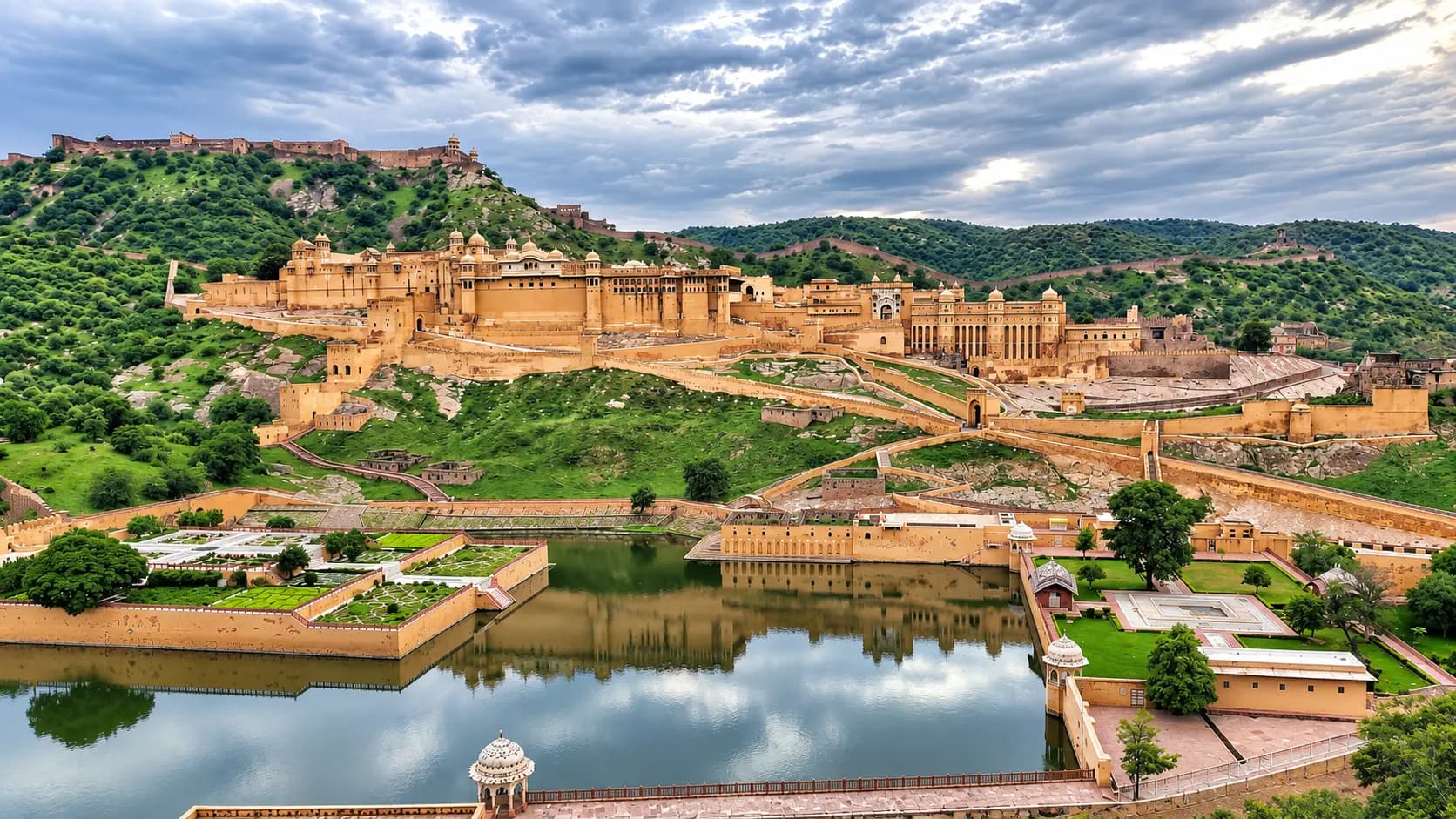
Perched majestically atop a jagged ridge of the ancient Aravalli Hills in Jaipur District, Rajasthan, Amer Fort (often written as Amber Fort or Amber Palace) is one of the crowning architectural jewels of the Indian subcontinent. Rising approximately 11 kilometres north of Jaipur’s walled Pink City in the historic settlement of Amer, this massive citadel overlooks the emerald waters of Maota Lake and the geometric, star-shaped saffron garden beds of Kesar Kyari.
Amer served as the ancestral fortified capital of the Kachhwaha Rajput dynasty for more than six centuries, until the visionary astronomer-king Sawai Jai Singh II founded the planned modern city of Jaipur on the plains below in 1727. In 2013, Amer Fort was formally inscribed as a UNESCO World Heritage Site as a flagship component of the serial Hill Forts of Rajasthan.
Constructed from warm yellow and pink sandstone interwoven with gleaming white Makrana marble, Amer represents the sublime culmination of Rajput-Mughal architectural synthesis. Commissioned in 1592 CE by Raja Man Singh I - Emperor Akbar’s celebrated Rajput general - and substantially expanded over the next century by Mirza Raja Jai Singh I and Sawai Jai Singh II, the palace unfolds through four monumental terraced courtyards. Within its towering crenellated walls lie some of India's most celebrated palatial marvels, including the dazzling Sheesh Mahal (Mirror Palace), the frescoed Ganesh Pol, the colonnaded Diwan-e-Aam, and the sacred, centuries-old shrine of Shila Devi.
Start here. Open a tile for the full details.
Why goRead details
Whether you are fascinated by royal history, military architecture, decorative craftsmanship, or panoramic landscape photography, Amer Fort is an indispensable travel destination:
When to visitRead details
Visiting an open-air stone citadel spanning several levels requires careful attention to Rajasthan’s stark seasonal climate.
Entry & permissionsRead details
Fees, visiting hours and entry rules may change. Confirm the latest details with the official operator or local authority before travelling.
Amer Fort operates with well-organized, visitor-centric ticketing and heritage facilitation under the Department of Archaeology & Museums:
- Visiting Timings:
- Day Tour: Open daily from 08:00 AM to 17:30 PM.
- Night Tourism (Amber by Night): Open daily from 18:30 PM to 21:15 PM. Courtyards, facades, and the Sheesh Mahal are beautifully illuminated with theatrical mood lighting.
- Light & Sound Show: Staged every evening in the natural amphitheatre below the fort overlooking Maota Lake:
- English Show: ~19:30 PM (Winter) / 20:00 PM (Summer).
- Hindi Show: ~20:30 PM (Winter) / 21:00 PM (Summer).
- Show Ticket: Approximately ₹200 to ₹300 per person.
- Ticket Tariffs:
- Day Entry (Indian Nationals): ₹100 per adult; ₹20 for students (valid school/college ID required).
- Day Entry (Foreign Nationals): ₹500 per adult; ₹100 for foreign students.
- Night Tourism Entry: ₹100 (Indians); ₹500 (Foreigners).
- Jaipur Composite Ticket (Smart Option): If you plan to explore multiple monuments in Jaipur, purchase the official Composite Ticket (valid for 2 consecutive days). It covers Amer Fort, Hawa Mahal, Jantar Mantar, Nahargarh Fort, and Albert Hall Museum for ₹300 (Indians) or ₹1,000 (Foreigners), offering massive savings.
- Permissions and Regulations:
- No Drones: Operating recreational or commercial camera drones over Amer Fort, Maota Lake, or surrounding hill ridges is strictly prohibited by Jaipur Police and archaeological authorities.
- Audio Guides: Multilingual digital audio guide headsets (in English, French, Spanish, German, and Hindi) are available at Jaleb Chowk for ₹200 to ₹250.
- Temple Decorum: Footwear, leather bags, and leather belts must be deposited at the shoe counter outside the Shila Devi Temple entrance.
Plan your visitRead details
Amer Fort is located approximately 11 kilometres north of central Jaipur along the historic Delhi highway corridor, making it exceptionally easy to reach by all modes of transport.
Explore the full guide - choose a topic below.
Why visit?
Whether you are fascinated by royal history, military architecture, decorative craftsmanship, or panoramic…Explore detailsClose details
Whether you are fascinated by royal history, military architecture, decorative craftsmanship, or panoramic landscape photography, Amer Fort is an indispensable travel destination:
- The World-Renowned Sheesh Mahal (Mirror Palace): Built by Mirza Raja Jai Singh I in the 1630s, the Sheesh Mahal is a glittering chamber whose walls and ceilings are inlaid with thousands of concave Belgian convex mirrors and silver foils set into intricate floral plaster arabesques. Ancient chroniclers marveled that on a dark night, a single lit candle inside the chamber multiplied across thousands of glass facets to create the illusion of standing under a starlit desert sky.
- A Masterpiece of Rajput-Mughal Architectural Fusion: Amer Fort seamlessly harmonizes Rajput military strength - such as impregnable ramparts, subterranean escape corridors, and steep elephant ascents - with the delicate aesthetic refinements of Mughal court culture, visible in symmetrical charbagh gardens, carved marble jaali screens, and cooling water fountains.
- The Historic Shila Devi Temple (1604 CE): Tucked inside the outer courtyard of Jaleb Chowk, this sacred Shakta shrine houses a miraculous black-stone idol of Goddess Kali (Shila Devi). Brought from Jessore (Bengal) by Raja Man Singh I in 1604 following his military triumph, the temple remains an active center of royal devotion, especially during the vibrant nine nights of Navaratri.
- The Monumental Ganesh Pol Gateway: Completed around 1640 CE, this three-tiered ceremonial archway is celebrated as one of the most magnificent palace gates in Asia. It is adorned with exquisite vegetable-dye frescoes depicting Lord Ganesha, framed by latticed marble oriel windows (jharokhas) through which royal women in purdah observed state processions entering the courtyard.
- Enchanting Night Tourism (Amber by Night): Beyond the daytime crowds, visiting Amer between 18:30 and 21:15 reveals a totally different palace persona. Bathed in soft golden illumination, the ramparts glow dramatically against the dark Aravalli skies, accompanied by cool evening mountain breezes, illuminated marble courtyards, and world-class Light & Sound shows.
What to expect
Exploring Amer Fort is an immersive, multi-hour journey through four distinct courtyards that ascend…Explore detailsClose details
Exploring Amer Fort is an immersive, multi-hour journey through four distinct courtyards that ascend progressively in architectural intimacy and royal status.
Arrival and Ascent to Jaleb Chowk
Visitors approach the fort along the shores of Maota Lake, where the colossal sandstone bastions reflect upon the water alongside the floating terraces of Kesar Kyari.
To reach the palace entrance atop the hill, travelers can walk up the broad, stepped cobblestone ramp, hire a local jeep or authorized golf cart shuttle from the lower parking clearing, or ride an authorized tourist taxi to the rear Chand Pol entrance.
The ascent brings you into Jaleb Chowk, the vast first courtyard. Historically, this parade ground was where returning armies assembled, captured treasures were displayed, and royal bodyguards paraded. Today, Jaleb Chowk houses ticket counters, clean public amenities, audio guide kiosks, and the entrance to the revered Shila Devi Temple. Devotees enter through solid silver repoussé doors depicting the ten incarnations of Vishnu and the Mahavidyas to seek the goddess's blessings.
The Second Courtyard: Diwan-e-Aam
Passing through the imposing Singh Pol (Lion Gate), visitors ascend to the elevated second courtyard, dominated by the magnificent Diwan-e-Aam (Hall of Public Audience).
Open on three sides, this expansive pillared pavilion features an outer double colonnade of red sandstone columns topped by intricately sculpted elephant-head brackets holding lotus buds in their trunks. The inner colonnade is crafted from smooth white Makrana marble. Here, the Maharaja sat on an elevated throne to receive petitions from citizens, review state affairs, and host visiting imperial dignitaries.
The Third Courtyard: Royal Quarters & Sheesh Mahal
Ascending further through the breath-taking Ganesh Pol, you step into the private royal realm of the Maharajas.
To your left stands the spellbinding Sheesh Mahal (Jai Mandir). Its interior chambers are lined with marble dado panels intricately carved with vases, flowers, and fluttering butterflies, surmounted by ceilings glistening with concave mirror mosaics. Above the Sheesh Mahal sits the Jas Mandir, a private pavilion featuring delicate marble lattice screens that offer panoramic vistas overlooking the Aravalli ridges and the distant fortifications of Jaigarh Fort.
Directly opposite the Sheesh Mahal, across the geometric, sunken Mughal-style Aram Bagh garden, stands the Sukh Niwas (Hall of Pleasure). Designed for respite during scorching summer months, this hall features magnificent sandalwood doors inlaid with ivory and an ingenious indoor cascade system: cool water from rooftop tanks flowed down a corrugated marble incline into channels that circulated throughout the room, cooling the desert air.
The Fourth Courtyard: The Zenana
The deepest and oldest section of the palace is the Zenana (Women's Quarters), designed by Raja Man Singh I in the late 16th century.
Centred around a large open courtyard with a central pillared pavilion (baradari), the Zenana consists of dozens of secluded, multi-room apartments built for the royal queens and concubines. In an ingenious design ensuring absolute royal privacy, each apartment has its own private balcony and staircase connecting to the King’s private quarters, allowing the Maharaja to visit any queen without the knowledge of the others.
Subterranean Tunnels to Jaigarh Fort
Adjoining the rear of the complex is the entrance to the fortified underground escape tunnel. Recently restored and illuminated with electric lamps, this fascinating 2-kilometre tunnel winds through the mountain ridge, connecting Amer Fort directly to the military citadel of Jaigarh Fort perched high on Cheel ka Teela. Walking through these cool, vaulted stone corridors offers an unforgettable glimpse into medieval military engineering.
Best time to visit
Visiting an open-air stone citadel spanning several levels requires careful attention to Rajasthan’s stark…Explore detailsClose details
Visiting an open-air stone citadel spanning several levels requires careful attention to Rajasthan’s stark seasonal climate.
Seasonal Breakdown
- Winter (October to March) - Ideal Heritage Touring: Winter is the most comfortable and rewarding season to visit Amer Fort. Daytime temperatures in Jaipur average a pleasant 14°C to 26°C under radiant, clear blue skies. The stone courtyards are comfortable to walk through throughout the day, and visibility across the Aravalli hills from the upper terraces is crystal clear.
- Monsoon (July to September) - Verdant Hills & Atmospheric Skies: Monsoon rains bring dramatic relief from the summer heat. The rocky Aravalli hills turn emerald-green, Maota Lake fills to its brim, and passing monsoon clouds wrap around the watchtowers, creating magnificent photo opportunities. Temperatures hover between 26°C and 34°C, though midday humidity can be high.
- Summer (April to June) - Scorching Heat: Summer in Jaipur is intense, with midday temperatures routinely exceeding 40°C to 44°C. The sandstone terraces and unshaded courtyards radiate extreme heat between 11:00 AM and 16:00 PM. If visiting in summer, enter at 08:00 AM sharp to finish by 10:30 AM, or opt exclusively for the Amber by Night tour (18:30 to 21:15), when ambient temperatures cool significantly.
Major Cultural Festivals
- Navaratri (March/April and September/October): The nine nights of Navaratri see tens of thousands of pilgrims flocking to the Shila Devi Temple inside Jaleb Chowk. Special morning and evening pujas, floral decorations, and ritual hymns create an electric spiritual atmosphere.
- Jaipur Literature Festival & Winter Heritage Season (January): Amer Fort hosts special evening cultural performances, classical music recitals, and illuminated heritage walks that showcase Rajasthan's vibrant living arts.
How to reach
Amer Fort is located approximately 11 kilometres north of central Jaipur along the historic Delhi highway…Explore detailsClose details
Amer Fort is located approximately 11 kilometres north of central Jaipur along the historic Delhi highway corridor, making it exceptionally easy to reach by all modes of transport.
By Air
- Jaipur International Airport (JAI): Located in Sanganer, approximately 22 kilometres south of Amer Fort. The airport handles direct daily domestic flights from Delhi, Mumbai, Bengaluru, Hyderabad, Kolkata, and Chennai, as well as international connections from Dubai and Sharjah. Pre-paid airport taxis and app-based cabs (Uber/Ola) take roughly 45 to 60 minutes to reach Amer via the JLN Marg and Amer Road bypass.
By Train
- Jaipur Junction (JP): The primary railway station, located roughly 13 kilometres southwest of Amer Fort. It is served by premier express trains including the Vande Bharat, Shatabdi, and Rajdhani Expresses from New Delhi, Agra, Ahmedabad, and Mumbai. Taxis and auto-rickshaws take approximately 30 to 40 minutes from the station to Amer.
- Gandhinagar Jaipur Station (GAD): Located 15 kilometres south, serving select express services.
By Road & Public Transit
- City Bus Route 29 (JCTSL): An extremely affordable and convenient public transit option. Confirm the current charge and what it includes with the operator or service provider. Visitor admission, vehicles, parking, activities and accommodation can have separate charges.
- App-Based Taxis & Auto-Rickshaws: Uber and Ola operate extensively throughout Jaipur. Confirm the current charge and what it includes with the operator or service provider. Visitor admission, vehicles, parking, activities and accommodation can have separate charges.
- Private Vehicles and Driving: Drive north along Amer Road past the Jal Mahal (Water Palace) in Man Sagar Lake. Ample paid multi-level vehicle parking is available near the base of the fort on the Delhi Bypass road.
Entry, timings and permissions
Fees, visiting hours and entry rules may change.Explore detailsClose details
Fees, visiting hours and entry rules may change. Confirm the latest details with the official operator or local authority before travelling.
Amer Fort operates with well-organized, visitor-centric ticketing and heritage facilitation under the Department of Archaeology & Museums:
- Visiting Timings:
- Day Tour: Open daily from 08:00 AM to 17:30 PM.
- Night Tourism (Amber by Night): Open daily from 18:30 PM to 21:15 PM. Courtyards, facades, and the Sheesh Mahal are beautifully illuminated with theatrical mood lighting.
- Light & Sound Show: Staged every evening in the natural amphitheatre below the fort overlooking Maota Lake:
- English Show: ~19:30 PM (Winter) / 20:00 PM (Summer).
- Hindi Show: ~20:30 PM (Winter) / 21:00 PM (Summer).
- Show Ticket: Approximately ₹200 to ₹300 per person.
- Ticket Tariffs:
- Day Entry (Indian Nationals): ₹100 per adult; ₹20 for students (valid school/college ID required).
- Day Entry (Foreign Nationals): ₹500 per adult; ₹100 for foreign students.
- Night Tourism Entry: ₹100 (Indians); ₹500 (Foreigners).
- Jaipur Composite Ticket (Smart Option): If you plan to explore multiple monuments in Jaipur, purchase the official Composite Ticket (valid for 2 consecutive days). It covers Amer Fort, Hawa Mahal, Jantar Mantar, Nahargarh Fort, and Albert Hall Museum for ₹300 (Indians) or ₹1,000 (Foreigners), offering massive savings.
- Permissions and Regulations:
- No Drones: Operating recreational or commercial camera drones over Amer Fort, Maota Lake, or surrounding hill ridges is strictly prohibited by Jaipur Police and archaeological authorities.
- Audio Guides: Multilingual digital audio guide headsets (in English, French, Spanish, German, and Hindi) are available at Jaleb Chowk for ₹200 to ₹250.
- Temple Decorum: Footwear, leather bags, and leather belts must be deposited at the shoe counter outside the Shila Devi Temple entrance.
Nearby places to consider
Amer Fort is surrounded by an extraordinary concentration of Rajput royal monuments, hill citadels, and historic…Explore detailsClose details
Amer Fort is surrounded by an extraordinary concentration of Rajput royal monuments, hill citadels, and historic temples:
- Jaigarh Fort (approx. 2 km uphill via road or tunnel): The imposing military fortress perched atop Cheel ka Teela, housing ancient royal armories, weapon foundries, and the colossal 50-tonne Jaivana cannon.
- Panna Meena ka Kund (approx. 1 km northeast in Amer town): A stunning 16th-century square stepwell famous for its criss-crossing, symmetrical geometric staircases and serene pavilion architecture.
- Jagat Shiromani Temple (approx. 1 km west in Amer town): A magnificent 17th-century temple dedicated to Lord Krishna and Meera Bai, featuring masterfully carved stone pillars, Torana arches, and a black-stone idol worshiped by saint Meera Bai.
- Jal Mahal (approx. 5 km south along Amer Road): The picturesque "Water Palace" built in the center of Man Sagar Lake, appearing to float gracefully on the water against the backdrop of the Aravalli hills.
- Nahargarh Fort (approx. 7 km via hill road): The historic defensive fortress crowning the edge of the Aravalli ridge, famous for the Madhavendra Bhawan palace of nine identical queen suites and panoramic sunset views over Jaipur.
In pictures
The practical bits
Before you go.
Plan ahead
To make the most of your journey to Amer Fort and avoid common pitfalls, keep the following structured…Explore detailsClose details
To make the most of your journey to Amer Fort and avoid common pitfalls, keep the following structured recommendations in mind:
Timing and Crowd Avoidance
Amer Fort is one of the most visited monuments in India.Explore detailsClose details
Amer Fort is one of the most visited monuments in India. Check the current visiting hours and permitted access with the site operator before departure; ceremonies, closures and visitor sessions can affect access. You will enjoy cool morning air, empty courtyards, soft golden light for photography, and unhurried access to the Sheesh Mahal.
Wear Sturdy Footwear for Cobblestone Ramps
The fort complex covers an expansive multi-acre hilly footprint.Explore detailsClose details
The fort complex covers an expansive multi-acre hilly footprint. Exploring all four courtyards, staircases, and subterranean tunnels involves walking 3 to 4 kilometres over uneven stone ramps, polished marble thresholds, and cobblestones. Wear well-cushioned walking sneakers or trekking shoes with reliable rubber grip. Avoid smooth-soled sandals or high heels that can slip easily on steep inclines.
Combine with Jaigarh and Nahargarh Forts
Make a full day of exploring the fortified ridge above Amer.Explore detailsClose details
Make a full day of exploring the fortified ridge above Amer. After touring Amer Fort, follow the newly restored subterranean tunnel or drive up the scenic mountain road to Jaigarh Fort (home to the Jaivana cannon, once the world's largest wheeled cannon). In the late afternoon, proceed along the ridge to Nahargarh Fort to watch the golden desert sunset over the sprawling city of Jaipur from the iconic Padao terrace.
Carry Sun Protection and Water
The vast open courtyards of Jaleb Chowk and Diwan-e-Aam offer limited shade.Explore detailsClose details
The vast open courtyards of Jaleb Chowk and Diwan-e-Aam offer limited shade. Carry a reusable water bottle (refill stations are located inside Jaleb Chowk), sunglasses, a wide-brimmed sun hat, and high-SPF sunscreen. While cafes operate inside the palace, keeping light snacks in your daypack is recommended for families traveling with children.
A few things you might wonder
Common questions about visiting Amer Fort (Amber Fort). Fees, visiting hours and ceremonies are researched details that may change; confirm current arrangements with the operator before travelling.
Where is Amer Fort located and who built it?
Why is Amer Fort a UNESCO World Heritage Site?
What is the Sheesh Mahal and why is it famous?
What are the opening hours and entry ticket prices for Amer Fort?
How do visitors get to Amer Fort from Jaipur city?
What is the Shila Devi Temple inside Amer Fort?
Is there an underground tunnel connecting Amer Fort to Jaigarh Fort?
What is the best time of year to visit Amer Fort?
Explore more in Jaipur
Discover other destinations around this hub
Planning a trip to Jaipur?