Jaisalmer Fort (Sonar Quila)
Comprehensive visitor guide to Jaisalmer Fort (Sonar Quila), Rajasthan. Explore the UNESCO living citadel, 99 bastions, Jain temples, palace museum & timings.
Location
Jaisalmer, Rajasthan
A closer look
Your visit, at a glance.
Jaisalmer, Rajasthan
GET TO KNOW THE PLACE
Rising like a colossal golden sandcastle from the flat, shimmering expanses of the Great Indian Thar Desert in Western Rajasthan, Jaisalmer Fort - universally celebrated as Sonar…
The story of Jaisalmer Fort (Sonar Quila)
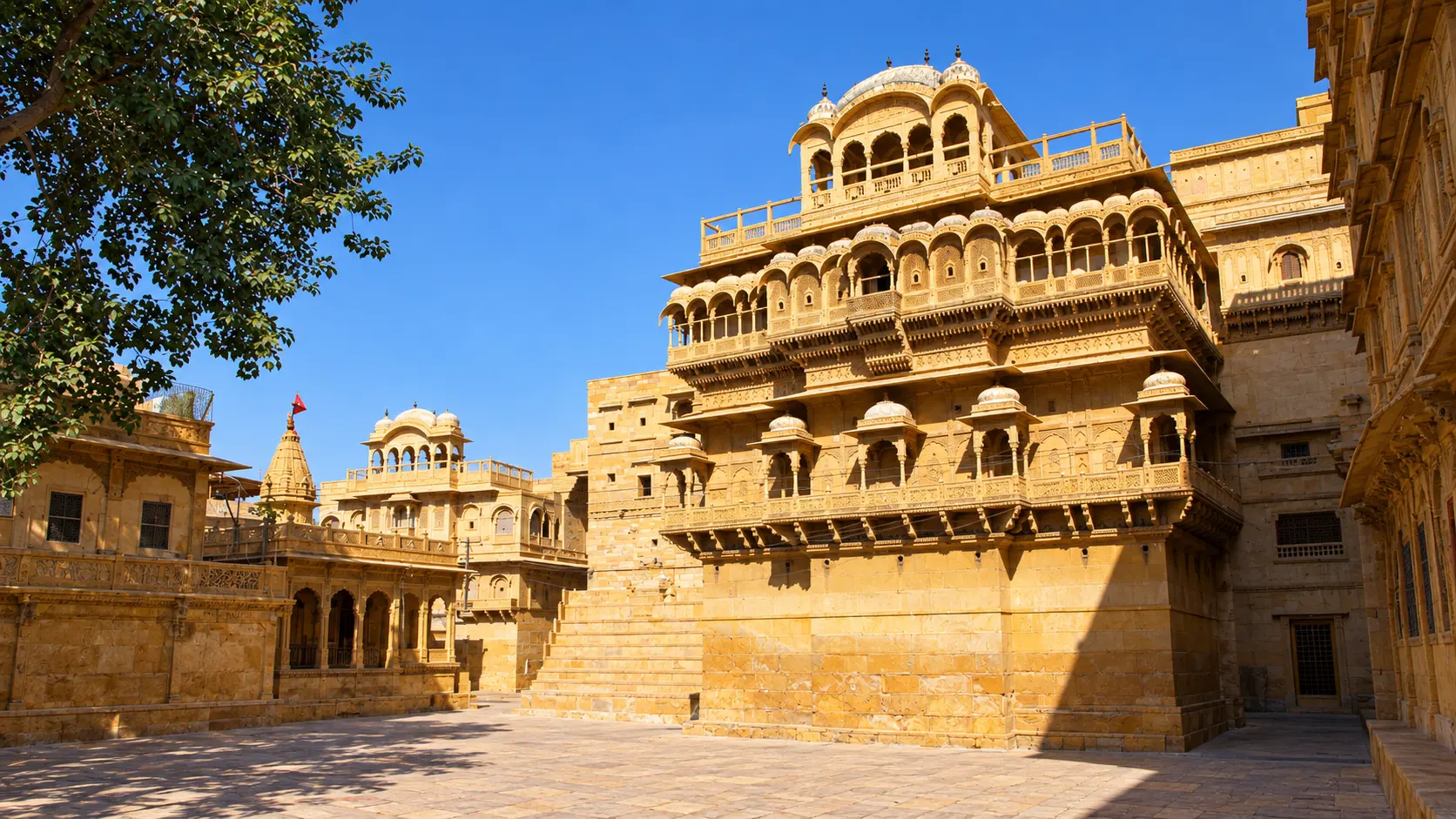
Rising like a colossal golden sandcastle from the flat, shimmering expanses of the Great Indian Thar Desert in Western Rajasthan, Jaisalmer Fort - universally celebrated as Sonar Quila (the "Golden Fort") - is one of the most romantic, dramatic, and historically intact medieval strongholds on Earth. Founded in 1156 CE by the Bhati Rajput monarch Rawal Jaisal, the fortress crowns the summit of Trikuta Hill (a three-peaked triangular sandstone ridge) rising roughly 76 metres (250 feet) above the golden city below.
In 2013, Jaisalmer Fort was formally inscribed as a UNESCO World Heritage Site as a cornerstone component of the serial Hill Forts of Rajasthan. What sets Jaisalmer apart from nearly every other fortress in Asia is its extraordinary status as a living citadel: roughly one-fourth of the historic city's population - nearly 4,000 residents across Brahmin, Rajput, and artisan communities - still live, work, pray, and maintain households inside its 850-year-old walls.
Constructed entirely out of local yellow Jurassic sandstone using mortarless dry-stone masonry held together by interlocking joints, gravity, and iron dowels, the fort undergoes an enchanting optical transformation with the changing desert sun. At dawn and midday, the ramparts glow with the tawny hue of a lion’s mane; as evening falls, the sandstone turns to deep, molten amber-gold, an ethereal spectacle that inspired master filmmaker Satyajit Ray’s acclaimed 1971 mystery novel and movie Sonar Kella.
Start here. Open a tile for the full details.
Why goRead details
For globetrotters, architecture lovers, and cultural explorers, Jaisalmer Fort provides an authentic step back into the era of the trans-Saharan and Silk Road camel trade:
When to visitRead details
Because Jaisalmer is located deep in the Thar Desert, climate is the single most critical factor in planning your journey.
Entry & permissionsRead details
Fees, visiting hours and entry rules may change. Confirm the latest details with the official operator or local authority before travelling.
Visiting Jaisalmer Fort is straightforward and traveler-friendly, though individual attractions inside maintain distinct schedules:
- Fort Citadel & Street Access:
- The fort ramparts, residential lanes, and viewing bastions are completely free of charge and Daylight visits recommended; confirm any after-dark access a day.
- Fort Palace Museum (Raj Mahal):
- Operating Hours: Open daily from 09:00 AM to 18:00 PM (October to March) and 08:00 AM to 19:00 PM (April to September).
- Admission Charges:
- Indian Citizens: ₹100 per adult; ₹50 for students.
- Foreign Nationals: ₹500 per adult (includes multilingual electronic audio guide headset).
- Camera Fee: ₹50 for still cameras; ₹100 for video equipment.
- Medieval Jain Temples:
- Visiting Hours for Tourists: Open daily between 08:00 AM and 12:30 PM. In the afternoon, the temples are reserved for private Jain devotional worship and closed to non-devotees.
- Admission Charges: Nominal temple trust conservation fee of ₹50 to ₹100 per visitor; camera fee of ₹50 to ₹100.
- Strict Temple Rules: Footwear, socks, and all leather articles (belts, wallets, watchstraps, leather jackets, shoes) must be deposited at the temple entrance. Modest dress covering shoulders and knees is mandatory. Photography of the inner sanctum Tirthankara idols is prohibited.
Plan your visitRead details
Jaisalmer is located in westernmost Rajasthan and is well connected by railway, highway, and seasonal flights.
Explore the full guide - choose a topic below.
Why visit?
For globetrotters, architecture lovers, and cultural explorers, Jaisalmer Fort provides an authentic step back…Explore detailsClose details
For globetrotters, architecture lovers, and cultural explorers, Jaisalmer Fort provides an authentic step back into the era of the trans-Saharan and Silk Road camel trade:
- One of the World’s Last Living Medieval Citadels: Walking through Jaisalmer Fort is an active immersion into living history. Cows amble down narrow stone lanes, school children run past 15th-century doorways, elderly turbaned elders smoke beedis on carved stone stoops (otlas), and families hang vibrant hand-block-printed quilts from ornate stone balconies (jharokhas).
- The Seven Exquisite Medieval Jain Temples: Built between the 12th and 15th centuries out of warm yellow sandstone, this interconnected labyrinth of seven shrines is an astonishing masterwork of stone filigree. Dedicated to Jain Tirthankaras like Chandraprabhu, Rikhabdev, and Parasnath, the temples feature soaring domed ceilings carved with celestial dancers, intricate marble icons, and micro-sculpted pillars that rival the famous Dilwara Temples of Mount Abu.
- The Ancient Gyan Bhandar Manuscript Treasury: Situated in a subterranean chamber beneath the Sambhavnath Jain temple, the legendary Gyan Bhandar was founded in 1500 CE by Jain scholar Jinabhadra Suri. It is one of Asia’s oldest and most precious private libraries, preserving thousands of ancient palm-leaf (talapatra) and handmade paper manuscripts dating back to 1060 CE.
- The Seven-Storey Fort Palace Museum (Raj Mahal): Dominating the central public square of Dussehra Chowk, the historic royal palace of the Maharawals offers a fascinating journey through royal mirror chambers, silver thrones, ceremonial arms, and panoramic battlements overlooking the entire Thar Desert.
- Panoramic Sunset Overlooks from the 99 Bastions: The fort’s triple concentric defensive wall is crowned by 99 massive semi-circular bastions. Perching atop a bastion cafe at sunset to watch the entire city of yellow sandstone houses, the shimmering surface of Gadisar Lake, and the vast desert horizon turn from gold to dusky violet is one of the great travel experiences of India.
What to expect
Visiting Jaisalmer Fort is an active, multi-sensory walking adventure that weaves through narrow alleyways, royal…Explore detailsClose details
Visiting Jaisalmer Fort is an active, multi-sensory walking adventure that weaves through narrow alleyways, royal courtyards, and sacred stone shrines.
Ascending Through the Four Fortified Gates
The approach to the citadel begins at Gopa Chowk, the bustling town square at the foot of Trikuta Hill. From here, visitors ascend a broad, cobblestone ramp designed with sharp 90-degree zig-zags to break the momentum of charging enemy war elephants.
To enter the upper fort, you must pass through four sequential defensive stone gateways:
- Akhai Pol (First Gate): Commissioned in 1756 by Maharawal Akhai Singh, featuring massive wooden gates studded with iron spikes.
- Suraj Pol (Sun Gate): Adorned with a carved yellow-stone sun motif, catching the first golden rays of dawn.
- Ganesha Pol: Topped with a sculpted stone image of Lord Ganesha blessing all who enter.
- Hawa Pol (Wind Gate): The final barrier, opening into the wide expanse of Dussehra Chowk. Here, desert winds funnel through the archway, providing immediate relief from the heat.
Dussehra Chowk and the Royal Palace
Dussehra Chowk is the beating civic heart of the citadel. In medieval times, this cobblestone plaza was where the Maharawals held military durbars, performed royal horse sacrifices, and celebrated the annual Dussehra festival.
Facing the square is the towering facade of the Raj Mahal (Fort Palace), intricately carved with cantilevered stone jharokhas, lattice screens, and delicate brackets. Visitors enter the Fort Palace Museum through a low doorway designed to force entering guests to bow their heads.
Inside, the self-guided audio tour winds through narrow whitewashed stairways and cool stone corridors, leading through:
- The Raja-ka-Mahal, featuring the royal bedchamber lined with mirrors and European tiles.
- The open-air marble Coronation Throne, where successive Bhati rulers were crowned before the public.
- The Rani-ka-Mahal (Queen’s Palace), featuring secluded balconies from which royal ladies viewed court affairs.
- The rooftop ramparts, which provide an unparalleled 360-degree aerial panorama of the Thar Desert stretching toward the Pakistan border.
Exploring the Jain Temple Complex
A short stroll through the labyrinth of residential lanes west of Dussehra Chowk brings you to the sacred enclave of seven interconnected Jain temples. Built between the 12th and 15th centuries by wealthy Jain merchants who financed the Bhati kings' desert caravans, these temples form an astonishing sanctuary of devotion.
Entering the principal Chandraprabhu Temple (1509 CE), visitors are greeted by a forest of sculpted pillars, torana archways, and a multi-tiered dome carved with dozens of sensuous celestial nymphs (apsaras) playing flutes, cymbals, and mridangam drums. Beneath Sambhavnath Temple lies the subterranean Gyan Bhandar, where visitors can view illuminated palm-leaf manuscripts and ancient Sanskrit/Prakrit texts written in gold ink.
The Historic Havelis and Bastion Cafes
Beyond the royal and religious monuments, the joy of Jaisalmer Fort lies in wandering aimlessly through its quiet residential quarters. Notice the red and white religious symbols painted beside doorways, the ancient stone hitching posts for desert camels, and the elaborate jharokhas of medieval merchant havelis. Dozens of charming rooftop cafes occupy the upper bastions, serving masala chai, cold fresh juices, and traditional Rajasthani thalis (featuring ker sangri, dal baati churma, and gatte ki sabzi) alongside panoramic desert views.
Best time to visit
Because Jaisalmer is located deep in the Thar Desert, climate is the single most critical factor in planning your…Explore detailsClose details
Because Jaisalmer is located deep in the Thar Desert, climate is the single most critical factor in planning your journey.
Seasonal Breakdown
- Winter (October to March) - The Golden Season: Winter is undeniably the ideal period to visit Jaisalmer Fort. Daytime temperatures are mild, crisp, and brilliantly sunny, averaging between 18°C and 26°C with zero humidity. Nights are refreshingly chilly (dropping to 7°C to 12°C), calling for cozy shawls or woolen jackets. This is the prime season for walking the fort ramparts, attending desert festivals, and enjoying camel safaris.
- Monsoon (July to September) - Humid and Mild: Jaisalmer receives very little rain (typically under 150 mm annually). Monsoon brings occasional short desert showers that temporarily wash the yellow sandstone clean and produce dramatic cloud formations over the fort. Midday temperatures remain warm (32°C to 38°C).
- Summer (April to June) - Brutal Desert Heat: Desert summers are punishing, with dry, scorching winds (loo) pushing daytime temperatures between 42°C and 48°C. Walking on the sun-baked stone ramparts between 10:00 AM and 17:00 PM is dangerous due to heat exhaustion. If visiting in summer, explore the fort exclusively during the early morning hours (07:00 to 09:30 AM) or after sunset.
Desert Festival (January / February)
Held annually on the full moon of Magh (typically late January or February), the Jaisalmer Desert Festival fills the fort with sound and spectacle. Folk dancers, Kalbelia performers, Manganiyar musicians, and royal camel processions march through the fort gates to Dussehra Chowk, kicking off three days of grand desert celebrations.
How to reach
Jaisalmer is located in westernmost Rajasthan and is well connected by railway, highway, and seasonal flights.Explore detailsClose details
Jaisalmer is located in westernmost Rajasthan and is well connected by railway, highway, and seasonal flights.
By Train
- Jaisalmer Railway Station (JSM): Located approximately 2 kilometres east of the fort base. It is the western terminus of the North Western Railway and connects directly by comfortable express trains to Jodhpur (5 - 6 hours), Jaipur (11 - 12 hours), and Old Delhi (via the Ranikhet Express and Delhi - Jaisalmer Express). Confirm the current charge and what it includes with the operator or service provider. Visitor admission, vehicles, parking, activities and accommodation can have separate charges.
By Air
- Jaisalmer Airport (JSA): Located roughly 14 kilometres southeast of the town. During the peak tourist winter season (October to March), regular domestic flights operate to and from New Delhi, Mumbai, Jaipur, and Ahmedabad.
- Jodhpur Airport (JDH): The primary year-round airport, located approximately 285 kilometres east. Private tourist cabs from Jodhpur to Jaisalmer take approximately 4.5 to 5.5 hours along the smooth, four-lane National Highway 11.
By Road
- From Jodhpur (approx. 285 km / 5 hours): Drive west via Pokhran along the impeccably maintained NH-11 across the Thar Desert landscape.
- From Bikaner (approx. 330 km / 5.5 hours): Travel southwest along NH-11 via Phalodi and Ramdevra.
- Local Transit & Fort Access: Cars, tourist vans, and large taxis cannot enter the narrow fort gates. Private vehicles must be parked in the authorized paid lots in Gopa Chowk at the foot of the hill. From Gopa Chowk, visitors can walk up the ramp (approx. 5 to 10 minutes) or hire an authorized motorized auto-rickshaw to drive up to Dussehra Chowk.
Entry, timings and permissions
Fees, visiting hours and entry rules may change.Explore detailsClose details
Fees, visiting hours and entry rules may change. Confirm the latest details with the official operator or local authority before travelling.
Visiting Jaisalmer Fort is straightforward and traveler-friendly, though individual attractions inside maintain distinct schedules:
- Fort Citadel & Street Access:
- The fort ramparts, residential lanes, and viewing bastions are completely free of charge and Daylight visits recommended; confirm any after-dark access a day.
- Fort Palace Museum (Raj Mahal):
- Operating Hours: Open daily from 09:00 AM to 18:00 PM (October to March) and 08:00 AM to 19:00 PM (April to September).
- Admission Charges:
- Indian Citizens: ₹100 per adult; ₹50 for students.
- Foreign Nationals: ₹500 per adult (includes multilingual electronic audio guide headset).
- Camera Fee: ₹50 for still cameras; ₹100 for video equipment.
- Medieval Jain Temples:
- Visiting Hours for Tourists: Open daily between 08:00 AM and 12:30 PM. In the afternoon, the temples are reserved for private Jain devotional worship and closed to non-devotees.
- Admission Charges: Nominal temple trust conservation fee of ₹50 to ₹100 per visitor; camera fee of ₹50 to ₹100.
- Strict Temple Rules: Footwear, socks, and all leather articles (belts, wallets, watchstraps, leather jackets, shoes) must be deposited at the temple entrance. Modest dress covering shoulders and knees is mandatory. Photography of the inner sanctum Tirthankara idols is prohibited.
Nearby places to consider
A visit to Jaisalmer Fort is the centerpiece of exploring the enchanting heritage and desert wilderness of the…Explore detailsClose details
A visit to Jaisalmer Fort is the centerpiece of exploring the enchanting heritage and desert wilderness of the Thar:
- Patwon ki Haveli (approx. 500 metres east of the fort base): The grandest and most flamboyant mansion complex in Jaisalmer, consisting of five interconnected 19th-century merchant havelis covered in mind-boggling stone filigree and gold-leaf murals.
- Nathmal ki Haveli & Salim Singh ki Haveli (approx. 600 metres from fort): Two celebrated merchant mansions famous respectively for asymmetrical twin facades carved by rival brothers and a striking peacock-shaped upper balcony.
- Gadisar Lake (approx. 1.5 km southeast): A historic 14th-century rainwater conservation reservoir surrounded by carved yellow-sandstone chhatris, shrines, and the majestic Tilon ki Pol gateway.
- Bada Bagh (approx. 6 km north): A hauntingly beautiful royal cenotaph garden situated on a desert ridge, featuring dozens of intricately carved sandstone chhatris built in memory of the Bhati Maharawals.
- Sam Sand Dunes & Thar Desert National Park (approx. 40 km west): The sweeping, wind-carved desert dunes where travelers experience camel safaris, 4WD dune bashing, desert camps, and starlit nights under the open desert sky.
In pictures
The practical bits
Before you go.
Plan ahead
To experience Jaisalmer Fort respectfully, safely, and thoroughly, keep the following structured recommendations…Explore detailsClose details
To experience Jaisalmer Fort respectfully, safely, and thoroughly, keep the following structured recommendations in mind:
Practice Responsible Tourism and Conserve Water
Because Jaisalmer Fort was built over 800 years ago using dry-stone masonry resting on soft sedimentary bedrock…Explore detailsClose details
Because Jaisalmer Fort was built over 800 years ago using dry-stone masonry resting on soft sedimentary bedrock, modern flush plumbing and excessive wastewater seepage have historically saturated the hill's clay layer, contributing to partial collapses of some outer bastions. Support fort conservation by minimizing shower times while visiting, avoiding excessive water waste, and patronizing local businesses that have connected to municipal wastewater drainage networks. Many conservationists recommend staying in hotels outside the fort walls and visiting the citadel on foot during the day.
Wear Sturdy, Non-Slip Walking Shoes
Exploring Jaisalmer Fort requires extensive walking across steep cobblestone ramps, uneven sandstone flagstones…Explore detailsClose details
Exploring Jaisalmer Fort requires extensive walking across steep cobblestone ramps, uneven sandstone flagstones, and polished temple thresholds. Wear comfortable, broken-in walking shoes or trekking sandals with excellent rubber grip. Avoid smooth leather soles that slip easily on worn stone inclines.
Time Your Visit for Temple Openings and Golden Hour
Check the current visiting hours and permitted access with the site operator before departure; ceremonies…Explore detailsClose details
Check the current visiting hours and permitted access with the site operator before departure; ceremonies, closures and visitor sessions can affect access. Exploring the temples early ensures peaceful, uncrowded halls and soft morning light filtering through the carved stone jharokhas. Spend the midday touring the Fort Palace Museum or relaxing in a shaded courtyard cafe. In the late afternoon (around 16:30 PM), head to the western Cannon Point bastion to watch the golden desert sunset.
Bargain Courteously for Local Handicrafts
The lanes of Jaisalmer Fort are filled with artisan shops selling famous local crafts: camel leather bags…Explore detailsClose details
The lanes of Jaisalmer Fort are filled with artisan shops selling famous local crafts: camel leather bags, hand-embroidered mirror-work wall hangings, yellow fossil-stone tableware (habur stone), and silver tribal jewelry. Shop patiently, compare prices across different shops, and engage in good-humored bargaining.
A few things you might wonder
Common questions about visiting Jaisalmer Fort (Sonar Quila). Fees, visiting hours and ceremonies are researched details that may change; confirm current arrangements with the operator before travelling.
Where is Jaisalmer Fort located and who founded it?
Why is Jaisalmer Fort called the "Golden Fort" or "Sonar Quila"?
What makes Jaisalmer Fort unique compared to other Indian forts?
How many bastions does Jaisalmer Fort have?
What are the opening hours and entry charges for Jaisalmer Fort?
What is the Gyan Bhandar inside the fort?
Can cars or taxis drive into Jaisalmer Fort?
What is the best time of year to visit Jaisalmer Fort?
Planning a trip to Jaisalmer?